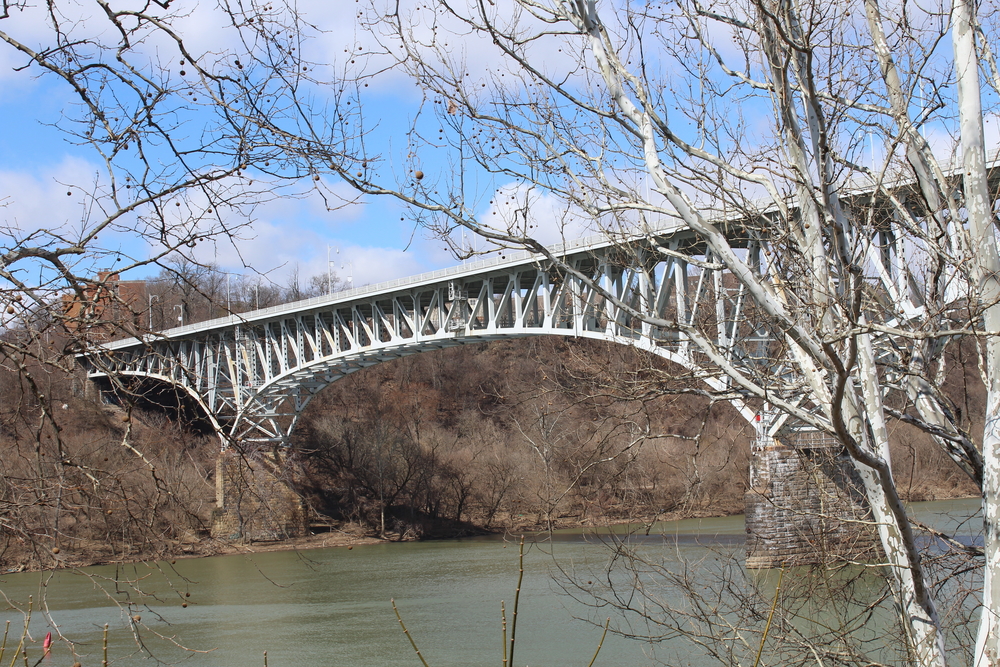
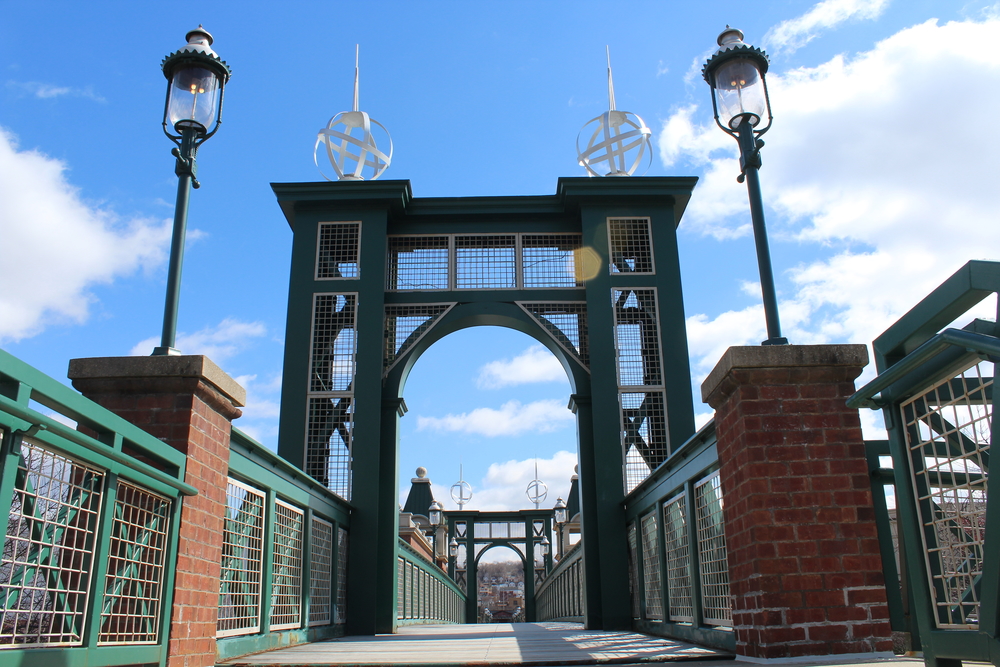
Grays Homestead Bridge at the Waterfront Mall. Photo by Madeleine Henrie
The Heart of the Furnace
There is nothing quite like the pride of Pittsburghers. Self-proclaimed “Yinzer”, Rebekah D., knows well the reasons why. Her sagacity of Pittsburgh pride was born from the furnaces of the once great American steel empire. For generations, her family has lived and worked in the mills of the Monongahela Valley. Rebekah, herself, was born and raised in nearby Carnegie, a fact that makes her smile as we sat one day to talk. Her family is of Russian decent and she honors her heritage by wearing her wedding ring on her right hand, as does her recently married daughter. Like many from Pittsburgh, she has a strong sense of her heritage, both as a Russian and a descendant of the mills.
Here, families just like Rebekah’s lived to fuel the furnaces of the steel industry; which provided their daily bread in good times, and little more in the bad. Yet, it is due to these people that the steel industry was made possible at all. Workers, as well as communities, faced exploitation, degradation, injury, pollution, and even death in the pursuit of greater and greater quantities of steel. Some communities, such as Homestead, site of the now long-gone Homestead Steel Works, have been dramatically altered from the days of steel production. The struggle of steel workers, however, is fresh in the minds of their children who inherited Pittsburgh from them. The spirit of the forgotten and neglected workers remains alive in the cultural memories of the area’s inhabitants. Thus, to know the beating heart, the furnace of Pittsburgh itself, one must explore the lives of those who built the steel industry by the sweat of their brows.
Homestead of Today
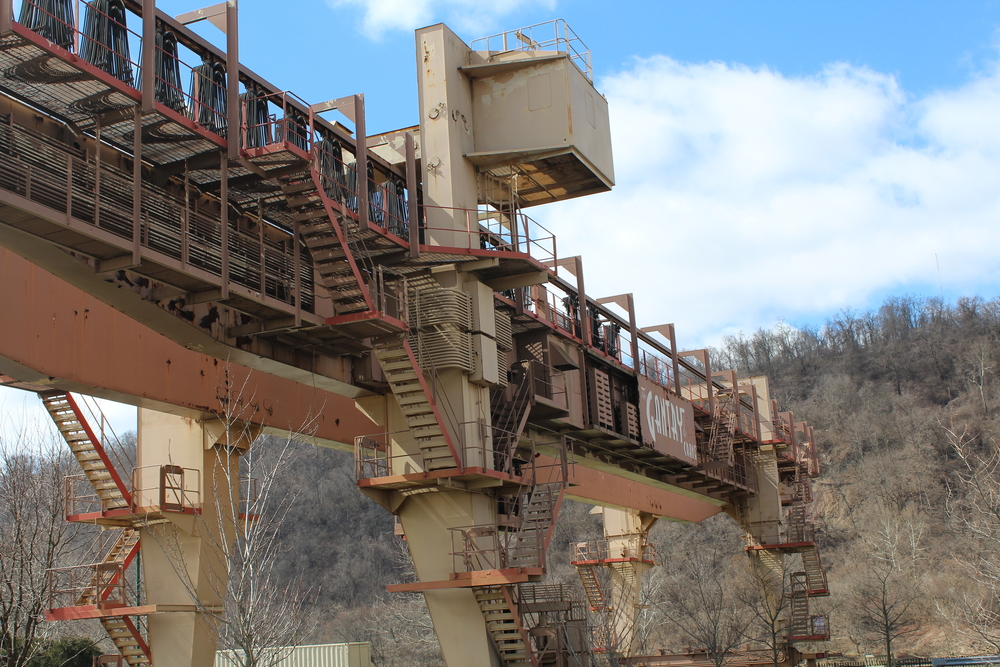
In the city of Homestead, only the retired smokestacks at one end, the old pump house at the other, and discarded industrial debris scattered throughout the site remain of the once powerful steel mill. Rebekah reminisces of another Homestead entirely. “Drive up the hill, there are some amazing homes,” she recommends, “and of course go see the library. I think its better than the one in Oakland.” Rebekah adores the handsome building, which sits overlooking the site of the former steel works, for the nostalgia it evokes; It reminds her of childhood, she says. As per the original plans in 1898, the library houses its collection, an athletic club, and a music hall that Rebekah’s husband performs at regularly, all under one roof. Surrounding the library are orthodox churches with marquees inviting visitors inside. The homes she refers to belonged to “the ones making enough to go up the hill,” and out from under the shadow of the works. She continues “of course, in those days the houses, and the works, came right down to the river, it was all about the river.” Although the works no longer stand, the shadows of the steel industry remain present in the daily lives of Pittsburghers.
Rebekah remarks on the changed identity of Homestead with a hint of annoyance. She explains, “now there’s that mall,” calling it an “eyesore” to make her feelings clear. When asked about the closing of the mill for good, she pauses, then asserts, “well that wasn’t until the 80s. But it might as well’ve been closed down.” Her father was of the last generation to make a living from the works. “The 70s were terrible,” she states with a visible shudder. For Rebekah, the new shopping center does not pay proper tribute to the legacy of Homestead, at least not as her family would have remembered it – in both the good and painful times of little work and income.
Homestead of Yesterday
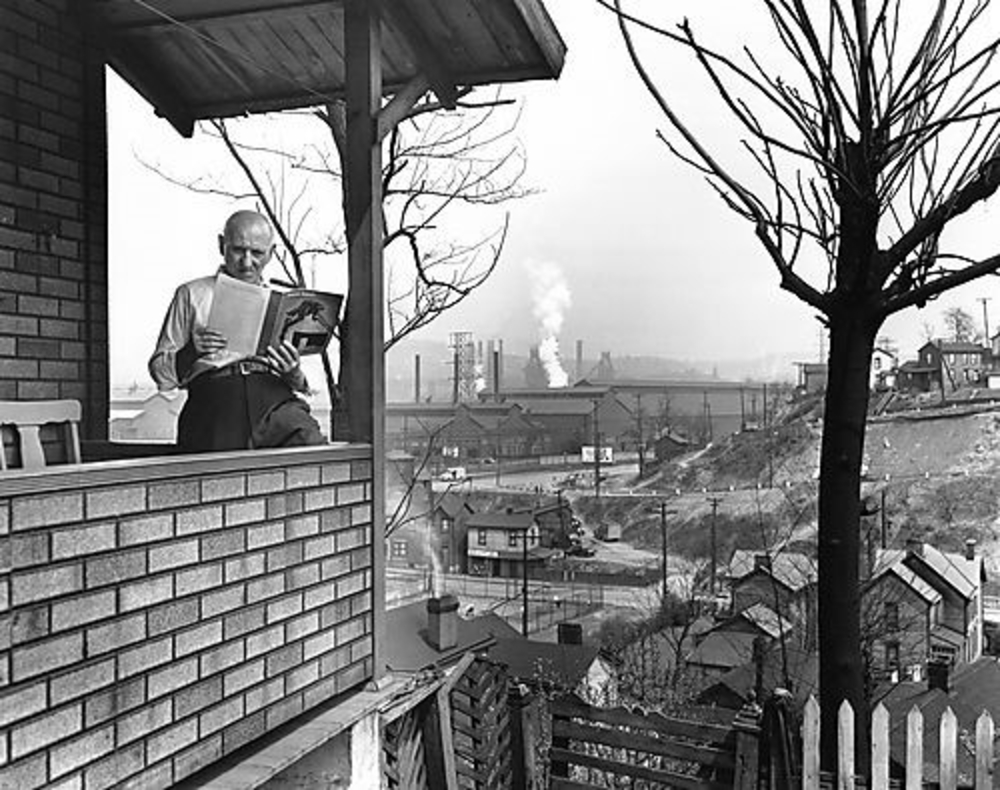
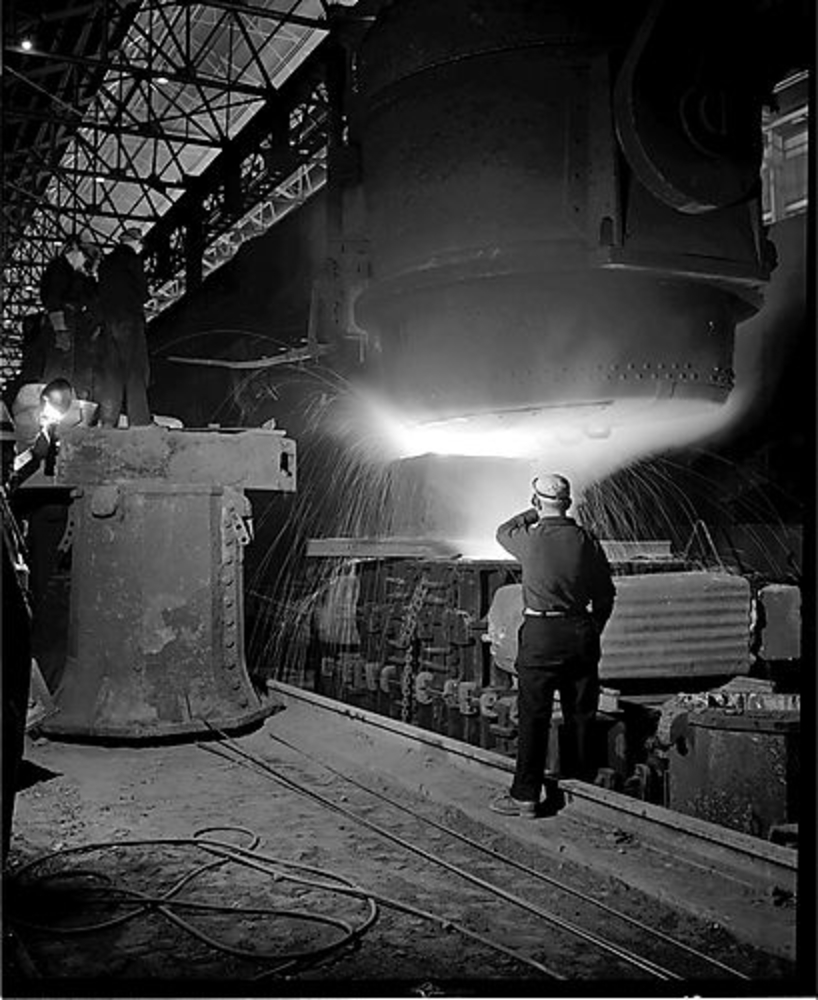
At its height in the mid-20th century, the Homestead Steel Works was a place of constant, dulling activity. The full swing of production demanded round the clock shifts and an indefinite supply of surplus laborers. Immigrants and their children, like Rebekah’s family, fulfilled this demand. Their houses were erected within sight of the works, inextricably combining the two spaces, and making a home of the entire industrial Mon valley. The brightest source of light in the dark interior spaces of the mills would have been burning furnaces and poured molten steel. Safety standards at the mill’s height in the mid 20th century required little protective precautions. Most workers would have been ill-dressed to be so near such dangerous substances. Yet, the immense role of this out-of-control molten metal in the history of mill life cannot be overstated. Many came from all over the world to find work, attracting a diverse range of ethnic groups from Eurasia and beyond. In the steel mills, they found both light and darkness, hope and despair. Workers’ livelihood depended solely on the mills, and any lost wages could result in financial setbacks and disasters for families all over Pittsburgh. Although Rebekah’s memory mostly references the mid-1970s, soul and health-leeching labor are characterized in cultural representations of millwork, such as in Out of this Furnace by Pittsburgh native, Thomas Bell, in 1941.
“When human flesh and blood could stand no more… it got up at five in the morning as usual and put on its work clothes and went into the mill,”
-Thomas Bell, Out of this Furnace
Bell wrote of the monotonous and demanding labor of the steel mills, “when human flesh and blood could stand no more, it got up at five in the morning as usual and put on its work clothes and went into the mill; and when the whistle blew it came home,” (Bell 49). Rebekah witnessed the toll of millwork on the body as she watched her mother care for her aging and ailing grandfather as a child. She continues this tradition, born from life in the mills, by caring for her own mother now. It is often difficult and laborious work, but she considers it an obligation that she is proud to perform. When asked on her thoughts of assisted living for her mother’s declining condition, Rebekah always replies, “it’s not what we do.” Now that the Homestead Works are gone, it is traditions like these, preserved from another era, that allows the values, practices, and traditions of steel mill workers to remain intact.
Homestead of Tomorrow
Rebekah and her husband never personally had anything to do with the production of steel, like many residents of the Pittsburgh area nowadays. They have settled into the new economy of Pittsburgh and embrace the new diversity it has brought. Rebekah works in medicine and her husband teaches music. In Rebekah’s family, a new tradition of work has emerged; her daughter has become a teacher. Within her own family, Rebekah has noticed change, but also clings tight to the traditions and cultures of her heritage. To her, Homestead will always be site of the works, even as the structures themselves have been torn down. The site of the works to Rebekah extends beyond the boundaries of the new mall settled in its place. It extends to the river, the Carrie Furnace across the way, up the hill, and the relationships between the people located at each point. To see where her family toiled for generations become physically erased stirs mixed feelings. It was a horrible place,” she says, but “it was really something, really everything then.”
Works Cited
Bell, Thomas. Out of This Furnace. Little Brown and Company. Boston, 1941.
D., Rebekah. March 13, 2018. University of Pittsburgh. Personal interview.
Gaughan, William J. “Happy 50th Anniversary!” Historic Pittsburgh, University of Pittsburgh, Homestead, PA, April 1949. http://www.historicpittsburgh.org/islandora/object/pitt%3A943.44952.GN
Gaughan, William J. “Pouring Ingot.” Historic Pittsburgh, University of Pittsburgh, Homestead, PA, August 1946. http://www.historicpittsburgh.org/islandora/object/pitt%3A943.84641.GN