Forbes Field Wall
A Look at Pitt Through the Archives
The Archives Center consists of history dating back to the 1700’s and is a very useful source for learning about the history of Pittsburgh, whether it be buildings, coal mining, the steel industry, etc. The building itself does not stand out as anything special; it is what the building contains that is the important part. During my class’s visit to the Archives Service Center, we learned about the different resources and collections that are available to us in the building, as well as the digitalized versions on the Historic Pittsburgh website. I was looking through different collections and stumbled upon a collection called “Pitt Campus Life.” I thought it would be interesting to look through the history of the University of Pittsburgh and what has changed over the past century. Going through the collection, I picked out a few pictures that I found interesting, ranging from the building of the Cathedral of Learning to a football game.
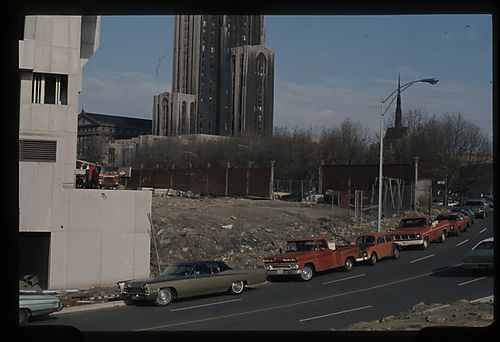
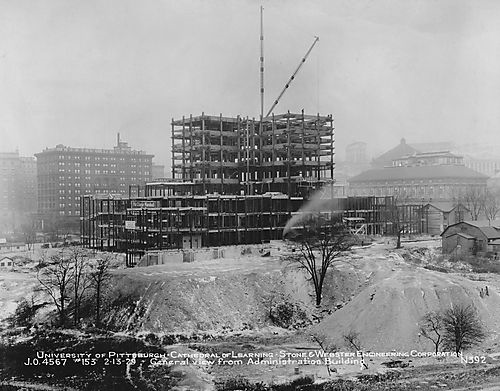
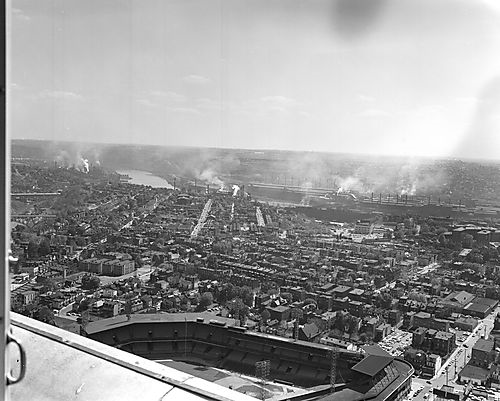
The first image I included is a picture of the Cathedral of Learning, or “Cathy,” in its early stages of development. The image was taken on February 13th of 1929, three years after the building process began. It is amazing to me to picture what is going on in that image to turn into the Cathedral of Learning that stands in Oakland today. The second image I chose is labeled “Forbes Field Wall” and was taken some time between 1972 and 1974. It depicts the remnants of the Forbes Field wall, which once held the stadium for the Pittsburgh Pirates. The area is now occupied by Wesley W. Posvar Hall, with the home plate from Forbes Field preserved in the floor of Posvar. I previously did not know that the Pittsburgh Pirates stadium was located in Oakland until I found that image. Going off of that image, I found a picture of the view from the top of the Cathedral of Learning, taken on May 9th of 1962. From the view, you can see the stadium in Forbes Field. The image was taken eight years prior to it being torn down and depicts a much different image of Pittsburgh than if someone were to look out at the same view now. You will no longer see Forbes Field, you’ll see a lot of buildings, including Posvar.
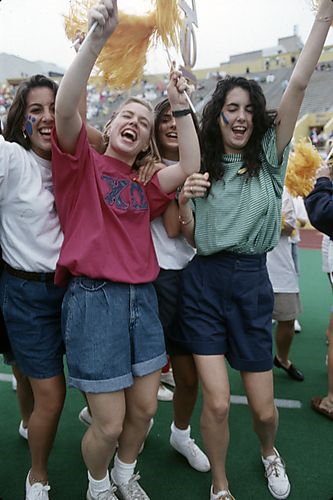
The final image that I chose to focus on is probably one of my favorite images that I found. It is labeled “Pitt Fans After a Win Against Maryland” and is an image of four girls celebrating at Heinz Field on October 5th of 1991. The University of Pittsburgh Panthers had just beat Maryland 24-30 under head coach Paul Hackett. The image appears to be very simple and insignificant historically, but that is what makes me like it even more. This image is an example of the many different things that are available in the Archives. The Archives are not only made up of historically significant documents and images, but also images from day to day life through the years.
The Archives Through a Humanistic View
In an article written by Arjun Appadurai called “Archive and Aspiration,” he talks about the humanist perspective on archives, saying that it archives are just a “social tool for the work of collective memory.” He also goes into the significance of archives in migration and how archives give poorer migrants hope and ideas open to them through the availability of archives. Archives open up the imagination to seeking better lives for migrants and their families. Appadurai stresses the idea of looking at archives, not as “a container of the accidental trace, [but] more as a site of a deliberate project.” With this perspective, it could help move us away from the Cartesian split, which is the separation between the neuro-archives and social archives. He believes that archives are not only about memories, but also the imagination and everyday tools. The humanist viewpoint focuses heavily on the imagination and the ethical view of the archives.
“In this sense the archive is an empty box, a place, a site or an institution, whose special goal is the guardianship of the document”
The Importance of the Archives and the Surrounding Neighborhoods
The archives are full of documents that hold historic significance. It is very beneficial to have a building dedicated to archives, so everything is in one place and easier to access for those who are doing research on the history of Pittsburgh or looking into a specific collection. The Archives also holds the history of the neighborhood that the building is located in, Point Breeze and Homewood. For a separate paper, I did research on the neighborhood of Homewood. It was a neighborhood that was originally inhabited by wealthy Caucasian families with large estates, but over time, was transformed into a neighborhood with a heavy African American inhabitance. This transition is due mainly to the city buying out parts of Homewood where many African Americans lived to build more businesses. They were pushed out and moved into parts of Homewood. The neighborhood continued to transition into a more business-oriented neighborhood, as opposed to the rural area it originally was.
It is neighborhoods such as Homewood that make the Archives so important. Without the archives, we may not have the documentation and history of Homewood as we do now, as well as many other neighborhoods. The Archives give people the ability to look into the history of Pittsburgh and what was going on in specific times in history. The archives are very beneficial to both University of Pittsburgh students and the community as a whole, as thousands of resources are available. If it weren’t for the Secret Pittsburgh class, I probably would not have known that the Archives existed and what resources are available to everyone. I think it’s important to make it well known what resources are available at the Archives Service Center and how both students and the community can utilize the documents and images within the building and Historic Pittsburgh website, such as for history projects on anything to do with Pittsburgh’s past..
Works Cited
Appadurai, Arjun. “Archive and Aspiration.” Archive Public, Panos Kouros-Elpida Karaba, archivepublic.wordpress.com/texts/arjun-appadurai/.
Howard, Rachel, et al. Secret London: An Unusual Guide. 4th ed., Versailles, Jonglez, 2015.
University of Pittsburgh Library System, editor. “Historic Pittsburgh.” Historic Pittsburgh, U of Pittsburgh Library System, historicpittsburgh.org/. Accessed 2 Apr. 2018.
Fig. 1 Cathedral of Learning Construction; February 13th, 1929
Fig. 2 Forbes Field Wall; Facilities Management; 1972-1974
Fig. 3 Oakland View from the Cathedral of Learning; May 9th, 1962
Fig. 4 Pitt Fans After a Win Against Maryland; October 5th, 1991