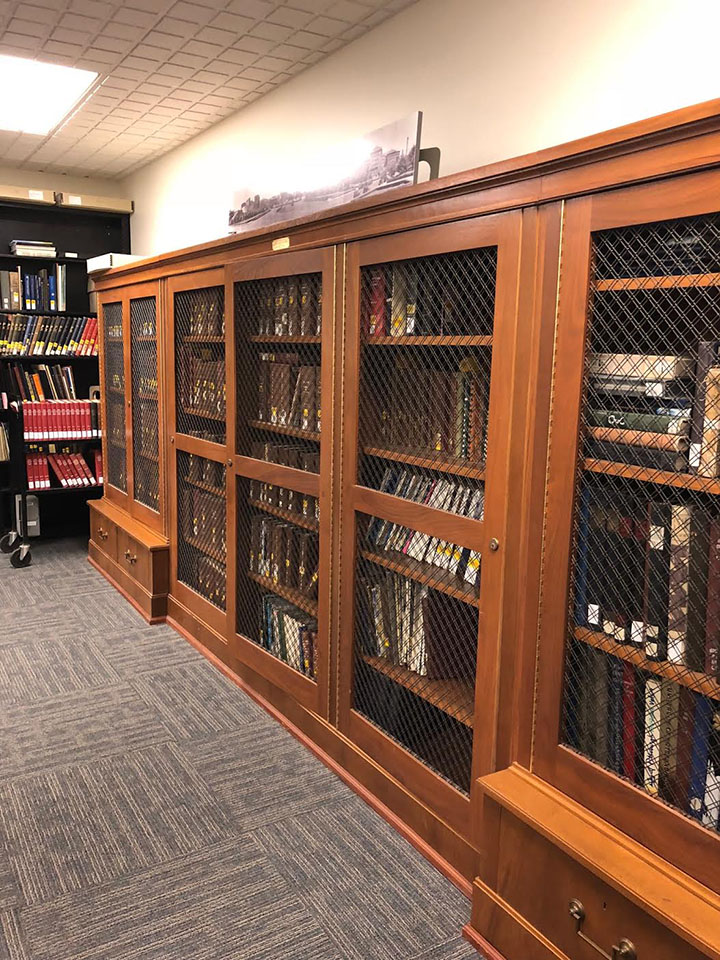
Bookshelves in the Reading Room. Photo taken by Diana Shraybman.
Archival Aspiration: Fusing the Past with the Future
Our site visit to the University of Pittsburgh Archive Service Center was my first visit to an archive. I had done some research prior, on the location and content held within. However, I did not dig deeper than solely looking on their website. While my research was initially minimal, the trip left me with such curiosity that I dove further into an investigation.
The Visit
When we arrived at the archives, it was different than I expected. In my mind all I knew was that we were in a random part of Pittsburgh, rather far from campus. Seeing the building stunned me at first. It did not seem of interest and was very bland and large. It had no “geometrical ideal patterns” or “grandiose diagonals linking the symbols of power” (Eaton 130). There was no luxurious entrance or architectural enticement. In my head I had pictured a museum style building to draw people in and denote the history and importance of the contents within. Instead, it was “autonomous architecture – freestanding, determined by function devoid of superfluous ornament…” (Eaton 131) And so I was greeted by a building that could blend in as any other industrial complex. This made me think back to class discussion and wonder if This made me think back to class discussion and wonder if
“The archive is no more than a social tool for the work of collective memory”
– Arjun Appadurai
Upon entering the surprises continued. The inside did not mask the industrial feel of the building, and the further I went within the more obvious it became. From rooms dedicated to preserving materials, to publicly accessible resource rooms, to more private areas, there were many spaces to be seen.
The Rooms
The reading room, where the public obtains the resources or archival material, is decorated in an antique style. There is wooden furniture that fills the area, along with plenty of overflowing bookshelves. This creates a rustic vibe throughout and brings you closer to the historical documents. The space is finished, so the ceiling and walls are intact and complete, which is not true of all the rooms housed inside the Archives. The shelves are filled with informative texts depicting different periods of time or certain events in Pittsburgh’s history. On top there are framed documents signifying important moments from Pittsburgh’s past. The room encompasses the history and stories itself that are waiting to be told inside and encourages you to further explore the documents and materials offered.
“That the archive is not just a way to preserve accidental, but precious traces of collective memory”
– Arjun Appadurai
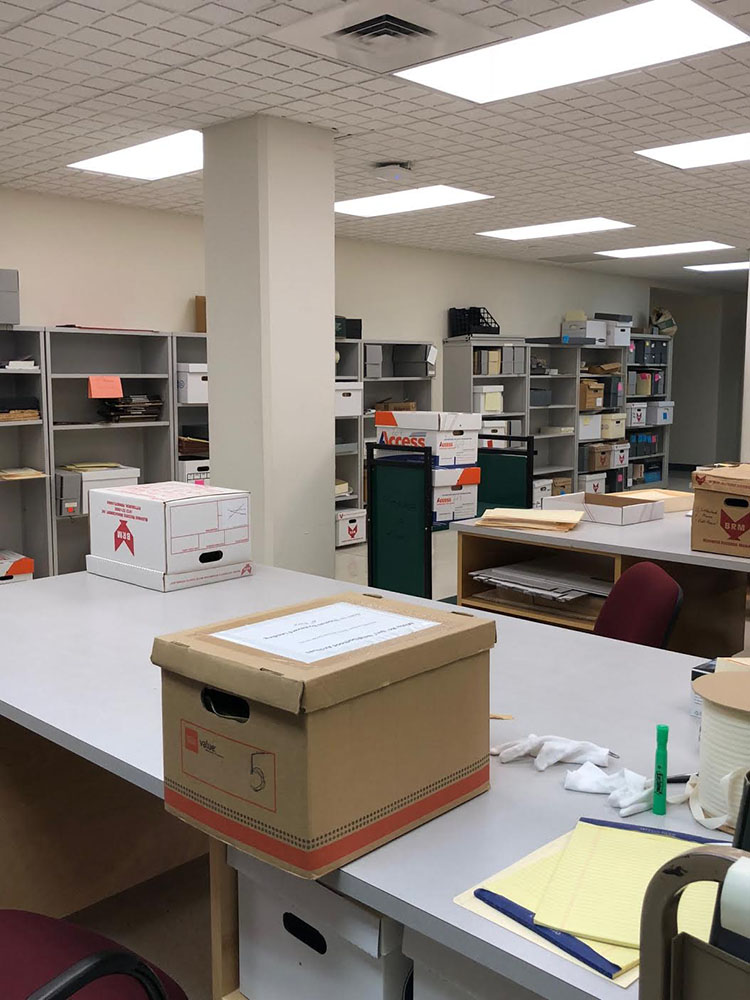
Adjacent to the reading room, is a more private, but still accessible room for staff. Inside you can see students working on different projects: whether organizing finding aids, putting together collections, or preserving materials, the room is clearly designated as a workspace. You begin to see that “rather than being the tomb of the trace, the archive is more frequently the product of the anticipation of collective memory, thus the archive is itself an aspiration rather than a recollection” (Appadurai). The people busy at work brought a new perspective showing all that goes into the process is more than just a recollection. It is important because it shows that the archives are striving towards a goal of educating the public and helping the community by preserving the past. This is much more than just collecting and storing the materials, instead, it is sharing them.
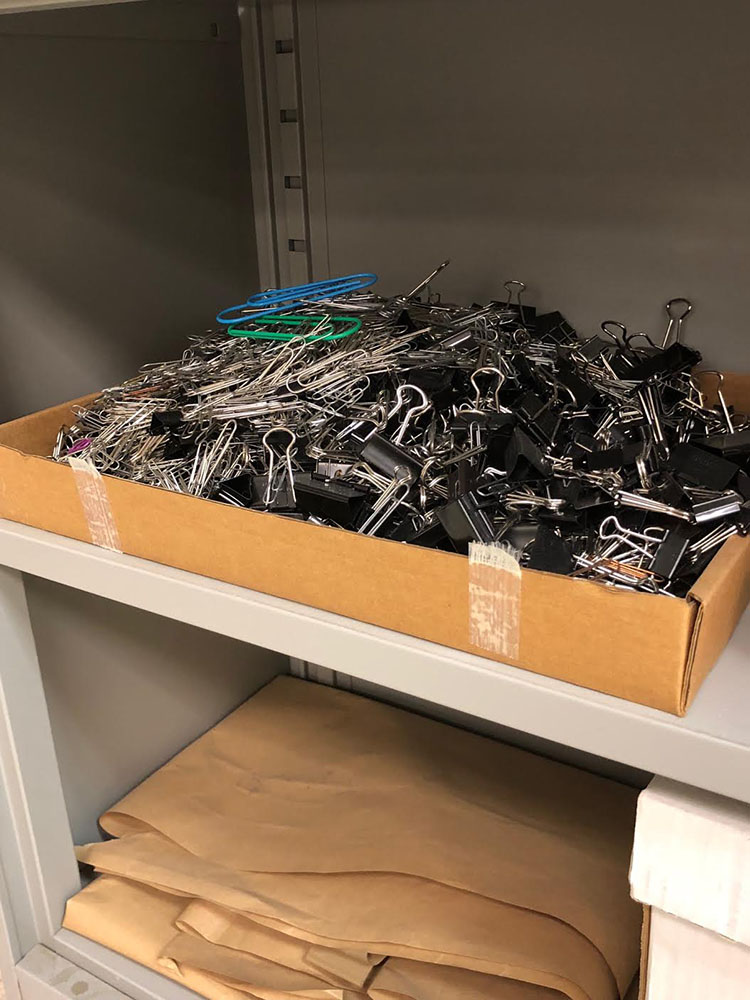
There are tables stacked with boxes that overwhelm the room, computers line the back row, and work materials fill the spaces in between. From lab coats, to a giant box overflowing with clips, there are unexpected supplies in every corner. This is where the behind-the-scenes work takes places, and also where the core of the building starts to become uncovered. Although still put together, it provides a different vibe than the reading room. While the reading room was cozy and warm, this room provides a more business-oriented feel. This is where the true colors of the building are seen.
Connecting with the Past
While on the tour of the site, I was informed about past uses of the building. The Archives, which are part of the Library Resource Facility “occupy three floors of the five-story former Emerson Electric Building…” (Blake). Before it was the Archives, this building in Point Breeze used to be a factory. After seeing more of the building and going further inside, this was a sort of “ah-hah” moment hearing out loud what I had been thinking the entire tour. This building, with its industrial feel and endless space, used to house a factory. It was all making sense now. Once we entered the less publicly accessible area, I could not only physically see the past of the factory, but I could smell it. There was a distinct scent that had not been in any other area of the building, that was like a mixture of old and industry. Not only did an odor fill the space, but pipes, tubes, and vents lined the ceiling. The area was unfinished, and clearly showed a past of manufacturing.
“[The Archives] occupy three floors of the five-story former Emerson Electric Building…”
– Sharon Blake
It was after seeing all of the rooms along with their differences and similarities, that I was able to piece together the purpose behind it. Before heading on the tour of the building, we were given some background and information on what the Archives are. Not only did I learn about what resources can be found, or how to access historical information I may need, but I learned about the location and the reasoning behind it.
Perceiving the Future
While at first, I thought it was strange that the Archives were so far away from the heart of Pitt’s campus, it actually makes sense. There is no room on campus to fit everything that is held inside, which is why “it was designed to help ease the overflow of materials from Pitt’s Hillman Library in Oakland” (Blake). The Archive Service Center “houses all University archives as well as important collections reflecting Pittsburgh’s history; the preservation lab; the Digital Research Library; technical services; gifts and exchange; and information systems” (Blake). This just goes to show that the massive size and shear amount of materials could not be practically held on Pitt’s campus. However, getting to the Archives as a student is made easy with a shuttle that travels back and forth from campus to the Archives throughout the day.
“The form of a continual urban sprawl,
a pattern that has developed
with industrialization and the automobile”
– Ruth Eaton
The neighborhood of Point Breeze is also a fitting location. The past of the neighborhood was industrial, full of manufacturing and factories; it took “the form of a continual urban sprawl, a pattern that has developed with industrialization and the automobile” (Eaton 131). This is what explains the building that the Archives are currently housed in. It is remnants that remain of the past from the neighborhood and, are ironically holding other materials of the past within. It’s an interesting juxtaposition with the current status of Point Breeze as a mostly residential neighborhood. This shows the transformation and preservation not only of Point Breeze as a neighborhood, but Pittsburgh as a city.
The University of Pittsburgh Archive Service Center has a purpose well beyond the services and aid they provide for the community. The Archives tell a story, and not just through the historical materials and documents inside. The building itself tells a story. It represents the past through its architecture, structure design, and layout. However, it shows the present by its surrounding location and those residing nearby. The building is complex; it illustrates the transformation an area can go through, while preserving a segment of the past. The story that the building had to tell spoke to me and peaked my interest in further investigation. The Archives are not just historical in their documents, but also in the building they call home.
Works Cited
Appadurai, Arjun. “Archive and Aspiration.” Archive Public, WordPress, 9 July 2012.
Blake, Sharon. “Pitt to Dedicate New Library Resource Facility on Thomas Boulevard in Point Breeze Oct. 2.” University of Pittsburgh News, University of Pittsburgh, 30 Sept. 2002.
Eaton, Ruth. “The City as an Intellectual Exercise.” Utopia: the Search for the Ideal Society in the Western World, by Roland Schaer et al., The New York Public Library, 2000, pp. 119–131.