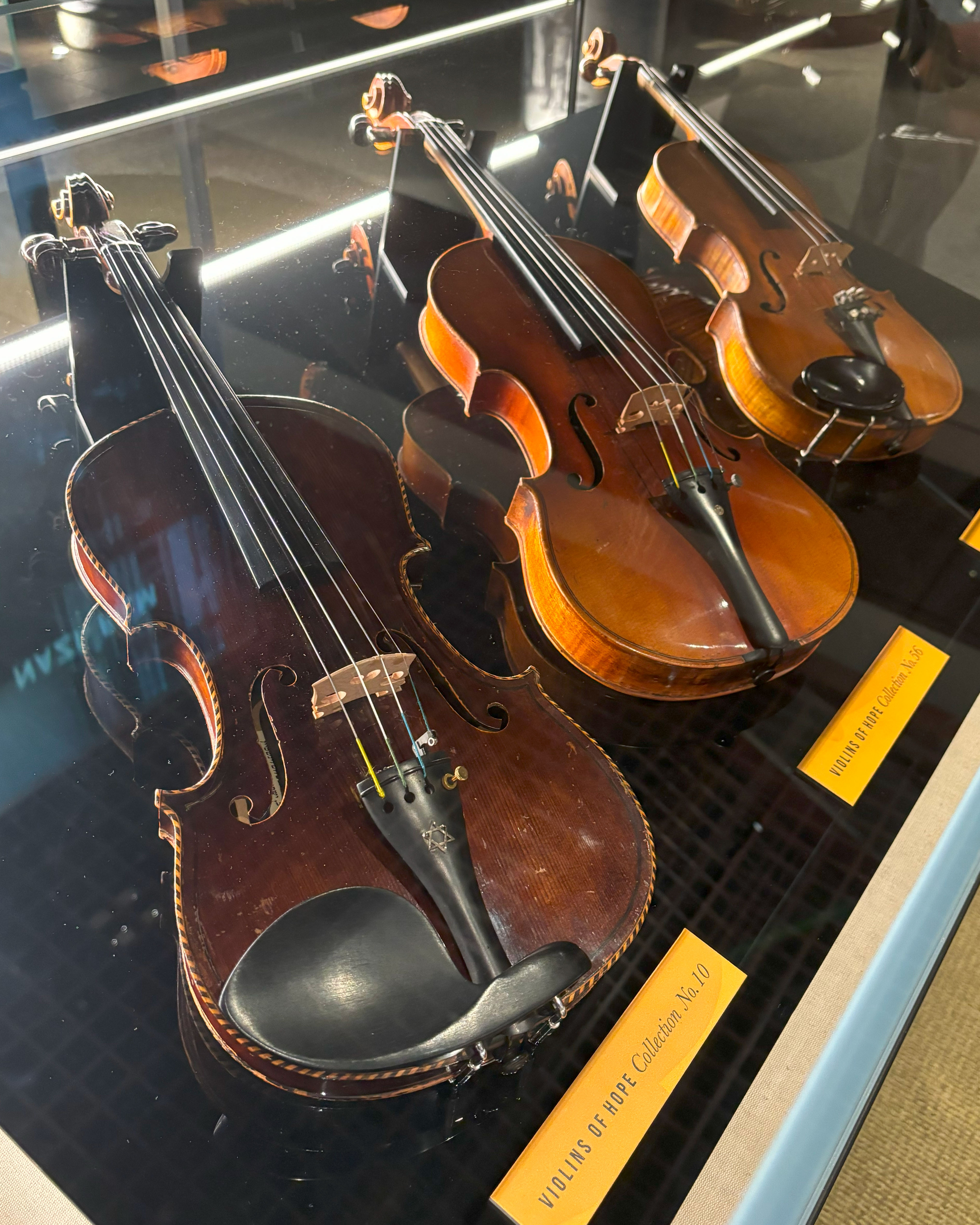
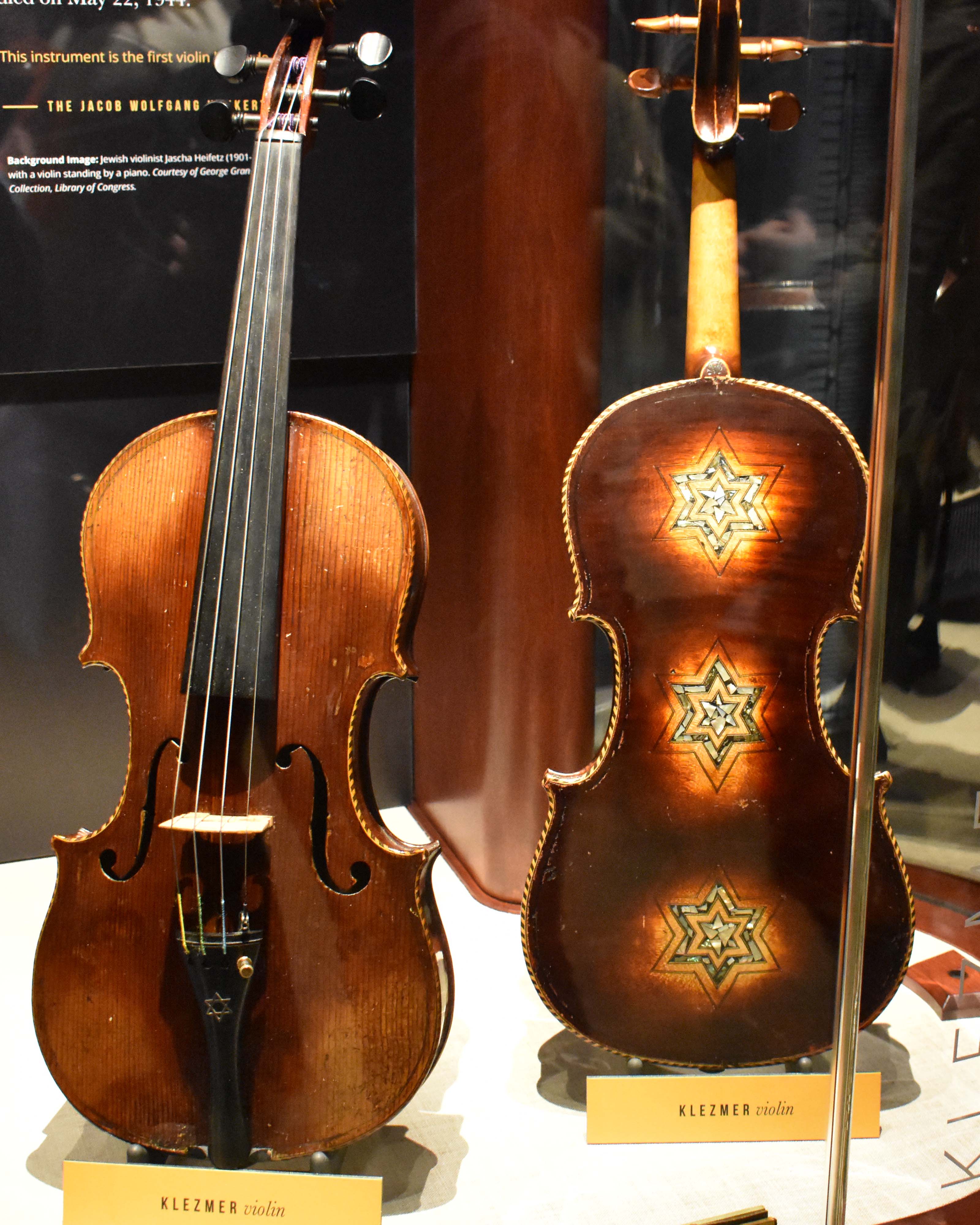
Three violins from the Violins of Hope exhibition. Photo by Alyssa Carnevali, 2023.
The Survival of Jewish Art and Story in Violins of Hope
This page contains the transcript, show notes, and sources for the third episode of the Secret Pittsburgh Podcast, Season One . To listen to the episode, as well as the rest in the series, visit our SoundCloud.
Transcript
Shelby Thayer [00:00]: When our site visits for this project were scheduled, and we planned to visit Rodef Shalom synagogue, there was no war in Israel and Palestine. Our site visit plans were changed to reflect this reality. Our exploration and podcast on this site involves its history and continued importance for members of Pittsburgh’s Jewish community and to everyone in the Pittsburgh community.
Shelby Thayer [00:30]: Forced relocation, losing family and friends, and the erasure of culture during the Holocaust left an everlasting impact on Jewish communities. Even today, anti semitic acts are still committed against the community. A temple in Pittsburgh, Tree of Life, was attacked in 2018 and 11 Jewish lives were lost. While it may seem impossible, through all of this, the community still finds hope. Music and Art have given Jewish people a way to stay connected through all of the attacks and destruction that have been committed against them.
Shelby Thayer [01:10]: Welcome to Secret Pittsburgh, and the past 15 weeks we’ve traveled across the city, learning the stories of Pittsburgh’s people and places. Join us as we explore Rhodope Shalom and the Violins of Hope exhibit. I’m Shelby Thayer, let’s go!
Shelby Thayer [01:36]: Violins of Hope is a traveling exhibition that focuses on the recovery of violins, violas and other musical instruments from the Holocaust and the end of World War II. The Violins of Hope exhibition is currently on view in Pittsburgh, Pennsylvania, at Posner Hall in Carnegie Mellon University until November 21st. But what is the specific connection between Jewish people and violins? This question can be answered by taking a closer look at the purpose of violins in Jewish culture.
Shelby Thayer [02:05]: The importance of music within the Jewish faith stretches back to anti-Semitic tracts in Europe that rejected Jewish people’s relationship with music. According to historian Sander Gilman, in the writings of Shakespeare, the stereotypical Jewish character in The Merchant of Venice was “denied any special relationship to Western [civilized] music.”. This beginning of antisemitism from the works of Shakespeare, the belief that Jewish people lacked Western civility because they did not have a special bond with music, was carried over in the writings of Richard Wagner’s 1850 essay entitled “Judaism in Music”. According to Wagner, the Jewish people lacked innate musicality as the artistic bent of Jewish people was focused on needless luxury. From the writings of Wagner, Jewish musicians, such as Giacomo Meyerbeer, entered the forefront of artistic creation to “show that they too could contribute to European high culture”. By the 1930s, Jewish men were encouraged to learn and play the violin to push back against the increasing anti semitism in Europe, and to show that they too were a significant producer of high culture.
Shelby Thayer [03:10]: When Nazis took over Germany in 1933, the connection between music – especially the violin – and Jewish practitioners was integral to Jewish identity. By being connected to the violin, Jewish men could illustrate their “moral quality”, as society believed that music was an integral part of one’s respectability. Within the concentration camps, Jewish people cultivated a unique form of resistance – resistance through music. Guido Fackler writes that even in 1933, music was used as a method to ridicule prisoners, with Nazi leaders at the camps performing satirical welcoming songs to the inmates. The violence of concentration camps was not only through the attacking of inmates’ physical bodies, but also through the attacking of music and other aspects of the Jewish identity. In the Columbia-Haus concentration camp, Jewish prisoners were forced to establish amateur music ensembles to play on behalf of Nazi commanders in order to “suppress the screams” of those being tortured. Even during such ridicule, the Jewish people still played music for other inmates within their bunks during the night. Instead of allowing the Nazis to completely take over music for their own purposes, the Jewish musicians held within the camps helped their fellow inmates to cope with life in the camps. By playing the violin, they reminded prisoners that there were ethical, humane, artistic and aesthetic values beyond the life threatening and terrifying camp environment.
Shelby Thayer [04:47]: Violin music gave prisoners an opportunity to hold on to their culture and humanity throughout their time in the camps. The Nazis did everything in their power to eliminate Jewish culture and identity. Both playing traditional songs and hearing them throughout the camps reminded prisoners of their homes and who they were. The music gave prisoners a chance to mentally escape from the camps and have moments of hope. These moments gave many prisoners a sense of strength, and the ability to continue on and hope of freedom in the future.
Shelby Thayer [05:19]: The love for violin was a great unifier in concentration camps. Prisoners would use violin music as an escape from the reality. We had a conversation about this with Barbara Khristie, a volunteer who works as a tour guide at the violence of Hope exhibit. During this discussion, she played music by one of her former students, Daniel Orsen. The title of this collection is Wagner’s Nightmare, and contains a variety of pieces that Wagner would have wanted to stop Jewish violinists from playing during the Holocaust.
Barbara Khristie [05:49]: The fact that these instruments survived that have survived through horribleness. And the fact that their history has been passed on to us gives us hope. They gave hope for the moments that they were listened to or performed upon in the terrible circumstances. I doubt very much if I told you about Eric Weininger. He was first he was sent to Dachau. He was a violinist. Not splendid but definitely good. And his violin I probably didn’t tell you this either. His violin he was able to hold on to. So many instruments were confiscated. So picture if you will, a march of prisoners going into Dachau. And the fence next to them has prisoners pressed up against it to your Eric Weininger, you’re carrying your violin and a Nazi comes up and tries to confiscate it from you. You toss it over the fence and somebody catches it over there. Now there’s a Nazi coming to confiscate it from there so they toss it back over. Somehow, I don’t know if this happened for Eric Weininger, I know it happened. He was able to keep his violin and he liked to start up musical ensembles. But the Nazis weren’t giving this any they have in other places, given you know, yeah, okay, we’ll listen, but they didn’t there. So where he was able to take people to perform and to listen, was a latrine that was not in use. Latrine, the fancy word for toilet. So imagine being in a latrine. And you get to hear this music.
Shelby Thayer [07:52]: Songs played during the Holocaust connect many people back to the hardships that Jewish people survived during the war. Music has a unique ability to transport the listener to another time or place. Music allows you to link emotions and memories to a specific tune. This connection has the power to stay with you through your lifetime and even evoke similar feelings in other listeners from a different time and place.
Barbara Khristie [08:19]: You’re going to hear what was being spoken and sung back then the same voice and you can picture where they work, what they were enduring, and how they were escaping.
Shelby Thayer [08:46]: Playing the violin also gave Jewish people an opportunity to fight back from outside the concentration camps. In talking with Sandra Rosen, a board director for Violins of Hope we learned of the story of Moetleschlein. He was a 12 year old boy whose family was murdered by Nazis in his home, leaving him the only survivor. Moetleschlein then traveled with a resistance group that worked against the Nazis.
Sandra Rosen [09:14]: He was a wonderful violinist. His name is Moetleschlein. His violin is at Yad Vashem, which is the Holocaust Museum in Israel. He was an orphan because the Nazis killed his mother and his father and his sister. And he found refuge with a group of partisans who were living in the woods and doing what they could to undermine the Nazis as they advanced on communities. He was with Uncle Misha’s partisans group. He went out into the town every day to play the violin, with the hopes that somebody would throw him some coins or some scraps of food that he could bring back to the partisans. And one day while he’s playing, he gets tapped on the shoulder. And he gets recruited by a Nazi soldier telling him, come with me, I’m going to give you some better clothes, and you’re going to come every day, and you’re going to play at the Nazi Social Club. And so every day he goes, and he plays at the Nazi Social Club, and they provide him with some food, which he can take back. And on one of these days, he happens to find a room that is unoccupied. It is empty, it has some barrels, there are cracks in the walls, if either of you are a Pittsburgher, you know what a basement in Pittsburgh looks like, so you know, in my mind, that’s what this looked like. And he tells Uncle Misha, and they devise a plan. And every day thereafter, when Motele leaves the club, he leaves his violin and a barrel in there. And he brings the empty case back to the woods, and they put explosive
powder, gunpowder, into the violin case, he takes it back to the Nazi club, and he takes the powder and he very carefully puts it into the cracks in the walls. And he does this day after day. The violin stays there, at night, the explosive powder comes until one day he comes back to Uncle Misha and they says they’re going to have a big meeting, and they’re going to be lots of soldiers here tomorrow. So tomorrow comes he takes the last amount of powder with him and fills the crack, takes the violin upstairs and he plays. And at the end of the day, he goes downstairs. He takes his violin and puts it in case this time, sets the explosives on fire and runs to get out of there. Instead of taking the regular path back into the woods, he goes across a waterway with the violin held above his head. Uncle Misha and the partisans are there to pull him out just as the building explodes. And he turns around and he says that was for my mother. That was for my father. And that was for my sister. So that’s the resistance on the part of a 12 year old child who lost everything and at least had an opportunity to get some revenge.
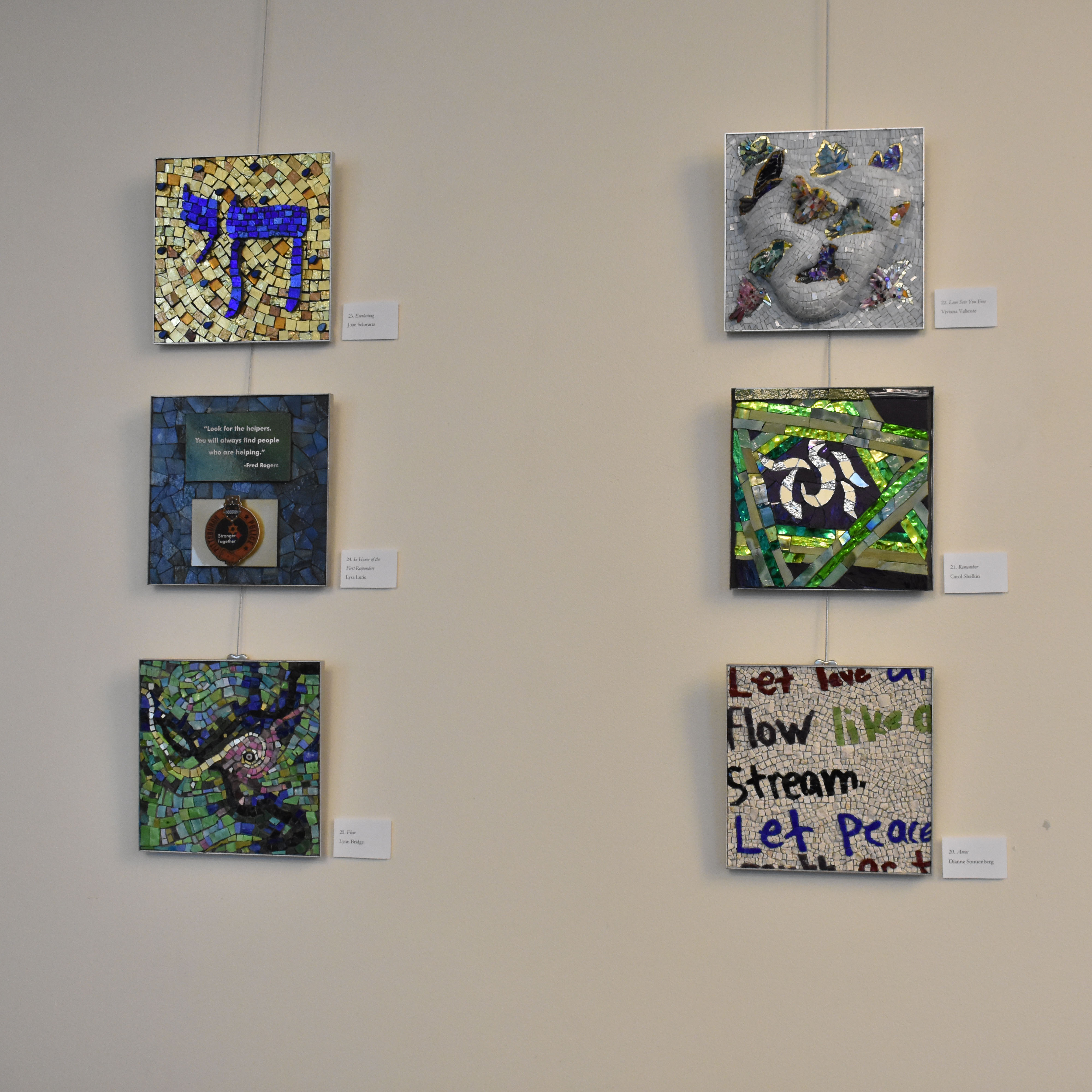
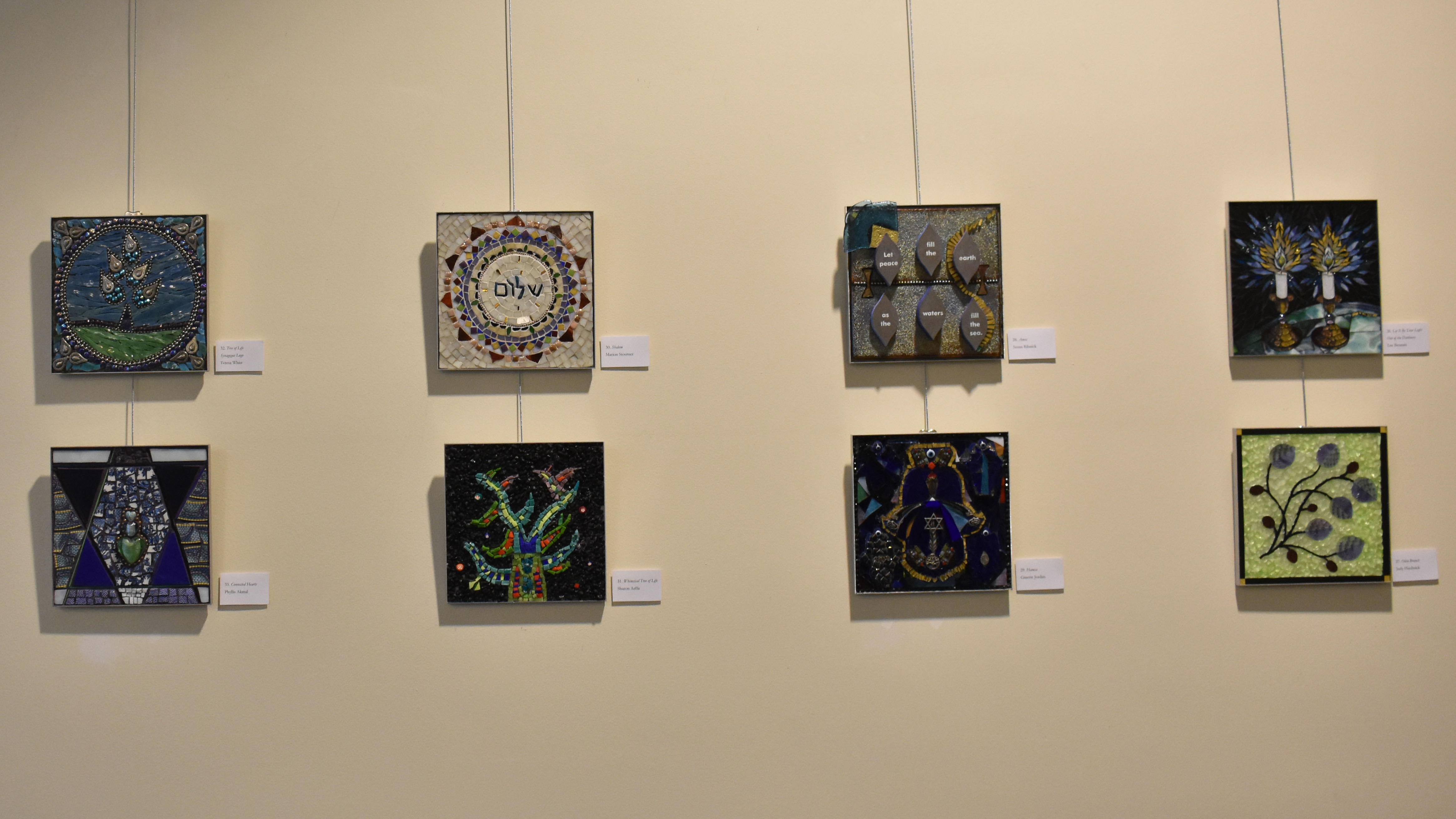
Shelby Thayer [13:03]: While the Holocaust has ended, anti-semitic beliefs have not been eliminated. In 2018, the Tree of Life synagogue in Pittsburgh saw a horrific shooting fueled by these anti-semitic beliefs. In an effort to remember the lives lost during the attack. Susan Ribnick founded a mosaic exhibit that is currently inside the Rodef Shalom congregation titled “From Darkness to Light: Mosaics Inspired by Tragedy; working in tandem with Violins of Hope. Mosaics from 36 artists around the world comprise the exhibition. Two of the pieces directly quote a handwritten note left by a sixth grader Cooper D. at the memorial for victims of the shooting. Drawing on a verse from the Jewish Bible, the note reads, “Let love and justice flow like a mighty stream. Let peace fill the earth as water fills the seas”. This expression of hope left behind by a sixth grader at the time of the attacks illustrates the Jewish faith. Even in times of such devastation, hope permeates. In one of the mosaics that appears at Rodef Shalom, the artist intersects the deep grief from lives lost in the shooting with an expression of hope. Susan Ribnick’s mosaic “Dedication Panel” uses the tiles as interconnecting roots for leaves, which name the 11 people killed in the attack. The top of the mosaic – colored brown – emphasizes rot, death, and destruction. Moving down the piece, the color changes becoming a yellow green, a light green, and then a dark green, changing from the brown of autumn – when the shooting occurred – to the dark green of summer as a reminder of the depths of tragedy that unfurl but shows that as time passes, grief can grow to represent hope.
Shelby Thayer [13:49]: The death and destruction that continually attacks the Jewish community cannot be forgotten. But it’s also important to emphasize the hope that can grow. Playing beautiful music and creating meaningful art allows resistance to continue within the community. Music and art are just some of the avenues that have allowed Jewish people to show strength through all of their hardships.
Shelby Thayer [15:18]: Thank you for joining us as we uncovered one story of Rodef Shalom and the Violins of Hope exhibit. We hope you’re inspired to visit these places and find your own Pittsburgh stories. Please tune in to all the episodes we’ve produced this season. You can find show notes and a transcript at secret pittsburgh.org I’m Shelby Thayer. Nehal Chakraborty served as an audio editor and Alyssa Carnevali wrote and researched this episode. See yinz later!
Transcribed by Shelby Thayer using Otter.ai. Thanks to Sandra Rosen for advise and corrections.
Show Notes and Corrections
[01:36-01:45]: The violins of hope is a collection of violins, there is only one viola and one cello in the entire collection of 103 instruments.
[02:59 – 03:10]: Music was integral to Jewish life before WWII. You can tell the number of boys in a Jewish family by the number of violins hanging on the walls of the family home. Jewish musicians were among the finest musicians throughout Europe’s orchestras prior to WWII.
[08:53- 08:55]: Sandra Rosen is the Chair of Violins of Hope Greater Pittsburgh.
[13:28 – 13:31]: The exhibit was at Carnegie Mellon University Posner Hall. Rodef Shalom was a secondary location for exhibiting only the mosaics.
Bibliography
42955_Freqman_Hoochie_Violin_Variation. https://freesound.org/people/FreqMan/sounds/42955/
Fackler, Guido. “Cultural Behavior and the Invention of Traditions: Music and Musical Practices in the Early Concentration Camps, 1933-6/7.” Journal of Contemporary History, vol. 45, no. 3, 2010, pp. 601-627. https://www.jstor.org/stable/20753617
Gilman, Sander L. “Einstein’s Violin: Jews and the Performance of Identity.” Modern Judaism, vol. 25, no. 3, 2005, pp. 219-236. https://www.jstor.org/stable/3526854
Khristi, Barbara. Personal Interview. 3 Nov 2023.
Kosta T – Informality. https://freemusicarchive.org/music/Kosta_T/Informality/02_-_informality
Rosen, Sandra. Personal Interview. 3 Nov 2023.
Sad-Violin-Music-Piano-Violin-Saddest-Song-No-Copyright-Music. https://www.youtube.com/watch?v=QfFZl2Fho7I
Savfk-At-The-Kitchen-Table-Freestockmusic. https://www.free-stock-music.com/savfk-at-the-kitchen-table.html
Scott Holmes Music – Deep Ident. https://freemusicarchive.org/music/Scott_Holmes/podcast-background-music/deep-thinker-ident/
Serge Quadrado Transition – FMA Podcast Suggestion. https://freemusicarchive.org/music/serge-quadrado/single/transition-fma-podcast-suggestion/