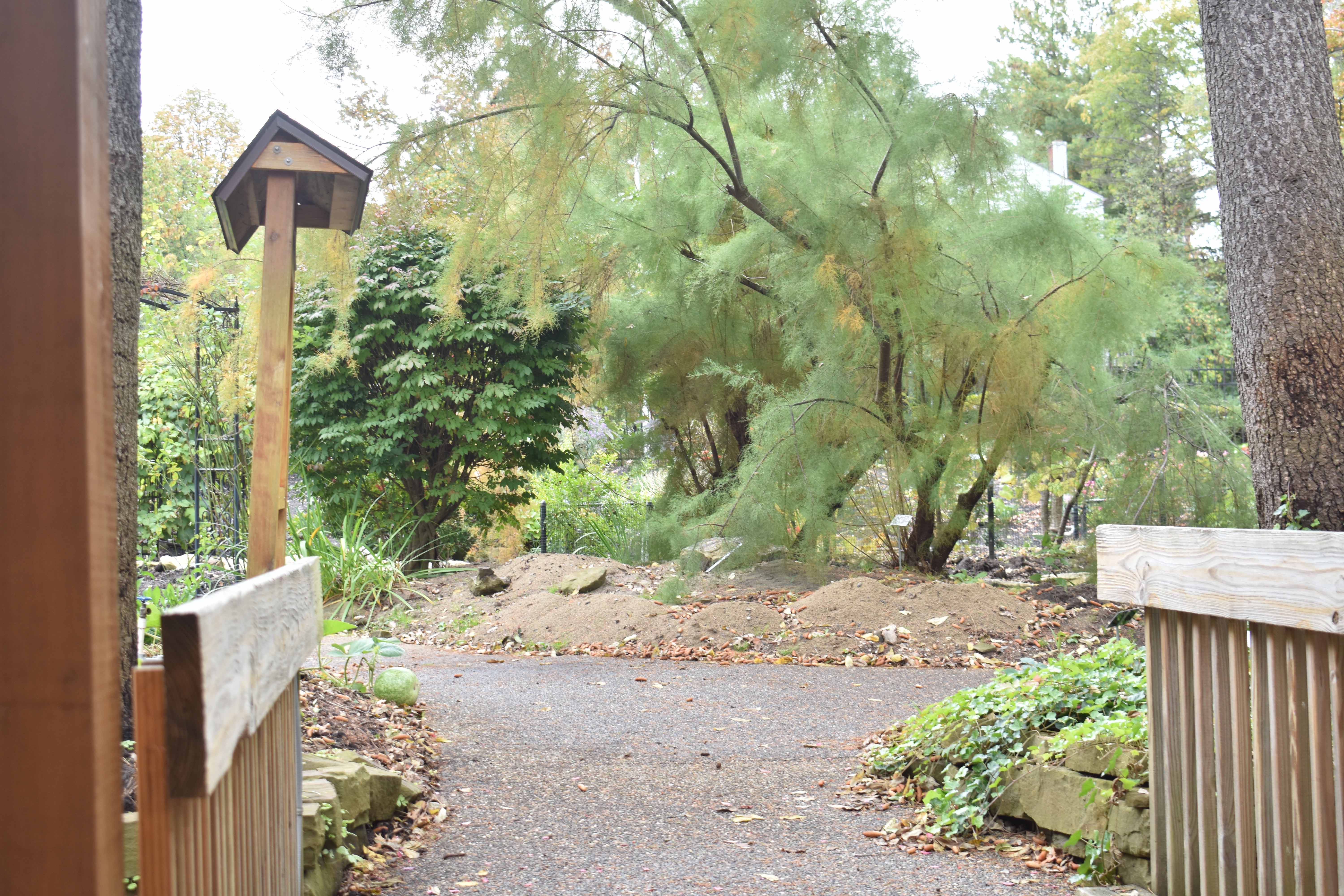
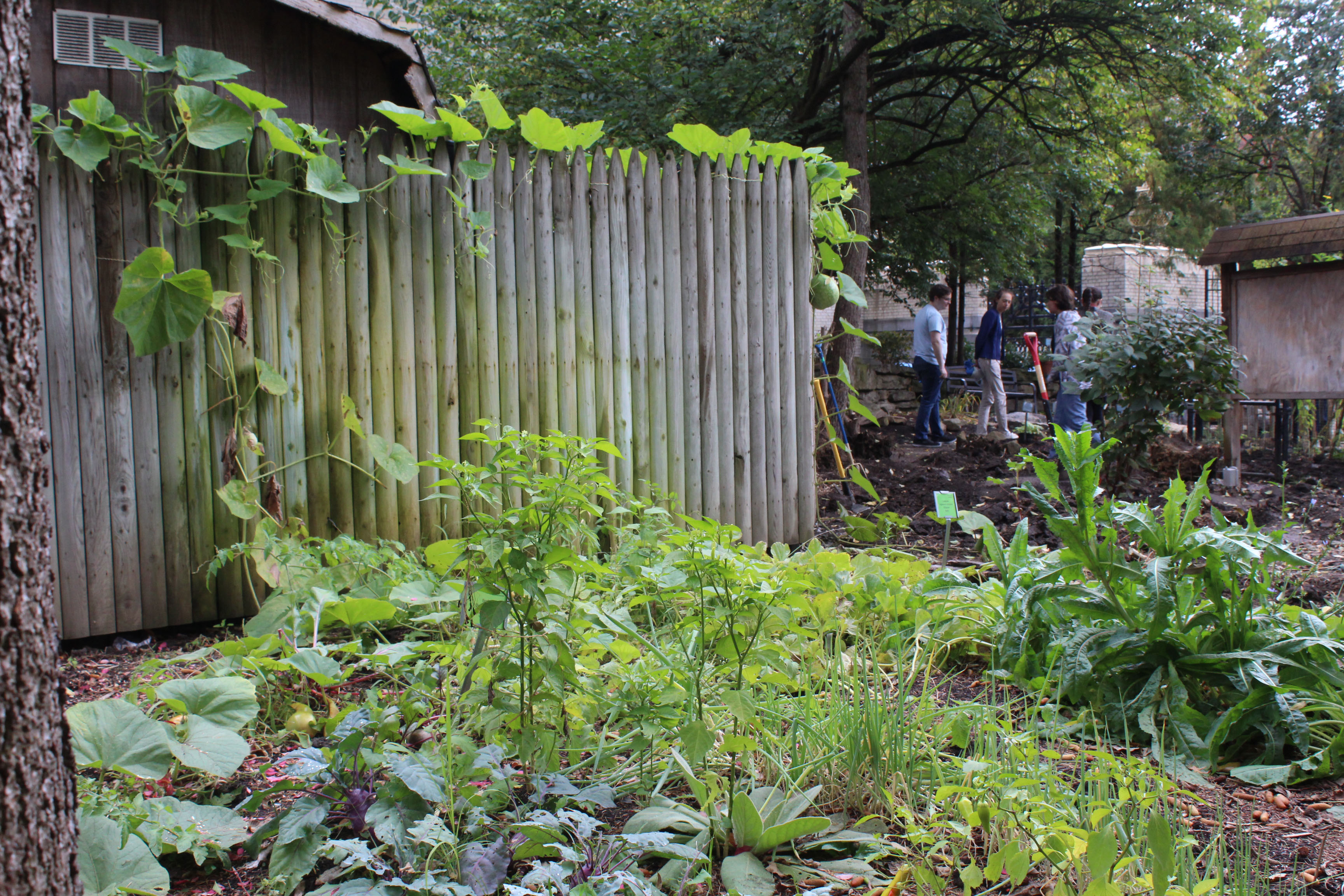
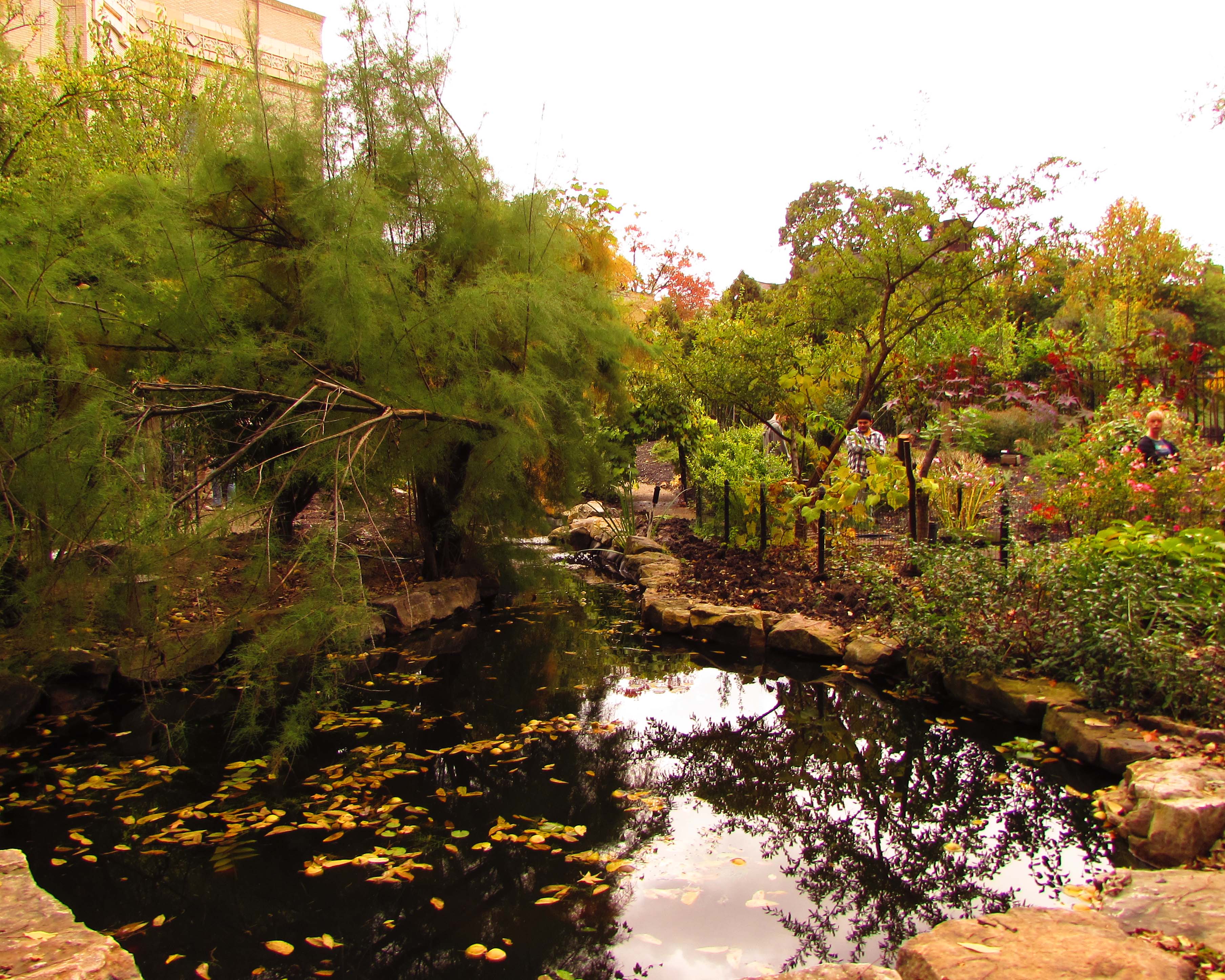
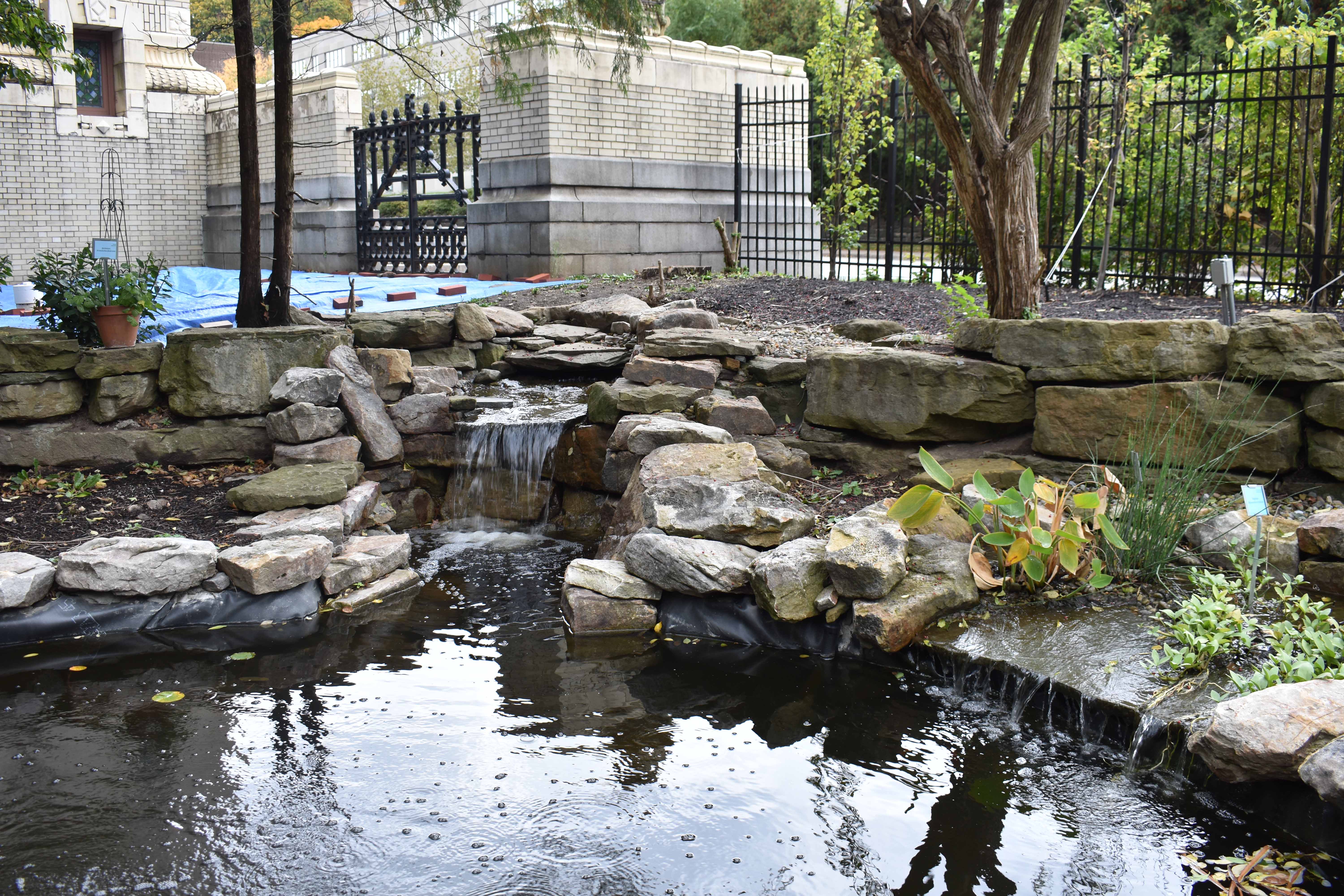
Entrance to the Biblical Botanical Garden at Rodef Shalom. Photo by Alyssa Carnevali, 2023.
Renewal at the Rodef Shalom Biblical Botanical Garden
This page contains the transcript, show notes, and sources for the sixth episode of the Secret Pittsburgh Podcast, Season One . To listen to the episode, as well as the rest in the series, visit our SoundCloud.
Transcript
Al Pratt: We had scheduled our site visits and finalized our plans to visit the Rodef Shalom synagogue before the escalation of violence in Israel and Palestine. Our site visits were adjusted to reflect this reality and our exploration of the site involves its history and continued importance for the members of Pittsburgh’s Jewish community and to everyone in the Pittsburgh community.
Welcome to Secret Pittsburgh. In the past 15 weeks, we’ve traveled across the city, learning the stories of Pittsburgh’s people and places. Join us as we visit Rodef Shalom. I’m Al Pratt, let’s go.
In this episode, we will talk about Reformed Judaism, its history in the United States and Rodef Shalom, a Reformed congregation right here in Pittsburgh.
The Holocaust resulted in the mass displacement of Jews from Europe with around 200,000 coming to America. But even before that, there were generations of Jewish Americans buildings lives and legacies in our country, and in Pittsburgh. You may already be familiar with the Pittsburgh platform, for those of you who aren’t this was a document created in 1885, that calls for Jews to adopt a modern approach to the practice of their faith. This eight paragraph document included among other things, an acknowledgement of some of the stories in the Bible as metaphors and not literal, an emphasis on the compatibility of faith and science, a leaving behind of traditional ideas of dress restrictions and kosher eating habits, and a doctrine of social justice.
These tenants were not universally accepted by reformed sects, but the Pittsburgh platform remains incredibly influential. These differences in belief even made their way into the architecture of more recently constructed synagogues.
As these distinctly American Jewish communities were forming from groups displaced from their home countries in Europe, they sought to place emphasis on their belonging in their new home city.
Dasya Petronova of Rodef Shalom, a reformed congregation between Oakland and Shadyside, had this to say about the building.
Dasya Petronova: Did she tell you about the direction that the Ark is facing? It is not in the same location as it would be in the other buildings, even in reform. So I don’t recall the exact rule but I believe it has to face either east or in the direction of Israel. Ours does not. And that was done to indicate that the kingdom is everywhere. You don’t have to turn towards a particular direction because you’re here now and this is all the same holiness. So it’s a really interesting building.
Al Pratt: Rodef Shalom the congregation housed in the described synagogue has roots in Pittsburgh reaching back to before the Civil War. This congregation actually hosted the convention that produced the Pittsburgh platform.
Solomon Freehof, a former Rabbi at Rodef Shalom was a spearhead in the American Reformed Judaism movements after the turn of the century. In 1955, he outlined the history and impact of the movement. As Rabbi Freehof describes, the reform movement began in Germany but it was only within America that it flourished, becoming an quote, essential part of American Jewish history. The beginnings of Reformed Judaism received pushback from more conservative leaning members of the community. Some viewed the new positions we described earlier, as an attempt to quote please Christians, a response to increasing anti semitism in Europe. However, in Rabbi Freehof’s words, Reformed Judaism was not a movement to secularize Jewish people or make them seem more Christian.
Instead, this group of American Jews wanted their Judaism to quote, fit them as modern people. This ideology of growth and adaptation has suited the congregation of Rodef Shalom well, it continues hosting services and serving as a cornerstone of the community.
The most public facing part of Rodef Shalom’s campus follows that same doctrine of adaptation and growth.
Rabbi Freehof’s eventual successor, Rabbi Walter Jacob and his wife Irene Jacob were both born in Germany during the rise of German anti semitism after World War One. At the end of the decade, Irene’s father managed to move their family to England, where they spent the rest of the war. Walter’s own family fled to the United States in 1940. According to Rabbi Jacob it was Irene’s exposure to the small garden at their home in England that made her a lifelong horticulturalist or expert in plants cultivation, beginning her career at the age of 16. The couple settled in Pittsburgh in 1958, and while Rabbi Jacob began his career at Rodef Shalom, Mrs. Jacob spent much of her time in the nearby Phipps Conservatory in Oakland. She eventually sought to establish her own garden at the synagogue. We spoke again with Dasya Petranova, who’s currently managing the garden, about its history.
I asked to Dasya if they could, in their own words describe the mission of the Biblical Botanical Garden as it was founded and as they carry it on today.
Dasya Petronova: It was, they cut ground on the garden, I believe in 1985 and opened it in 1986. So we’re coming up on the 40th year anniversary for the garden. It was the child of Rabbi Jacob and Irene Jacob, when he was our primary rabbi, and that was his role for a very long time, he’s an amazing person, you should be in the archives looking. But at that point, we just wanted to establish a garden that had biblical themes. And that was there, they put a lot of care into how things were arranged and displayed, I have the original inventory to the plants, and I can’t replace them at this point, because laws have changed. So just obtaining these plants is illegal.
The garden continued under Irene’s care, until 2014, actually, no, I think before that 2013. And she had put the pavilion in, put the water features in, built up the land around it, all of the land that’s around it, around the water feature, you can’t tell by looking at it. It’s been filled in with construction material, which is one of my challenges now is removing that, but it was built up so that it would support good soil, and there’s a lot of good soil in there. It’s amazing how they spent a lot of money getting that dirt, you don’t think of dirt as expensive until you understand it.
But after that she had written starting, I want to say in the late 80s, early 90s, a newsletter that goes with it called Papyrus, and it’s not a complete archive log for me, but it gives me the original visions that she had. And it was very much the way that humans and plants interacted in the biblical sense. So anything that was like, the grains, there are five grains that are significant to Judaism, it’s, they’re called the Five Grains of Israel. And there’s the species of Israel, which is a different set of plants, and that’s going to be your date palms, your pomegranates, stuff like that. It’s, it’s really interesting to see from the inside, from a religious perspective, all of these plants, whereas I just see them as okay, this plant has this pollinator, it lives under these conditions. But now I’m doing it from an ethnographic point of view.
Al Pratt: You said a little bit about the mission for the garden, what, in your words is that mission?
Dasya Petronova: To educate people about botany of the Bible, the Hebrew Bible specifically, and the environmental conditions under which this entire philosophy was born. Also, to bring a little piece of the Levant here.
Al Pratt: We visited the garden in October, after all of the plants had been carefully moved to a greenhouse. Biblical plants are used to a desert climate, as you can imagine, it’s difficult to maintain them through the dreary Pittsburgh winters. Rabbi Jacob is perhaps the more well known of the couple within the wider Pittsburgh area. His life is detailed in his biography titled the 17th generation, the life’s work of Rabbi Walter Jacob, but Irene Jacob is the mastermind behind the Botanical Garden. In addition to being a published botanist, Mrs. Jacob was, as Dasya describes, a very fiery personality.
Dasya Petronova: Irene passed away in 2014. She was a prolific writer on the garden plants. We have several of her books in the gift shop and in my office, and she was a passionate plant person. She did a lot. I wish I could have met her, I hear she was a riot she had, I have in the shed right now, a BB gun of hers that she would shoot the rabbit with and I have the rabbit too still lives there, the baby of the rabbit. But yeah, she was a she was an eccentric person. And it’s a real shame that she’s not here today.
Al Pratt: In my non-horticulturalist eyes, Dasya is doing amazing work continuing the mission of the garden, finding close relatives of biblical plants that are able to survive in our frequently cold and wet Berg. They do an exemplary job continuing the work of Mrs. Jacob, who passed away in 2012. In addition to general renovation of the garden Dasya is working on creating themes for each year, such as animal or incense plants, and hosting more nature focus events within the garden.
Dasya Petronova: I am hoping this next season to get a birds of prey demo out there for the kids. I have the zoo coming out the zoo is going to be visiting too a lot of people who do come in that I strike up conversations with, they’re troubled sometimes and they need just a quiet place to be. And that’s what I hope they get when they’re there.
Al Pratt: They hope that over the next decade, someone with a passion for the natural world is inspired to take over their work and tend to the garden. I asked Dasya if they had any general advice for our listening audience.
Dasya Petronova: Grow a plant. Just grow a plant, let it die, do it three more times, then you’ve got statistically significant results but you know, have an interaction with some plants.
Al Pratt: For more information on the biblical Botanical Garden, visit Rodefshalom.org/garden. We’ll include a link in our show notes. If you’re in Pittsburgh between June and September, be sure to give it a visit.
The synagogue bustles with activity on the morning of Rosh Hashana services celebrating the Jewish new year. Before the main congregation service there’s a children’s service. It’s held in a more modern addition to the synagogue, complete with a projector and folding padded chairs.
There’s stained glass windows along the top of the walls that catch the morning light. One of the images depicting two hands forming the Hebrew letter Shin. This gesture was popularized by Leonard Nimoy as the Vulcan salute the way he included his Jewish background into his roles.
The room is filled with children ranging from those still stroller bound not entirely aware of what’s happening around them to kids running up and down the aisles with their friends. Service includs singalongs, and apples and sticks of honey are passed around at its conclusion, representing a wish for a sweet new year.
One of the rabbis who has been serving with Rodef Shalom congregation for years, mentioned that she knew some of the parents in the audience when they were attending as kids. And now they’re bringing their own children to celebrate the holidays. As Dasya described.
Dasya Petronova: It’s an ecosystem. The religion is an ecosystem. And that’s something I think was missed before.
Al Pratt: And it is a flourishing ecosystem with a rich history here in our very own Pittsburgh, from the Orthodox communities in Squirrel Hill to Rodef Shalom’s reformed congregation.
Thank you for joining us as we uncovered one story of Rodef Shalom and its biblical botanical garden. We hope you are inspired to visit this place and to find your own Pittsburgh stories. Please tune in to all the episodes we’ve produced this season. You can find this episode’s show notes and transcript at secret-test.local/. I’m Al Pratt, your host for this episode as well as the audio editor along with Neha Chakraborty. Alyssa Carnevali wrote and researched this episode. Thank you again for joining us. See Yinz later!
Bibliography
Bird-Sounds-Nature-Birds-Noises-Royalty-Free-Sound-Effect. https://pixabay.com/sound-effects/search/birds/.
Free_No_Copyright_Nature_Sound_Music. https://www.youtube.com/watch?v=J8unj-Zp2S0.
Freehof, Solomon B. “Reform Judaism in America.” The Jewish Quarterly Review, vol. 45, no. 4, 1955, pp. 350-362. https://www.jstor.org/stable/1452937.
Gentle_Solemn_Piano_Cinematic_Background_Music_for_Videos. https://www.youtube.com/watch?v=J2x4IiLi3zE.
Gilbert, Shirli. “Buried Monuments: Yiddish Songs and Holocaust Memory.” History Workshop Journal, no. 66, 2008, pp. 107-128. https://www.jstor.org/stable/25473010
Hopeful_Inspiring_Instrumental_Cinematic_Piano_Music-Royalty_Free. https://www.youtube.com/watch?v=vJOzeIET0Gk
Magid, Shaul. “The Holocaust and Jewish Identity in America: Memory, the Unique, and the Universal.” Jewish Social Studies, vol. 18, no. 2, 2012, pp. 100-135.
Petronova, Dasya. Personal Interview. 3 Nov 2023.
Scott Holmes Music – Deep Thinker Ident. https://freemusicarchive.org/music/Scott_Holmes/podcast-background-music/deep-thinke r-ident/.
Scott Holmes Music – Emotional Cinematic Ident. https://freemusicarchive.org/music/Scott_Holmes/podcast-background-music/emotionalcinematic-ident/.
Tabachnick, Toby. “Rodef Shalom’s Biblical Botanical Garden is Testament to Jacobs’ Love for Plants, Each Other.” Pittsburgh Jewish Chronicle, 17 June 2015. https://www.jstor.org/stable/10.2979/jewisocistud.18.2.100.