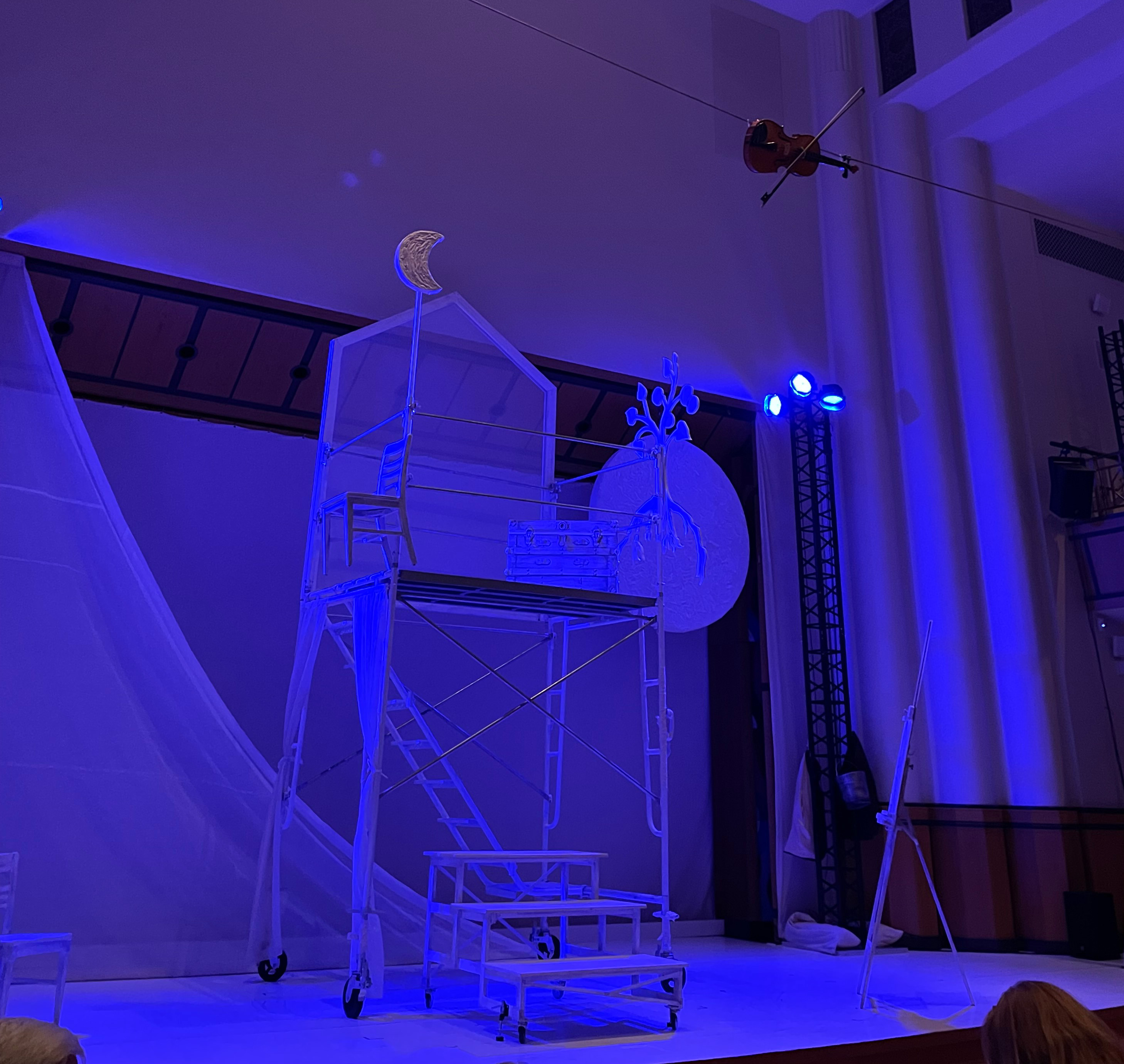
Quantum Theatre sign. Photo by Taya Hoetzlein-Sirman, 2023.
Quantum Theater: Productions in Pittsburgh
This page contains the transcript, show notes, and sources for the tenth (and final) episode of the Secret Pittsburgh Podcast, Season One . To listen to the episode, as well as the rest in the series, visit our SoundCloud.
Transcript
Catie: Imagine taking a deep breath in, the air cold and crisp in your lungs. Above you, a characteristically Pittsburgh sky sprawls on endlessly, steely and gray. The vivid skyline is pressed against it like the scenic backdrop of a play. Beneath you, the yellow bridge is sturdy and you can hear the Alleghany running, running, running…
[river sound]
Welcome to Secret Pittsburgh! In the past 15 weeks, we’ve traveled across the city, learning the stories of Pittsburgh’s people and places. Join us as we explore Quantum Theatre. I’m Catie Grable. Let’s go!
The sounds of Pittsburgh are varied, distinctive, and often noisy…
Clanging industry [factory noise],
Cheering stadiums [fans cheering],
And chugging trains [train goes by].
[piano music]
They’re also emblematic of the very place they emanate from: gritty, nuanced, and unapologetic. There are thousands upon thousands of stories in and around and about Pittsburgh: Stories that have sunk into the Allegheny, that flow through the Monongahela, and float down the Ohio. Stories embedded in those jagged cliff cutouts, buried in the Appalachian mountain range next to the coal that powered the very industry that once defined this city. Stories that glow in setting steel and that rise through sputtering smokestacks. Stories that wind through narrow alleys and twisted streets and up steep steps, and stories that march proudly down Fifth Avenue.
Pittsburgh is a place that lends itself to storytelling, with its distinctive geography, deep lore, illustrious history, and various unique places. It only makes sense that a company like Quantum Theatre would spawn here, in a city so conducive to their mission.
Quantum Theatre, per their own mission statement, “is a company of progressive, professional artists dedicated to producing intimate and sophisticated theatrical experiences in uncommon settings, exploring universal themes of truth, beauty, and human relationships in unexpected ways.”
They do this through site-specific productions and environmental theater that interacts with its surroundings. You might’ve already listened to our previous episode about how they put on The Flying Lovers of Vitebsk in the Rodef Shalom synagogue, connecting a Jewish story to Pittsburgh’s Jewish heritage and places. We were fortunate enough to be able to discuss this site-based mission with Karla Boos, Quantum Theatre’s founder and creative director.
What made you choose Pittsburgh specifically for your company?
Karla: Yeah, I felt that the size of the city and the kind of approachability of the city would be something I could deal with. I was in Los Angeles, I didn’t know how a person would start a theatre company in Los Angeles, truthfully. And at the same time, I felt that I was bringing something that Pittsburgh did not have. And those two things turned out to be true. And Pittsburgh, I gotta hand it to Pittsburgh, has been very adventurous and open and willing. And I say to young people who asked, you know, how do you get started? Well, never hesitate to ask for something that you need or want. You do have to deliver something that speaks to people. But if you do, I think you would find that this is a city where there’s reaction and appetite.
Catie: So our class, Secret Pittsburgh, involves thinking about how specific places inform and construct a narrative. This place based mission seems very similar to your site specific production. Can you tell us a little about the process of adapting a performance to specific environments?
Karla: Yeah, we are so allied, and it’s really great, to be talking to Secret Pittsburgh folks. I agree that place is this contributor to experiences, right? Because a place has the layers of history, the past is there right alongside the present, and maybe the future. And it just makes for such liveness and it highlights that people bring a lot of themselves to any experience that we have. And I really like collective experiences. You know, that’s what the performing arts are about. That’s why however great Netflix becomes, we still gather to experience something that we know everyone there in the room or the site is going to bring different things to it and come away a little bit differently from it. But it’s like the act of coming together there that makes it so. I have a 30 plus year history in Pittsburgh, of kind looking behind that door, or learning that once upon a time this happened here. And I love the physical landscape of the city as well. I love the mix of architecture, the natural landscape with the hills and the rivers in the great amount of green space. So all of those things are like an endless quest that I’m on and it has never become boring to me. There’s always another place. It really inspires artists, directors and designers, especially designers, so you know, yay, Secret Pittsburgh, keep coming to quantum please because you discover a place as well as you know, have an experience.
Catie: Can you discuss Pittsburgh, specifically as a venue for this non traditional theater? Pittsburgh has a notable heritage as a place of industry and has garnered many monikers over the years: Steel City, City of Bridges, City of Champions. It is known for its immigration, its rich culture, and its impressive reinvention. Have you been able to incorporate these distinctive features in your performances? And if so, how have they manifested?
Karla: Well, yes, you catch me- our last work was Hamlet staged at the Carrie Furnace, that monument to, in some ways hubris, right? There was a time when we were the kings of the world with our steelmaking, but it was an ephemeral time. And the Carrie Furnace stands as a monument to that ambition, and it’s transformed in a beautiful way–if you’ve been there, if you haven’t, you must go–to really a natural space. And yet there is that evidence of the industry that it once created. So this is just one example. We staged a play by Tom Stoppard in Allegheny Cemetery that was about loss and the passage of time and how the past informs the present. I think all cities probably have a version of what Pittsburgh does, but it does feel especially rich in Pittsburgh.
[musical interlude]
Catie: Those who study the performance arts like Gay McAuley make the argument that performance impacts a place, and place simultaneously impacts performance, thus launching a cyclical interplay. In his words, when a production is put on in a certain location, it “activates memories, enables the place to tell a variety of stories, and permits the past to resonate in the present.” At the same time, it “enhances the creative agency of the spectators, who bring their own knowledge and memories of that place, and others like it, to the performance, thus unleashing a dynamic and volatile meaning making process.”
Quantum Theatre, as a site-based production company, thus takes advantage of this interaction between place and story to involve the audience and add dimension to their work. As you heard Karla tell it, Pittsburgh has a particular depth of history that offers a particularly rich landscape for story-telling. Their most recent show–The Flying Lovers of Vitebsk–was their 100th, and since 1990 they have staged productions all over Pittsburgh, in places ranging from outdoors in Mellon Park to a former burger place in the Waterfront, and all kinds of places in between. In each place they perform, the audience brings their own preconceptions and ideas that inform their perception of the play, and must be added to, changed, or deconstructed through the performance.
In reviewing the places we’ve journeyed together throughout this podcast series, it’s incredible to consider the way in which our interactions with places have transformed our interpretations of them and the narratives associated with them.
If you listened to the previous episode about the Carrie Blast Furnace, you are likely aware of its history of steel-making, and the associated injustices, as well as the way that it has revived itself into a place of arts and community. This is a common narrative throughout Pittsburgh.
For example, the August Wilson House is located in the Hill District, a historically thriving black community that was targeted for redevelopment in the middle of the 20th century, displacing thousands and leading to an economic deterioration. It was this place, both its height and then its eventual fall, that inspired August Wilson’s Pittsburgh Cycle. Since then, there have been efforts to revive the Hill District, and the August Wilson House is a manifestation of such efforts. They actually host their own theatrical productions in the house’s backyard.
Likewise, the Nine Mile Run in Frick Park represents an effort to renew and restore a waterway that was previously polluted, and create beauty and natural access in an urban setting. It is another tale of revival.
Quantum Theatre is a thread that connects all the places we’ve gone together. As the singular site without a physical location associated with it, the Quantum Theatre can claim all of Pittsburgh as its “place” as it seeks to find the stories hidden everywhere throughout the city.
However, Karla was careful to note that while the performances put on by Quantum Theatre are aligned with the place they are held in, it is the play that comes first rather than the site. In her words:
Karla: There are these gorgeous stone aqueduct-type structures that are under Panther Hollow Bridge near Phipps Conservatory. I think I would stage opera under there. I want to hear the power of the human voice, you know, really amazing music under those bridges. Right. So it’s, it’s more like that sometimes I’ll say, I think it’s, it’s Shakespeare or, there’s a magnificent place called the King estate. We want to stage this outdoors. It’s at the end of Highland Avenue. And there’s this beautiful bowl of green grass with a mysterious entrance into the woods. And a little Folly Tower. This is on Negley Avenue, right. So you know, there are places all around and how you come to make it happen is- is another part of the story, of course.
Catie: So when you’re kind of putting on these productions, do you pick a site first? Or do you kind of have a sort of show that you want to put on first and then you look for sites? Like what is your process of like, kind of choosing this season’s productions and where they’re going to be?
Karla: Right, the play really comes first, although there are sites like I’ve just mentioned a few that live in my psyche, and I hope to find the right play for them, the way we go about it is we’re doing a play and we choose the site, ideally with the director and designers involved for the play, for what will unlock its power. And often it’s not a literal thing that we’re looking for. It’s something like the director will say I want great height, or I want to see the performers come from a great distance. We usually know when we want it to be outdoors rather than indoors because we’ll be dealing with changing light. Right. So, it’s always the work first though, in general, yeah.
Catie: Through Quantum Theatre, we can see the way that place interacts with story, and story, in turn, interacts with place. Next time you find yourself strolling down one of Pittsburgh 446 bridges, lamenting the cloudy day or the cold wind off the river, think instead of “the broken beauty” of the city, and all the fragmented stories that compose it.
We’ll let Karla have the parting thought, regarding the importance of place and the significance of the mission shared by the Quantum Theatre and Secret Pittsburgh.
Karla: Well, I think I just want to say, I love that in this day and age where so much is virtual, or so much is mitigated by technology, you guys are about real places, real things and the discovery of them and the journey to find them, and all the things that happen to you along the way as you our journeying, you know, and how it makes you more empathetic, more connected to each other and to the city, to the past to the future. I just think that’s great. It’s deeply part of my mission. So keep it up. Keep going to live performance in general, right, not just Quantum but we all need to value that or else we’ll lose it.
Catie: Thank you for joining us as we uncovered one story of Quantum Theatre. We hope you are inspired to visit this place and to find your own Pittsburgh stories. Please tune-in to all the episodes we’ve produced this season. You can find show notes and a transcript at secret-test.local/. I’m Catie Grable. Simona Matiyevsky served as audio editor, and Taya Hoetzlein-Sirman wrote and researched this episode. See yinz later!
Show Notes
Here you can find more information about Quantum Theatre, Karla Boos, Pittsburgh, and Site-Specific Theatre.
Bibliography
Boos, Karla. “Secret Pittsburgh.” Interview by Taya Hoetzlein-Sirman, Catie Gable, Simona Matiyevsky. November 3, 2023.
Firestein, Stuart. “Experimental Theatre.” Nature (London), vol. 443, no. 7114, 2006, pp. 913–14, https://doi.org/10.1038/443913a.
Fischer, Carol Anne. Quantum Theatre: A Language for the Voices of Contemporary Theatre. ProQuest Dissertations Publishing, 2004.
Henry.Osborne. “River Sound.” Freesound, 14 Sept. 2021, https://freesound.org/s/587087/.
Innes, Christopher, and Christopher Innes. Avant Garde Theatre, 1892-1992. Routledge, 1993.
JuliusH. “Piano Bar – Piano Lounge Background Chill Music.” Pixabay, 27 April 2021, https://pixabay.com/music/acoustic-group-piano-bar-piano-lounge-background-chill-musi c-4178/.
Markedit. “Train upon us.wav.” Freesound, 13 June, 2012, https://freesound.org/s/157873/.
McAuley, Gay. Site-Specific Performance: Place, Memory and the Creative Agency … – Core, core.ac.uk/download/pdf/229426471.pdf. Accessed 12 Nov. 2023.
Nathans, Heather S. “Pittsburgh in Stages: Two Hundred Years of Theater.” By Lynne Conner. Pittsburgh: University of Pittsburgh Press, 2007. Theatre Research International, vol. 34, no. 1, 2009, pp. 92–93, https://doi.org/10.1017/S030788330800432X.
Oversub. “Hammer.Wav.” Freesound, 19 June, 2022, https://freesound.org/s/639235/.
Penguin Victory: CMUsound. “BM-PittPensCele.Wav.” Freesound, 30 Apr. 2009, freesound.org/s/71945/.
Program for Daniel Jamieson and Ian Ross’s The Flying Lovers of Vitebsk at Rodef Shalom, Pittsburgh, PA. Quantum Theatre, 2023.
Simon, Ed. An Alternative History of Pittsburgh. Pittsburgh: Belt Publishing, 2021.
“What We Are.” Quantum Theatre, 31 May 2023, www.quantumtheatre.com/what-we-are/.
Zukerman, Natalia. Tumbalalaika. In MuseScore4. Adapted by Benny Hill. Uploaded by Jonathan Miranda. 1 December, 2023. https://musescore.com/user/26870840/scores/5016022?share=copy_lin.