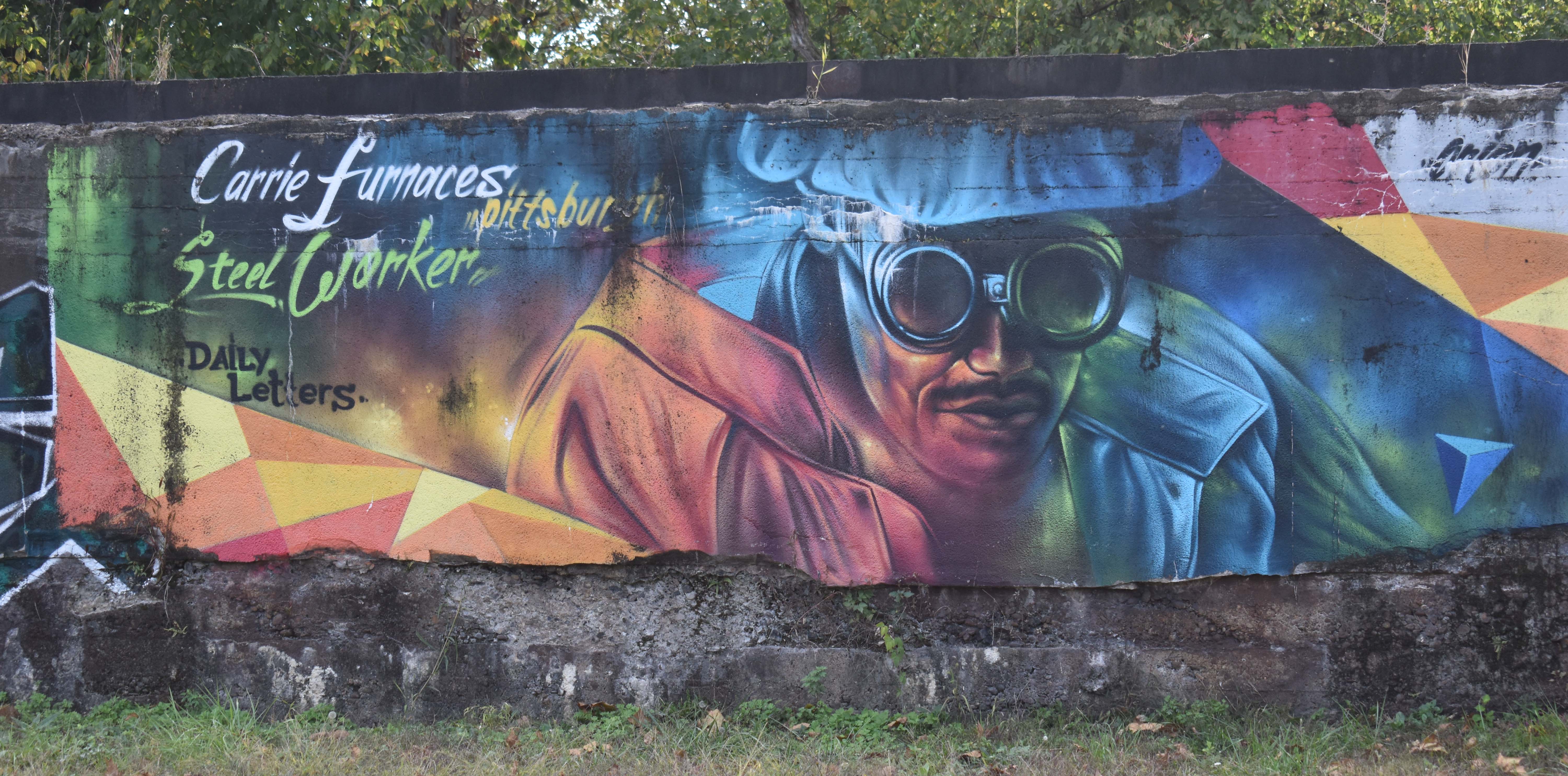
Graffiti of a steel worker. Photo by Jennifer Ponce Cori, 2023.
Carrie Blast Furnaces: Community and Art
This page contains the transcript, show notes, and sources for the eighth episode of the Secret Pittsburgh Podcast, Season One . To listen to the episode, as well as the rest in the series, visit our SoundCloud.
Transcript
Welcome to Secret Pittsburgh. In the past 15 weeks, we’ve traveled across the city learning the stories of Pittsburgh’s people and places. Join us as we explore the Carrie Blast Furnaces. I’m Jennifer Ponce Cori, let’s go.
If you’re from the Rustbelt the Carrie Blast Furnaces are easy to miss It’s something that could go entirely unnoticed.
It does not demand attention or want you to think about it. And that’s not because of its size. In fact, the furnaces are huge. Its silos and towers rise far above from the tree line, spanning across 168 acres on the banks of the Monongahela River. The size might actually be one of the things that would garner a second look.
But no. The furnaces go unnoticed because, if you are from the Rustbelt, It resembles many of the other coppery brown buildings that your dad told you used to be a mill. Used to bring jobs to Pittsburgh. Used to be important. If you do notice and take a second look from afar, it feels very unimportant. It looks hollow and very, very still.
No smoke raises from the furnaces. No trains come and go delivering materials or leaving with a precious iron. None of the city port authority buses approached it. And why good they? What is there anymore besides the skeleton steel corpse? Turns out, there’s a lot there.
The Carrie Blast Furnaces lie in Swissvale, about an hour on the bus from downtown Pittsburgh, followed by a 20 minute walk onto the property. The coppery brown buildings peak up over the heads of developments and open fields. Standing in front of it, the whole structure is massive. Two brick buildings stretch about 100 yards away from the road, with a small grassy field between them.
A huge metal exhaust pipe snakes around the buildings. Connecting them to the furnaces behind the buildings and the courtyard, two boxy Towers, furnaces number six and seven, stretch 92 feet into the air and once released, tons of a smog and pollution into the atmosphere. Today, however. The furnaces are perfectly still, save for a cool breeze that rustles the leaves throughout the property.
The only voices are those of the tourists that walk through the various buildings. Everywhere you look, you can find flaking stone, rusting metal. Remnants of iron bits and graffiti, old and new. Plants spring out of the walls, over ledges, and through rock. The bright green color stands out brilliantly against faded red metal.
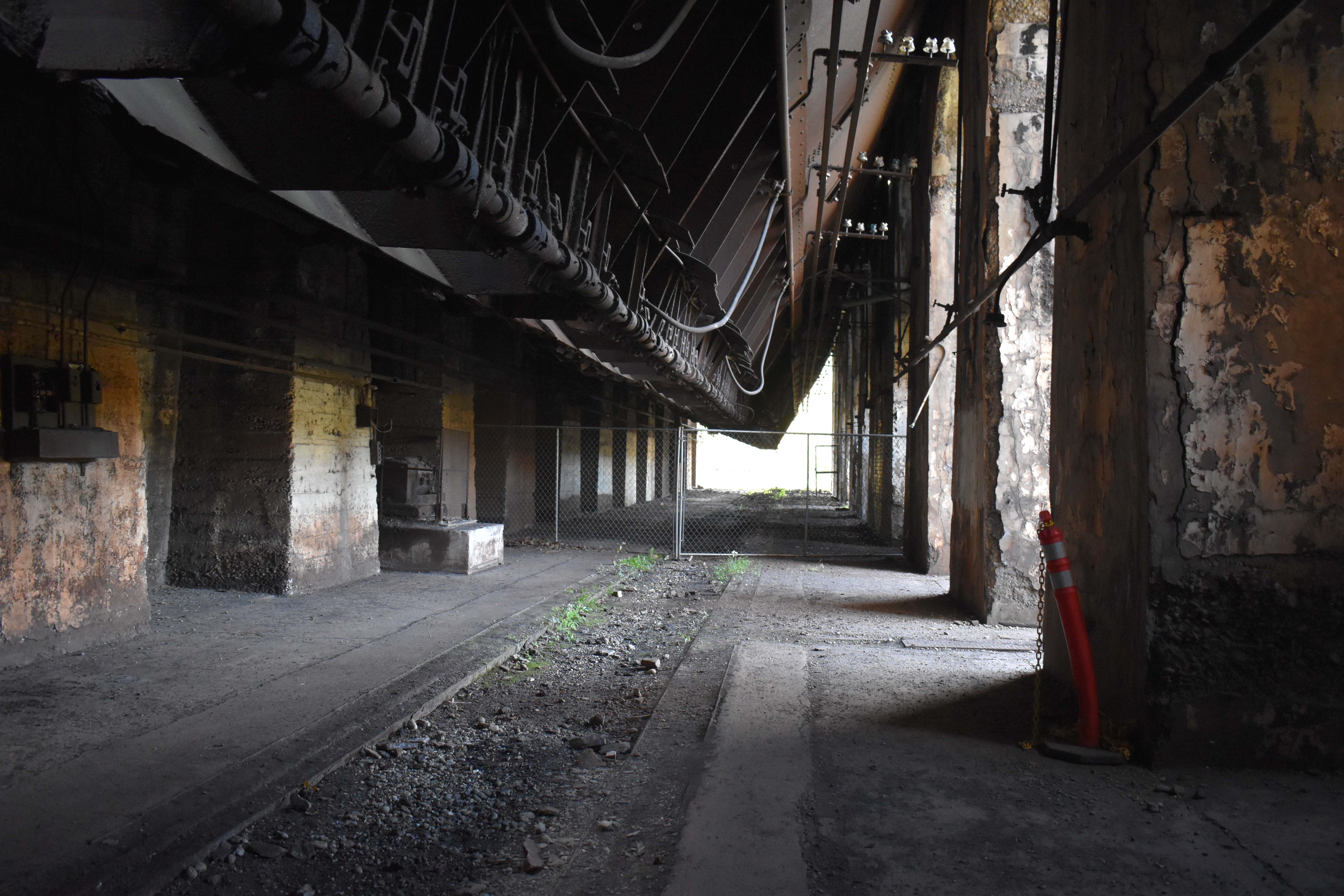
From the outside, the whole place is remarkable. And in just the right light, makes for an almost beautiful complement to the changing Pittsburgh leaves. Inside the structure is a different story. Away from the light, the structures are no longer a warm, rusty brown, but instead a cold gray. Winding staircases lead up and out of sight.
Pathways drop off suddenly. Shattered brick and chipped paint line the walkway. Since the workers have left and the doors close, it feels touched only by time itself.
Rivers of Steel is deeply invested in maintaining the Carrie Blast Furnaces, along with other attractions in Pittsburgh associated with its rich history and still such as the Explorer, Riverboat, the Pumped House, the W.A. Young, and Sons Foundry and Machine Shop.
So, what does this organization do? To start, Rivers of Steel maintains the Carrie Blast Furnaces. Reinforcing and maintaining the vast site is a major challenge. It has been over 30 years since the site has been a functioning mill, and with this time, ware and tear has taken its toll on the site.
Rivers of Steel has put millions of dollars into the site to get it to the point where it safe to have tours for the public. This is one of the main draws of Carrie, being able to walk through these place and see what those of the past has seen. Combine this with the amazing tour guide of Carrie and you have a perfect storm to get an interesting story of the site while having a great time doing it.
Keith Close is a current tour guide at Carrie Blast Furnaces. Here is what he had to say when asked about Rivers of Steel and their mission. “
Rivers of Steel is preserving a big chunk of Pittsburgh history. They are preserving the legacy of steel. The more important to me is preserving the people. The people are very important. So much is written about Andrew Carnegie or Henry Clay Frick, Phipps, the whole group of those people at the top. But we want to emphasize more the people that did the dirty work.”
This speaks perfectly to what we have seen throughout our research of the site. Rivers of Steel also maintains the Boast Building, where it currently houses its headquarters.
This building overlooked the Homestead Mill and served as housing for many steelworkers. Maintaining these sites and doing tours is great, but Rivers of Steel goes above and beyond these goals with captivating events such as the Festival of Combustion. These events are geared towards the public and keep engagement levels high since the closure of the mill.
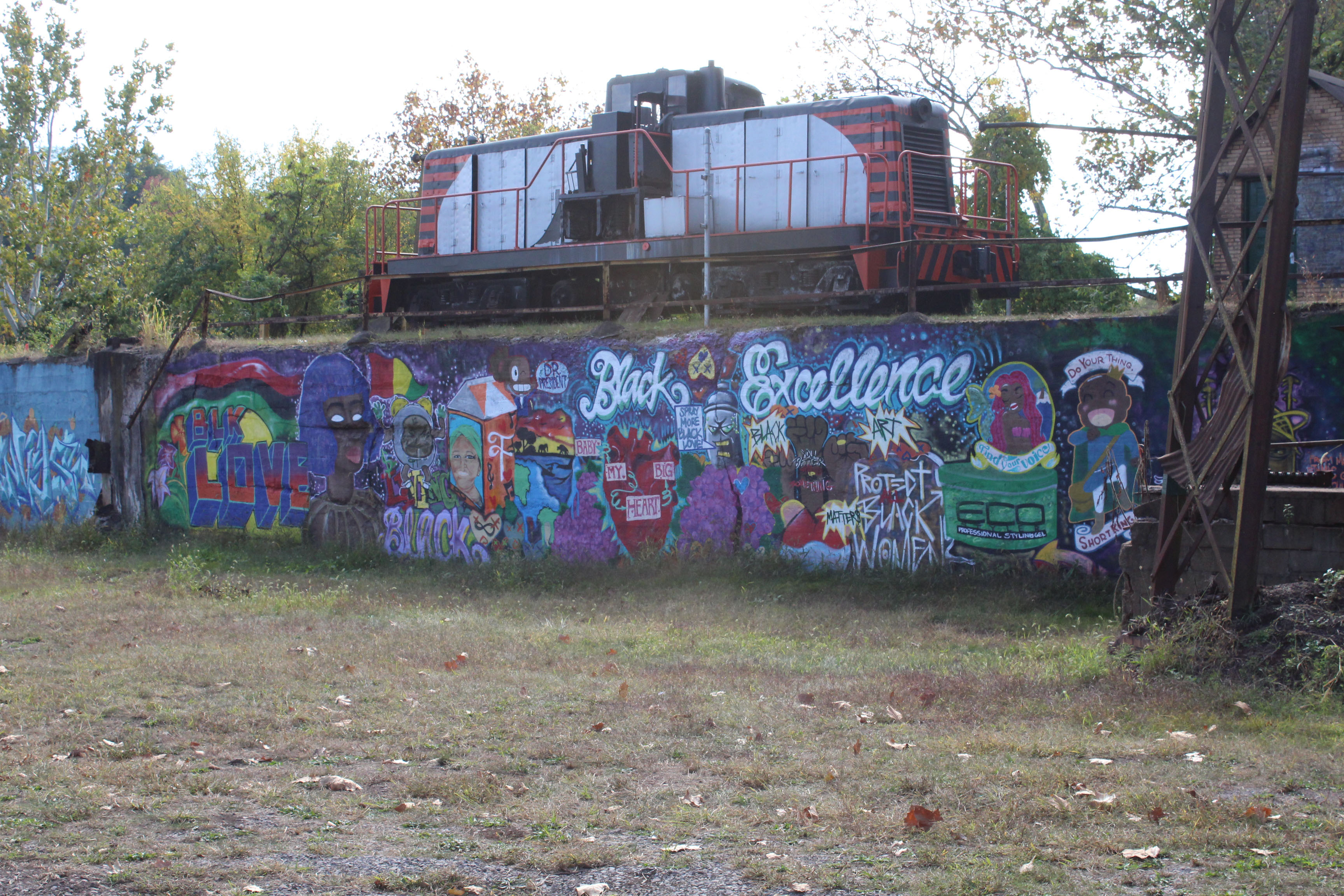
Art is at the forefront of the Carrie Blast Furnaces, with graffiti, not only acting as a way to engage the community, but also adding to the stories that the site can tell. Stories of steel, African American heritage, and many others can be seen covering the walls that surround the mill, making the site a vibrant canvas.
Going forward, Rivers of Steel has many ideas for the site. One such idea is a separate museum building which could house artifacts from the site. This will further the draw of the site and keep people coming back to continue educating themselves on the rich history of Carrie. The world is a canvas and Carrie is used to paint the heritage of Pittsburgh.
Rivers of Steel has made the Carrie Blast Furnaces into a great location that invites many to explore the heritage of the region through experiential learning. Education, it’s a main goal of the site. Tours are offered and attended by many looking to learn something new or think back on the past. We, the producers of this podcast, attended one of these tours and were shown around by an amazing tour guide, Barney Terrell.
Barney guided us through the complexities of the site and brought with him some thought provoking stories that make huge impacts on the group. Many of the stories told by Barney and the site show a connected team of steel workers bonded through the challenging conditions that they face.
But how Is the community here in Swissvale receiving the site now? Has Rivers of Steel kept these people at the forefront of Carrie, just as how it was built and run? From everything that we have seen, yes is the answer. The Carrie Blast Furnaces are being actively used, keeping the community of the past alive through continued engagement with a craft that built not only Pittsburgh, but the entire nation.
Swissvale is at the core of this engagement, with many of these events geared towards the people who currently live here. Tickets are offered to Swissvale citizens, often before the general public has access to them, as a way to thank the community. This keeps the community, that thrived due to the mills alive, and in turn, keeps the values of these people at the center of what is done here.
Rivers of Steel has been working on getting a shuttle system for one of the local churches to the site to allow those without cars easier access to the furnaces. Expanding accessibility and outreach of the powerful stories of the site.
Carrie is a place of continued use. And it’s a remembrance of the heritage of Pittsburgh. Another site that has been preserved, that pertains to the Carrie Blast Furnaces, is the Bost Building. This place sits nestled in Homestead, directly across from the site that used to be the Homestead Mill.
Its function was as a hotel or apartment for the steelworkers due to its close proximity to the mill. This piece of history houses archival materials that belongs to the Carrie Blast Furnaces. The collection includes safety posters, union pins, blueprints from the site, clothing, hard hats, tools used at the site, and so, so much more.
By looking out towards the river, one can imagine what someone living in this space might have witnessed. The pride, greed, and mix of emotions the worker must have felt knowing what they were a part of. A Dollar Tree now inhabits this space. What does this say about the area and society? That I would like you to decide.
The rest of the building, of what is not used as office space for Rivers of Steel personnel, is used to showcase materials from the steel mills of the past as well. This location is open to the public and continues the legacy of steel in Pittsburgh. This preservation is all thanks to the Rivers of Steel and the hard work done day in and day out by these people.
Just because the gates of the Carrie Blast Furnaces is closed and U.S. Steel abandoned it, does not mean it was without life. Young people flocked to the site as the prime spot for graffiti art. Tags throughout the site can be identified, from the tops of the silos, to hidden crevices, to high out leggings.
We spoke with Barney Terrell, who had studied the furnace’s evolution from the industrial powerhouse to artistic haven. When we asked about the graffiti, He says that “if you are small enough and nimble enough, you can get just about anywhere in here”. Without any clear manager or authority, the site was largely unregulated, allowing for a flock of young artists to claim it.
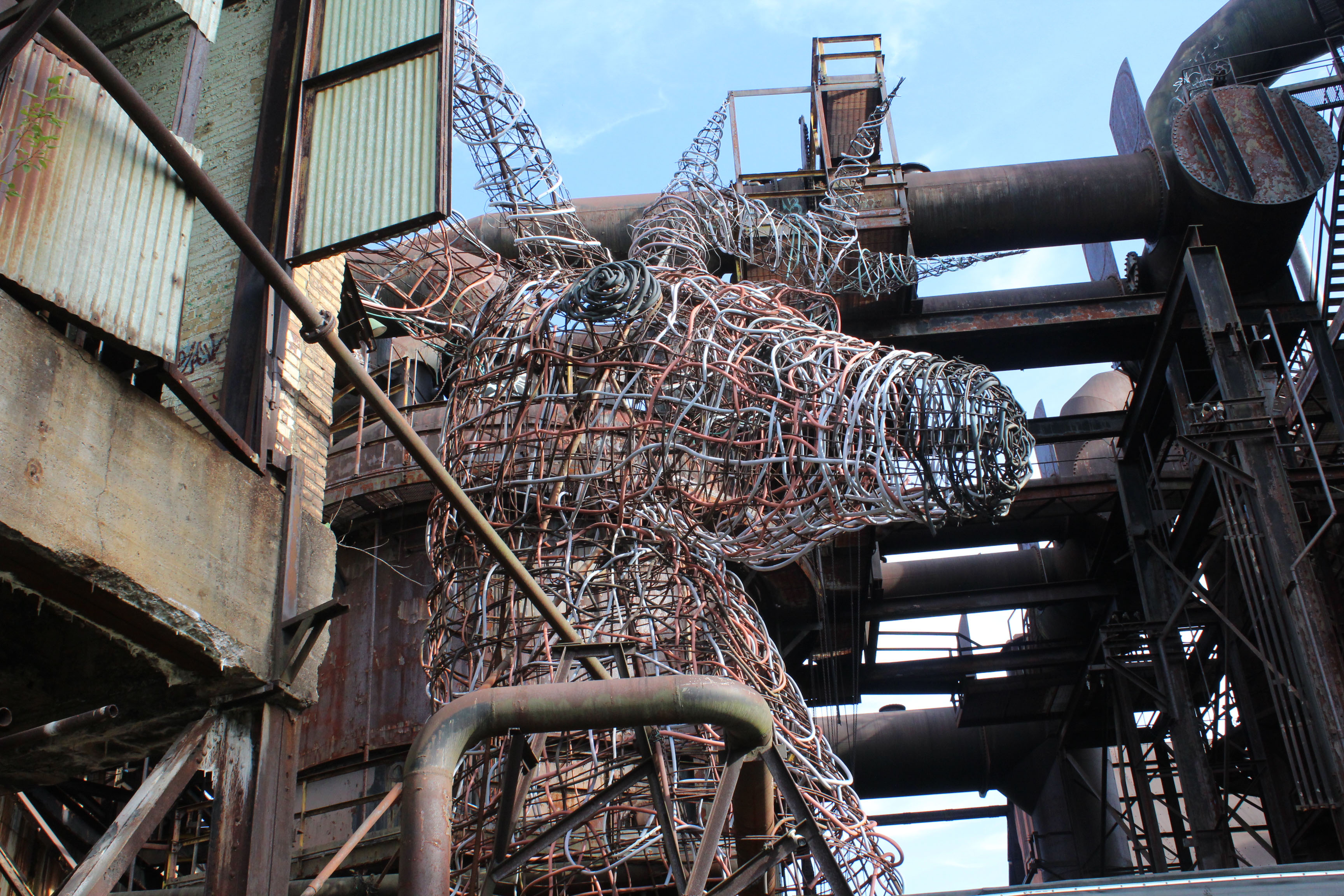
At the same time, nature too began reclaiming this site. Herds of deer returned to the grassy property to graze, something that would have been unheard of while the mill was operating. This reclamation by nature inspired an underground group of artists, the Industrial Arts Co-op, to construct a sculpture of a towering deer head using only materials found on the property.
Here is what Barnie Terrel had to say about the importance of the steel deer. “You know, as Ron has said multiple times, that if that deer wasn’t there, none of the rest of the art would be. It just really set, it set a new direction for everyone”. Clearly, this art piece has been crucial. In transforming the space.
Artists work on this piece for a year. Collecting materials and shaping them into an animal all too familiar in Western, Pennsylvania. This piece is now a beloved hallmark of the site, representing a collaboration between artists and the property’s reclamation by nature. This artistic spirit can be found all around the furnace, especially in the graffiti, something the site has come to welcome.
Where maintenance once tried to keep the site free and clean of tags, Rivers of Steel now welcomes them with some guidelines. Artists may not paint on the actual buildings. Instead they are restricted to a wall that encloses the back of the property, visible to tour groups. For Rivers of Steel this method has work in keeping illegal graffiti away in a 2016 article with the Pittsburgh City Paper, Rivers of Steel Archives Director Ron Baraff said “if you provide an outlet for the artist, 98 percent of them are going to be so grateful for the outlet that they’ll work within whatever parameters are there and it keeps illegal activity down”.
With the freedom to paint the resulting artwork through the furnace property is remarkable. Paintings of animals, shapes, and elaborate tags bring bright color to the mostly dulled space. With the artwork, there is a sense that the space is still alive, still a place where things are being created and where people are collaborating.
Even archived images of the mill workers are recreated on the walls, demonstrating an understanding of this place’s story. This identity, both historical site and artistic haven, it’s something that Rivers of Steel and the Carrie Blast Furnaces have embraced with open arms. Rivers of Steel wants to bring the historical industry back to life for Pittsburgh today.
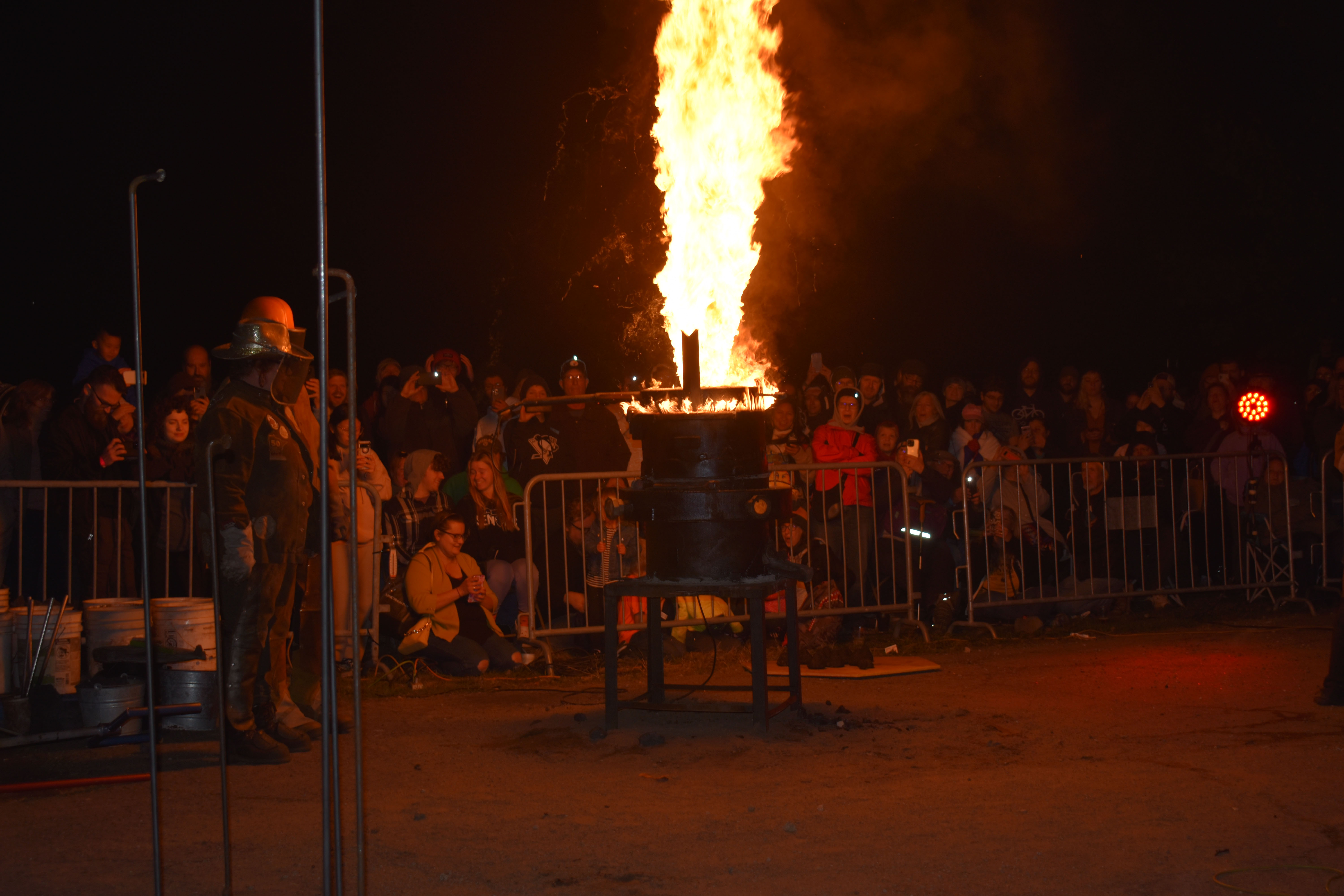
We attended the annual Festival of Combustion, an event that invites people to celebrate the story and art at the Carrie Furnaces. Demonstrations allowed festival goers to witness iron pouring, glass blowing, blacksmithing, and welding. Here, noise returns to the furnace. People return to the furnace. Fire returns to the furnace.
Under a rare blue Pittsburgh sky, visitors are given a glimpse into a life at the furnace. Heavily clothed and masked smiths pour molten iron into molds. For many onlookers, including ourselves, this is our first time witnessing the metalwork that made this city. Barney acted as a tour guide on the date of the festival.
“This is a blast furnace. It was hot. You kind of get that feeling from even the small one that they’re using for these things. And you get artists that come in and are able to, to practice their craft. You know, I, I did tours that day and I probably took 70, 80 people around that day that had never been, most of them had never been there before. They’d never seen anything like this and all of them were like, Oh God, this is great. We want to be a destination for people to go to and things like the Festival of Combustion really push that because it’s this this is what we can do.”
From fences uncooled by the bright fall breeze, we watch the work ahead. They move in harmonious unison, pacing themselves and calling out their next move so as not to make a mistake. Some pull chains, others push a metal frame into place. One stands atop a platform feeding a blowing fire. From that fire, the glowing metal emerges, trickling in a bright orange. The crowd ooos at it, amazed to see the thing that once lit up this whole rusting building, that once tempted the greed of barons and titans, that fed a region for over a century, that built a city.
To see that in this space felt like meeting a character out of a novel. But it’s not just the steel that is celebrated at the festival. Blacksmiths hammer pieces still hot from their furnaces. A welder assembles a sculpture made of scrap metal, spark flying around his tent. Glass blowers twirled their still moving pieces in and out of the hot oven for the delight of their audience.
The earth smells of fall leaves and fire. The ovens are hot, but the crowd is cooled by the breeze of the Monongahela River. The voices are joyful. Children amazed at the demonstrations, craftmen eager to talk about their trades and all men telling stories about their time at the mill.
Remembering this site in younger days, remembering other mill that no longer stand remembering the smells, the voices, the stories, their craft. We talk with Colton Rohleder, a representative for U.S. Steel at the Festival of Combustion. He told us about his involvement with the festival.
“The first time I went to the Festival of Combustion, it was also in 2019. It had previously happened. I had never heard about it until that year. and I was working at U. S. Steel. And I remember when I went to the festival, I was expecting to see U. S. Steel present. And You know, because obviously you go there and you quickly realize this is a blast furnace, steel used to be made here, and then I didn’t see U.S. Steel present. And that kind of was a shock to me. It really did blow my mind that U. S. Steel wouldn’t be there. So, ever since that, first time I went to the Festival of Combustion, I really made it my goal to make sure that U. S. Steel was involved.”
It is amazing how Colton was able to involve U.S. Steel with the site once again. There is something new created at the Carrie Blast Furnaces, and something old that’s remembered. In this space, the crafts that are so often deemed industrial are seen as art, and the site that was once a hallmark of pre-war industry is now where arts and history are held close.
Thank you for joining us as we uncover one story of the Carrie Blast Furnaces. We hope you are inspired to visit this place and to find your own Pittsburgh stories. Please tune in in all the episodes we've produced this season. You can find show notes and. Transcript at secret-test.local/. I'm Jennifer Ponce Cori. Diego Cuevas served as an audio editor, and Margaret Ciesinski and Nicholas Kelly wrote and researched this episode.
See yinz later!
Show Notes
Thank you so much to Dr. Paine from Rivers of Steel for spending the day with us at the Bost Building and being an excellent source of information.
Thank you to Robert and the Pitt Media Creation Lab for the equipment used to record this podcast.
We would also like to thank Pittsburgh band Moontown for allowing us to use their song “I Know” in this episode. All of their music can be found on Spotify and Apple Music.
At these web pages, you can find more information about Rivers of Steel, Black workers at Carrie, and the Bost Building.
Bibliography
Cindy, and Don. “Do They Still Make Steel in Pittsburgh?” Keystone Answers, 23 Jan. 2023, keystoneanswers.com/do-they-still-make-steel-in-pittsburgh/.
Homestead Borough. “History of Homestead.” Homestead, 2021, homesteadborough.com/visitors/homestead-history/.
Lukus, Sydney, and Andrew Niemynski. “The Waterfront.” Request Rejected, secretpittsburgh.pitt.edu/sp/node/347. Accessed 19 Oct. 2023.
McCoy, Carly. “A Sustainable Look at the Arts and Grounds of the Carrie Furnaces.” Rivers of Steel, 15 June 2023, riversofsteel.com/a-sustainable-look-at-the-arts-and-grounds-of-the-carrie-furnaces/.
McCoy, Carly. “Understanding Historic Preservation in a Dynamic Frame: The Graffiti Arts Program at the Carrie Blast Furnaces.” Rivers of Steel, 21 May 2020, riversofsteel.com/graffiti-arts-program-carrie-blast-furnaces/.
Nuttall, Rebecca. “Pittsburgh Police Are Cracking down on Graffiti Artists, but Are Arrests Really the Best Way to Handle the Issue?” Pittsburgh City Paper, Pittsburgh City Paper, 4 Oct. 2023, www.pghcitypaper.com/news/pittsburgh-police-are-cracking-down-on-graffiti-artists-but-are-arrests-really-the-best-way-to-handle-the-issue-1898961?showFullText=true.
“Rivers of Steel Makes Way for New Creations in Old Sites of Industry (U.S. National Park Service).” National Parks Service, U.S. Department of the Interior, 26 June 2020, www.nps.gov/articles/000/rist_blastfurnaces_graffitiarts.htm.
United States Steel. “United States Steel.” Home, 2023, www.ussteel.com/.
Clouse, Keith. Interview. Conducted by Jennifer Ponce Cori. 16 November 2023.
Rohleder, Colten. Interview. Conducted by Jennifer Ponce Cori. 14 November 2023