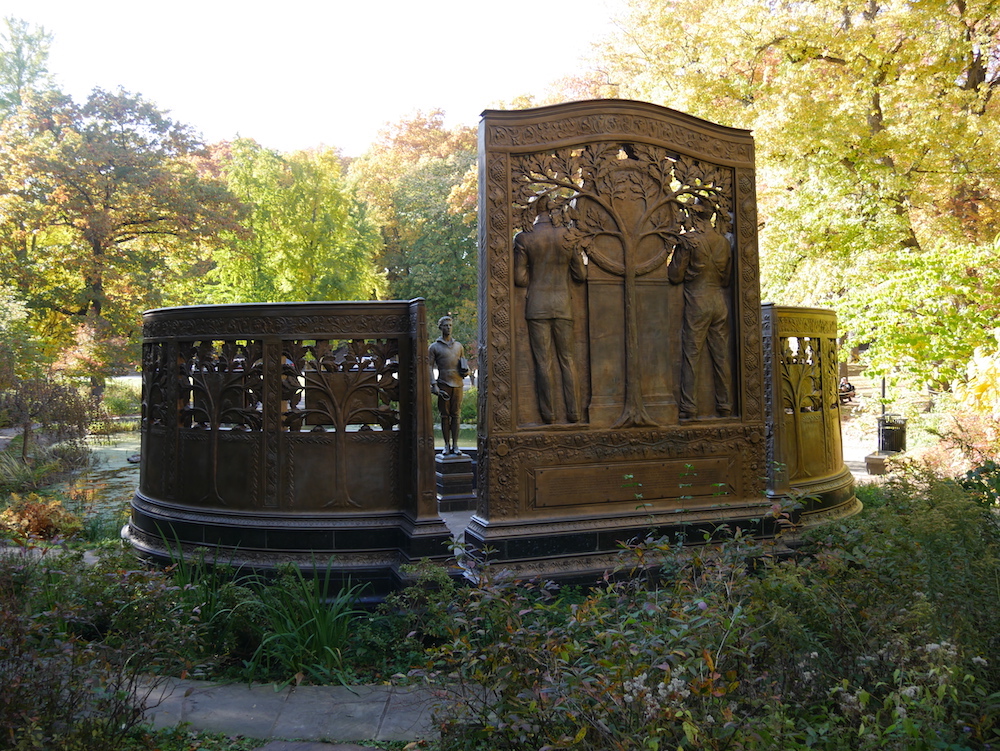
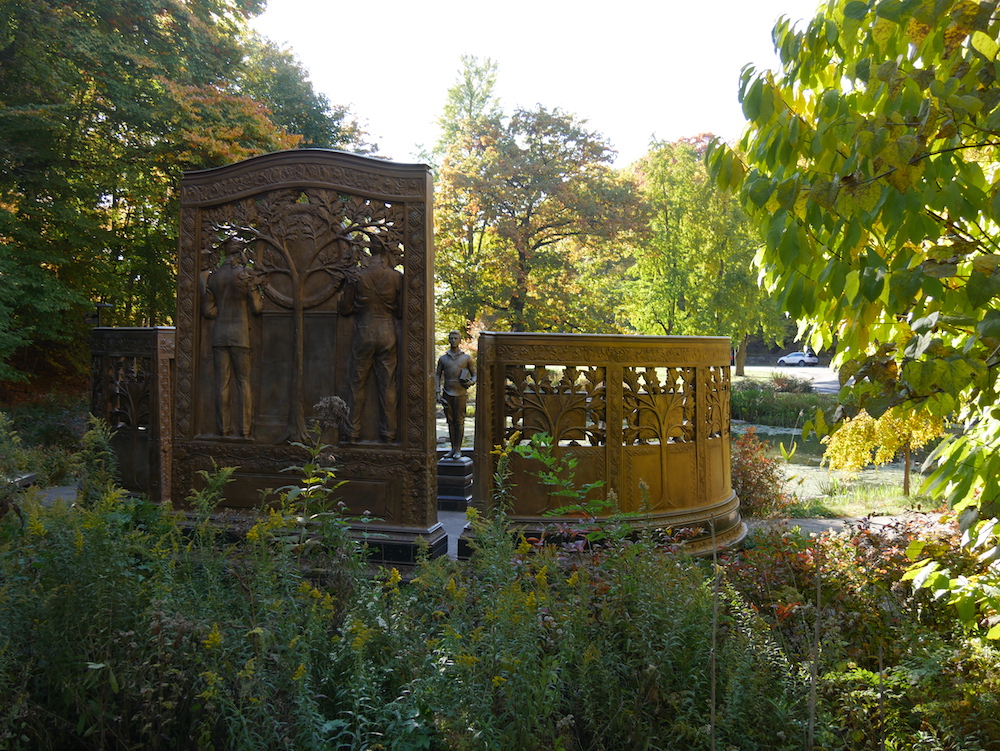
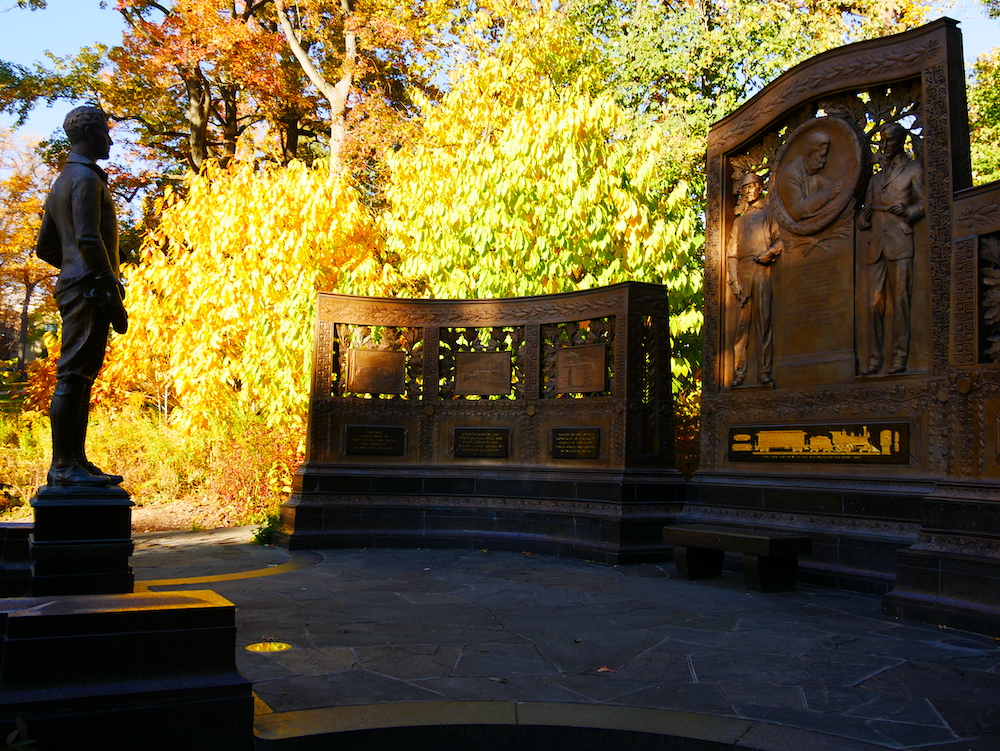
Behind view of memorial. The scupltre of the boy can be seen in the space between the panels. Photo by Ava Eckenrode, 2022.
Learning from Westinghouse
“George Westinghouse could have made a lot more money during his lifetime if he hadn’t treated his workers so well” – Andrew Carnegie, Pittsburgh-based industrialist (Reis).
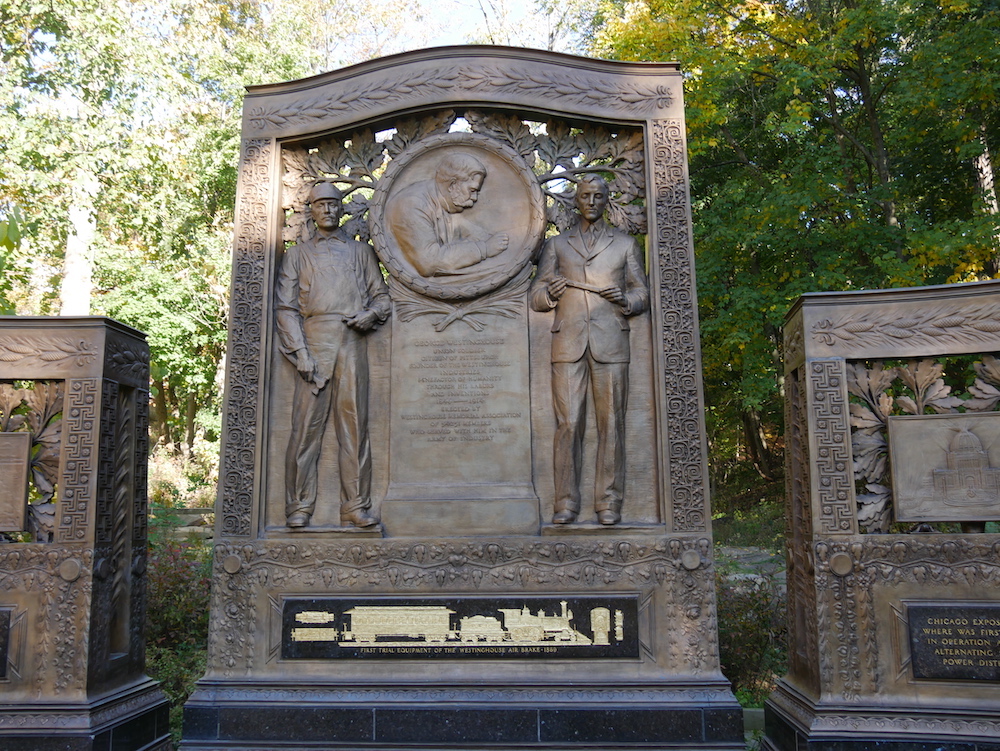
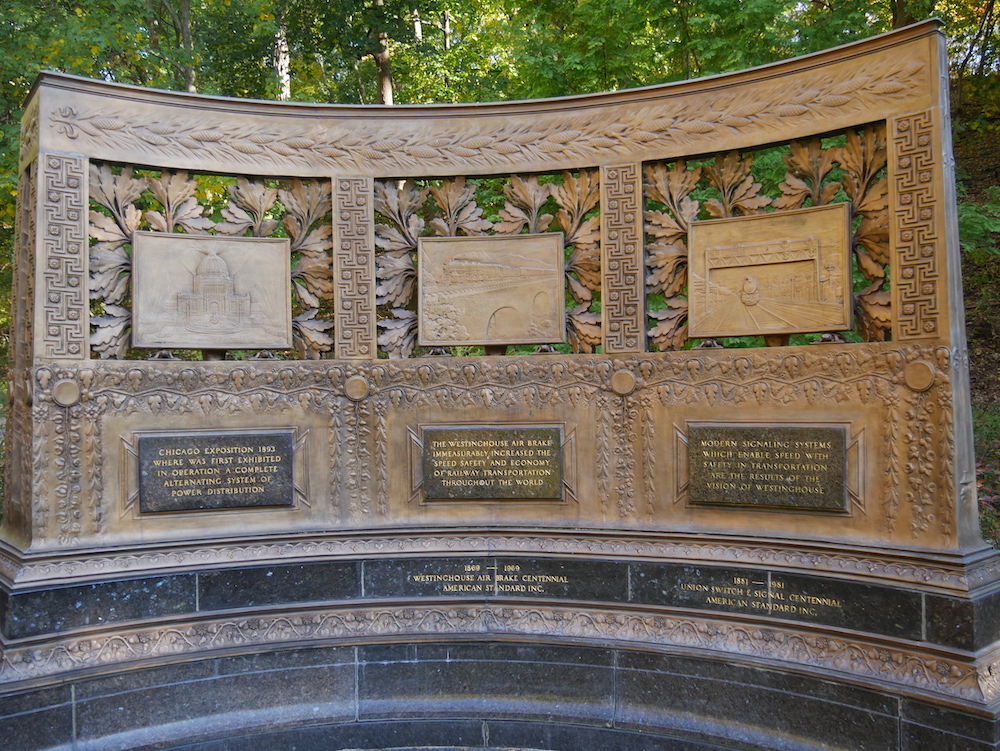
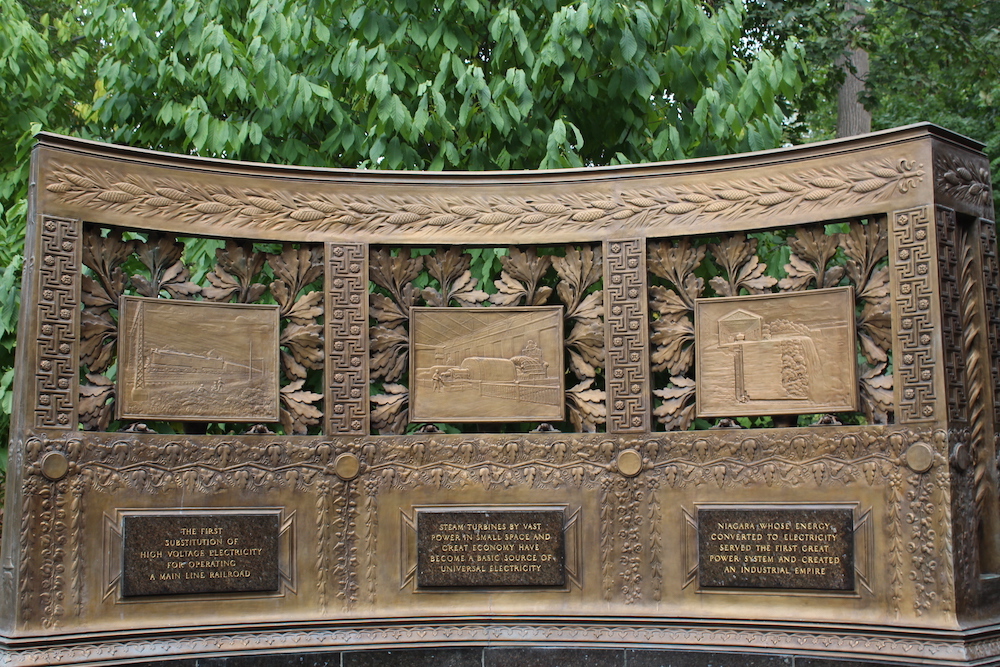
George Westinghouse is honored for his inventions and treatment of employees through the memorial, but he is not the center of attention on the bronze sculptures. You may not notice Westinghouse immediately because his picture takes up little space, or because you may have learned little about him. His profile is depicted in the top center, surrounded by two other men and inventions on the panels. The three men and boys are sculptured from the same, equalizing bronze material upon the same marble pedestals, all available in a public place. Under the three men, a gold train highlights the first test of the airbrakes.
Westinghouse had little desire for flashy acknowledgments so a memorial may seem like a surprise, but his workers proposed and funded the memorial (Huber 5; “Westinghouse Memorial & Pond”). The treatment of his employees was different from the other Pittsburgh industrialists during his time as he prioritized workers’ rights to time off, healthcare, childcare, and an easier opportunity to buy homes were available. While his intent may have been to improve the work produced, there is no doubt quality of life was very different under Westinghouse compared to other large employers. Several employee accounts praise him for the respect they received while working under him (Lindstrom).
Westinghouse’s profile is surrounded by a working man and a teacher. In contrast to Westinghouse, their bodies are fully sculpted to honor his factory and engineer employees. Westinghouse has over 300 patents and many developed by his workers. He ensured the engineers who developed a product would have their name on the patent, not himself, leading to product names after the inventors such as the Scott voltage regulators and Schmid dynamos (Reis).
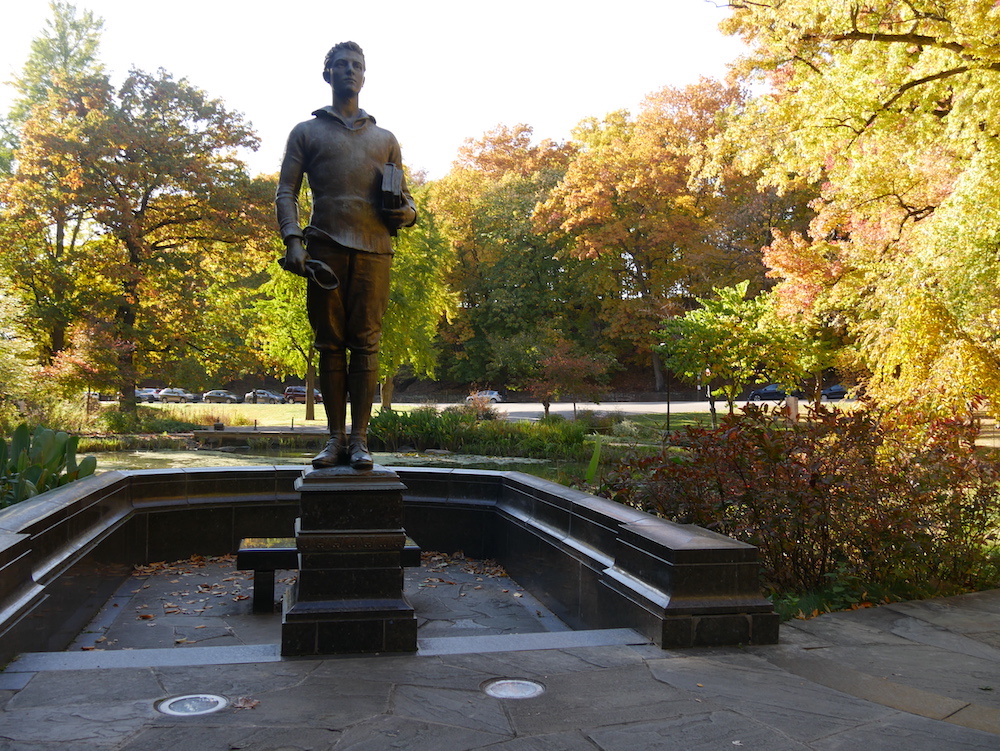
The boy in the center who looks up to Westinghouse is titled “The Spirit of the American Youth” and has a universal message of looking up to Westinghouse for his revolutionary inventions and knowledge (“Westinghouse Memorial & Pond”). His crumpled hat represents his enthrallment by Westinghouse’s accomplishments as he carelessly ruins it. What could merit this term “revolutionary inventions” though? Depictions of inventions on the panels include advancements in the air brake, signaling, and electricity for trains. Trains were one of the most popular modes of transportation and the Westinghouse air brakes made it safer and more efficient, allowing longer and heavier trains while saving lives. Air brakes are still in use today for trains, trucks, and some elevators with few improvements from initial tests starting in the late 1800s (Reis and Espy). Along with the other advancements noted, a Westinghouse memorial would seem incomplete without a gold train. Harvesting hydro-energy from Niagara Falls, alternating current, and steam turbines are celebrated along the memorial.
A young boy can learn more from Westinghouse than just innovation though, and so can other business owners. They can learn compassion, respect, and sharing the benefits of working as a team. The goal of his inventions was not to make money, but to benefit and advance society further (Reis). When you walk behind the memorial and up a couple of stairs, the perspective shifts to where the boy is looking up at you. The chance of someone looking up to you for your creations and kindness is motivating. Being at a more similar height is inspiring in showing you are equal even if you are not an inventor or man. It also shows the possibility of the boy looking up to people with differing backgrounds. The fully developed sculpture shows this view is meant to be seen and this perspective is meant to be felt.
Westinghouse is not without flaws, and I like to view the relationship as older generations who can learn from younger ones as well. Segregated housing, factories, and activity centers existed under Westinghouse while also suppressing union development (Westinghouse Air Brake Co. 14-16, “Working Conditions”). Many pictures from the Westinghouse Air Brake Company pamphlet show men and women separated in classes. Women are depicted learning stenography for secretary skills with available classes in sewing compared to the men learning specific mechanics of inventions (Westinghouse Air Brake Co. 55-57) Higher pay, education opportunities, and activities outside of work were available with hopes to decrease desire for unions. The men and young boy being that same quality of detail, material, and pedestal makes learning from each other possible as they have mutual respect. Younger generations often demand more inclusive and kind conditions, which Westinghouse can learn from.
The memorial was proposed after he passed to be useful to employees. Before the memorial, it was simply a beautiful pond. As the memorial was completed, it became a meeting place for employees. Now, the memorial is often a small part of people’s walk around Oakland with a place to relax on one of the several marble benches. Younger kids often use the area to discover new plants and interact with the environment. Several updates had been made to improve the park’s water flow, lights, and plants (“Westinghouse Memorial & Pond”). Because it is Pittsburgh, the most useful times will be in the warmer months. What you experience will be heavily influenced by the time of year you visit. The warmer months have colorful flowers surrounding the pond while the plants are duller and less full in the winter. A layer of duckweed develops over the pond, creating a solid green area only broken by water movement.
Your visit may be short and barely acknowledge Westinghouse, much like my visits used to be. I lived in Pittsburgh hearing a school and bridge named after him on top of visiting the memorial countless times before I knew why any of that would exist. When I went back to learn about him, I was so confused as to why I had not learned more. A Westinghouse invention will likely impact your life at least once. No matter how the memorial serves you, everyone gains a beautiful park to visit and maybe even some inspiration.
Works Cited
“Air Brake family: industrial and social activities.” Westinghouse Air Brake Company, Publication 9044, Westinghouse Air Brake Company, Wilmerding, PA, Sept. 1920. DC_002_0205, Published Collections Department, Hagley Museum and Library, Wilmington, DE 19807.
“Westinghouse Memorial & Pond.” Pittsburgh Parks Conservancy. pittsburghparks.org/park-projects/westinghouse-memorial-and-pond/. Accessed 14 Nov. 2022.
Huber, William. George Westinghouse Powering the World. McFarland & Company, Inc. 2022.
Lindstrom, Natasha. “Restored Westinghouse Memorial unveiled in Schenley Park.” TribLIVE, 6 Oct. 2016, archive.triblive.com/local/pittsburgh-allegheny/restored-westinghouse-memorial-unveiled-in-schenley-park/. Accessed 28 Nov. 2022.
Reis, Edward. “A Man for His People.” Mechanical Engineering. 1 Oct. 2008 Volume 130 Issue 10: 32–35. doi.org/10.1115/1.2008-OCT-3. Accessed 28 Nov. 2022
Reis, Edward and Carol Lee Espy. “Westinghouse – Chapter 5 – The Need for Brakes.” YouTube, uploaded by Great Documentaries, 28 Oct. 2015, www.youtube.com/watch?v=k6nXOd7b7fw. Accessed 18 Nov. 2022.
“Working Conditions” Library of Congress. Inside an American Factory: Film of the Westinghouse Works, 1904.www.loc.gov/collections/films-of-westinghouse-works-1904/articles-and-essays/the-westinghouse-world/working-conditions/. Accessed 29 Nov. 2022.