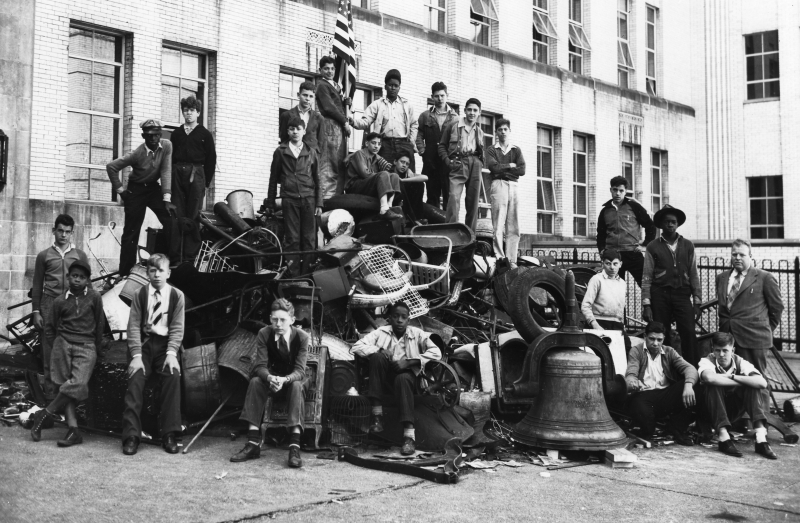
During WWII, Pittsburgh Public Schools participated in scrap drives to support the war effort. In this photograph, students from Prospect Elementary and Junior High Schools sit and stand atop of their scrap heap. "Prospect School Scrap Collection Campaign." Year unknown (c.1935-1945). Senator John Heinz History Center, Pittsburgh. Pittsburgh Public Schools Photographs, Ca. 1880-1982. Historic Pittsburgh Site.
Interested in Recycling? You Are Not Alone.
“There is no such thing as ‘away.’ When we throw anything away, it must go somewhere.” -Annie Leonard
Recycling is one of modern society’s greatest ideals. The ability to turn an item that has lost its intended utility–for instance, an empty aluminum can that once held a beverage–into something new is a testament to human ingenuity and perseverance. According to Pat Franklin, Executive Director of the Container Recycling Institute, “Over the past twenty years [1993 to 2013] we’ve trashed more than 11 million tons of aluminum beverage cans worth over $12 billion on today’s market. Someday we’ll be mining our landfills for the resources we’ve buried.” Over that time, methods for recycling have evolved, and it is now ubiquitous to see recycled goods in just about any public space, whether it be the 100% post-consumer recycled napkins at Chipotle, the recycled cardboard food boxes that are now common at many restaurants, or many glass bottles. Despite these advancements, however, recycling as we know it is still incapable of relieving the strain on the environment that comes from the extraction of resources for the production of disposable consumer goods, and it is still not a catch-all to prevent valuable resources from ending up in landfills. As such, other methods of recycling manufactured goods that involve reusing them in creative and unexpected ways have become more prevalent in recent years; this act is sometimes called upcycling.
In Pittsburgh, this surge of energy in recycling is actually a resurgence; Pittsburghers have participated in recycling efforts for the better part of the last century. The above photo depicts school-age Pittsburgh youth participating in a scrap drive to support the US war effort. At that time, recycling more or less just meant melting down scrap metal to be recast into something useful (likely for armor plating for warships), and it was due to the fact that resources were in short supply. Today, the goal of recycling–and upcycling–is much different, and is capable of so much more. The Pittsburgh Center for Creative Reuse, along with other organizations like it, is working diligently to educate the community about ways to best divert waste from ending up in a landfill. Unlike during the war effort, Pittsburgh’s recycling community today is fueled by a creative energy; instead of melting down scrap as a wartime necessity, Pittsburghers are now working hard to repurpose manufactured goods in order to reduce their environmental impact and to give new life to an object that would otherwise be thrown away.
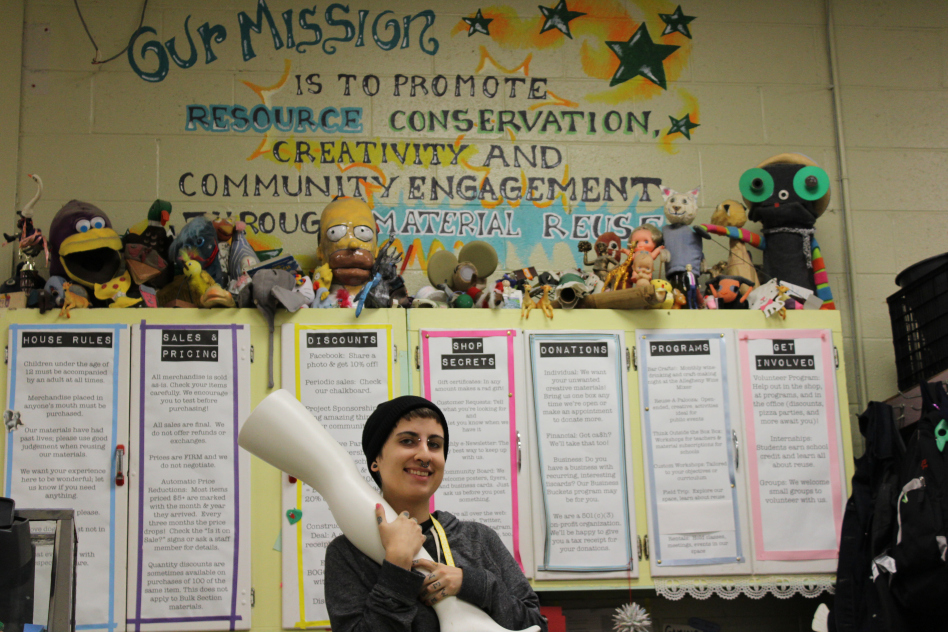
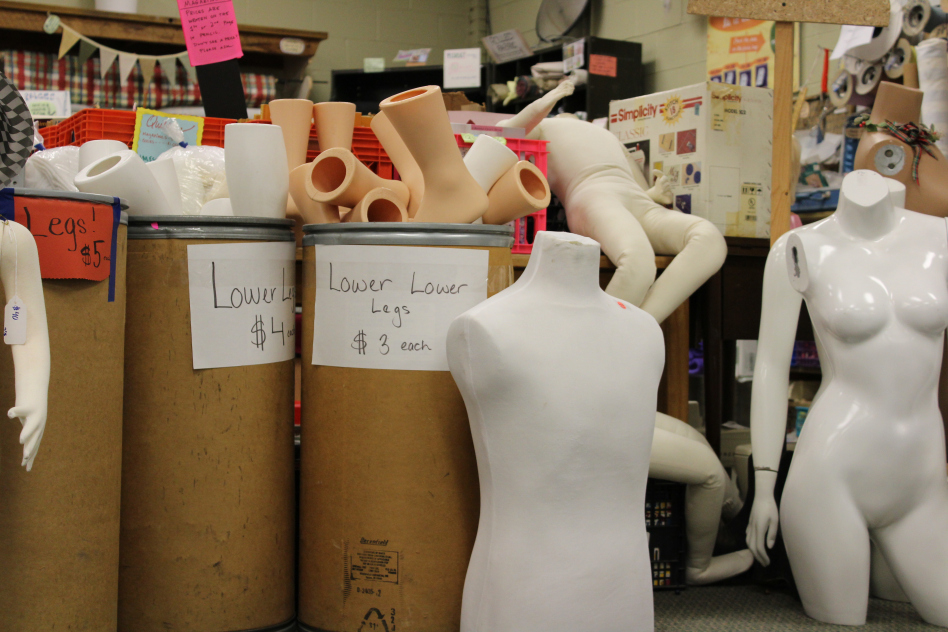
The Pittsburgh Center for Creative Reuse is leading the way in Pittsburgh’s recycling community, and they are active in their local area, Point Breeze, as well. The PCCR holds regular classes and seminars to teach participants strategies for diverting waste from landfills. They also participate in various events around Pittsburgh; for instance, the PCCR’s booth at the annual Pittsburgh Regatta is always among the most popular booths at the event! The PCCR’s staff is a creative bunch, and they have filled their store with many different idea sheets. One such sheet shows how discarded trophies can be repurposed and crafted into a hat rack without much trouble. Projects such as these show participants and observers how easy it is to upcycle post-consumer manufactured goods; the only things that are truly required are imagination and ingenuity. These are traits the staff of the PCCR has in abundance; Cammie, pictured above, was full of suggestions for different mannequin-related projects: one such suggestion was to use a mannequin as the base of a table! The truth is, creativity is the only limitation that exists when it comes to creating at the PCCR. There is such an immense treasure trove of goods to choose from that one could spend all day at the PCCR and still not see all that they have to offer.
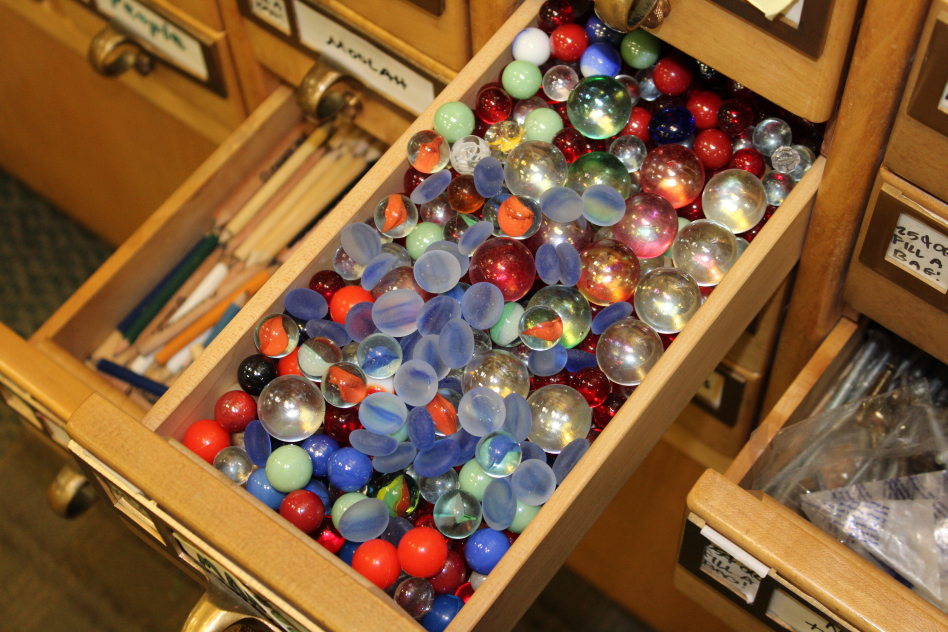
It is crucial for a visitor to the PCCR to understand this one important thing: all the goods available at the PCCR were donated by people who had no further use for them. A new visitor may initially be surprised by the amount of perceived ‘junk’ held within the drawers of the PCCR. But, that is actually the innate beauty of the PCCR and what they are all about: turning one person’s trash into a usable object, and preventing that object from ending up in a landfill by making it into something useful again. The cultural and community benefit is that participants are able to reuse their neighbor’s discarded marbles or screws or golf pencils, all while reducing their community’s environmental impact on the world.
The PCCR has seen the number of participants who come through their doors increase over the years, as more and more Pittsburghers become aware of, and involved in, the efforts to upcycle and divert the flow of usable goods from landfills. This growing movement bodes well for the future; as the upcycling movement swells and reaches a crescendo, it is reasonable to assume that the quantity of objects that end up in landfills will decrease, and shops like the PCCR will spring up in response.