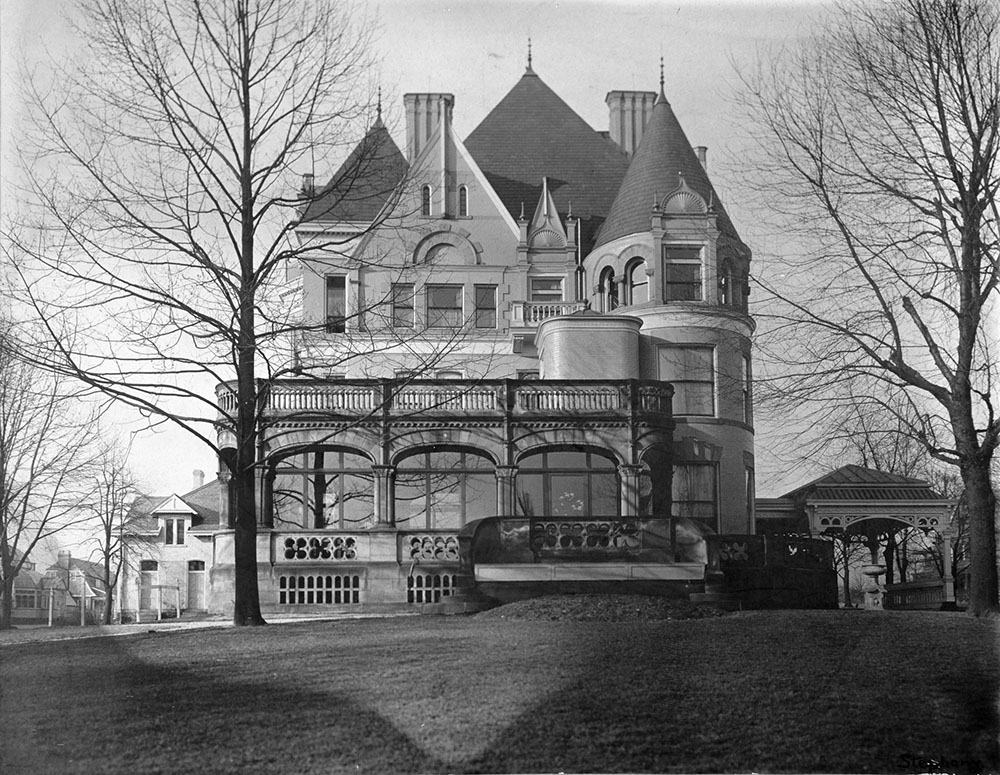
Exterior of Clayton 1901. Photo Frick Collection
Helen Clay Frick: The Woman Whose Name Could Stand On Its Own
Helen Clay Frick’s life was always focused on precedent. First with her father, Henry Clay Frick, famous for his wealth and second by the tragic death of her older sister, Martha, who died when she was 6 and Helen was 3. This caused her much grief, for years to come.
Helen and her family moved into their Pittsburgh home, Clayton, and stayed there from 1893 until 1905. Helen was five years old when they moved in and seventeen when they moved across the country to New York City. At age 20 in 1908, three years even after she and her family had moved to a much larger and extravagant home in New York, Helen decided that she wanted her debutant gift from her father to be Frick Park. Frick Park would turn out to be one of the most popular public parks established in Pittsburgh and is still widely used today. Helen wanted her gift to be something that everyone could enjoy in the city that she knew and loved.
Even further, Helen chose to go against her father’s wishes and host her debutant party in Pittsburgh. After Henry left for work, Helen and her mother snuck onto a train southbound towards their Pittsburgh home. This was the first of many elegant parties that Helen and her brother Childs would host at Clayton. At one celebrated Christmas party, Childs and Helen held over 70 guests while their parents held a close gathering of 12 friends. The party was memorable enough that the Pittsburgh Post-Gazette reported it as “a beautifully appointed event”.
It’s easy to imagine why Helen loved her home in Pittsburgh so much. It was much smaller than her family’s home in New York, but the lack in size was made up for in the character and love of the people who inhabited it. Looking at the Frick home with what Barthes calls “The Third Meaning” is really helpful in understanding Helen’s love for the home. Barthes explains this meaning as “The one ‘too many’ the supplement that my intellection cannot succeed in absorbing, at once persistent and fleeting, smooth and elusive, I propose to call it the obtuse meaning” (54). The exact feeling of the home cannot be captured in an image or even described, it is only known through feeling and imagined memories. If we imagine Clayton using “third meaning” we can see the home was always bustling. Maids were cleaning, servants were preparing the next meal, butlers were running errands, stable-boys were caring for the horses, landscapers were tending to the grounds, Mademoiselles were running after young Helen, and likewise tutors after Childs in the playhouse, Mrs. Frick was planning her next social event, and Mr. Frick was running his wildly successful business. This is where Childs and Helen grew up, laughing in the grass, running around their playhouse, sneaking around and hiding in the tiny peaks of the big home, and learning from their Mademoiselles. This is where both the Mademoiselles and Mrs. Frick were served breakfast in bed, where the servants carefully laid plates in preparations for Mr. Frick’s important guests, especially President Roosevelt. So many of Helen’s childhood memories were held here, so it would make sense that she would want to make more at Clayton throughout her young adulthood life and onward.
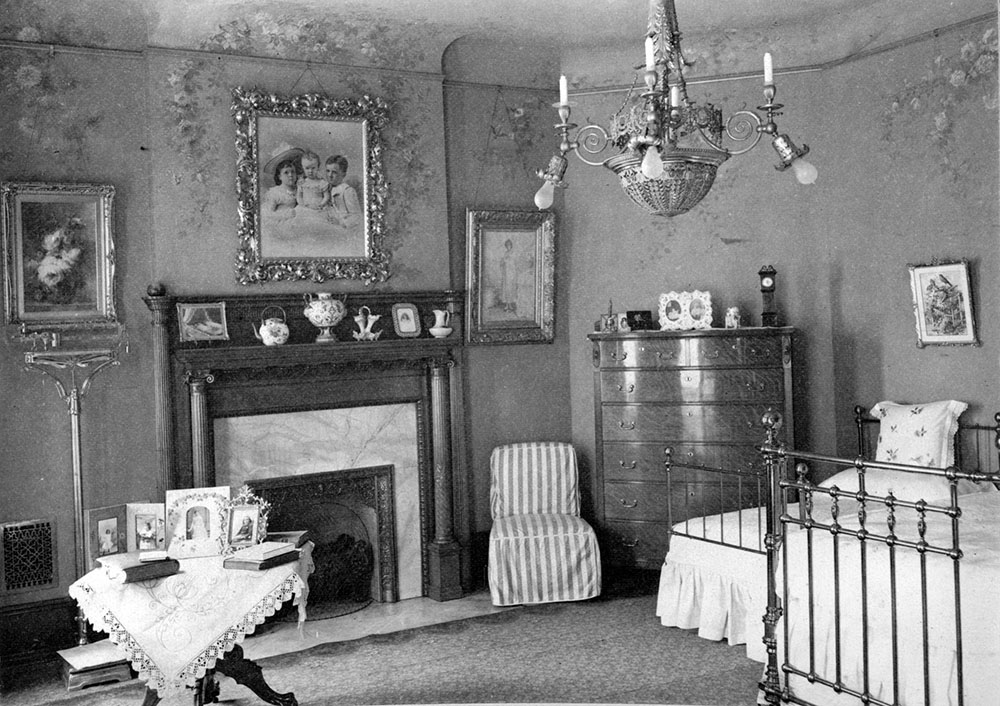
The photograph of Helen’s bedroom in 1901 lets viewer imagine Helen caring for her dolls with tender love and care, arranging tea parties for her stuffed animals that mimic the extravagance of her own mother’s tea luncheons, and warming her feet in front of the fire before bed. There is a feminine aura that sits in the room, one can imagine that even as Helen grew older the girlishness stayed rooted in the room. She lived in this same bedroom even throughout her adult stay there despite the girlish decor and the temptation of all the other larger rooms throughout the home. The intricate flowers painted to surround her on every wall, family paintings, and cozy fireplace were an aspect of this home that never changed depending on how old she was or who she had become. Helen never was fond of change as she continued to use her gas lights in her bedroom and the original telephones that were both installed when the house was built in 1897.
Despite spending most of her adult life in Upstate New York working with The Frick Fine Art Collection and The Frick Fine Art Reference Library, Helen’s roots were in Pittsburgh. Her room can be imagined in a number of ways, whether it’s playfully imagined in her days of childhood enjoying pretend games or regally imagined with Helen in older age sitting down to write to a friend at her desk and being called upon by her butler for someone with a calling card at the front door. In any way this space is imagined, it is unequivocally Helen’s space.
This could be part of the allure of Pittsburgh for Helen, that the city is her space. She grew up there, knowing all of the nooks and crannies of Clayton, greeting her friends and neighbors as she walked through Frick Park, and not having to give in the ubiquitous changes in New York. In Pittsburgh, she was known as Miss Frick. Not known as the daughter of a famous businessman, nor the sister of the girl who died at a tragically young age, but Miss Frick. The woman who threw extravagant parties, the woman who donated a park to the city of Pittsburgh instead of asking for something for herself, the woman who still used calling cards to introduce herself to new neighbors until the late 80s, the woman who loved art and cultivating collections, the woman who was passionate about education and culture. Frick, the woman who could create a name of her own in the city she loved, Pittsburgh.
Works Cited
Barthes, Roland. “The Third Meaning.” Image Music Texts, Hill and Wang, pp. 50–68
Pitz, Marylynne. “In 1908, Helen Clay Frick Picked Pittsburgh To Make Her Debut.” Pittsburgh Post Gazette, 16 Dec. 2014.
Russell, John. “Helen Clay Frick Dies at 96; Founded Art Library in 1920.” New York Times, 10 Nov. 1984.