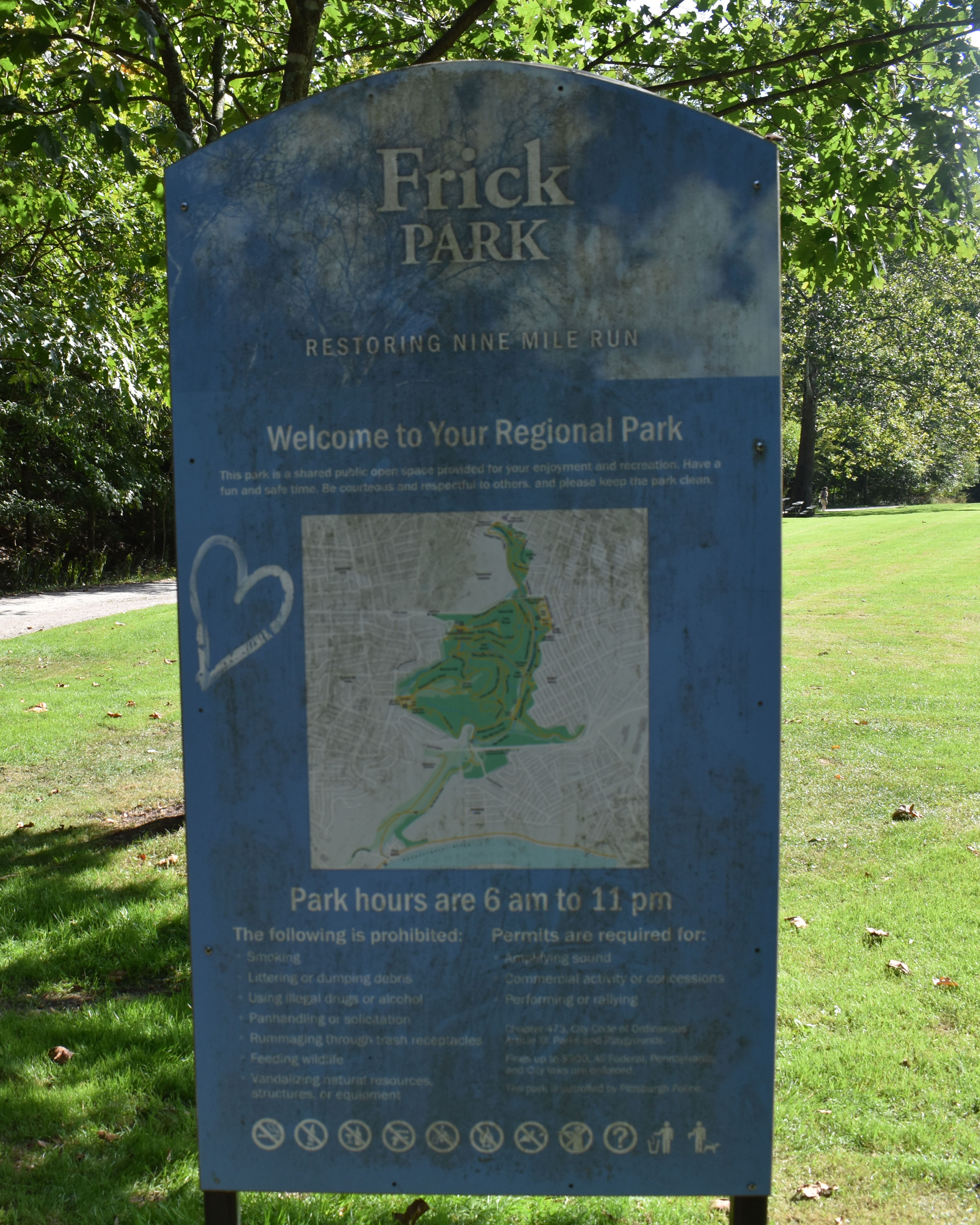
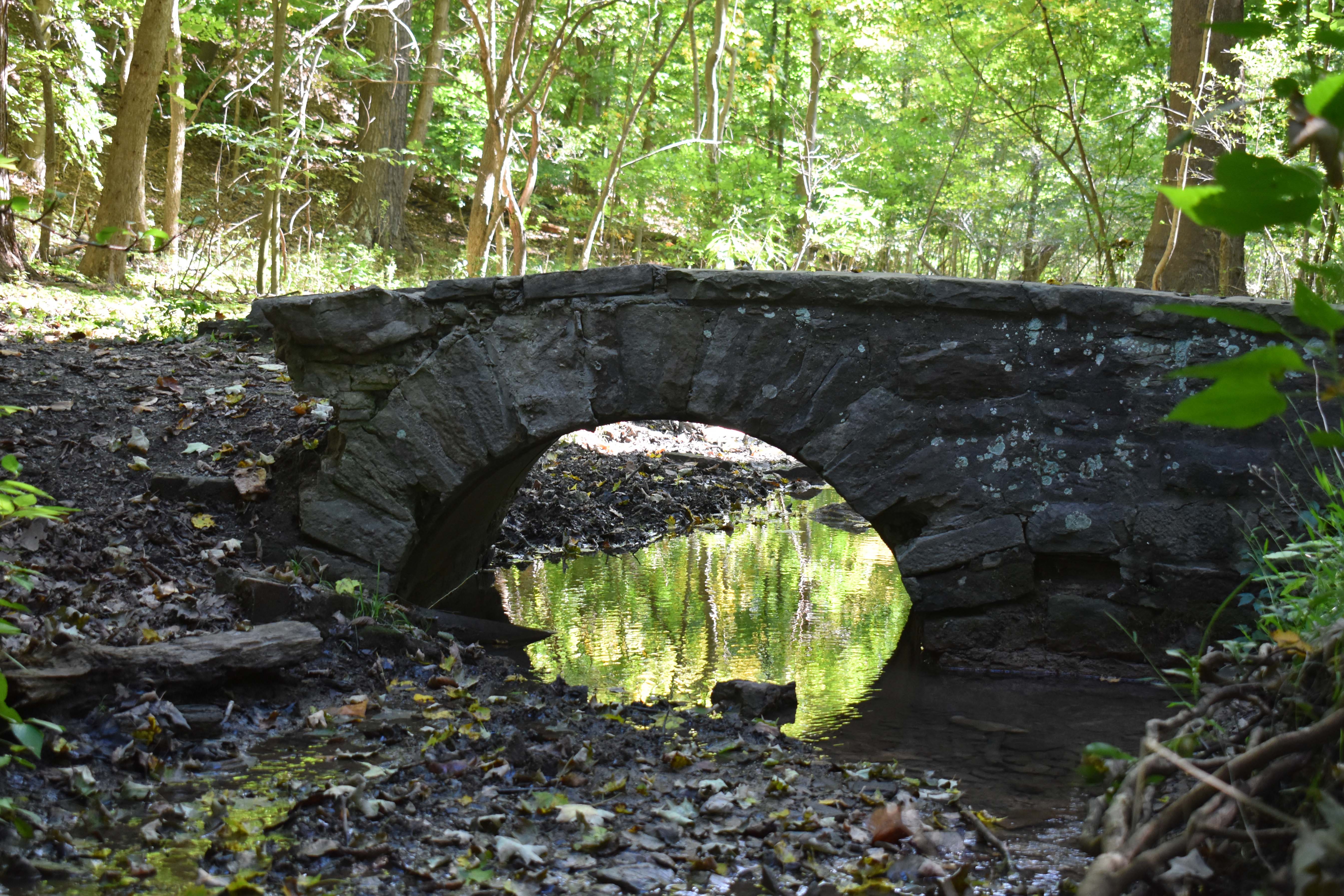
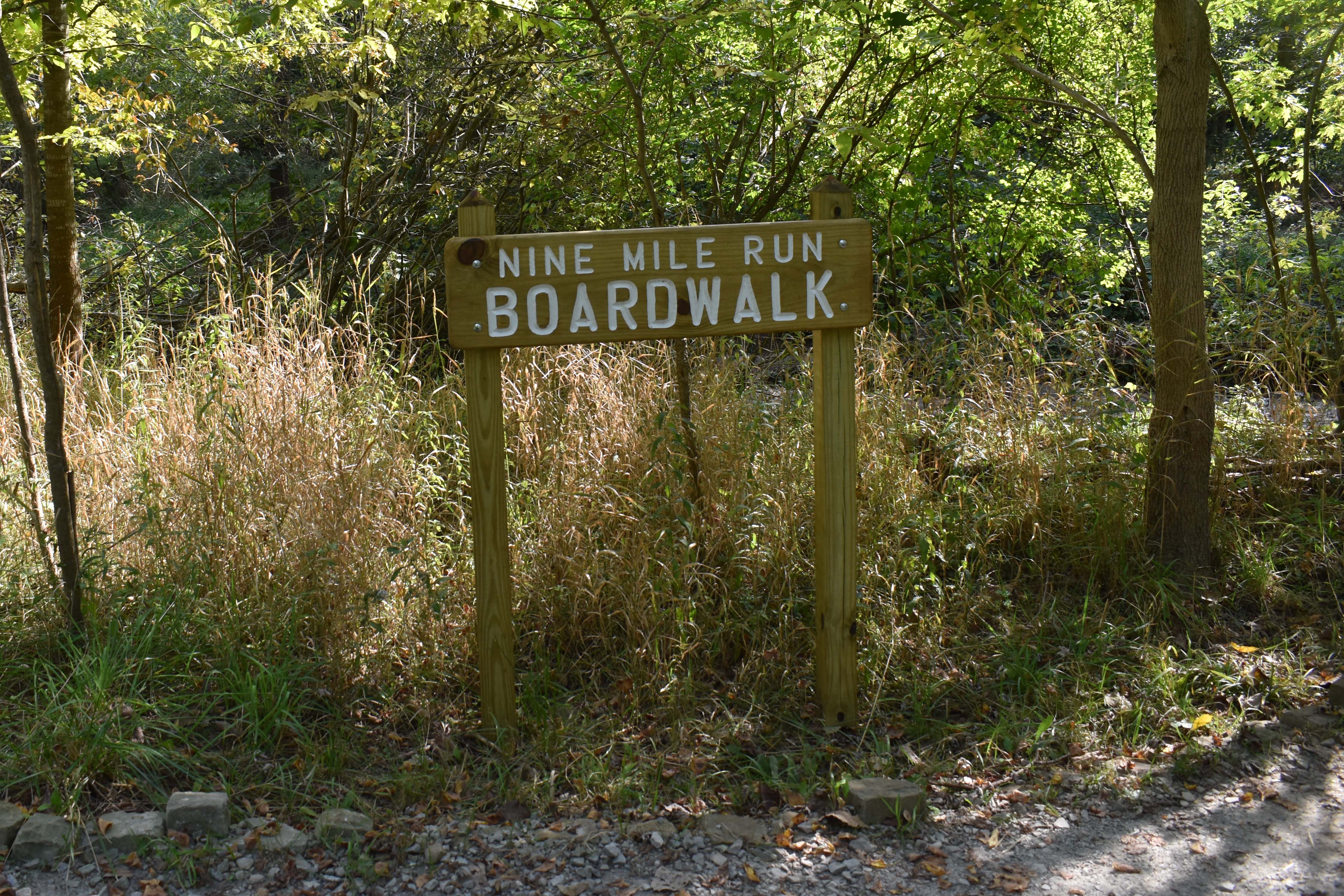
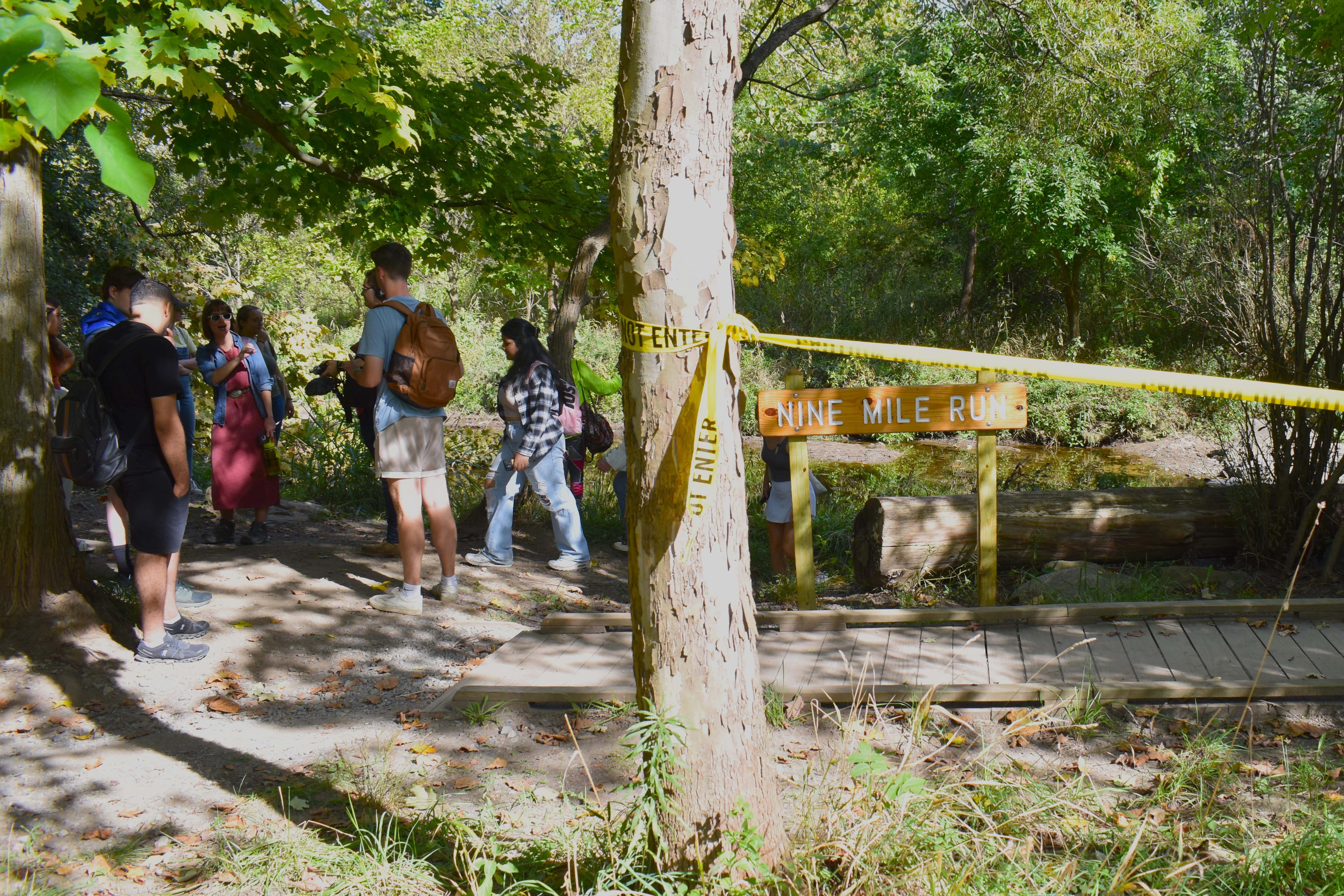
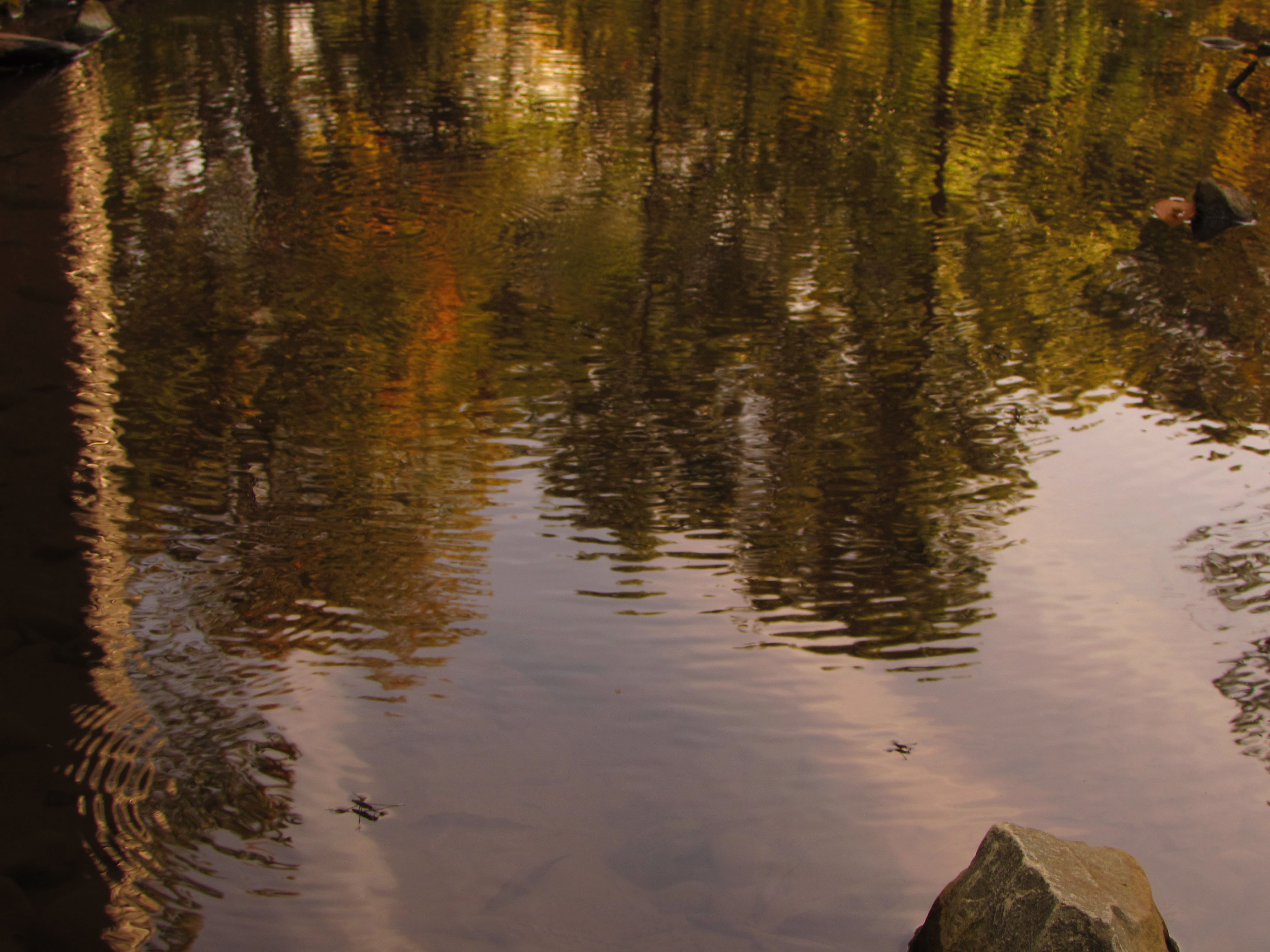
Frick Park sign. Photo by Veronica Close, 2023.
Unearthing Pittsburgh’s Secret Streams of Sewage
This page contains the transcript, show notes, and sources for the second episode of the Secret Pittsburgh Podcast, Season One . To listen to the episode, as well as the rest in the series, visit our SoundCloud.
Transcript
Hunter Bash: Picture yourself in the nature of Frick, Pittsburgh’s biggest historic park. Perhaps you’ve found Fern Hollow Creek paralleling your trail, winding through the nature enhanced with public art. Then you arrive at the point where Fern Hollow loses its name as it connects with Nine Mile Run. You step off the trail to connect with nature, entering the shallow parts of the stream to explore. Then someone comes by and says: “don’t touch the water. There’s sewage in there.”
Hunter: Welcome to Secret Pittsburgh! In the past 15 weeks, we’ve traveled across the city, learning the stories of Pittsburgh’s people and places. Join us now as we explore Nine Mile Run and the buried streams of Pittsburgh. I’m Hunter Bash.
Kevin Collins: And I’m Kevin Collins.
Hunter: Let’s go!
Hunter: Okay, so, some background. Our class went down to Frick park to learn a little more about Nine Mile Run, one of many Pittsburgh waterways, and the public art surrounding it. The stream is a secret place, after all, even to me, a native Pittsburgher. I had never even heard of Nine Mile Run before this class. So when we got up to the stream we wanted to get a closer look, enjoy the water, I got real close with the mic for some sound effects, and I honestly didn’t even hear exactly what the guy said, do you remember what he told us?
Kevin: Uh, he came up and he said ‘stay out of the water, it’s basically sewage.’
Hunter: Yea, so our professor passed on the message and after hearing that, I started to wonder, ‘why would there be sewage in the water?’ My first thought is like, ‘well, maybe there are some answers upstream.’
Hunter: So you, me, and Veronica get back on the trail—
Kevin: Right
Hunter: —and followed the stream backwards. And, as we were walking, we passed these like, big sewer grates.
Kevin: Ah, right I remember those.
Hunter: They were like these concrete tubes with like, a manhole cover, and I remember seeing the first one and thinking ‘hmm, that’s strange’ and I just kept walking but then we encountered a couple more and I was like, ‘ok I gotta stop and take a picture of these.’
So, we keep walking along, glancing at Nine Mile Run as we walk by. Um, but at some point the trail starts going uphill and a fence begins that separates the trail from the stream. And I remember looking down at the stream at this point and we all noticed the color.
Hunter: It was this fluorescent, sickening green.
Kevin: And cloudy.
[..]
Hunter: My first thought was algae, which information from the organization American Rivers confirms. Algae can change the color of waterways, and algae growth can be increased by soil or pollution runoff.
Kevin: So maybe runoff is the answer.
Hunter: Right, maybe. So, alright, enough distractions. We get to the end of the trail and it just, kinda turns into this parking lot and leads into this regular city road. But the stream, it doesn’t end. I mean obviously, it’s gotta flow from somewhere. But it’s coming out of this big tunnel.
Kevin: It’s buried.
Hunter: Exactly. And with the stream buried, so too is the mysterious origin of sewage in the water.
[…]
Kevin: So, what…did we give up?
Hunter: Well, no, but there was another layer now. Many, actually. I had so many questions. Why was the stream buried? Was it buried in sewage pipes or separate? If it was separate, how did sewage end up in it? I really wanted to get to the bottom of why Nine Mile Run—and other streams like it—are buried. I thought this might bring me closer to finding out how the sewage got there in the first place.
Hunter: This—
Brought me in contact with Megan Guy.
Megan Guy: Uh, my name is Megan Guy. I use she/her pronouns. Um, I am the Outreach Coordinator for the Pittsburgh Water Collaboratory.
Hunter: Megan told us that the Pittsburgh Collaboratory for Water Research, Education, and Outreach–
Megan: Uh, most folks call us the Pittsburgh Water Collaboratory.
Hunter: Aims to connect people in the community to research and to resources to conduct their own research. They work a lot with UpstreamPGH, an organization that does restorative work for the Nine Mile Run watershed. After learning a bit about the organizations, I asked Megan about the history behind stream burial.
Megan: Stream burial, it happens across the United States. This isn’t uncommon. Um, it’s something that is really prevalent in urban areas, especially.
Hunter: And if you know one thing about Pittsburgh history, it’s–
Megan: Steel. Steel, steel. At that time they were really trying to, like, build communities around the steel mills. You needed more development, you needed more houses, you needed more grocery stores, and so, a lot of what they ended up doing was putting a stream into a channel to make sure that they could build to help with the growing population.
Kevin: So it was sort of a side effect, or, a necessity for building the industrial city that we have?
Hunter: Yes. Pittsburgh was once just like the rest of Eastern PA: a whole lot of forest. But once it really had its industrial boom…well, you can’t really build the foundation for a house if there’s a stream running across the ground.
Aaron Birdy: When Pittsburgh was early on in the development, there were about 33 above-ground streams within the city proper—
Hunter: This is Aaron Birdy, the Plan, Build manager at UpstreamPGH, that organization I mentioned earlier. He told me that urban development wasn’t the only reason for stream burial in Pittsburgh.
Aaron: As more and more areas were developed, those streams became the natural sewers for the developed areas, so all the sewage would go into the local stream down to the Monongahela River.
Kevin: But what about neighborhoods downstream? Were these streams like, actual sources of water for people?
Hunter: At the time, yes. And that presented some huge issues.
Aaron: In the early 1900s the Typhoid Fever deaths [in] Pittsburgh were like, through the roof.
Hunter: Burying the streams, he said—
Aaron: —was kind of done as a way to bury the problem and so that people couldn’t interact with the stream, use it to drink, bathe, any of that.
Kevin: So, burying the streams…avoided the problem? They didn’t actually stop dumping sewage into them?
Hunter: Yup. And what this means is that, though infrastructure has certainly improved over the years, letting sewage flow into streams is something we’ve been doing in Pittsburgh for a very long time.
[…]
Kevin: So, are we still just dumping all our sewage into these buried streams?
Hunter: Not exactly. We’ve since added a sewage system into the buried fray. But I was still left wondering about how that sewage system ended up mixing with city streams. I asked Megan about the impact of stream burial.
Megan: Streams are a completely vital part of an ecosystem. Like, they’re, it’s not just the water that’s flowing in like, one super confined area. There’s this whole network of water underneath that stream where the water can connect to the ground water and feed into like, you know, supporting the vegetation and, you know, supporting other habitats alongside of the stream.
Hunter: And Aaron explained how those natural impacts extend to urban environments.
Aaron: Yea so when you kinda take a natural system and you start to culvert all of the individual little braided streams and put them into pipes, so you’re taking what normally was a forest or a wetland, turning it into paved surfaces or housing, you’re increasing that impervious surface—
Hunter: —a surface that can’t absorb any water.
Aaron: You’re taking, basically something that could absorb most of the rain that falls on it and making that, like, the quickest route possible to get from that source to the local sewer.
Hunter: So, then rainfall becomes a new problem to deal with.
Kevin: What does he mean it goes to the sewer? Aren’t sewers like, buried under houses and buildings? How does rainwater make it into the sewers?
Hunter: So, this brings us closer to some pretty big stuff. You know how city roads have those storm grates on them?
Kevin: Yea, like the ones at corners and in alleys?
Hunter: Exactly. Have you ever wondered where stormwater goes once it goes down those?
Kevin: I don’t know. I guess I never thought of it.
Hunter: Out of sight, out of mind.
Kevin: Wait, so are you saying those flow into the sewers?
Hunter: Bingo.
Hunter: Pittsburgh doesn’t have two separate systems for handling stormwater and sewage. So it all just…runs together
Kevin: And then, what, it just all goes right into the rivers?
Hunter: Well, not always.
[…]
Hunter: Ok, so to begin to answer your question in detail, I have to tell you a bit about how Pittsburgh homes receive and dispose of their water. So, Pittsburgh Water and Sewer Authority, or PWSA, pulls water out of the Allegheny River, treats it, and sends it to homes. People use the water, it goes down the drain, and enters the sewage network. As I hinted to before, Pittsburgh has what is called a Combined Sewer System.
Megan: When you have combined sewer systems, stormwater is also going into that same pipe that your sewage and other, uh, discharge from your homes and businesses is going to. That pipe is all going to one place.
Kevin: Where…where’s that?
Hunter: That one place is the ALCOSAN wastewater treatment plant. That’s the Allegheny County Sanitary Authority, ALCOSAN. They bring in all the sewage from the entire city, get the water all cleaned up and dump it back into the Ohio River. And the water that they dump into the river is actually cleaner than what’s already there. So, ALCOSAN got started with their work in April of 1959, diverting sewage out of the waterways. This works just fine, most of the time.
Kevin: Why only most of the time?
Hunter: It becomes an issue of capacity. Combined Sewer Systems were banned in 1940, but obviously Pittsburgh was building infrastructure for sewage long before 1940. What this means for us now is that when it rains, ALCOSAN can’t keep up with the rain coming in through those storm grates on the streets…and the sewage that is coming in just as fast as it always does.
Kevin: So it overflows.
Hunter: Exactly. And we really don’t want that stuff coming back up the pipes and into our homes, so we have what are called Combined Sewer Overflows, or CSOs. They’re honestly really simple to understand, uh, and if you want to see how they work we have a really good image in the show notes, but, basically, a CSO is a simple pipe structure that diverts sewage overflow out into the nearest river or buried stream. But this, of course, means that sewage ends up dumped into our waterways.
Megan: So for example, like in Nine Mile Run there is a Combined Sewer Overflow to have a release point for that wastewater.
Hunter: Into Nine Mile Run?
Megan: Yea, yea.
Hunter: So, those are the sewage grates we saw when we were walking along Nine Mile Run, that’s how sewage got into the stream, that’s it. That’s our mystery solved.
Kevin: Wait, but I gotta go back to buried streams for a second. Cause it seems like buried streams means more rainwater flows into the sewage systems, which in turn causes more sewage to end up in buried streams.
Hunter: That’s exactly right. Before streams were buried, runoff had a natural path to get to the rivers, but now it has to share space with the sewage system. And that means that, with our current infrastructure, every time it rains more than one tenth of an inch, sewage ends up in our waterways.
Kevin: So, what, can anything be done to fix it?
Hunter: Yes, and actually, there is progress already underway.
[…]
Aaron: Their current plan’s to build um, a network of deep tunnels to catch the overflow. It’s supposed to reduce that from 9 billion to less than 2 billion a year.
Hunter: That’s 9 billion gallons of sewage entering waterways, down to 2. Aaron described ALCOSAN’s plan to cut down on sewage entering waterways by building these, sort of, storage tanks that can hold excess sewage until the treatment facility can catch up. It’s really great news that the large companies and infrastructure of Pittsburgh are behind fixing the problem. But Megan also pointed out that community effort in this fight is extremely important and very much alive.
Megan: There are so many passionate people about water in our region. People are really looking to implement change for the better and these like, passionate groups of people are really starting to come together and say hey, I really wanna make a positive change for my community and I know you do too so maybe let’s work together.
Hunter: She goes on to mention the really great work being done by organizations like UpstreamPGH, where Aaron works.
Aaron: We worked to plant, um, over fifteen hundred trees in the watershed, install thousands of rain barrels on people’s homes, um, to try and, again, manage the rain where it falls and ‘slow the flow.’
Hunter: Aaron described these small contributions made by regular people like you and me. Rain barrels, rain gardens, anything that can catch rainwater and keep it out of the sewage system cuts down on overflow into rivers and streams. He assured us these individual efforts continue to support the restorative work that he and his organization do to manage the stream in Frick Park.
Aaron: Post-restoration I think the stream has kind of created a sense of, um, space down there that invites people to get close to it, enjoy it, take pictures, um. I think the impact, you know, in the park has really been polishing, you know, something that needed some love, so um. I think that that was, you know, an amazing, um, transformation for that part of the park but we realized that, you know, the work that we did in Frick Park, maintaining that is really dependent on how the water is managed upstream. The key has always been to work with communities and work with the municipalities because that’s where the water is draining from, you know, that’s where we can make an impact.
Hunter: And both Aaron and Megan left us with some hopeful notes that remind us the power of individual effort.
Aaron: You can make an impact even just at your house. You can make an impact through planting a tree.
Megan: No matter how small it might seem, having like, hundreds of people do one small thing adds up to a big difference.
[…]
Hunter: Thank you for joining us as we uncovered one story of Nine Mile Run. We hope you are inspired to visit this place and to find your own Pittsburgh stories. I’m Hunter Bash.
Kevin: And I’m Kevin Collins.
Hunter: This episode was edited by Veronica Close and written and researched by Hunter Bash and Kevin Collins. We would like to thank Aaron Birdy from UpstreamPGH and Megan Guy from the Pittsburgh Water Collaboratory for agreeing to interview with us. Please tune-in to all the episodes our class has produced this season. You can find show notes and a transcript and more episodes at secret-test.local/. See yinz later!
Show Notes
Here’s a webpage with a very useful illustration of Combined Sewer Overflows: “Sanitary Vs Combined Sewer Systems.”
If you’re interested in learning more about UpstreamPGH, you can check out their website here. Make sure to check out their resources on the “Get Involved” tab if you’d like to make a difference!
You can learn more about the Pittsburgh Water Collaboratory at their website here. Their website is more focused on research but has some very interesting articles. One in particular that provided a lot of background knowledge for this project was “How does stream burial affect water runoff?” which can be found here.
Bibliography
Allegheny County Sanitary Authority. History Timeline. n.d. Web. 17 November 2023. <https://www.alcosan.org/about-us/history/history-timeline>.
—. Wastewater Treatment. n.d. Web. 17 November 2023. <https://www.alcosan.org/what-we-do/wastewater-treatment>.
American Rivers. What Makes a River Different Colors. 2023. Web. 17 November 2023. <https://www.americanrivers.org/what-makes-a-river-different-colors/>.
Bain, Dan, Emily Elliott and Becky Forgrave. How does stream burial affect water runoff? Pittsburgh: Pittsburgh Collaboratory for Water Research, Education, and Outreach, 2022. 12 November 2023. <https://www.water.pitt.edu/sites/default/files/2022-06/Forgrave_Briefing.pdf>.
Birdy, Aaron. Personal Interview Hunter Bash. 9 November 2023.
Guy, Megan. Personal Interview Hunter Bash. 16 November 2023.
Pittsburgh Parks Conservancy. Frick Park. 2023. Web. 17 November 2023. <https://pittsburghparks.org/explore-your-parks/regional-parks/frick-park/>.
Sewer Equipment Company of America. Sanitary vs. Combined Sewer Systems. 2023. Web. 17 November 2023. <https://sewerequipment.com/sanitary-vs-combined-sewer-systems/>.
Audio Credits
cookies+policy. “Bright Cinematic Boom (Slow Reverb).” 2021. <https://freesound.org/people/cookies+policy/sounds/555243/>.
Eelke. “Analog Camera click shutter.” 2019. <https://freesound.org/people/Eelke/sounds/462827/>.
Mark Wilson X. “Drowning.” 2023. <https://freemusicarchive.org/music/mark-wilson-x/quiet-moods/drowning-1/>.
mrrap4food. “Toilet Flushing.” 2019. <https://freesound.org/people/mrrap4food/sounds/470621/>.
Puddle of Infinity. “Young And Old Know Love.” n.d. <YouTube Creator Studio Library>. Setuniman. “thoughtful moment 0_19c.” 2011. <https://freesound.org/people/Setuniman/sounds/136658/>.
Straget. “The rain falls against the parasol.” 2020. <https://freesound.org/people/straget/sounds/531947/>.
yanvince and comusal. “magnificent.” 2023. <https://youtu.be/m7HcGCbzB00?si=F2xCgeJtdTZuArBn>.