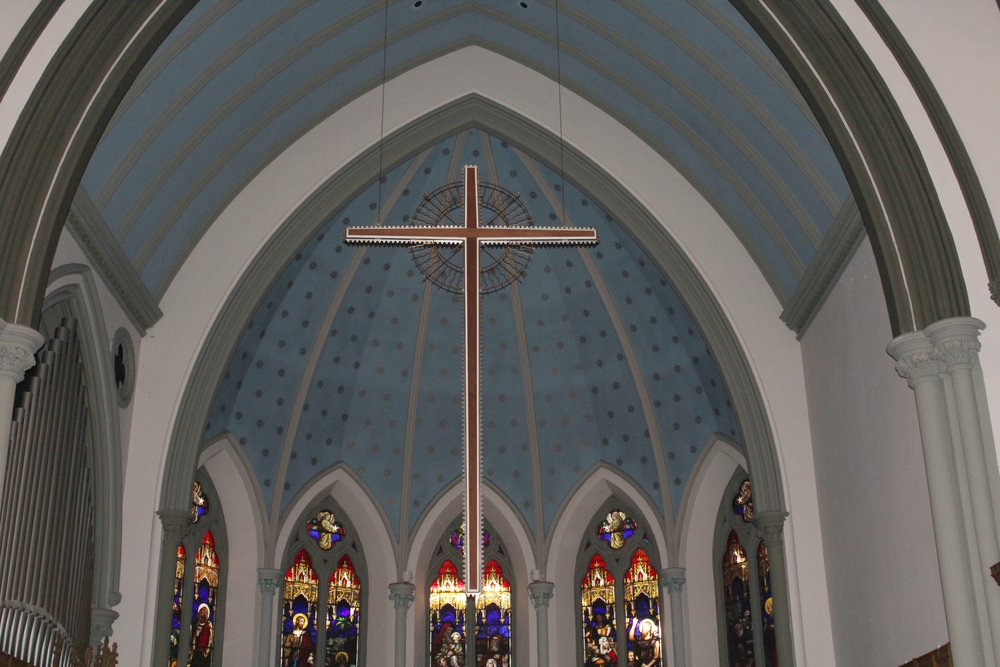
Suspended Cross representing the steel, glass, and aluminum industries of Pittsburgh. Photo by Janine Faust
Trinity and Pittsburgh’s History
Edward Soja defines a lived space as “combining the real and imagined”, which can be seen as the way people view or interact with a space (Soja). Trinity Cathedral is very much a lived space and has been since Pittsburgh’s beginning. For centuries Trinity has been occupied by different people who have transformed both the church and the city over the years. Without people interacting with Trinity as a space, it would not be here today. Trinity and Pittsburgh have been connected through Trinity’s long history that dates back to the Native Americans who first occupied the land, up until present day where Trinity is still active in Pittsburgh’s community. Trinity and Pittsburgh would be very different without the people who started the church or the people that kept it going throughout the years.
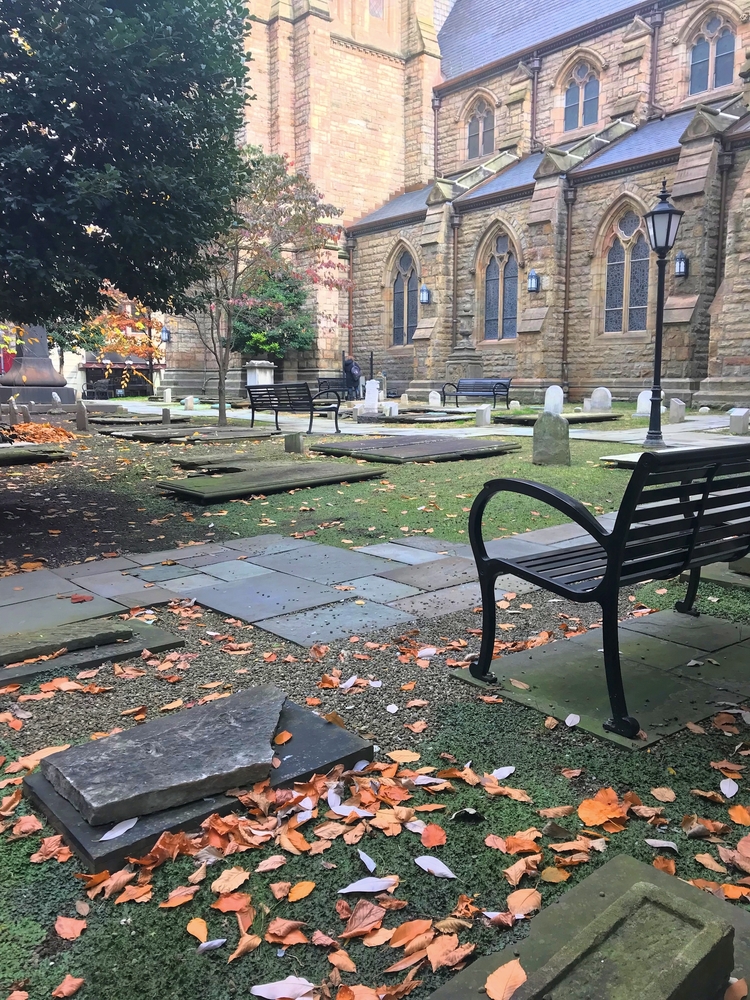
In October of 1787, one of William Penn’s heirs gave a plot of land to John Ormsby, one of the trustees who was active in the creation of Trinity (Muhl). Dating back earlier than the founding of Pennsylvania, or even the discovery of America, the land was inhabited by Native Americans, specifically the Shawnee Nation (Trinity 1946). The Native Americans, the French at Fort Duquesne, and the British at Fort Pitt all used the land as a burial ground, which eventually contained more than 4,000 graves (Muhl). Underneath the Trinity Church that was built in 1825, there were graves of British officers, Revolutionary heroes, and an Indian chief, known as Red Pole (Trinity 1898).
Reverend John Taylor
The first rector of the church was Reverend John Taylor, who was also one of the founders of the University of Pittsburgh. According to Rev. John Taylor and His Commonplace Book, the population of Pittsburgh in 1800 was just 1,565 people, and out of that number, only a small amount were Episcopalians, so Rev. Taylor needed another source of income besides the church community. (Trinity 1946). To make extra money, he became a teacher at the Pittsburgh Academy, which later became the University of Pittsburgh. At the time, the academy had only one small building that consisted of a few classrooms. I doubt anyone at the time foresaw the beginnings of the University of Pittsburgh and the impact it would have on the community. Rev. Taylor led a very interesting life and played a vital role in starting Trinity and forming Pittsburgh.
Dr. Nathaniel Bedford
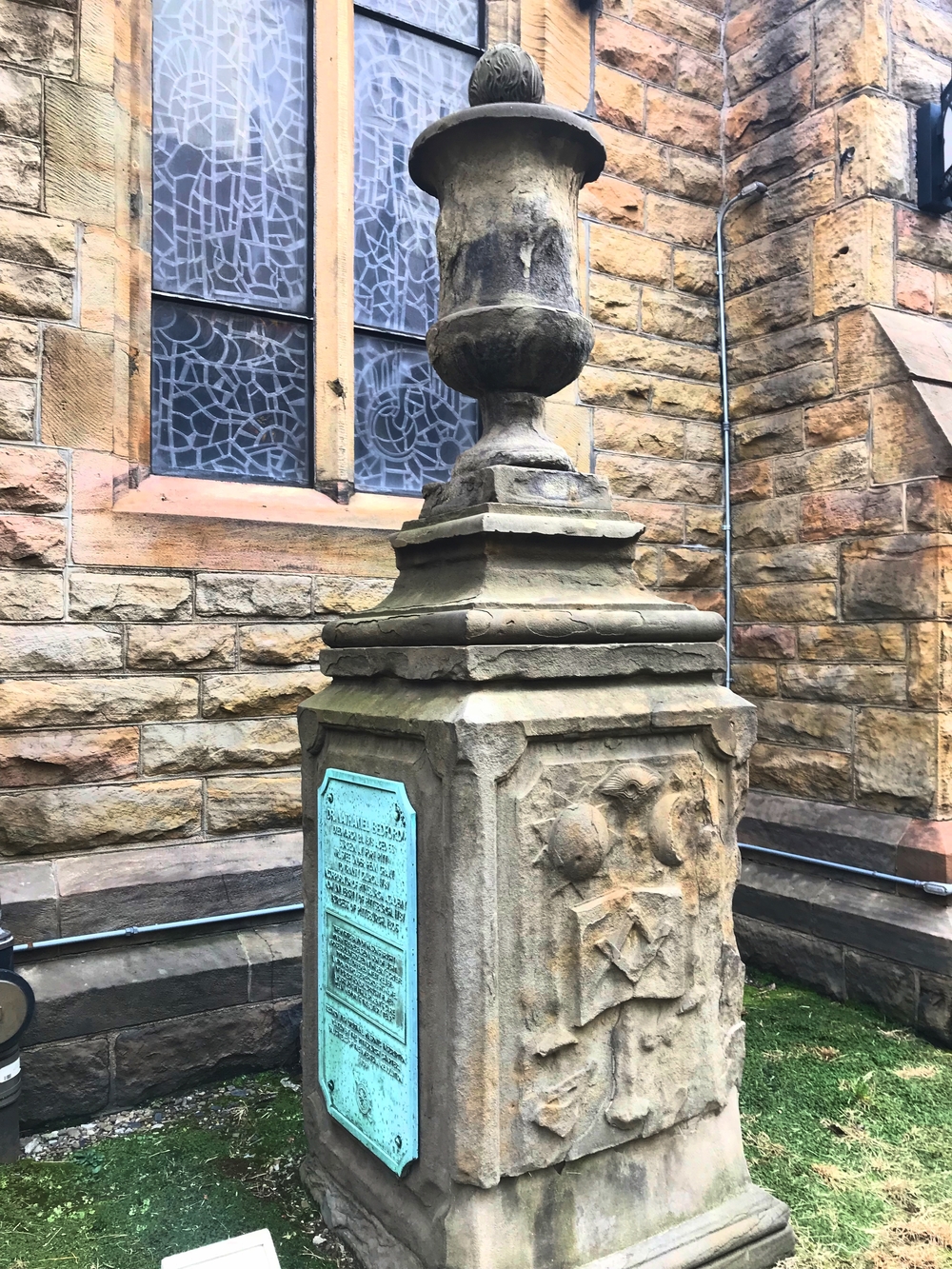
Alongside Rev. Taylor was Dr. Bedford who was one of the original trustees of Trinity under Penn Grant, a member of its building committee, and on the first vestry in 1787 (“Dr. Nathaniel Bedford”). He immigrated to the United States from England to be a military surgeon at Fort Pitt and instantly became very active in the community of Pittsburgh, and was a great influence on young men especially (“Dr. Nathaniel Bedford”). 1787 was also the year he was an incorporator of Pittsburgh Academy, which is now the University of Pittsburgh along with Rev. Taylor (“Dr. Nathaniel Bedford”). In 1806 he became an assistant burgess in the Burgess of Pittsburgh after Pittsburgh became a borough (“Dr. Nathaniel Bedford”). Dr. Bedford played a huge role in starting the city of Pittsburgh we know and love today through his work as a doctor, member of the vestry of Trinity Cathedral, founder of the University of Pittsburgh, and politician. He died March 21st, 1818 and was buried next to the church he helped found (“Dr. Nathaniel Bedford”). You can visit his grave at Trinity Cathedral burial ground located in between Trinity Cathedral and First Presbyterian Church.
Red Pole
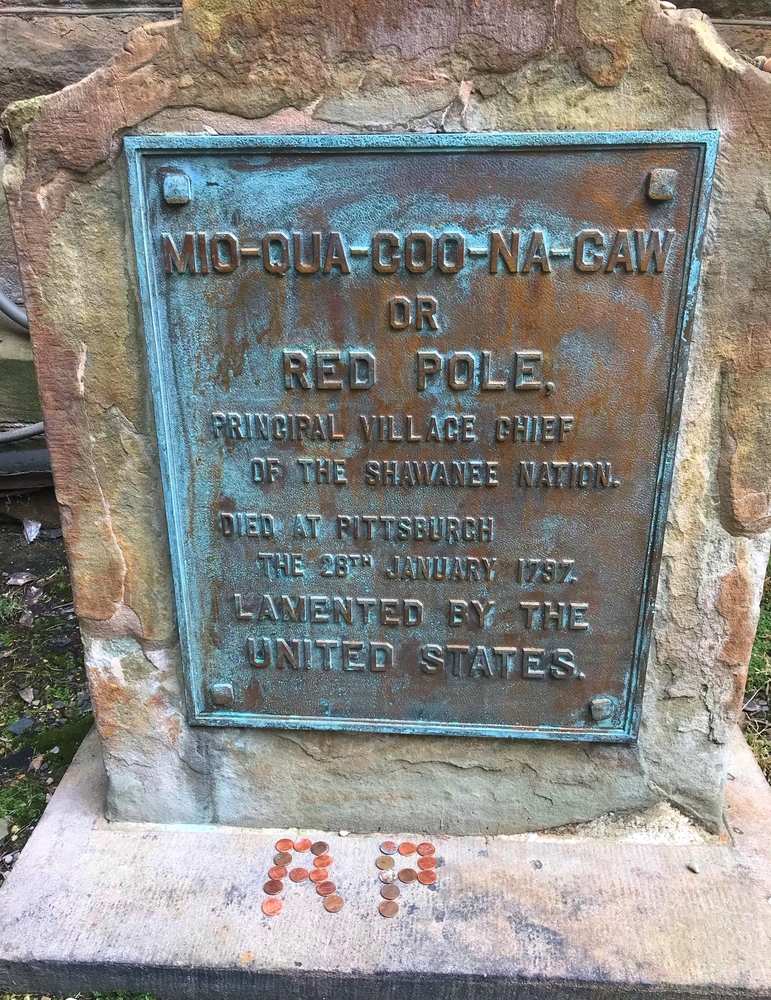
Buried next to Dr. Bedford is Mio-qua-coo-na-caw or Red Pole, a principle village chief of the Shawnee Nation. He signed the Treaty of Greenville in 1795, bringing a lasting peace to Pittsburgh and at the time, the western frontier (“Mio-qua-coo-na-caw or Red Pole”). A year later at Christmastime, Red Pole became very ill, and despite treatment from Dr. Bedford, he died January 28th, 1787 (“Mio-qua-coo-na-caw or Red Pole”). He was buried with great ceremony, in the same burial ground as fallen soldiers from Fort Duquesne and Fort Pitt demonstrating how well respected he was (“Mio-qua-coo-na-caw or Red Pole”). Red Pole being buried in Trinity’s burial ground illustrates Trinity’s connection to the complicated politics of the time.
When I walked into Trinity Cathedral for the first time, I noticed beautiful stained glass windows and the elegant altar, but most of all the suspended cross above the altar. Because it was not as ornate as the rest of the building my attention was immediately drawn to it. The cross was installed in 1967, following the fire that destroyed large parts of the cathedral (Muhl). It is fourteen feet long and is made out of steel, glass, and aluminum to honor the major industries in the city that Trinity has watched transform over the many years (Muhl). Steel Mills have been located not even blocks away from Trinity Cathedral since before 1850, making Trinity very connected to the steel industry (“Steel”). Between 1850 and the early 1900s there were about 10 mills, coke ovens, or foundries in close proximity to Trinity (“Steel”). The oldest part of the cathedral is Saint Mary’s Chapel, which was covered in soot from years of pollution from steel mills, and to this day still has a forgotten closet that has never been cleaned or refurbished (Knapp). With the steel industry being so close to Trinity during these years, it can be inferred that a majority of their congregation worked for or was connected to steel in some way. The suspended cross honors these hardworking people and all people of Pittsburgh and demonstrates Trinity’s long history with the city.
Over time, all cities go through changes, and Pittsburgh has definitely faced drastic changes over the years. In N.K. Jemisin’s book A City Born Great she addresses the idea of a city being “reborn”. Because Pittsburgh has been inhabited by so many different groups, it has been reborn many times. Its rebirth can be seen when the city was first establishing a government as a part of America, during the peak of the steel industry with the influx of immigrants, and the collapse of the steel industry with the fleeing population. Throughout these times of rebirth with new ideas and people, Trinity has been there as a place of support during difficult times through its past and present charity work and also a place of innovation and progress through individuals such as Rev. Taylor and Dr. Bedford.
Trinity Cathedral is just one building in the huge city of Pittsburgh but researching it opened the doors to so many stories of the past. Connecting one aspect of history to a much larger picture is eye-opening and can lead to so many more discoveries as well as a greater understanding of history and why places and things are what they are today. I encourage everyone to visit Trinity Cathedral and its burial ground to see the history of Pittsburgh through a different lens or to pick a site in Pittsburgh and research it. You never know what exciting things you will find out about the place and how it connects to a much bigger story.
Works Cited
“Dr. Nathaniel Bedford”. nd. Trinity Cathedral, Pittsburgh, Pennsylvania. 14 November 2018.
Knapp, Shannon. “Trinity Cathedral Tour”. Quantum Theatre.
Trinity Cathedral: Pittsburgh, PA, 14 September 2018. “Mio-Qua-Coo-Na-Caw or Red Pole”. nd. Trinity Cathedral, Pittsburgh, Pennsylvania. 14 November 2018.
Muhl, Andy. “Trinity Cathedral Pittsburgh.” Trinity Cathedral Pittsburgh, www.trinitycathedralpgh.org/.
Soja, Edward. Thirdspace: Journeys to Lost Angeles and Other Real-and-Imagined Places. Cambridge MA: Blackwell Publishing Inc., 1996. 53-70.
“Steel Footprints.” Rivers of Steel, Rivers of Steel National Heritage Area, www.riversofsteel.com/map/category/all/.
Trinity Cathedral. Trinity Cathedral Church of Yesterday and Today. 1946. MS- 31735051650541. University of Pittsburgh, Pittsburgh. University Library System. 31 October 2018.
Trinity Episcopal Church. Past and Present of Trinity Episcopal Church: One Hundredth Anniversary. 1898. MS- 31735051649774. University of Pittsburgh, Pittsburgh. University Library System. 31 October 2018.