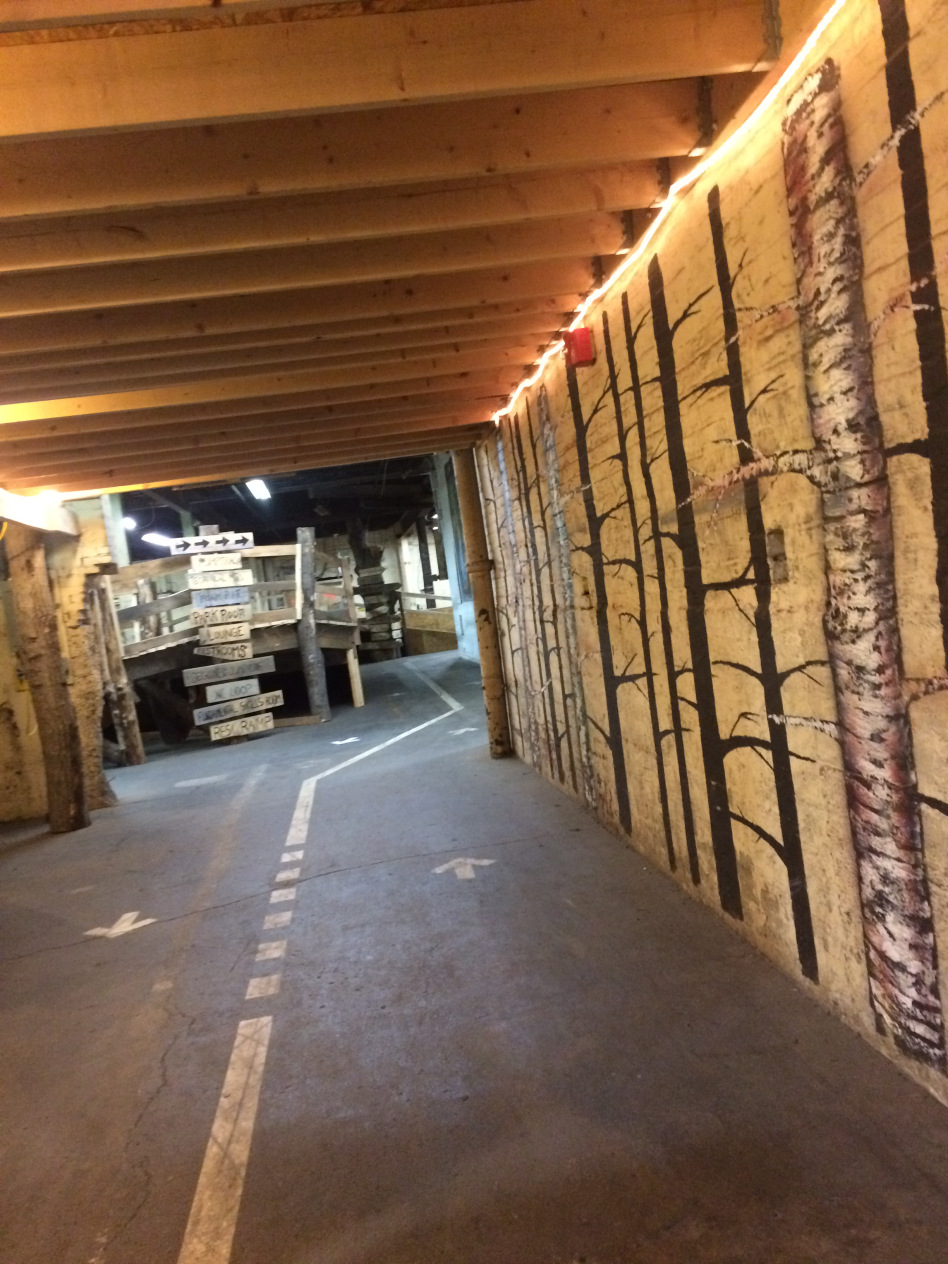
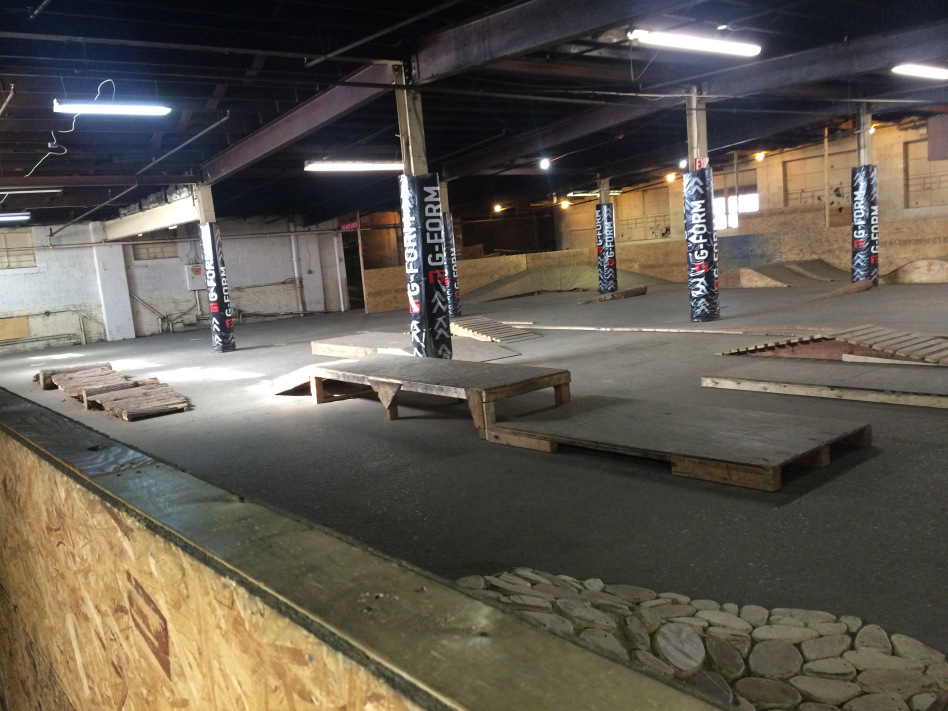
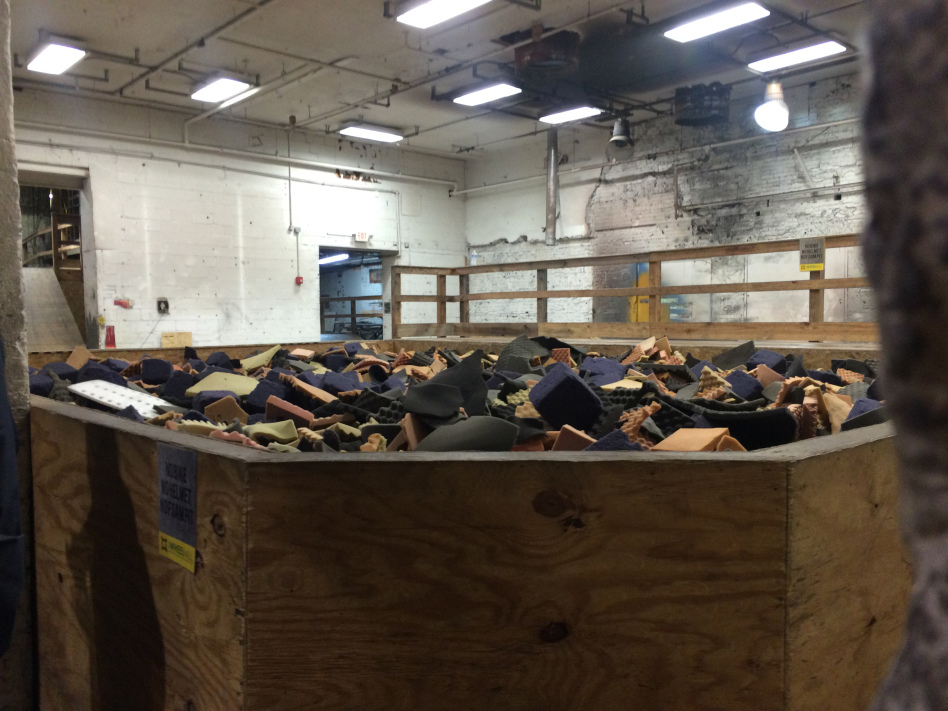
Indoor cycle track at the Wheel Mill. Photo by Jordan Dahlstrand.
Transitioning from a Steel Town to a Wheel Town: Pittsburgh’s Quest to be a Bike-Friendly City
Since before its creation, the bicycle has been a significant part of our society. If one were to head to Stoke Poges, Buckinghamshire, England to the St. Giles Church, he or she would find a stained-glass window depicting a man riding on a two-wheeled device. This image was created over two hundred years before anything like it ever came to life. In 1817, Baron Karl von Drais of Germany built a running machine called a laufmaschine, which had many elements that would transfer into what we know today as the modern bicycle (Macy, 14). Though significant, it has meant different things to different people. To some, it is a mode of transportation. To others, it is a recreational toy. As a whole, the bicycle can be seen as a “freedom machine.” Bicycles are a cheap way to get out and explore an area. Today, if one wanders around Pittsburgh, he or she will see various elements implemented for cycling including; bike lanes, rental stands, bike shops, and riverside trails. Something unique that Pittsburgh has for cyclists that most other cities do not have is The Wheel Mill, an indoor bike park on Hamilton Avenue in Homewood West. Pittsburgh as a whole has made great strides to become known as a bicycle-friendly town where riders of all ages and skill levels are able to explore the city space on wheels.
An Industrial Past
Although today we are able to utilize our free time to pursue our hobbies, whether that be riding bicycles or knitting sweaters, Americans in the past did not always have such freedoms. In pre-industrial times, people lived rough, short lives. The tempo of their lives was centered on the farming cycles. As life shifted to the industrial age, the tempo shifted more to the workplace –mainly in factories (Bell, 45). Workers had long, twelve-hour shifts and only one day off every other week. There was no time to do much besides work, sleep, and eat (Ruck). In the novel Out of this Furnace, author Thomas Bell described what life was like for steel mill workers in Braddock, Pennsylvania and the horrible conditions that led workers to fight for change through several characters, including a Hungarian immigrant named Kracha. He wrote,
“Kracha did what he was told and was paid for it every two weeks; his interest ended there. There was little about his work to make him feel it was important or necessary; on the contrary, the company lost no opportunity to impress upon him that his services could be dispensed with at any time, that it was really doing him an enormous favor by letting him work at all.” (44).
Workers eventually became fed up with their miserable lives and created labor unions to fight for better conditions and better pay. A man named Robert Owen started a campaign to allow people to work no more than eight hours per day. His motto was “Eight hours labour, eight hours recreation, eight hours rest (Widrich).” It was not until around 1914 when companies such as Ford Motors began to implement the eight-hour day. Due to individuals like Owen and technological advances that occurred during the Industrial Revolution, individuals could finally enjoy a life outside of the workplace, a life where leisure time was available (Ruck). This leisure time gave the majority of Americans the ability to enjoy sports and recreational activities, like cycling.
Steel City? More Like Wheel City!
This cycling friendly city that we know and love today only came to be over the past fourteen years. One of the major players in this evolution is Bike Pittsburgh, a nonprofit organization created to help residents, commuters, and visitors experience the city’s unique neighborhoods and landscape while navigating the city by bike or on foot through the creation of bikeways and walkways (Bike PGH!). The organization came to be in February 2002 after David Hoffman was hit by a car at the intersection of Negley and Penn Avenues during his bicycle commute to work. He soon decided to use the exposure that this accident brought him to bring attention to the need for bicycle safety in the city and created a website to discuss the issue. This site quickly caught the attention of thousands of riders in the city and led to a variety of events and initiatives. (To view the complete history, click here) In the spring of 2007 the city’s first marked bike lanes came to be and today there are approximately 62.33 miles of bike lanes strewn through out the city (Bike PGH!). Bike Pittsburgh has created most of the outdoor elements for Pittsburgh and The Wheel Mill has added the indoor biking element to the city.
A Freedom Machine
In 2013, The Wheel Mill opened its doors to the public. Since then, the park has made cycling more accessible to Pittsburghers year round. No longer do those with an interest in cycling have to put away their bikes when the winter weather brings snow and ice to the city. The Wheel Mill hosts events for people of all ages, young children, women, teens, men, skilled riders, new riders, and unicyclists alike! Although today, cycling events for women seem like nothing out of the ordinary, this would have been viewed as very problematic in the past. In the late 1890’s as bikes became very popular in society, many criticized women being allowed to ride them. The Young Adult nonfiction piece Wheels of Change shows both how women utilized the bicycle as a source of freedom and provides examples of those who criticized this notion. On June 29th, 1896, a young woman named Charlotte Smith who had recently spent the past decade fighting for women’s rights in the workplace spoke about her distrust of women utilizing bicycles and said,
“Bicycling by young women has helped to swell the ranks of reckless girls who finally drift into the standing army of outcast women of the United States. The Bicycle is the devil’s advance agent morally and physically in thousands of instances.” (Macy, 28)
Although this may seem ludicrous today, women in that time period had to deal with obstacles like this when they first started riding bicycles.
The Wheels of Conclusion
Over the last fourteen years, Pittsburgh has evolved into a bike town. There are bike paths, bike rentals, and an indoor bike park -The Wheel Mill. It can be easy to take these things for granted because they are so prevalent. One can simply walk outside of their residence and walk less than a mile to find a City Bike stand. However, if we take a look back at history, less than a century ago, Pittsburghers rarely got to enjoy leisurely activities of this nature because they were busy working strenuously in factories and steel mills. After fighting for better conditions, eight hour work days were created and life got easier. Today, because of these advancements, everyone can enjoy these freedom machines, regardless of age, gender, or skill level.
Works Cited
Bell, Thomas. Out of This Furnace. Pittsburgh: U of Pittsburgh, 1976. Print.
“BikePGH!” Bike Pittsburgh RSS. Accessed 23 Apr. 2016.
“Free Ride Pittsburgh: Who We Are.” Free Ride Pittsburgh. Accessed 27 Apr. 2016.
Macy, Sue, Jennifer Emmett, James Hiscott, Lori Epstein, Marty Ittner, Kate Olesin, Grace Hill, and Lewis R. Bassford. Wheels of Change: How Women Rode the Bicycle to Freedom (with a Few Flat Tires along the Way). Print.
McGill, Andrew. “Wheel Mill: One Man’s Vision Turns Homewood Warehouse into Indoor Bike Park.” Pittsburgh Post Gazette. Accessed 19 May 2013.
Ruck, Rob. Lecture. History of Sports. University of Pittsburgh, Cathedral of Learning, ON September 15, 2015.
Soja, Edward. Thirdspace: Journeys to Lost Angeles and Other Real-and-Imagined Places. Cambridge MA: Blackwell Publishing Inc., 1996. 53-70.
“The Wheel Mill.” The Wheel Mill Home. Accessed 24 Apr. 2016.
Widrich, Leonhard. “The Origin of the 8 Hour Work Day and Why We Should Rethink It.” The Huffington Post. TheHuffingtonPost.com, 9 Mar. 2014. Accessed 24 Apr. 2016.