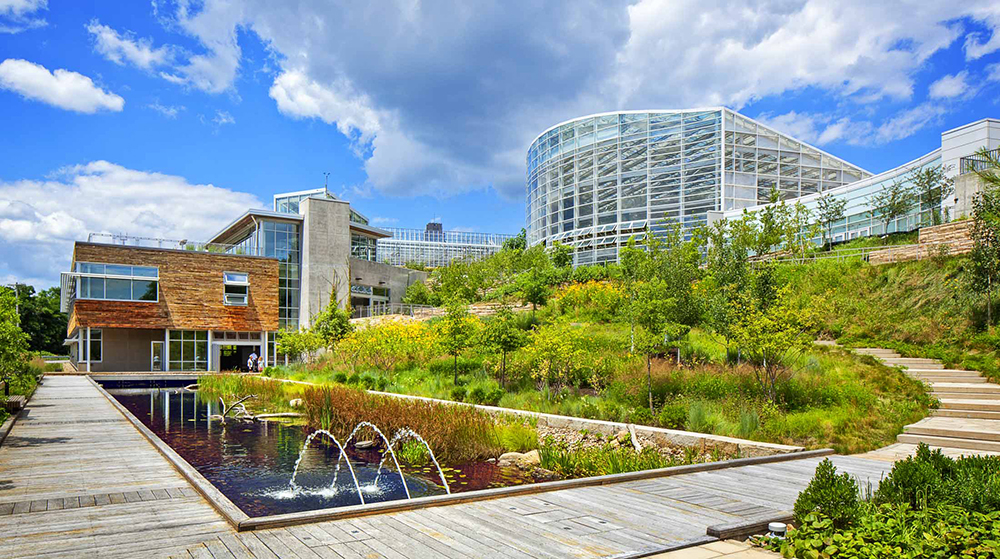
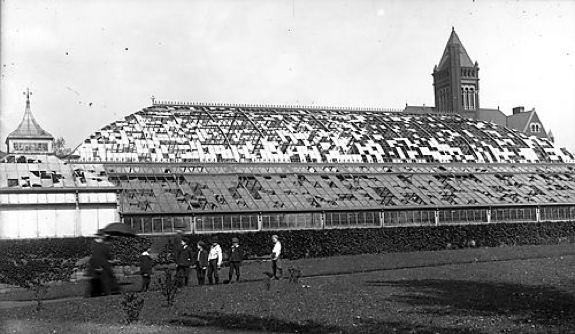
Panaromic view of Phipps’ Center for Sustainability; Photo © Denmarsh Photography, Inc.; Paul g. Wiegman; Renee Rosensteel; Joshua Franzos; Lofty Views.
Transforming a Dark Past into a Green Future
An exploration to Phipps Conservatory in Oakland is arguably one of the best sites to visit in the entirety of Pittsburgh, with visitors coming from around the world to gaze upon its beauty. Phipps has undergone a breathtaking transformation over the years, and not merely in the plants it contains, but rather the sustainability effort it has undertaken. Admiring the front of Phipps, one is awed by the stunning glass structures that comprise it or the glowing green of the front yard. Yet few know of the endophyte (a microorganism that has a symbiotic relationship to grass) used to enhance the grass rather than pesticides or the purposeful subterranean entrance to better maintain stable temperatures. Nevermind the award-winning 3-star Green Restaurant Certified café inside, which features organic, local food often grown right in Phipps’ gardens. But the crown jewel of Phipps’ efforts lies in its Center for Sustainability, one of eleven certified “Living Buildings” in the world and arguably the most rigorous green certification possible.
In order to be considered a Living Building, the site must perform in seven areas: site, water, energy, health, materials, equity and beauty. These are subdivided into a total of twenty “imperatives”, each of which focuses on a specific realm of influence. Some of note include: net positive water and energy, habitat exchange, local economy sourcing, and universal access to nature. But before this stunning legacy came to be, there was a darker past that threatened to overshadow it.
While the archives are filled with the exploits of Andrew Carnegie, Henry Phipps has rightfully earned a place beside him, even if it is quieter. Henry Phipps, a lifelong friend of Carnegie, was the second-largest shareholder in Carnegie Steel where he accumulated a sum of forty-eight million dollars (not equivalent to today’s conversion) and one of the largest fortunes in American History.
Phipps came from humble roots, dropping out of Allegheny County public schools at age fourteen (Wooster). His ingenuity for finding work was evident even at age seventeen when he borrowed 25 cents from his brother to place an ad in the Pittsburgh Dispatch. It read: “A willing boy wishes work.” Dilworth and Biddle, a company that made iron and railroad spikes, offered him a job as an errand boy. During this five-year period, he toiled tirelessly at night courses in accounting which allowed him,surprisingly, to advance as partner of the company. He then switched companies to work for Carnegie for over thirty-six years and helped develop his massive steel empire.
Phipps was often described by Carnegie as being his “money-getter” given, that he mastered corporate finance. Countless biographers highlight Phipps’ calm and logical personality, as the most important factor in ensuring that Carnegie Steel, with its divided shareholders, lasted until its merger with U.S. Steel. Upon successful merger in 1901, Phipps held eleven percent of company stock and profited between forty and fifty million from the sale. Phipps’ wealth began with Carnegie but his savvy financial skills eventually led to his creation of Bessemer Trust, currently one of the nation’s leading wealth managers.
Yet, wealth had a cost. Multitudes of deaths and injuries resulted from the blazing mills, such as the one on October 25, 1902 in which five workers lost their lives and countless others were injured due to an overflowing boiler explosion at the Carnegie furnaces (“Five Killed By Explosion of a Boiler.”). The numerous deaths, damage to the environment, and lasting scars cannot be undone but they can be honored in the present, evidenced in the Conservatory’s commitment to friendly eco practices and a welcoming environment to all of Pittsburgh’s residents.
Wandering through the Center for Sustainability, one is instantly relaxed by the ambient nature sounds and comfortable feel, as though you’ve just snuggled in for the night. It’s little wonder with concrete thermal heat walls and attractive stairs, purposely designed in order for you to select them over the tucked away elevator.
Each and every detail is meticulously planned for the good of nature and the people working there from, its rain water treatment that is stored beneath the very sidewalk you walk on, to its light shelves specifically designed in work spaces to bounce in more natural light. Phipps’ fortune, acquired through harmful practices, now acts as a benefactor of a “green laboratory” of sorts. What makes Phipps so striking today beyond its beautiful foliage, is the inventions and broadcasting of the successful green initiatives to the general public. In this way, Phipps tests out the various solutions proposed such as green walls, to ascertain the greatest benefit to the environment with the average consumer gaining much by their trial and error.
The Seed Classroom, a portable living classroom building, allows Phipps to serve the public’s most deserving citizens: its children. The classroom, used to educate students on the environment and eco-friendly practices, shines with its very own solar panels. The energy captured by the facilities’ solar panels in the summer powers the building and part of the Conservatory throughout the entire year.
In his dedication, Phipps made clear his desire to “erect something that will prove a source of instruction as well as pleasure to the people” (Wooster). He also issued a surprise stipulation, requiring that the conservatory be open on Sundays, so that workingmen and their families could visit on their day of rest. Local ministers denounced the proposal but Phipps proceeded with it anyway. As James H. Bridge noted in a 1902 biography, Phipps’ career “is without parallel for a man as successful as he has been: he never made an enemy, nor lost a friend.”
Phipps allows one to ponder the use of space and our relation to it. Upon reflection, the past is never truly past, and the past can be a home for the future: we are “like tourists in a foreign city lost to time” (Sweterlitsch 249). The legacy of Phipps is sure to be ever brighter in the future, perhaps allowing there to be room for both reprimand and a greener reconciliation.