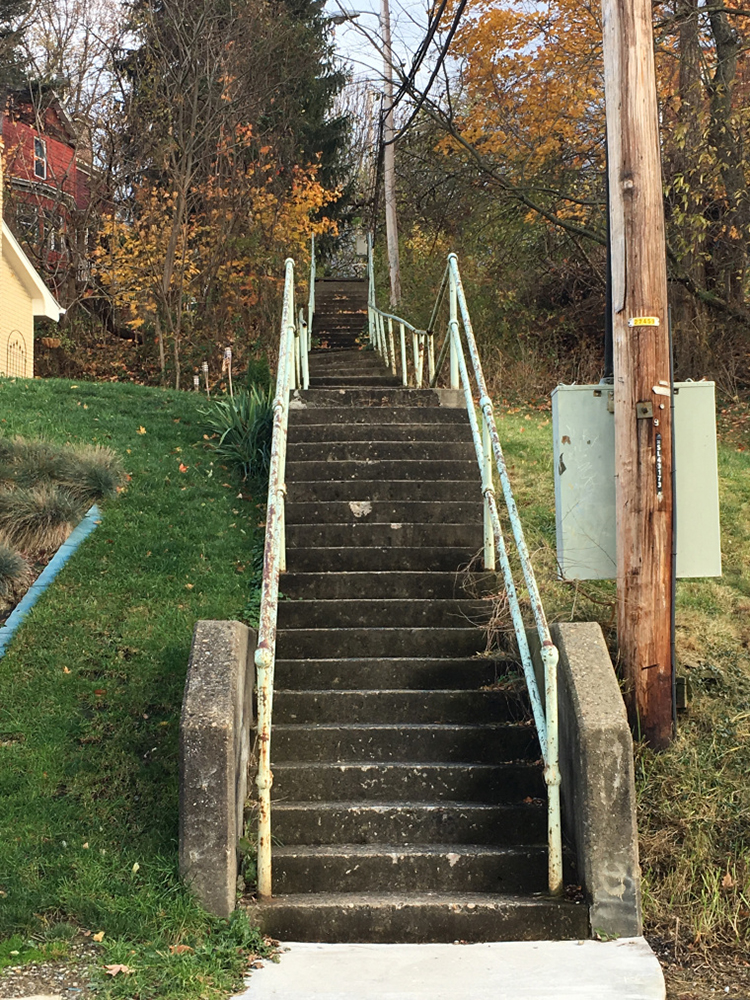
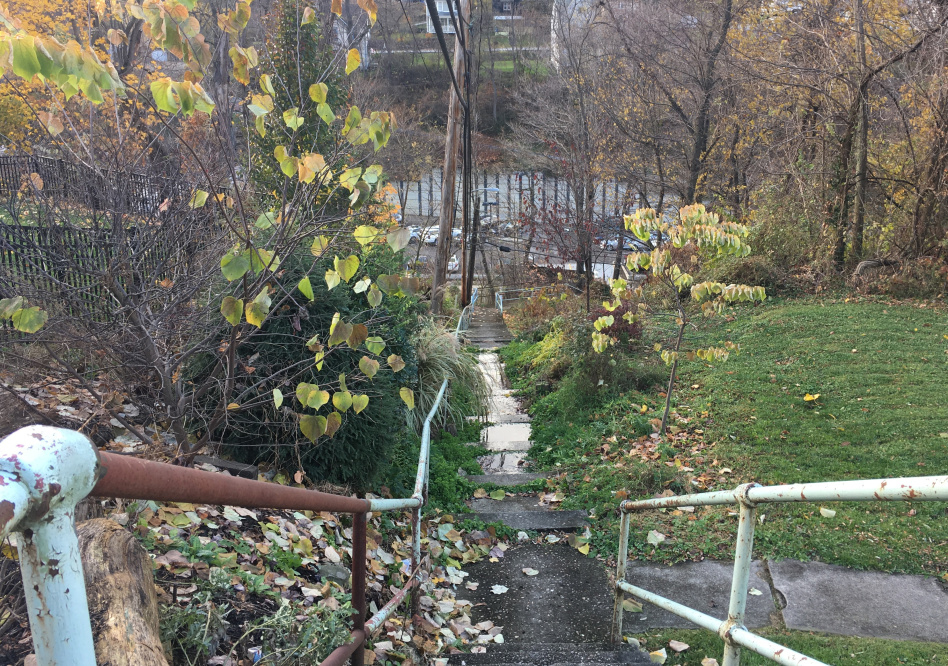
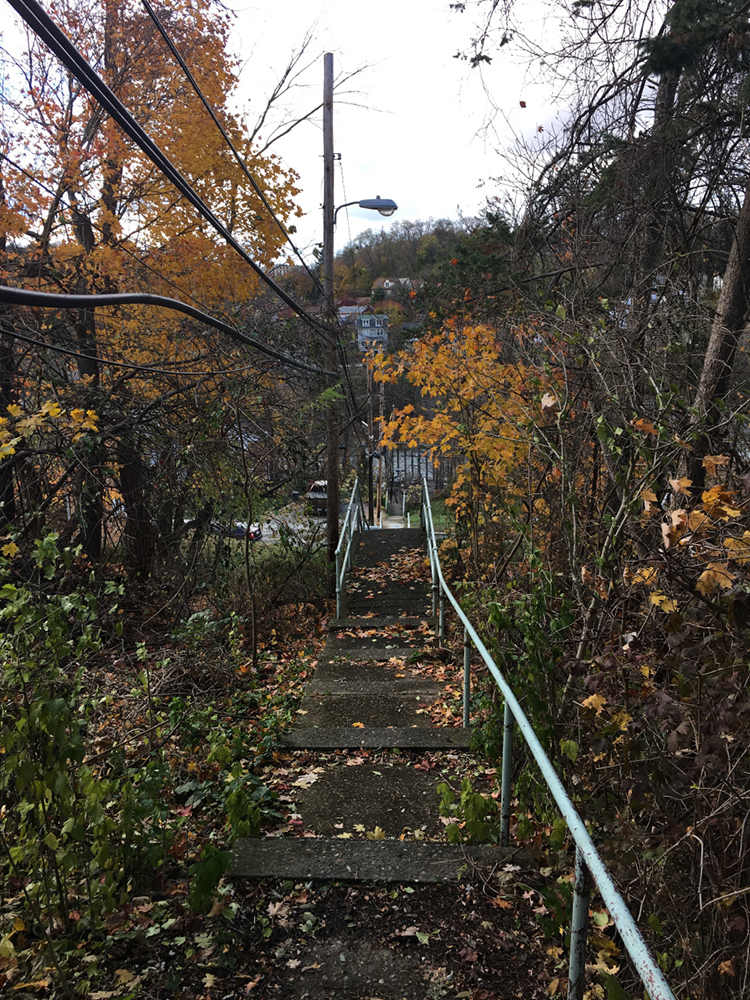
View up Ray Avenue Steps from Plainview Avenue. Photo by Jessica Feldman.
The Steps Less Traveled
When I first came to Pittsburgh, I was in awe of the city. It seemed so grand, yet also felt very homey. By the end of my first week, I had incredibly sore thighs from walking around so much, although in the moments of college orientation, I hadn’t noticed my discomfort. The rounded terrain tricked my mind into thinking I was just weak and not used to walking this much, rather than having to combat a constant change in altitude. But soon I began to discover short cuts throughout the city, most of which involved even steeper climbing, up or down Pittsburgh’s ever-present stairways.
Pittsburgh is known for the city having the most steps in America, and second only in the world to Venice. The lesser known fact is that the city itself maintains 712 sets of steps, 44,645 treads (the actual tops of the steps), and 24,108 vertical feet of stairs (Regan book description). That’s just what the city itself maintains; not how many steps are actually present in the city. The steps are as much a part of the landscape and feel of the city as the bridges, and allow for citizens to explore their city in a way unlike any other major metropolitan area. They offer a unique perspective when we reach the top, and give us another view from the bottom looking up.
In the playground of Pittsburgh, steps often replace sidewalks and have their own street names, demonstrating their great importance to the city. The City of Pittsburgh maintains only some of the steps, but several groups are involved in not only their upkeep, but also their importance in the public eye. The South Side Slopes Neighborhood Association hosts an annual StepTrek, where tourists and natives alike pay a small fee to follow courses throughout the South Side Slopes. This leads to breathtaking views of the city as well as Schenley Park. The two StepTrek courses cover about 2,500 steps, and 1,460 vertical feet. That is 3 feet taller than the Empire State building! The proceeds raised go back to the Neighborhood Association to help maintain the area, particularly since it contains about 10% of the 712 sets of steps in the city. This vertical height, of course, comes from the landscape of Pittsburgh, which is largely hills and mountains with very little completely flat land.
Although steps are part of my everyday life in Pittsburgh, I never really took the time to consider them, until I was driving one day in Beechview. My friend and I drove past an incredibly steep hill; where a sidewalk should have existed, only steps were present. The entire street looked like any other neighborhood, with houses lined next to each other with driveways and cars and foliage—except the street extended vertically into the sky. Or so it looked like from our point of view. As it turns out, we had stumbled across the Canton Avenue steps, the steepest stairway in the city. The next day we decided to go stair hunting and our first stop was back to this colossal street. Once the car was parked and we started up the stairs, it felt like we were climbing a ladder rather than a stairway. Once we reached the top at Hampshire street, we really felt like we were almost at the top of a cliff and we both pondered how cars would be able to drive up and down this steep and cobblestoned road.
Side Thought: Perspective
This was an interesting observation; at the bottom of the road, we hadn’t wondered about the cars coming down such a steep incline, but rather how the cars would get up to the top. Now that we were at the top of the steps, we found ourselves wondering how the cars would make it down the street without continuing into the houses below. Stairs, in particular, the Canton stairs in their extremism, create a change in perspective. In the very literal sense, there is a change from a low to a high view. This higher vantage point gives us a better outlook of our surroundings, but can make us feel like we’re teetering on the edge of falling from a magnificent peak. In a more abstract sense, this can also be how you feel when you’ve gained a lot of power and suddenly become afraid to lose it.
A change in perspective from high to low, can literally offer a more grounded feeling by being closer to the earth. But looking up from this lower vantage point, this can cause two very different reactions. One person looking up at a steep hill such as the Canton steps might consider it a great challenge to be conquered. Another person may look up the same hill and see it as daunting, and too big a task to be done. Steps are an incredible enzyme for a change in perspective, and Pittsburgh constantly forces its citizens to challenge their viewpoint.
Back on Track
After clambering up and down the Canton steps, my friend and I decided to visit another landmark—the Ray Avenue steps. After a short drive, which took us up down Fallowfield Avenue, site of the Fallowfield Bridge steps, we arrived in a quaint neighborhood. The narrow streets and small town aspect seemed like an odd place for the longest steps in Pittsburgh, but we found a place to park and peered up one set of the steps.
Then down the other set.
Was this the right place? It seemed like even the Canton steps were longer that this little staircase. But I had seen pictures on the internet, and knew this was the place, so we started climbing … and climbing… and we rounded a corner and suddenly there were even more stairs in front of us. The stairs were hidden among the rest of the neighborhood, fitting perfectly into the molding of the landscape. I tried to take a few pictures of my own, but quickly realized that there was no physical way to capture how long these steps were in one picture.
Side Thought: Photography
In our developing world, photography suddenly becomes a mean for information sharing—or a device to to hide information. Facebook, Instagram, Twitter, and any other social media platform allows users to share not only their photographs, but by extension their viewpoints, ideals, grievances and anything else on their mind at any moment. Photography, by nature, becomes very one sided in its expression. The viewer is limited in what they are told by the photographers decision of what to include and not include in the picture. And often, photographers are limited by the physical space and the rectangle of their camera lens, just as I was limited by the pure size of the Ray Avenue steps. Even in the instance with the Canton steps, a simple picture cannot express how steeply the street bends.
Where does this leave us?
Really there is only one conclusion… go see these steps, and as many as you can in Pittsburgh! This city is a wonderful, thriving place, with so many little gems to discover. Walk around, eat some good food, and go find a secret staircase to call your own.
Works Cited
Beyerlein, Doug. “Pittsburgh Stairs.” Pittsburgh Stairs. Community Walk, n.d. Accessed 16 Sept. 2016.
Feldman, Jessica. Ray Avenue Steps. Digital image. N.p., 06 Dec. 2016.
Feldman, Jessica. Canton Avenue Steps. Digital image. N.p., 06 Dec. 2016.
Howard, Rachel, Bill Nash, Stéphanie Rivoal, and Jorge Monedero. Secret London: An Unusual Guide. Versailles: Jonglez, 2015. Print.
Regan, Bob, and Time Fabian. The Steps of Pittsburgh-Portrait of a City. Pittsburgh: Local History, 2004. Print.
Walter, John. “Beechview.” Pittsburgh Steps. Frontier Net, n.d. Accessed 20 Nov. 2016.