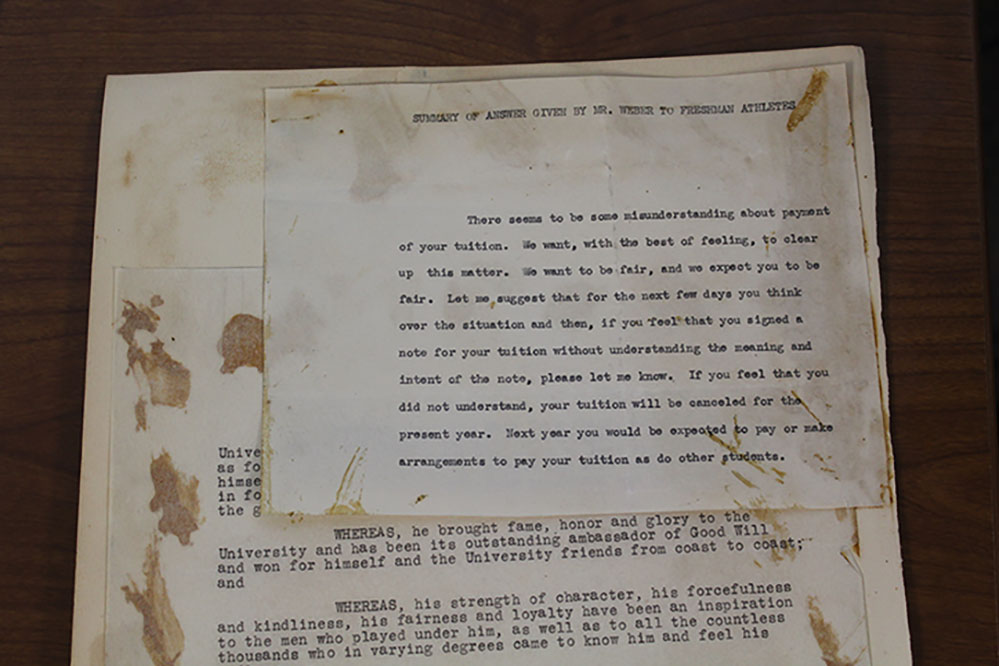
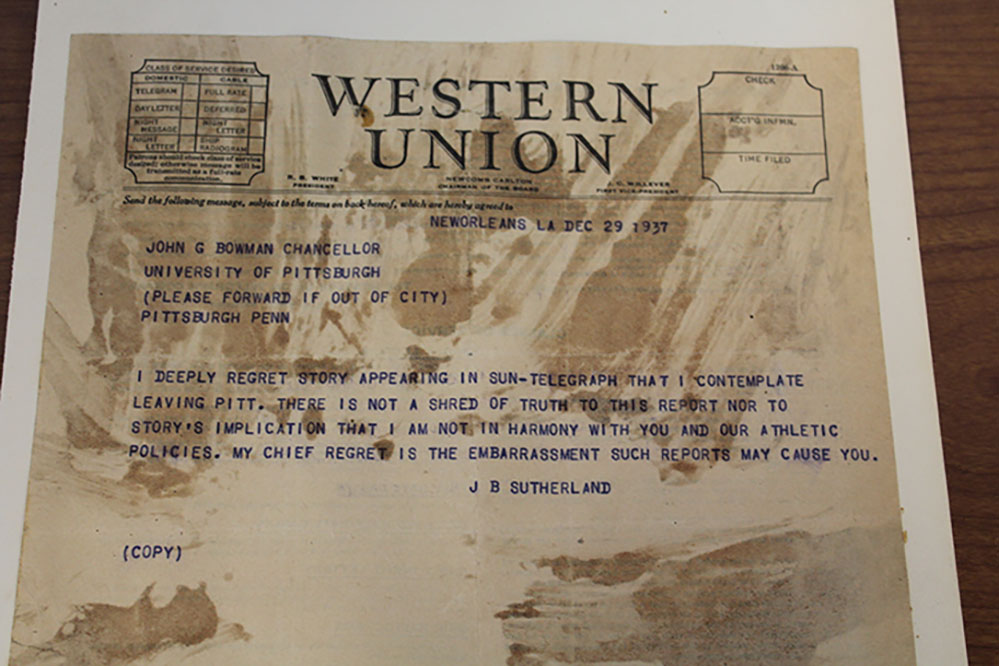
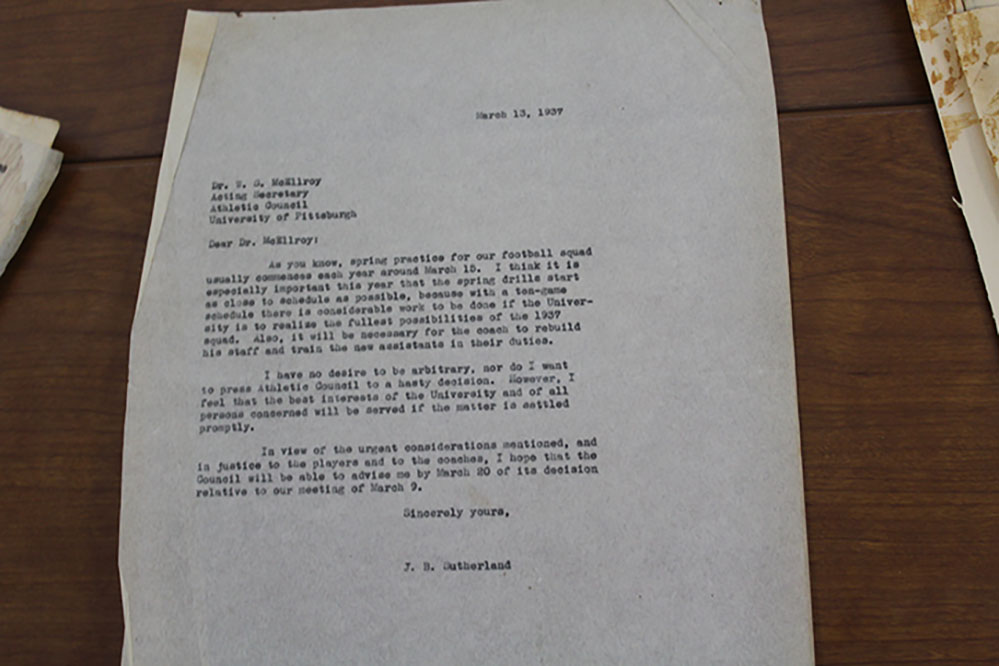
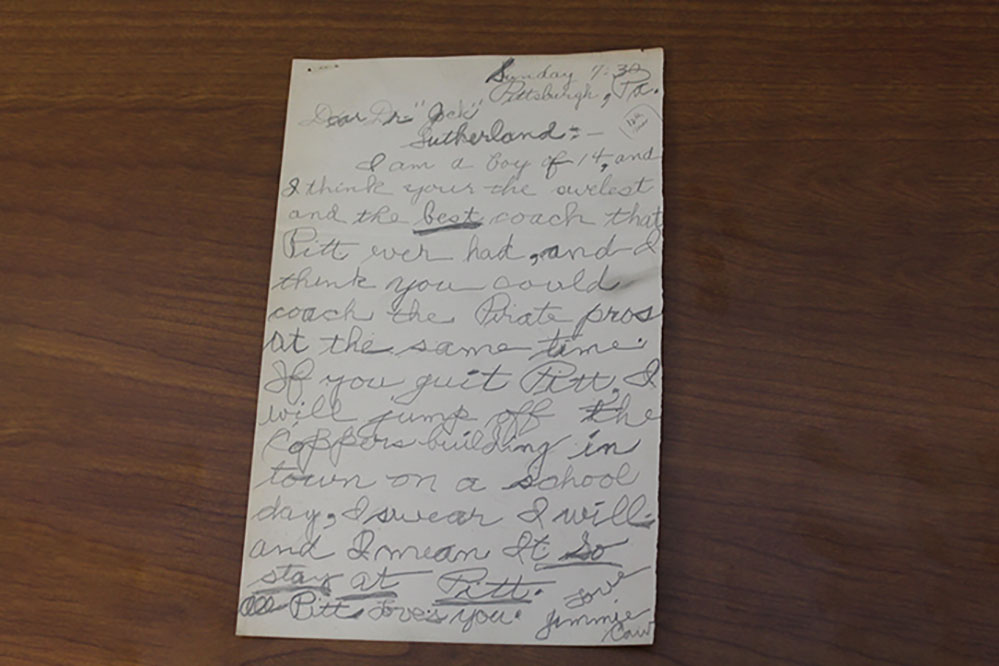
The change in policies with athlete's full rides caused major communication issues and numerous players did not pay the tuition Pitt believed it was owed. As a result, the above statement was released to clarify any misunderstandings. Photo by Zach Mitchell
Sutherland’s Hall of Mirrors
Between the years 1924 and 1939, the University of Pittsburgh became synonymous with the name “Jock” Sutherland, a man who did more for Pitt athletics in his 15-year tenure than every other one of the coaches combined have done in almost a century since his tumultuous resignation. Given his immaculate performance as a head coach of the football team, it would only stand to reason that he should have a hall—where, fittingly, the football team and several other athletic teams live throughout their time at Pitt—named after him and the immense success he enjoyed during his career. Sutherland Hall, which was completed in 1992 and conveniently located directly next to the Peterson Events Center as well as the other important and major athletic facilities, stands as a pristine reminder of the untarnished image that both the university as well as the community as a whole have of the time that Sutherland held the reins and controlled the athletics of the school. Or so Pitt would have you believe: “A cursory glance will not do it. Straining to hear a faraway voice or catch a nuance in the quiet subtext of a conversation requires attentiveness, a filtering of all the noise to hear the music” (Kimmerman, 11). Despite what the building may seem to proclaim ostensibly, there is a muffled voice crying out to be heard. The voice of a man who was wrongfully deposed from his rightfully earned position of power and influence as a football icon.
Sutherland boasted fantastic production both as a defensive end and while as the head coach of Pitt, exceeding nearly every expectation which could have been set for him at the beginning of his head coaching career was not a perfectly smooth road however. Due to his rampant success and dominance not only of the sport nationally, but also of the university as a result, his hiring upset several people involved in the academic side of the university who wanted to focus much more heavily on academics instead of being seen simply as a “football school” by a large majority of people both inside and out. To that end, several individuals who were in positions of power at the university at the time—namely John Gabbert Bowman— instituted a policy of de-emphasis for the football program, eliminating athletic scholarships, student athlete stipends, and the recruiting funds. This move to eliminate any power that Sutherland had in order to persuade possible prospects to attend the university and play for the program resulted in a drastic and rapid decline in the University’s success for years following his departure. Bowman’s manipulations, appropriately named Code Bowman, by numerous people in the upper echelons of the university, were controversial both with students and supporters of the football program: “the chancellor and some of his closest administrative aides… made conditions unbearable for Jock Sutherland and in doing so ruined the University’s position in the world of intercollegiate athletics…’[they] publicly [disemboweled] the University’s athletic program’” (Alberts, 158).
With a dubious name like Code Bowman, it becomes extremely hard for anyone to argue that this was anything other than a calculated and well thought out operation and in direct opposition to the immense power and influence that Sutherland had garnered by this point. What made matters even worse was the secretive nature by which everything was done and how deceptive the entire administration was at the time. In a correspondence with the president of the University of Florida, John Tigert, who had recently lost their own football coach, Bowman speaks in a rather backhanded way of Sutherland in private. The way that he speaks about Sutherland behind closed doors also makes it so much clearer just how tumultuous the power struggle at the university was at the time.
Even when attempting to serve as a character witness and recommend Sutherland for a head coaching job at another university, Bowman refuses to directly give him commendation and instead opts to take a somewhat strange and removed tone, in that he speaks as if he is not directly involved with Sutherland and has nothing truly admirable to say about him. This glaring lack of any direct attestation as to the nature of Jock’s personality paints a picture of Bowman not wanting to damage his career should the letter become public in the near future, but also as a point of pride by refusing to give him any complimentary remarks: “[Jock Sutherland] was given an unusually large supply of bad advice. I know nothing detrimental about his character. He is a rather silent man who was held in high respect here by his friends” (Alberts, 157). Because the letter was not public knowledge at the time it was written, and Bowman relinquishes that Sutherland is a respected individual, it becomes unambiguous as to why Bowman would not have been happy with Sutherland; the large amount of power he wielded stood as a direct obstacle to the authority and an impediment for Bowman’s capacity in his new position. Two things he had hoped to wield freely as chancellor.
Now, this is not to say that he should have given Sutherland a perfect character evaluation, but it should be viewed as nothing less than strange given the lack of any decided and concrete opinion. It is almost as if Bowman wants to simply straddle the fence and to play it as close to the vest as he possibly can to make sure all of his machinations are able to come to fruition. While it can be argued that Bowman supported Sutherland and did not propose policies intended to restrict his power and give the university back to its academic peers, this falls apart once one realizes that nearly everything Bowman and the members of his board did was not publicly announced until everything had been finalized. No one outside of the organization had any input or knowledge of what was occurring until it was too late, and the negative backlash from students, faculty, and alumni alike illustrates just how personally motivated—not to mention selfish—all of Bowman’s decisions during his time as chancellor were.
This history elucidates why it was necessary for the university to avoid directly addressing the huge scandal and disastrous resignation of Jock Sutherland directly at the time and would avoid naming him on any building for years to come. The first student dorms (Amos Hall, Brackenridge Hall, Bruce Hall, Holland Hall, McCormick Hall), all located in the Schenley Quad, were acquired by the university in 1955: “The University would construct dormitories for 3,500 students and provide housing for almost one thousand other students and faculty families” (Alberts, 268). Despite this large housing project, no building was dedicated to Sutherland’s memory until 1992, nearly 40 years after the first dormitories and on campus student housing were acquired. Sutherland Hall is one of the largest dorms on the university’s campus and boasts one of the most impressive views as well. But do not let the fact that it is one of the most impressive dormitories distract from the hypocrisy that went into its construction and naming. The football team lives in the building named after the former coach with no knowledge about how poorly he was treated at the end of his tenure and how underhanded the university was in ensuring that athletics were put on the back burner to academics following Sutherland’s resignation.
By the time Sutherland Hall was finally opened, it would be safe to say that anyone who remembered the massive and reprehensible scandal was either too far removed to care or had passed away years before. Jock Sutherland became nothing more than an icon of days gone by. A whisper told among those who reminisced about having a football team which could actually compete (having a consistent record above .500) and those who had heard stories from past generations. Anyone who would have had the desire and motivation to speak out no longer had the voice necessary to recall the scandal, and while it was not hidden in the traditional sense, it was no longer common public knowledge and only those who knew where and what to look for were able to successfully dig up the dark and devious history that Pitt had done its best to wash its hands clean of. While looking and focusing intently and discovering the secrets held within each wall and building, we must be careful not to lose ourselves: “the light shining brightly through single cells illuminates their elegant shapes. Time can vanish in exploring these places, like wandering through an art gallery of unexpected forms and colors. Sometimes I look up…and I’m taken aback at the plainness of the ordinary world, the drab and predictable shapes” (Kimmerer, 12). What the University of Pittsburgh did to Sutherland at the time, was wrong and deplorable but we must be careful not to lose ourselves in each and every minuscule detail and realize that hindsight is always 20/20, lest the beast we set out to uncover, a conspiracy, consume us ourselves and prevent us from being able to take things at face value again.
Works Cited
Alberts, Robert C. Pitt: the Story of the University of Pittsburgh, 1787-1987. University of Pittsburgh Press, 1986.
“Dr. John B. ‘Jock’ Sutherland.” Historic Pittsburgh, University of Pittsburgh, https://historicpittsburgh.org/islandora/object/pitt:FTBL06.UA
Facilities Management. “Sutherland Hall.” Historic Pittsburgh, University of Pittsburgh, 7 Oct. 1992, https://historicpittsburgh.org/islandora/object/pitt:STHR01.UA
Kimmerer, Robin Wall. “Learning to See.” Gathering Moss, OSU Press, 2003, pp. 7—13.
O’Brien, Jim (editor) (1982). Hail to Pitt: A Sports History of the University of Pittsburgh. Wolfson Publishing Co. p. 62.
Sciullo Jr., Sam (2008). University of Pittsburgh Football Vault: The History of the Panthers. Atlanta: Whitman Publishing.