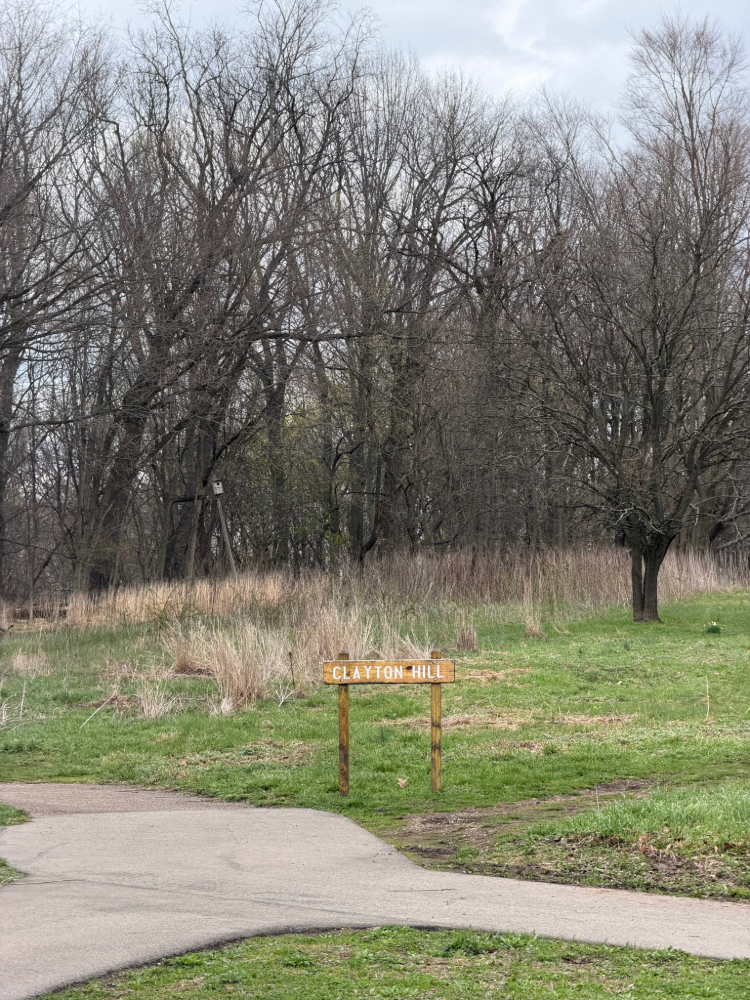
Photo by Grace McNally, 2026. View of Frick Park with trees and background
Sustainability and its Presence in the “Dirty ‘Burgh”
The Frick Environmental Center is located in the Squirrel Hill South neighborhood. It is a three-story environmental center that is owned by the Pittsburgh Parks Conservancy, which is a non-profit organization dedicated to completing park improvement projects. The Pittsburgh Parks Conservancy to date have raised $150 million to complete twenty-four major park improvement projects (“About the Pittsburgh Parks Conservancy”).
The interior of the Frick Environmental Center includes a “third space” living room area, with open windows providing fresh air and shelves stocked with toys for children created out of materials from the park. Visitors are likely to hear the chirping of birds that reside around the park. There is a community garden called “From Slavery to Freedom” at the entrance to the park. The garden educates the public about the experiences of people escaping slavery by featuring plants which would have been consumed along the route to the north. The garden is open to the public, and while any plant may be taken, the Frick Environmental Center encourages visitors to “bring your sampling platter, but do not bring your grocery list” (Conrad). Outside is a community fountain, which was specifically requested by community members when the Frick Environmental Center was being constructed. The Squirrel Hill community initially felt apprehensive about the creation of the Frick Environmental Center due to construction costs. However, Ellen Conrad, a tour guide at the center, wants community members to know that the team “came in with best intentions” to improve parks, sustainability, and green spaces in Pittsburgh (Conrad). Since opening the Frick Environmental Center, the aquatic life around the Center has had an opportunity to improve significantly due to the wetlands implemented by the Frick Environmental Center and the environmentally nurturing aspects of the Center’s architecture.
The outside of the Frick Environmental Center is in modern-style architecture, created specifically to serve not only as a green building, which means the building is carbon neutral, but also as a “Living Building.” Living Buildings must address environmental and cultural needs in the following areas: materials, equity, beauty, site, water, health, and energy. The primary material used for the center was wood, which is more environmentally friendly than concrete. The space promotes equity via ADA accommodations. Accessibility is extremely important at the Frick Environmental Center as it is a component of the Pittsburgh Parks Conservancy’s mission. For example, ADA walking paths run throughout the park, and off-road wheelchairs are available to use. Accessible bathrooms, including gender-neutral options, are available for visitors to use. Additionally, elevators are available. Beauty is an easy component of the Living Building requirements for the Frick Environmental Center to secure due to the natural wildlife and beauty in the surrounding park. All water used in the Center, whether it is for the fountain or bathrooms, is derived from rainwater that is collected in a 13,000-gallon water system (Conrad). Physical and mental health benefits can be achieved by visiting the park (Conrad). “Forest bathing” is a free program that offers mental health benefits by allowing participants to enjoy natural light in a city that is known for its overcast weather (Conrad). Finally, solar panels line the perimeter of the park, creating very low energy bills within the park and expelling extra energy to the power grid. Underground, there are eighteen geothermic wells that are about as deep as the Cathedral of Learning in Oakland is tall (Conrad). Geothermal wells cool and heat the building using the earth’s interior temperature and help to keep the Frick Environmental Center around a moderate 70 degrees year-round (Conrad).
The Frick Environmental Center provides numerous education program opportunities, which vary based on education level. Over 7,500 children participate in programming annually (“Education Programs”). For example, there is a Nature School program designed for ages 3-5 with the goal of practicing “respect and kindness towards others and nature” (“Education Programs”). Conversely, tours allow high school and college students to understand the Living Building certification to gain insight into sustainability. The Pittsburgh Parks Conservatory was “founded in December 1996 by a group of citizens concerned with the deteriorating conditions of Pittsburgh’s historic city parks” (“About the Pittsburgh Parks Conservancy”). Therefore, education geared towards younger generations is a method that the Pittsburgh Parks Conservatory is using to intensify their understanding of environmental stewardship and encourage them to improve Pittsburgh’s green spaces.
A similar location to the Frick Environmental Center includes Schenley Park, which is located in the Oakland neighborhood of Pittsburgh and is also funded by the Pittsburgh Parks Conservatory. Schenley Park has 456 acres and includes activities such as the Bob O’Connor Golf Course and the PNC Carousel in Schenley Plaza (“Schenley Park”). The Schenley Park Visitor Center is open at 9:00am each day and closes at varying times through the week (“Schenley Park”). Additionally, Emerald View Park, also funded by the Pittsburgh Parks Conservatory, has 257 acres and is located in Mount Washington in the city of Pittsburgh (“Emerald View Park”). Activities include 19 miles of trails and the iconic overlook of the Pittsburgh skyline (“Emerald View Park”).
Visitors of the Frick Environmental Center look to the space as a means for cultivating community. The inside of the center is an opportunity for community members to connect with one another for free in a time where free third spaces are limited and isolation is at an all-time high. Free programming and education for children foster equitable opportunities for citizens of all ages. Overall, the Frick Environmental Center is a fantastic resource for families, those interested in sustainability, or those looking to enhance their mental and physical health.
Works Cited
“About the Pittsburgh Parks Conservancy.” Pittsburgh Parks Conservancy, https://pittsburghparks.org/mission-values/. Accessed 15 April 2026.
Conrad, Ellen. Walking Tour of the Frick Environmental Center. Pittsburgh Parks Conservancy, 3 Apr. 2026, Pittsburgh, PA. Guided Tour.
“Education Programs.” Pittsburgh Parks Conservancy, https://pittsburghparks.org/education-programs/. Accessed 9 April 2026.
“Emerald View Park.” Pittsburgh Parks Conservancy, https://pittsburghparks.org/explore-your-parks/regional-parks/emerald-view-park/. Accessed 15 April 2026.
“Schenley Park.” Pittsburgh Parks Conservancy, https://pittsburghparks.org/explore-your-parks/regional-parks/schenley-park/. Accessed 15 April 2026.