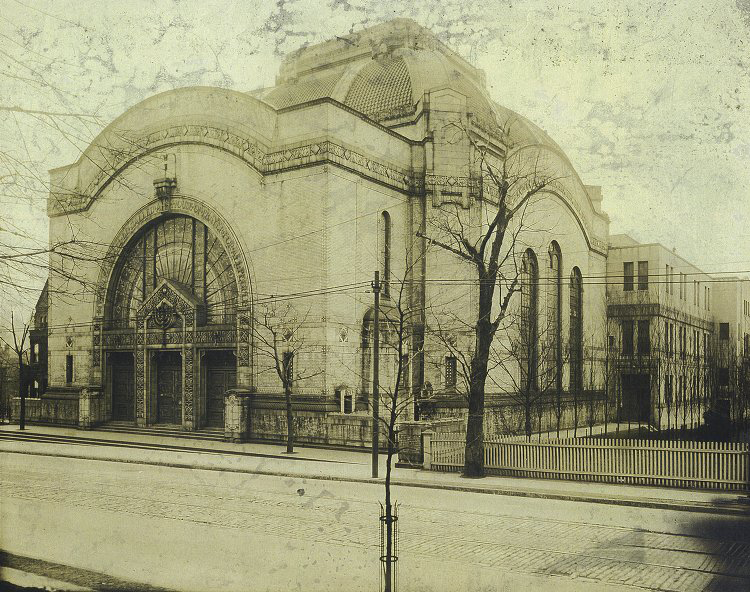
This is the third and current building of Rodef Shalom. “1907 Rodef Shalom Building Exterior.” Rodef Shalom Congregation Photograph Collection, Historic Pittsburgh Site.
Seen and Not Seen
Rodef Shalom has a very colorful and involved history in Pittsburgh. They are the oldest Jewish congregation in Pittsburgh and the surrounding area. Rodef Shalom is more than just the physical building that they are housed in; in fact many of the things that make Rodef Shalom unique have no physical presence or being. The building they are housed in at the moment is their third home; they outgrew their former locations. Rodef Shalom has always put community first, their original location was strategically located in walking distance for all of its members so they could make it to worship on the day of the Sabbath when they were not allowed to use technology or electricity. The being of Rodef Shalom is a combination of the physicality of the building, the people of the congregation, and the community involvement of the two together.
When I first visited Rodef Shalom I had very null feelings about the site. When I thought of “Secret Pittsburgh” what came to mind was Steelers stadium, Point Park, and other major landmarks; not a synagogue. I already had a preconceived notion of what a Jewish temple would be like. In George Robinson’s book Essential Judaism He goes over and explains the Jewish faith, the prayers, the history, the structure of the temple, and the traditions. Robinson states,
The essential structure of the synagogue today reflects the physical structure of the Temple as well. At the front of the sanctuary space is the Aron Kodesh/Holy Ark, containing the Sifrei Torah/Torah scrolls. Hanging over the Ner Tamid/Eternal Light, a visual equivalent of the eternal light of Torah, prescribed by God to Aron and his sons in Exodus 27: 20-22. (Robinson)
The quote shows the traditional structure of all Jewish temples and the meaning and history of their origin. I knew temples to only be places of worship, which is how Robinson’s text describes them. To most tourists Rodef Shalom is a utilitarian space, not a landmark. It is not a place to seek out and visit, unless you need to worship. Rodef Shalom is much more than its physical building and religious purpose.
The Trialectic of Being and the Irene Kaufmann Settlement House
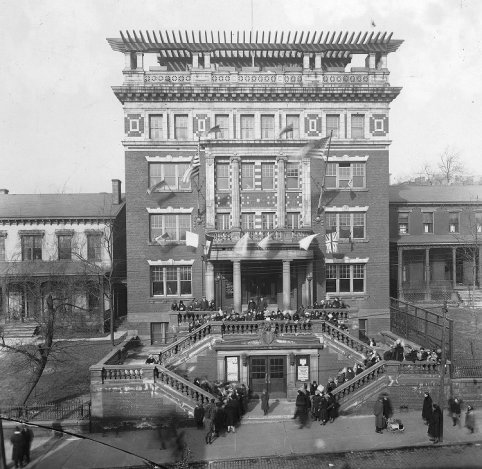
Rodef Shalom uses its space in a more fluid way than other institutions. It is not only a place of worship but fosters many non-secular functions, for example the Irene Kaufmann Settlement house (IKS). The IKS house was the largest settlement house for most of the 19th and 20th centuries in Pittsburgh; in the beginning it served mostly the Jewish population. In the settlement house there was a school, introductory English classes for migrant children and their parents, and many health services provided. When it first started out it was small enough to be housed in a few empty rooms at the Rodef Shalom building, but as it grew it required its own larger space.Rodef Shalom and the Rabbi of the time reached out to the Kaufmann family of the congregation to finance a new larger building to house IKS. The Kaufmann family named the building after their deceased daughter Irene. The spatiality of the two groups started out as one physical building but as time progressed they separated. Even though the two were not connected anymore the formation of IKS was linked to Rodef Shalom and many of the services in the new building were still provided by members of the congregation. IKS and Rodef Shalom served the community as a whole providing services to anyone no matter their religion. The sociality of the space expanded as the program grew to serve more people.
Space either present or non-present, physical or non-physical plays a major role in the current being of Rodef Shalom. Space is commonly thought to mean only the physical measurements of a building or place, but it has many other components that don’t meet the eye. Theorist Edward Soja breaks down and explains space with different trialectics. I will be using the Trialectic of Being to help explain the space of Rodef Shalom. The three components of the “Being” trialectic are spatiality, historicality, and sociality. Spatiality according to Soja combines the ideas of physical and conceived or imaginary spaces. Rodef Shalom has its physical space in the building it is housed in, although its conceived space is how it has interacted with the community throughout history. An example of this conceived space would be the history of the Irene Kaufmann Settlement house, as entailed before, Rodef Shalom helped found IKS but as time progressed the two organizations diverged. The two organizations are no longer connected physically. IKS is part of the space of the Rodef Shalom because it is part of spatiality of the organization. Historicality is the idea that events in history help mold the space of a being. IKS also serves as a good example for this because; the histories of the two organizations are intertwined and neither would be the same today without each other. Sociality is how a being interacts with the world around them. For Rodef Shalom the sociality is represented in all the services they provide now and in the past to the community. For example, Rodef Shalom offers bridge games every Monday and a private library to its members; both of these show the sociality of the being of Rodef Shalom.
When I went on my initial tour of Rodef Shalom there was no mention of IKS at all, I only learned about it through my personal outside research. This calls into question of historicality. IKS has almost been forgotten in its relation to Rodef Shalom both through the spatiality and sociality aspects. Historically IKS will always be a part of Rodef Shalom, just not as many people may know about it. Rodef Shalom involvement in IKS shows their community outreach and ideal of service. Even if the connection of the two beings is lost, the way that they shaped each other is still present today. On Rodef Shalom’s personal website (insert link here) they have a whole page dedicated to their history, nowhere on that page is there mention of IKS. Something so integral to the congregation and the city of Pittsburgh has been omitted on their personal history page. The connection between the two has become weaker through time but the impact of their time together is still felt in the city and carried though in the ideals of the congregation of Rodef Shalom today.
The Trialectic of Spatiality and Tamara
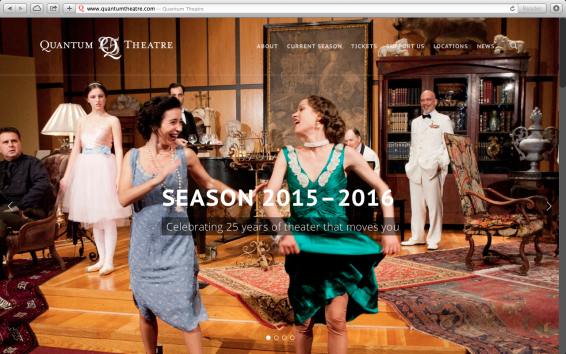
Rodef Shalom also challenges traditional ideas of space within the physical space of their building. Just recently in the spring of 2014 Quantum Theater Company, a local Pittsburgh company, collaborated with Rodef Shalom to use their space to put on a play. The play called Tamara took over the entire building except the sanctuary. It was an immersive production where the actors and sets encompassed the entire space and viewers walked around from room to room following the characters. Quantum changed the space of Rodef Shalom; spaces that were originally auditoriums or rooms of worship were now stages or dressing rooms. The entire building that was once a religious site was now a theater for four weeks. People who would have never come to Rodef Shalom were now part of the physicality and history of the space. Rodef Shalom allowed their space to be changed and altered dramatically, until it was almost unrecognizable as a temple. Quantum transformed and changed the being and space of Rodef Shalom temporarily.
By allowing the playhouse to take over the space Rodef Shalom also altered their perceived space. Perceived space is space that we can see, touch, feel, and smell. Soja further expands the idea of spatiality with its own trialectic. The trialectic of spatiality consists of perceived, conceived, and lived. The conceived space is the imaginary spaces and what we cannot see. The lived spaces are how we use space and how it affects our life, its kind of like a combination of perceived and conceived. For Rodef Shalom, the perceived space is the physical building they are in and what that means. I perceived the building as boring and utilitarian when I first visited. I had no idea about the community involvement and non-secular activities that Rodef Shalom has participated in. The conceived space of Rodef Shalom is similar to how they transformed the space into the theater production. Even though the sets and actors are no longer there when you walk through the space their past presence affects how you interact with it. The conceived space is anything that affects how you perceive the space in the moment that is not physically there. Lastly the lived space of Rodef Shalom is the combination of the two. The lived space is how we interact with the space and how we affect it based on what we can perceive and conceive about the space. My personal lived experience of Rodef Shalom is shown through my shift in appreciation. I went in thinking it would be boring but, through my research of Rodef Shalom my opinion of the space has changed. Even if I could not see the play happening, I knew it occurred and that changed how I saw and interacted with the space. The lived experience of space is a two way street. Conceived and perceived space affects how we humans see a space, but how we interact and change a space affects the conceived and perceived space in the future.
Rodef Shalom is an important pillar of the community. It is not just a place of worship; it also acts as a pseudo-community center for members and non-members of the congregation. Rodef Shalom is an integral part of the history of Pittsburgh. From the first congregation to the opening of the school and IKS, Rodef Shalom has concreted them selves as a member of the community and history. Through their use of physical and non-physical space Rodef Shalom has fostered their legacy of community involvement. The use of historicality, spatiality, sociality, conceived, perceived, and lived space helps to fully encompass the broad realities of what Rodef Shalom has done throughout history and the meaning of that in the present time.
Works Cited
“About Us.” RODEF SHALOM BIBLICAL BOTANICAL GARDEN. N.p., 11 Mar 2014. Accessed 16 Dec. 2015
“History.” Rodef Shalom. Rodef Shalom, 02 Oct. 2014. Accessed16 Dec. 2015.
Robinson, George. Essential Judaism: A Complete Guide to Beliefs, Customs, and Rituals. New York: Pocket, 2000. Print.
“Social Action.” Rodef Shalom. N.p., 24 Sept. 2014. Accessed 17 Dec. 2015.
Soja, Edward. Thirdspace: Journeys to Lost Angeles and Other Real-and-Imagined Places. Cambridge MA: Blackwell Publishing Inc., 1996. 53-70.
Image 1
“1862 Rodef Shalom Building.” 20121102-hpicrsc-0001 Rodef Shalom Congregation Collection. Historic Pittsburgh, University of Pittsburgh, Pittsburgh, Pennsylvania. Accessed 16 Dec. 2015.
Image 2
”1901 Rodef Shalom Building.” 20121102-hpicrsc-0002 Rodef Shalom Congregation Photograph Collection. Historic Pittsburgh, University of Pittsburgh, Pittsburgh, Pennsylvania. Accessed 16 Dec. 2015.
Image 3
“1907 Rodef Shalom Building Exterior.” 20121102-hpicrsc- 0003 Rodef Shalom Congregation Photograph Collection. Historic Pittsburgh, University of Pittsburgh, Pittsburgh, Pennsylvania. Accessed 16 Dec. 2015.
Image 4
“President Taft’s Visit to Rodef Shalom.” 20121102-hpicrsc-0006 Rodef Shalom Congregation Photograph Collection. Historic Pittsburgh, University of Pittsburgh, Pittsburgh, Pennsylvania. Accessed 16 Dec. 2015.
Image 5
“Anniversary Celebration”. 7812.129.IKS, Oliver M. Kaufmann Photographic Collection of the Irene Kaufmann Settlement, January 1918. Historic Pittsburgh, University of Pittsburgh, Pittsburgh, Pennsylvania. Accessed 05 Nov. 2015.
Image 6
Screenshot of Quantum Theater’s landing page, depicting the cast of the play Tamara. Tamara was written by John Krizanc and Richard Rose, it was directed by Karla Boo and John Shepard and preformed at Rodef Shalom from August 7th to September 14th 2014. Screenshot taken on December 16th, 2015.