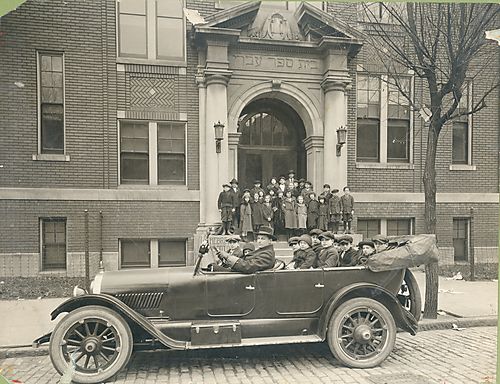

First Hebrew Institute bus outside of 1908 Wylie Ave, creator unknown, 1921
Reuniting the Hill through We-newal
The Hill looks nothing like it used to. The Civic Arena ate what were once the most thriving parts of the Lower Hill, and Pitt’s athletic fields span into the Upper Hill. It’s a story that can be a bit depressing when learning about the vibrant, thriving community of the Hill District in the 1940s-60s. Over the years, as the Hill has shrunk in geographic size, the community went through change too. Now, the University of Pittsburgh is looking to strengthen their relationship with the Hill in ways that benefit everyone involved. The Community Engagement Center (CEC) is just one way the University is embracing “we-newal” in the Hill, the idea of urban renewal that includes the community and residents that existed there beforehand.
On centrally located Wylie Ave sits a large, old, unassuming brick building which has a history deeply rooted in community. It has served as a social and educational space for decades. Initially, from 1916 to 1943, the large schoolhouse-like building housed the Hebrew Institute of Pittsburgh, which provided schooling to immigrant Jewish children. When the organization shifted their operations to Squirrel Hill, a new opportunity arose for 1908 Wylie Ave.
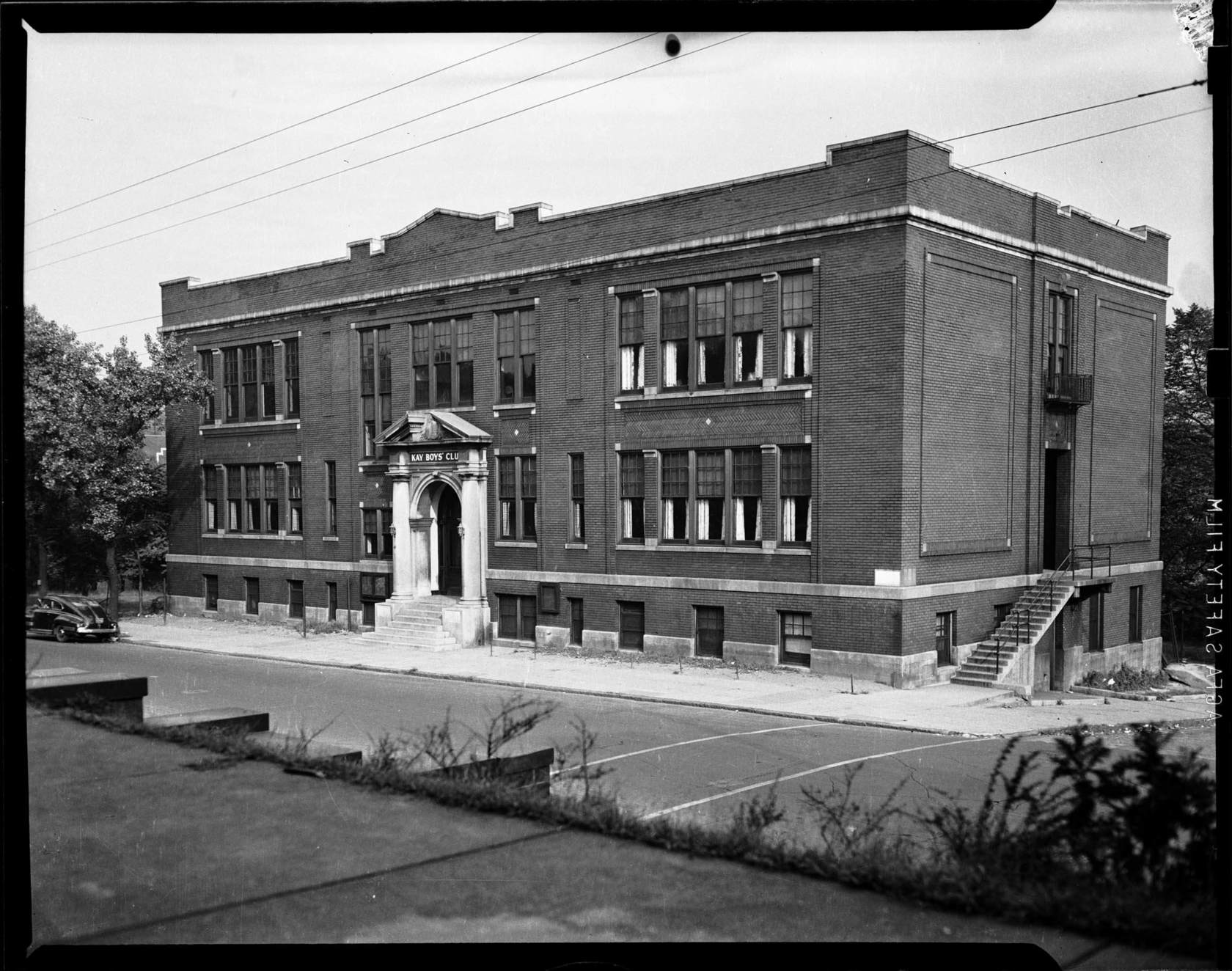
The Kay Boy’s Club was fundamental for the Hill District in a time of need. The social club arose out of the economic depression in the 1930s with distinct values of health, character, and good citizenship (Howell, 1944). They put special emphasis on boys’ lives and aimed to combat the anti-social attitudes arising at the time: unemployment, delinquency, and poor health were all contributing to the problem. Inside, physical activities such as boxing matches took place. The social center would thus remain a community space, this time for Hill District boys and men.
In more recent years, the large brick building was home to the Hill House Association’s Blakey Center. The Hill House Association held programming for senior citizens and other community engagement events focused on arts and entertainment (Taylor, 2018). Beyond their presence at 1908 Wylie Ave, the Hill House Association proudly opened a Family Dollar store in the Hill and would later open a grocery store to erase the neighborhood’s status as a food desert (McGowen, 2019). With mounting debts, the Hill House Association made the difficult decision to sell off their properties and cease operations. While some of their programs were picked up by other local organizations, the historical community building on Wylie Avenue sat mostly empty.
Buildings are places with stories, and although the building was empty, it was not the end of 1908 Wylie’s story. It would not be long before the University of Pittsburgh took interest in the historical brick building. This time, the University sought to convert part of the building into a Community Engagement Center (CEC). The mail goals of these CECs are to better the lives of children, youth, and families, share knowledge and resources, and above all, build stronger relationships between the local communities and the University (Miksch). Creating the CECs was a task that required careful consideration; urban renewal has left many scars on the Hill District, and the University had to be sure this time was different. The main way of changing these negative attitudes would be through “we-newal”. The idea focuses on revitalizing and reinvesting in the existing community, rather than gentrifying and displacing the former community. The property at 1908 Wylie Ave was the perfect opportunity for Pitt to reunite the Hill community with the space.
We-newal is multifaceted. It involves everything from what kind of buildings are used, how the interiors are structured, and what they offer. For the Hill CEC, we-newal means being greeted by a staff member, not a uniformed security guard. It also means ensuring that Pitt chooses to invest in existing architecture, rather than constructing new buildings. The University has committed to leasing existing structures to ensure that the money goes back into the Hill District instead of the University itself. It was heartening to see the lack of Pitt branding both inside and outside of the building. Currently, they have committed to at least 15 years of investment in the Hill District. The longevity of their commitment is impressive and genuine, and hopefully continues past just 15 years.
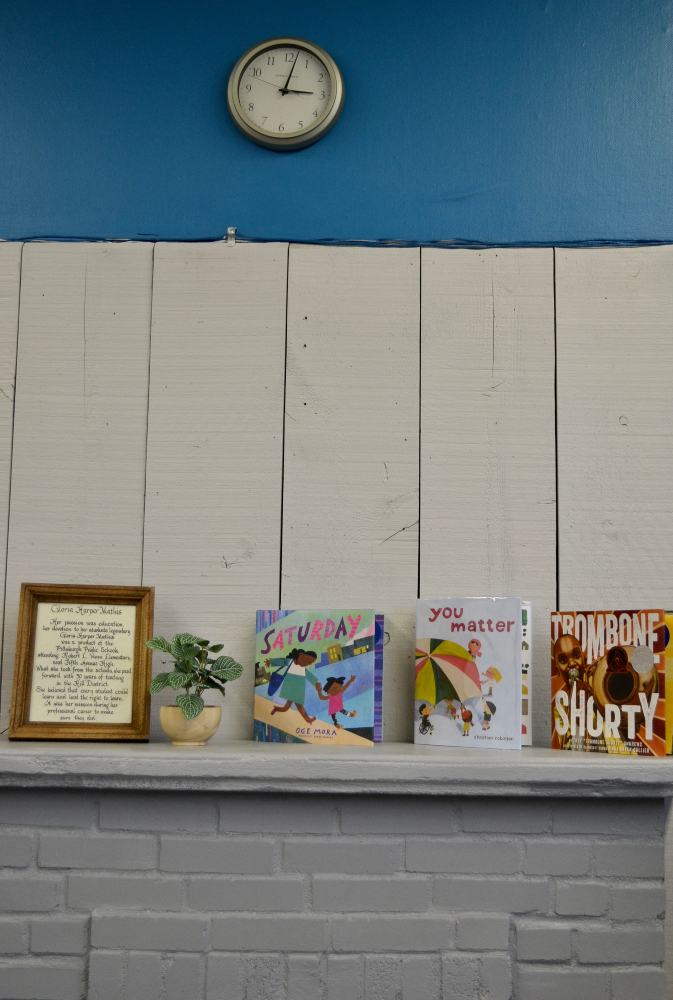
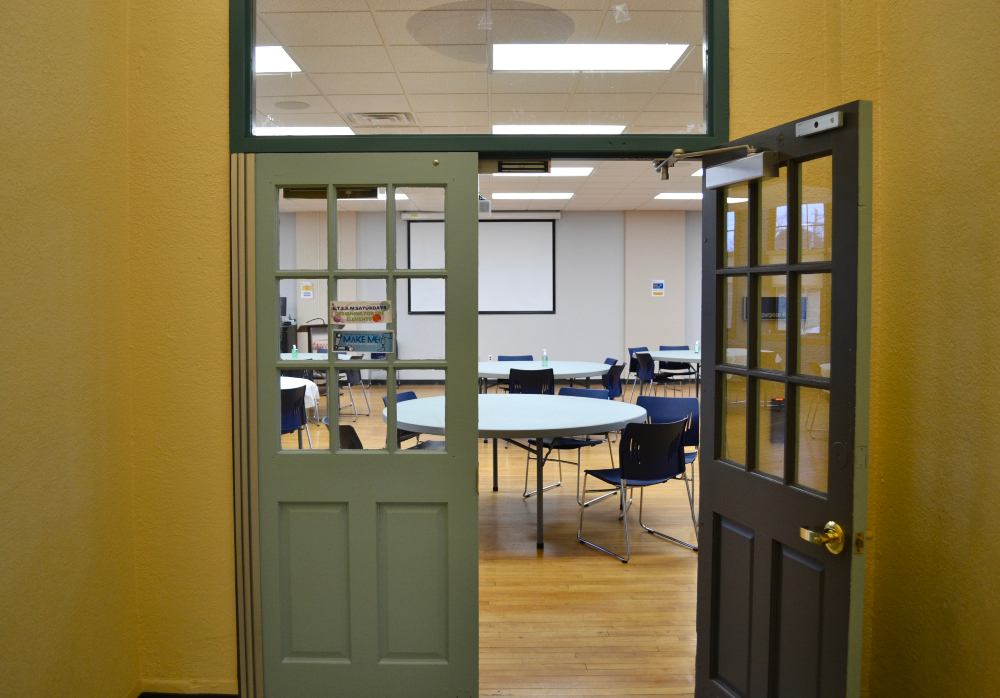
When inside of the CEC, it does not feel like a modernized research space, but a modestly decorated historical building. The paneling remains with a few cracks on the walls, but the room itself is equipped with modern technology, perfect for their STEAM Saturdays programming for 3rd to 8th graders and I.T. 101 program for high schoolers. Beyond children and adolescent programs, the CEC offers support groups, opportunities to meet with career counselors, and workshops. Anybody within the Hill District and/or the University can reserve a room for their club or organization for free. In many ways, the CEC is filling the gaps that the Hill House Association left.
Another way Pitt is dedicated to making the CEC a place for the Hill first, and the University second is by not allowing for research participation recruitment on the CEC’s grounds. Instead, 1908 Wylie Ave inadvertently conducts research through a public health clinic operated by Allegheny County in the building’s basement. At the clinic, anyone over the age of 13 with photo identification can receive testing and education on sexually transmitted diseases. The most valuable part is that it is all free. Between the University of Pittsburgh’s Community Engagement Center and Allegheny County’s public health clinic, 1908 Wylie is once again serving the Hill District community.
The residents of the community are perhaps the most important part of we-newal. The Hill CEC elects their own neighborhood advisory council, which Keith Caldwell, director of the University’s Place Based Initiatives, specifies is not a sanctioning body, but a “co-collaborative” one. The council can voice their opinions to be sure they align with the University’s goals within the Hill District. After all, the inclusion of residents is in the name: there is no renewal without “we.” Caldwell stressed that if there is a community reluctant to accept outsiders, there is probably good reason behind it. In the case of the Hill, their community has been nearly erased by the city which left many not only displaced, but also untrusting. The University’s relationship with the neighborhood advisory council is working to change this by including residents in important decisions. For once, the Hill residents are being heard.
Fighting the typical ways of urban renewal is no easy task. The University runs many risks of looking like they too just have ulterior development motives. It is evident that Pitt knows what needs to be done, and the Community Engagement Center is a positive example of what spaces can do for a community. With even more redevelopment underway in the Lower Hill, having a free and accessible community space will be more important than ever.
Works Cited
Howell, W.M. “The Hill District: Organizations: Kay Boys’ Club.” Www.info-Ren.org, www.inforen.org/projects/btul/exhibit/neighborhoods/hill/hill_n72.html. Accessed 14 Apr. 2023.
Miksch, Joe. “Pitt Reimagines Community Partnerships: New Community Engagement Centers to Create Mutual Benefits for Pitt and Communities.” University of Pittsburgh News Services, 2016, https://www.news.pitt.edu/news/pitt-reimagines-community-partnerships.
“Pitt CEC: Hill District.” Pitt Neighborhood Commitments, cec.pitt.edu/hilldistrict/. Accessed 14 Apr. 2023.
Records of the Hebrew Institute of Pittsburgh, 1963-1992, MSS#512, Rauh Jewish Archives, Senator John Heinz History Center, http://www.jewishhistoryhhc.org/uploads/7fe386c0- 85f5-4b18-963b-f25abc599f2b.pdf. Accessed 6 Apr. 2023.
Taylor, Rob,Jr. “Hill House Association Faces Tough Decisions.” New Pittsburgh Courier, Aug, 2018, pp. A1,A4. ProQuest, http://pitt.idm.oclc.org/login?url=https://www.proquest.com/newspapers/hill-house-association-faces-tough-decisions/docview/2108199101/se-2. Accessed 10 Apr. 2023.