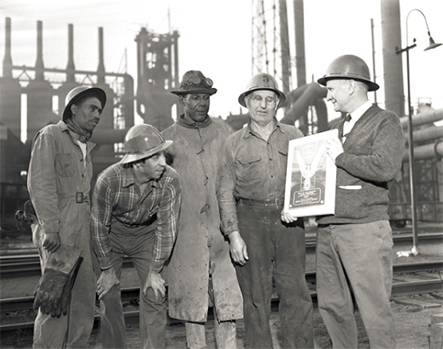
Workers at Carrie Furnaces accept a National Safety Award.
Memories of Molten Metal
As an outsider to Pittsburgh and its history of steel, I find the relationship that residents of the city have with the steel industry to be fascinating and perplexing. A combination of pride and guilt is mixed into that relationship and nowhere is this mixture more obvious than in Carrie Furnaces. The road leading to it misleadingly displays a “Road Closed” sign even though the road is passable, a fact that would suggest visitors aren’t welcome, despite the operation of tours. Up close, the site looks abandoned and forgotten – the machinery that was once alive now rusts silently. While there is much that stands out about the daunting giant that is Carrie Furnaces, what was most striking to me was that silence. It was difficult to imagine that this was once a place where the typical day was filled with “clouds of foul air and…endless grinding of gears and wheels and the shrieks of escaping gases” (Standiford 147).
I found myself wondering, why, if it’s so important to Pittsburgh’s history (so much so that it’s a National Historic Monument), isn’t Carrie Furnaces completely remodeled into a functioning museum fully open to the public? Why is it left in a limbo state of maintained slow decay between a full museum and inaccessible ruins? The simple answer is that “it’s a process,” as Ryan Henderson, the site manager, put it. Despite having plenty of material to display to the public, they haven’t been able to gather enough funds or a full-time staff to help them do so, so the complete rebirth of Carrie Furnaces has turned into an “in an ideal world” scenario. But the answer as to why these complications have risen lies in that aforementioned complicated relationship.
One person looks at the Furnaces and sees the dark and forbidding stacks as a reminder of the suffering of the workers who had to deal with grimy and dangerous conditions at the benefit of rich and ruthless industrial tycoons. Another looks at the Furnaces and sees the soaring stacks reaching for the sky as a reminder of American romantic ideals of progress in industrialization and the glory of honest hard work. Perhaps the reason why we struggle to properly create a monument to that past is because we disagree so much on how to remember it. The reason for the difference in their views lies in the memories of the person looking. Often, the first person is one who wants to forget. They’re now focused on a new Pittsburgh of technology and education that has no room in its shiny new identity for the soot of the steel age. The second is often former steel workers, or those with connection to those workers, who yearn to be remembered. They know about the dark underbelly of the steel industry, but they also see the benefits that came from it. To avoid the source of those benefits would be to brush aside those who worked themselves to death, in some cases, to create them. They recognize the importance in simply remembering. As cultural critic John Berger writes, “memory implies a certain act of redemption. What is remembered has been saved from nothingness. What is forgotten has been abandoned” (Berger 58). And we shouldn’t abandon those hard-working steelworkers.
Our tour guide, Jim Kapusta, seemed to embody the contradiction between these two views. The stories he told on the tour alternated between somber descriptions of the harsh conditions and light hearted jokes about his buddies and coworkers. He went from recounting a horrible accident he once witnessed, wherein a man fell screaming into the trough filled with boiling water. When they lifted him out and removed his gloves, “the skin came with them,” he said, but that didn’t stop their foreman from pushing this man back to work in the same spot a few months later. Shortly after telling this horror story, our guide’s eyes lit up in amusement as he fondly remembered how he and his buddies used to use the searing hot blowpipe to cook roast beef and have their own Thanksgiving under the furnace. After chuckling about a time that he threw a hot dog into the furnace to watch it instantly evaporate with a hiss, he went on to matter-of-factly state that he’d “seen people lose fingers, lose legs.” At another point, he went from saying “It was miserable” to “I loved it.” Despite presenting a balance between the two in some ways, it was clear that Jim was of the opinion that the spirit of Carrie Furnaces needed to be preserved. That spirit is not of the unforgiving, 3000-degree furnace or of seemingly ruthless steel tycoons like Henry Frick, but of the people Jim worked with – “the hardest workers you’d ever know…[his] buddies,” as he put it.
So the questions raised by Carrie Furnaces become, do we celebrate the hard work of steel workers, and in so doing, inadvertently celebrate the negative effects of the steel industry as a whole? Or do we try to move away from those negative effects, but in so doing, erase the legacy of hard work of those workers? Or is a balancing act possible? Can we preserve the past steel age and the identity of Carrie Furnaces during its glory days while working towards a redesign that looks toward the future of Pittsburgh and speaks to its identity today? Despite the difficulties they’ve faced in officially restoring the site, that balancing act is certainly being attempted through less official channels. Looking around the site, you can see areas where nature has reclaimed its property. Wildflowers sprout up among the leftover remains of coke. Weeds grow between the cracks of the concrete walls.
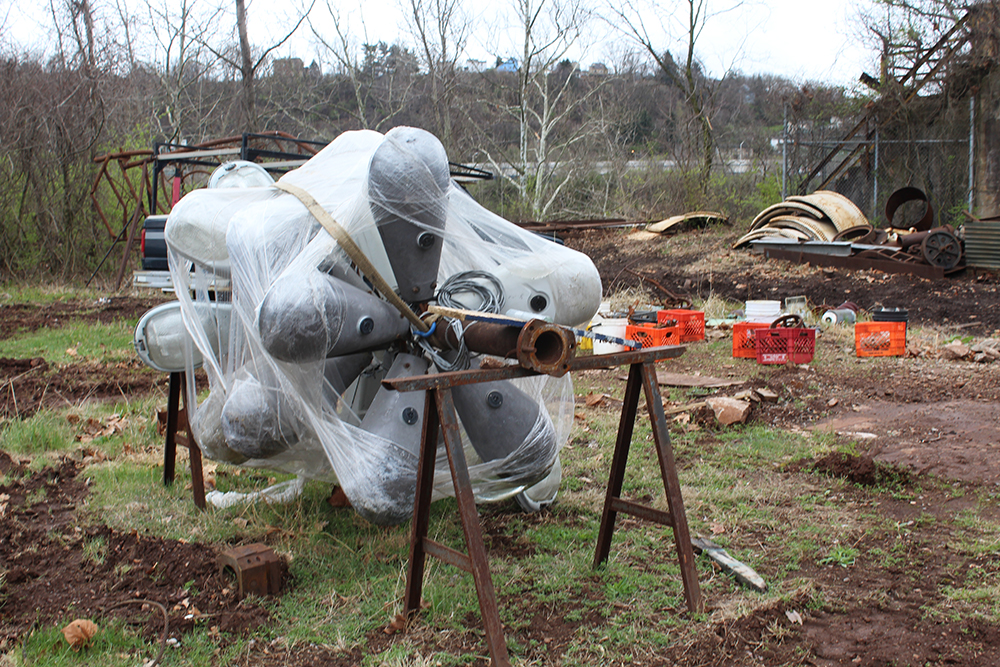
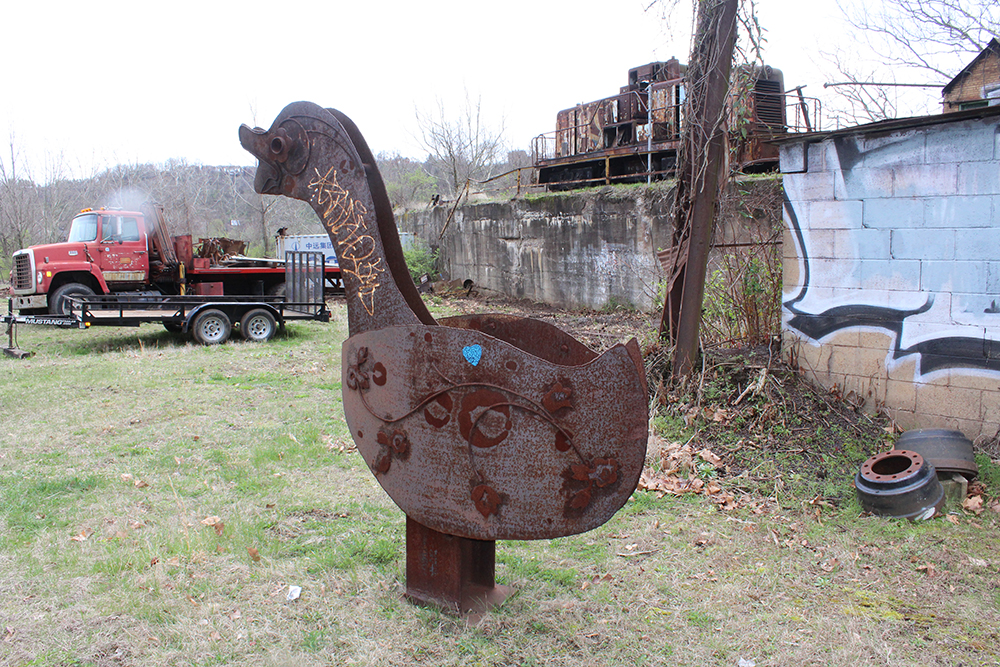
However, local Pittsburgh artists have both sped up and twisted this process of nature’s restoration. Sculptures made out of scrap metal collected from the site are scattered throughout, and most call back to nature in some way. The famous Carrie Deer, the first art installation to appear, is present alongside a duck with floral designs, a flower made of plastic and metal, a rocking horse, and a garden of scrap metal arranged like a flowerbed. The sight is one reminiscent of the story “How Pittsburgh Returned to the Jungle” in its description of how a “city hitherto notorious as being devoted to naked industry was now featured on all American tours for its beauty, and became the mecca of the recently married” (Long 2). Setting aside the fact that Carrie Furnaces is indeed a popular wedding spot, it’s important to highlight how this applies to these works of art. Art is something that emphasizes beauty, so to create art literally out of the remnants of industry (as artists do at Carrie) is to emphasize the beauty in industry. It’s not that these artists have set aside or replaced the harsh realities of the grime and darkness that ruled when the Furnaces were in operation with beauty, but that they’ve attempted to embrace that grime and darkness and turn its memory into something beautiful as a salute to those whose livelihood was connected to it.
There is no doubt that the men who worked at Carrie Furnaces struggled and endured the worst possible conditions a human can endure – “when human flesh and blood could stand no more it got up at five in the morning as usual and put on its work clothes and went into the mill,” as Braddock native Thomas Bell sums it up in Out of this Furnace (Bell 48). But there is also no doubt that while they endured that, they formed bonds with their fellow workers that couldn’t be broken and that wouldn’t have been formed without the steel industry. Jim was a prime example of that, as are many other workers who display their stories on the Rivers of Steel website, such as Robert Jackson, who, after describing those miserable conditions, states, “I’ll never forget those days and the men I worked with. I wouldn’t change it for anything.” In a similar fashion, the city prospered economically in a way that wouldn’t have been possible without the steel industry, so they too are forced to have a sense of pride for it. Both the city and workers of Carrie Furnaces might be, in some ways, “almost as much a product of that mill down there as any rail or ingot they ever turned out” (Bell 410). Like it or not, the steel industry was a part of Pittsburgh, and our nation, for centuries. Carrie Furnaces, by the very fact that it still exists (although no longer preserved in prime condition) stands as a symbol and memory of that industry. And by the small steps of restoration they continue to take through art, it may one day also stand as a symbol of rebirth and renewal.
Works Cited
Bell, Thomas. Out of This Furnace. University of Pittsburgh Press, 1976.
Berger, John. “Uses of Photography.” About Looking. New York: Vintage International, 1991. N. pag. Print.
Henderson, Ryan. Personal interview. 7 April 2017.
Jackson, Robert. “First Day on the Job.” Rivers of Steel – First Day on the Job. Rivers of Steel National Heritage Area, n.d. Web. 13 Apr. 2017.
Kapusta, Jim. Personal interview. 7 April 2017.
Long, Haniel. “How Pittsburgh Returned to the Jungle.” The Nation, edited by unknown, 1923, pp. 717.
Standiford, Les. Meet You in Hell: Andrew Carnegie, Henry Clay Frick, and the Bitter Partnership That Transformed America. New York: Crown, 2005. Print.