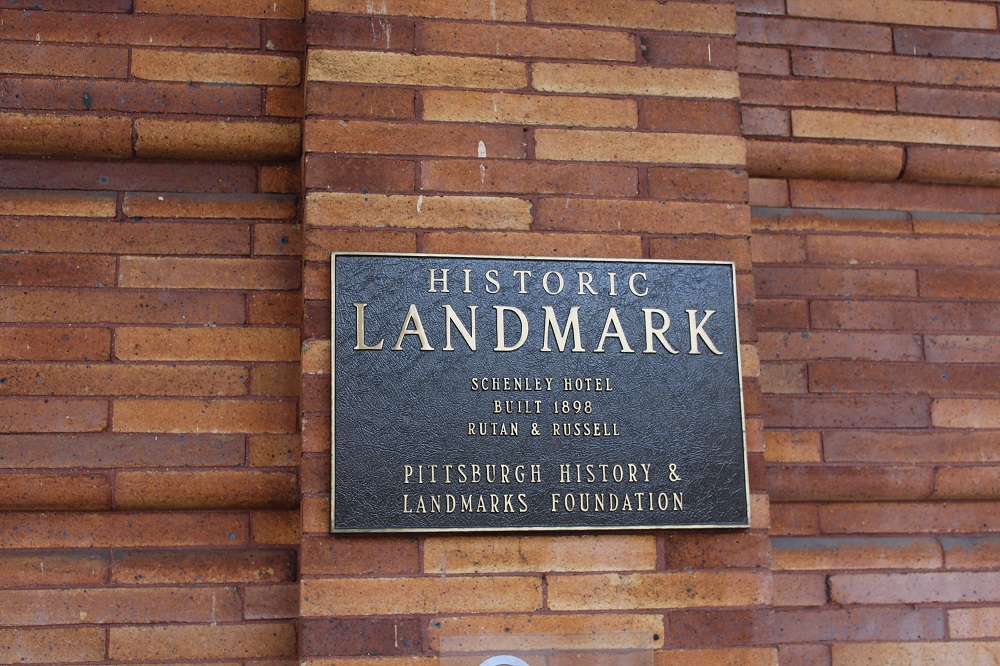
This plaque on the William Pitt Union is one of the only ways to see from the outside that it was previously the Schenley Hotel. Photo by Jon Rutkauskas.
Links Across Time and Reality: Experiencing the Paul’s Case Walking Tour
It’s a sign of a good book when you can get so immersed in the story that you forget where you are and have to look around for a few seconds to remember after you finish reading. On the Paul’s Case Walking Tour, that experience is completely flipped, and I learned that it is possible to be fully immersed in a text while still being fully immersed in the real world.
It was a cold winter day when my classmates and I were given a map made by our professor and sent out into Oakland with our copies of Paul’s Case, attempting to visit as many places as possible in our limited time. This map would later be revised and included as a part of the guidebook entry for the Willa Cather House.
“As for Paul, he ran down the hill whistling the soldiers’ chorus from “Faust,” looking wildly behind him, now and then, to see whether some of his teachers were not there to writhe under his light-heartedness.” (Cather)
I started at the beginning of the story, with a high school standing-in for Paul’s. As I stood outside the school, freezing cold in the winter, pages of the story flapping in the wind, I was anything but immersed. I hastily read the pages describing Paul’s struggles at school, and I imagined the emotions he would have had from them. Moving quickly on to the next location, I walked down the hill, as he did from school, and at this point I began to connect with Paul, at least a little. He was happy to get away from his messy school life, and I was happy to get moving in the cold so I wouldn’t freeze as much. Though our reasons were quite different, we were both happy to get away from that school.
“As it was now late in the afternoon, and Paul was on duty that evening as usher in Carnegie Hall, he decided that he would not go home to supper, but would hang about an Oakland tobacconist’s shop until it was time to go to the concert hall.” (Cather)
I eventually got back to Forbes Ave (after having the classic Pittsburgh experience of ‘you can’t get there from here’), and I walked towards the museums. Strolling through the neighborhood, I continued reading and reached the music hall. Reading about the music hall in this 100+ year old story as I stood outside its doors felt very strange to me. I was at the actual location in this fiction, not a comparable place, not a recreation, but the actual exact spot where Paul would have been in the story. I had never experienced anything like this with literature. I excitedly continued reading, energized to continue to follow Paul’s footsteps.
“During the last number he withdrew, and, after hastily changing his clothes in the dressing-room, slipped out to the side door where the soprano’s carriage stood. Here he began pacing rapidly up and down the walk, waiting to see her come out. Over yonder the Schenley, in its vacant stretch, loomed big and square through the fine rain, the windows of its twelve stories glowing like those of a lighted cardboard house under a Christmas tree… Paul followed [her] carriage over to the hotel, walking so rapidly as not to be far from the entrance when the singer alighted and disappeared behind the swinging glass doors” (Cather)
At this point I was able to follow along line-by-line with the story. I left the music hall after briefly listening to the music that might have played there, and I made my way back on to Forbes. I looked down the street towards the referenced Schenley Hotel (now the William Pitt Union), and I could picture this street as it would have been. I could see the rushing carriages in the night and feel the allure of the exquisite hotel drawing me in after the show, all superimposed on this street I’ve walked down countless times. I skittered down the street, unable to follow any carriages in my modern experience. Still, I felt the energy Paul had as he hurried to catch a glimpse of the life he dreamed of.
“In the moment that the door was ajar, it seemed to Paul that he too entered. He seemed to feel himself go after her up the steps, into the warm, lighted building, into an exotic, a tropical world of shiny, glistening surfaces and basking ease. He reflected upon the mysterious dishes that were brought into the dining-room, the green bottles in buckets of ice” (Cather)
I reached the William Pitt Union, the jewel of this tour, and this passage describing it as it was when the story was written. It was certainly a new perspective for me; since the building seems so plain and ordinary now, it’s hard to believe it was such a prestigious and exclusive establishment. Here, I could do something Paul was unable to: go inside. I entered the building as I had dozens of times before, and again, it felt different this time, with Paul’s thoughts and imagery able to blend with my own. I walked towards the back of the building, where some of the original design remains, and I was able to further immerse myself in the story. I looked up at the marble columns, the decorated ceilings, and imagined myself a guest at the hotel. I could certainly see why Paul envied this life. I walked outside, and slowly began to bring myself back to the present, back to reality.
[A side-by-side comparison of the hotel at it was in 1900 to today is available at this link]
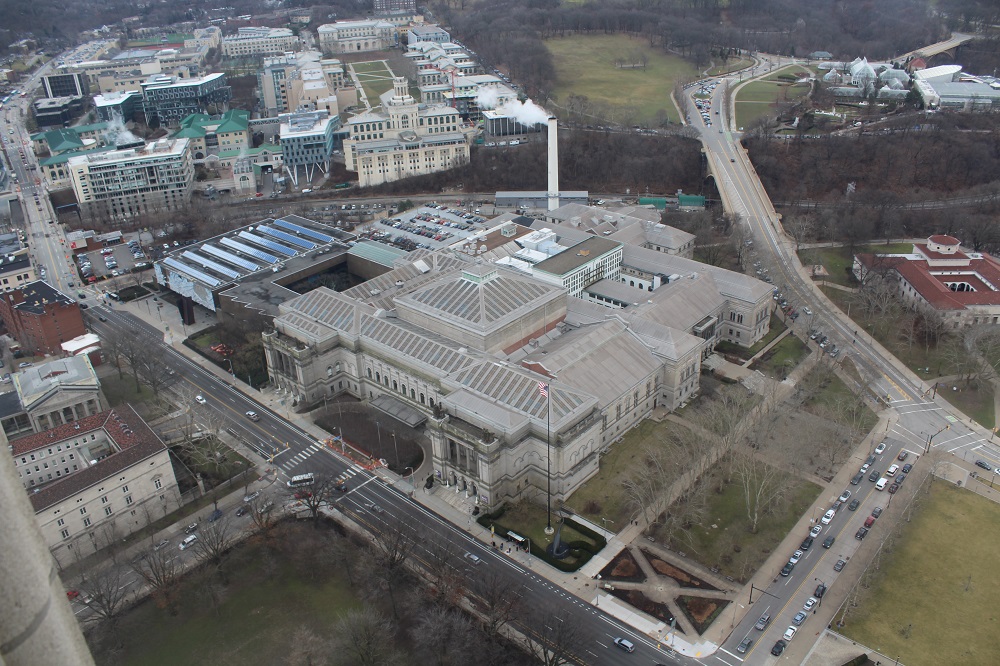
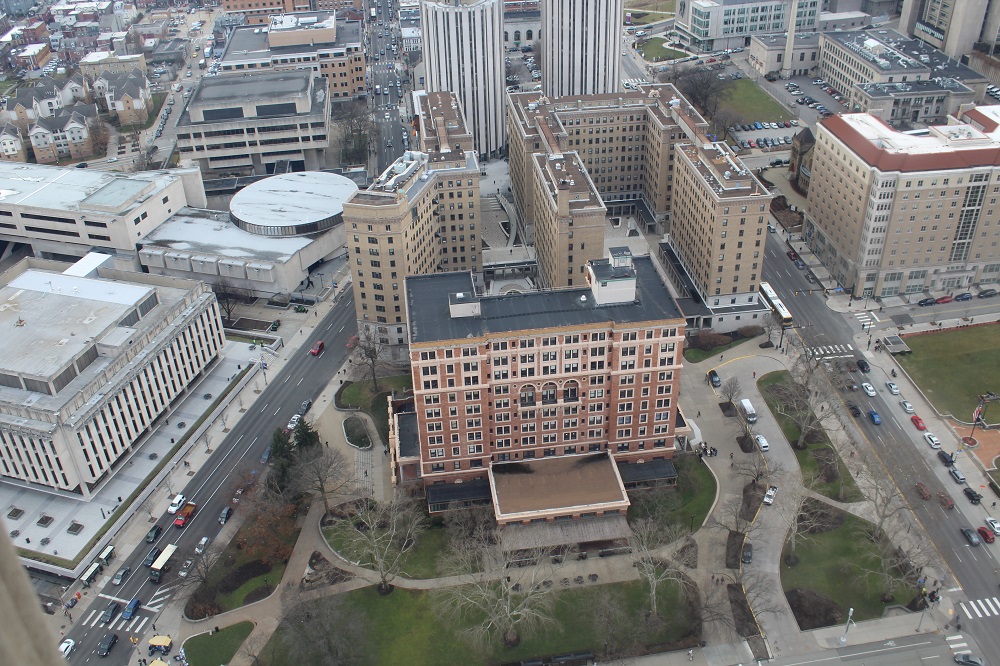
I crossed the street, to the Cathedral of Learning, and took an elevator up to the highest floor I could, the 36th floor. I got out of the elevator, popped my ears, and walked over to a window. From here, I could see for miles. I looked down towards the music hall, where I had been just a short while ago. It was a completely different experience. When I was walking on the street, immersed in the story, I felt the space from both times and both the reality and the fiction. From here, none of it seemed real. The massive street looked so miniscule. It felt like I was just looking at an image. This was yet another perspective I needed to merge with my other experiences. I walked to another window, looking down at the Union, and it too was different. From the outside, the Union hasn’t changed much from when Paul would have seen it, aside from some landscaping. From this high up, it was difficult to discern any details about the people walking on the street. They were just students going to the Union, but from this view, they could have been musicians and wealthy businesspeople walking out of their hotel. From up here, the time that had passed seemed much less significant, and had I never been there, I could have been convinced that the hotel was still there.
As I put my copy of the story away, took the elevator back down, moved on with my day, walking back to the classroom, I started parsing my experience. When we walk through a space, we not only perceive it in its present state, but we combine that with our past experiences and prior knowledge to create our full understanding. It’s useful to describe this experience with Edward Soja’s concepts of spatial theory and types of space. Reading the story this way took the information I was actually seeing and feeling of these places, my concept of ‘perceived space,’ and my own personal thoughts and history with these places, the ‘lived space,’ and combined those with the descriptions of places in the story, the ‘conceived space.’ By combining these spaces, I was able to understand and immerse myself in the literature better than I ever could just by reading or looking at pictures. I also was modifying my own understandings of the spaces, adding more to my own ‘lived space’ (Soja). So, it’s a bit of a symbiotic relationship, with my understandings of the spaces strengthening my understanding of the story, and the story improving adding detail to my understanding of the spaces. I think this is a very powerful way to read literature, and so different from the traditional method of blocking out your surroundings and trying to create a mental image of the story. Although it’s not possible to do to every piece of literature, when there is the possibility, it’s certainly worth it to try.
Works Cited
Cather, Willa. “Paul’s Case” The Willa Cather Archive, 1905, https://cather.unl.edu/ss006.html. Accessed 24 April 2019.
Detroit Publishing Co.. “Schenley Hotel, Pittsburgh, Pa..” Library of Congress. https://www.loc.gov/resource/det.4a09238/.
Soja, Edward. Thirdspace: Journeys to Lost Angeles and Other Real-and-Imagined Places. Cambridge MA: Blackwell Publishing Inc., 1996. 53-70.