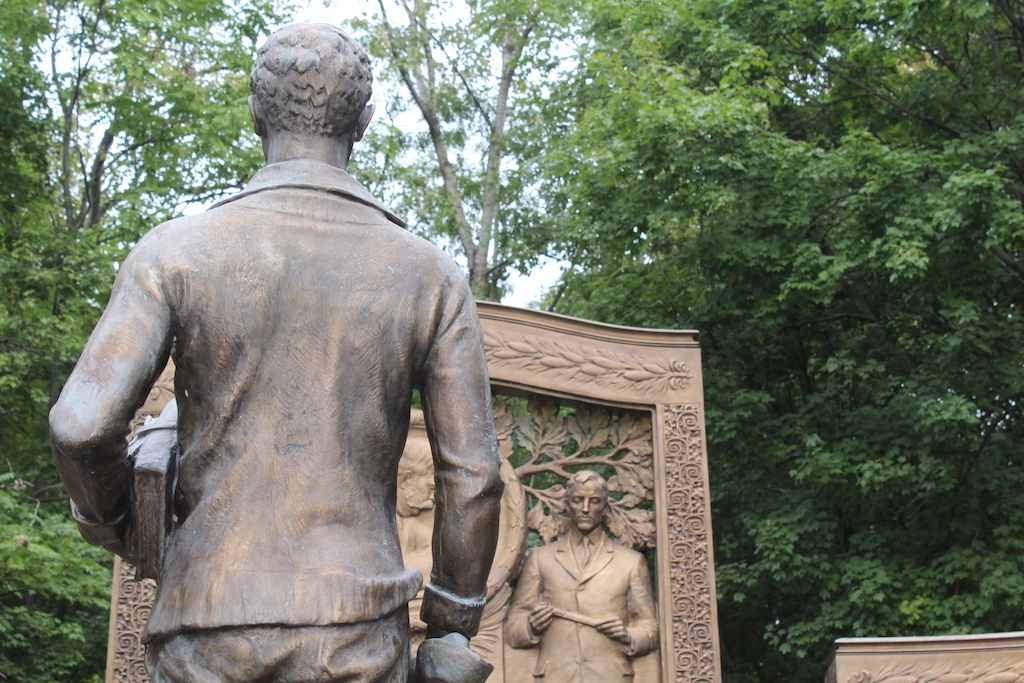
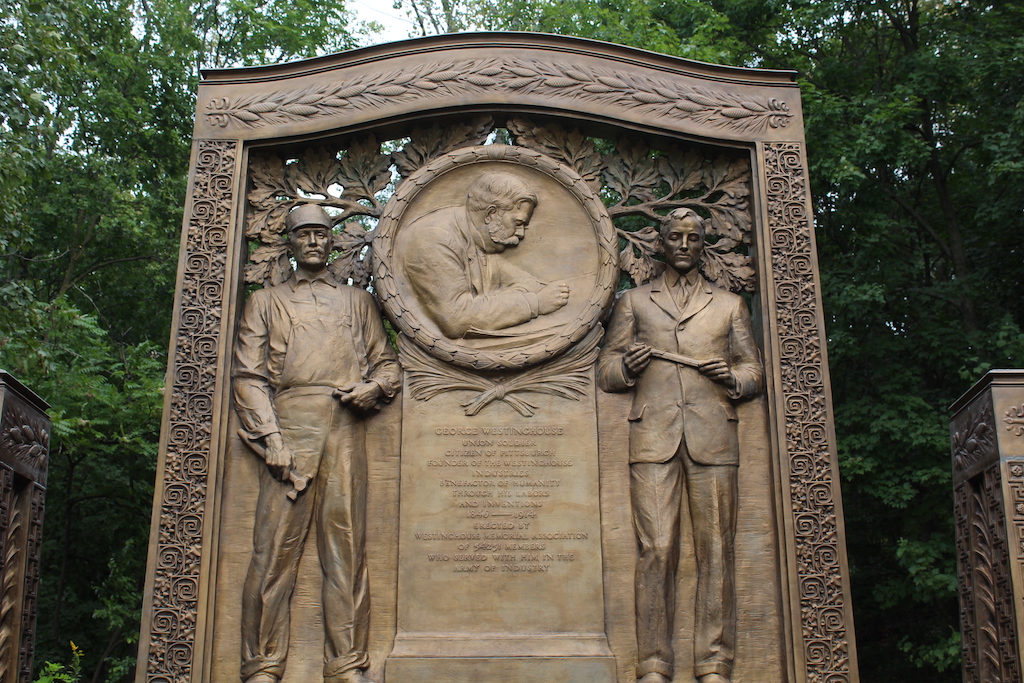
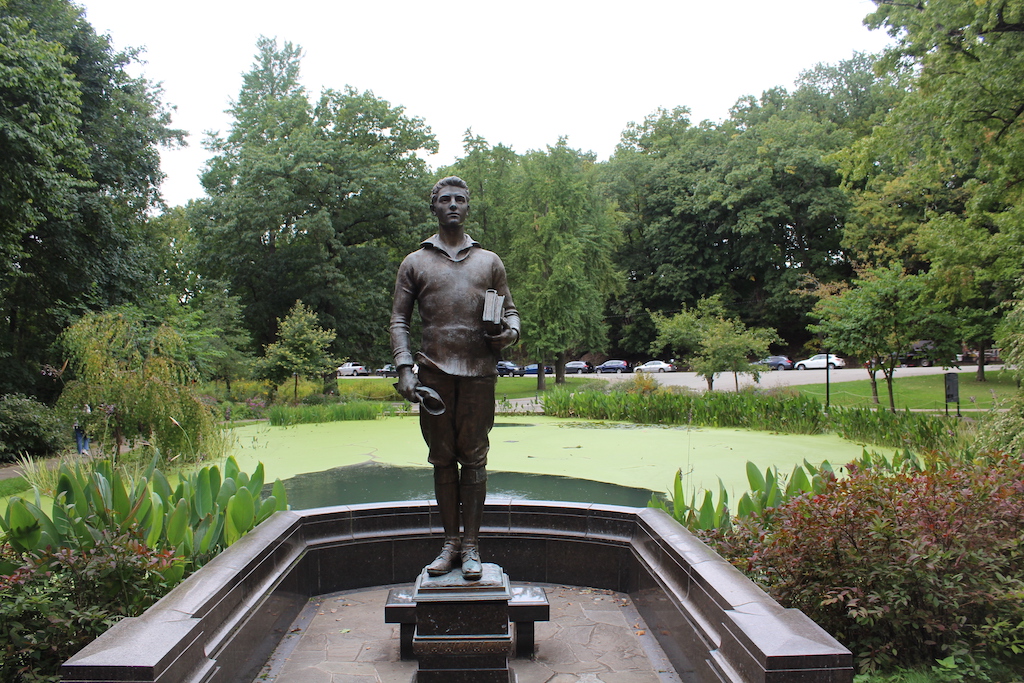
"The Spirit of American Youth" statue looking toward George Westinghouse. Photo: Amelia Pearson, 2022.
Immortalizing the Industrialist
As my classmates and I stood in front of a bronze memorial, I couldn’t help but ponder the history behind it —a history that is not well-known. The monument is comprised of two pieces, with the first being an inventor and an engineer framing a man deeply engrossed in his work. The second piece is a standalone statue of a young man, shoulders back and chin up, looking at the aforementioned. I became enraptured by this youthful man because of the hopeful, buoyant look in his bronze eyes. “The Spirit of American Youth,” named by its creator, architect Daniel Chester French, features an All-American boy standing on the prow of a ship, looking toward the grand piece, which is an ode to inventor and engineer George Westinghouse (Westinghouse Memorial). The young man, aspiring to become like Westinghouse, lays the foundation for the inventor’s impact on future generations, a legacy that continues to thrive.
The George Westinghouse Memorial, tucked away in Schenley Park in the Oakland neighborhood, represents a man who was not after his own heart. Erected in 1930, the inventor’s former employees pooled their funds to remember their employer, a man who invested in his workers by giving them a weekend (not common during the 1850s), piloting worker’s compensation, and providing fair housing in the company town, Wilmerding (Huber 49). In our Secret Pittsburgh class, urbanist and cultural theorist Edward Soja’s spatial theory, ‘Thirdspace,’ was discussed in detail, having three parts: firstspace, secondspace, and thirdspace. Examining each part, firstspace is concrete details of a space, secondspace describes how the space is perceived, and thirdspace is the way in which a person interprets a space for themselves. In its firstspace, the Memorial is comprised of bronze and is heavily influenced by the architectural style of Beaux-Arts. Examining the minute details, vines and leaves are woven throughout the piece, as well as small turtles (after conducting much research, I could not discern the reasoning for the reptiles except to pay homage to Turtle Creek). Panels describing Westinghouse’s inventions (airbrake, steam turbine, alternating current, etc.) surround the Memorial with inscriptions laden with gold. Intrinsically designed, “The Spirit of American Youth” statue includes characteristics complementary to the young folk: a rustled shirt, a crumpled hat in hand, and a spark in the eye. These intentional details create a place that can be uniquely interpreted by all people.
Continuing with the interpretation of spaces, the Westinghouse Memorial was created for remembrance but is utilized in different ways. When I visited the memorial, for example, a family was getting their photos taken. On any given day, you might find someone sitting on a bench watching the squirrels, a runner heading toward Steven Falcon trail, or a Westinghouse fanatic visiting for the first time. The seasons also play a role in how people experience this space; in the fall when I visited, there was beautiful foliage, a crisp scent in the air, and many leaves crunching under feet. In the winter, the snow sets a backdrop for the Memorial, as the pure, untouched snow powder allows the bronze to strike the eye. When springtime and summertime roll around, the sweet flowers are blooming, and a nice breeze comes off the pond. This space is a place for remembrance, learning, beauty, and anything else you can imagine.
As for my own experience, what Soja describes as thirdspace, I found the Memorial to be, in a word, grand. The site surrounds you with its curved pieces, making you feel small. Being small, however, is good. Smallness allows you to see that you are a part of something bigger than yourself- a puzzle piece. Westinghouse knew that even he was a small part in the grand scheme of industry, and he recognized that his employees were, too; the amount of respect the engineer garnered from his workers was proven when they raised $200,000 ($2,500,000 today) to build a memorial in his honor (Westinghouse Memorial). “In fact, it was his high-powered contemporary, Andrew Carnegie, who said, “George Westinghouse could have made a lot more money during his lifetime if he hadn’t treated his workers so well’” (Reis). The feeling of respect was in the air when I visited the site, making the place glorious.
The George Westinghouse Memorial is a space where many find themselves, literally and figuratively. Having no prior knowledge of the inventor, my curiosity was sparked by the imposing nature of the statue and the mysteriousness surrounding it. The bronze nestled into the flora and fauna is paradoxical, as while they are opposites, there is attraction. The pond in front of the monument adds the finishing touch, bringing the idea of the American Youth standing on the prow of a ship to fruition. The intricate details of the memorial play a role in the magnificence of the bigger picture, as the vines weaving throughout the piece represent the connectivity of Westinghouse’s inventions. The grandeur of this public space is not only supported by the Memorial itself but because the area is safe, well-maintained, and admired by its visitors. Overall, the scene set by the memorial itself and the interpretation of the space allows the awe-inspiring life of Westinghouse to unfold- to fresh eyes and returning visitors every day. The George Westinghouse Memorial seeks to encourage, influence, and stir new generations by telling the story of a man who put others before himself and strived to make the best better.
Works Cited
Huber, William R. George Westinghouse: Powering the World. MCFARLAND, 2021. “The Memorial Story.”
The Story of the Westinghouse Memorial, Westinghouse Memorial, https://www.westinghousememorial.org/story.htm.
Reis, Ed. “A Man for His People.” Mechanical Engineering, vol. 130, no. 10, 2008, pp. 32–35., https://doi.org/10.1115/1.2008-oct-3.