Hillman Library Dedication. 1968. Identifier: HLMN04.UA. Historic Pittsburgh Website.
Fifty Years, Catalogued
“Standing there in the stacks, turning the pages, I realized, as never before, what an isolated moment each photograph represents, one flash of light, one frozen instant stolen from time, after which time resumes.” –Francine Prose “Rubber Life”
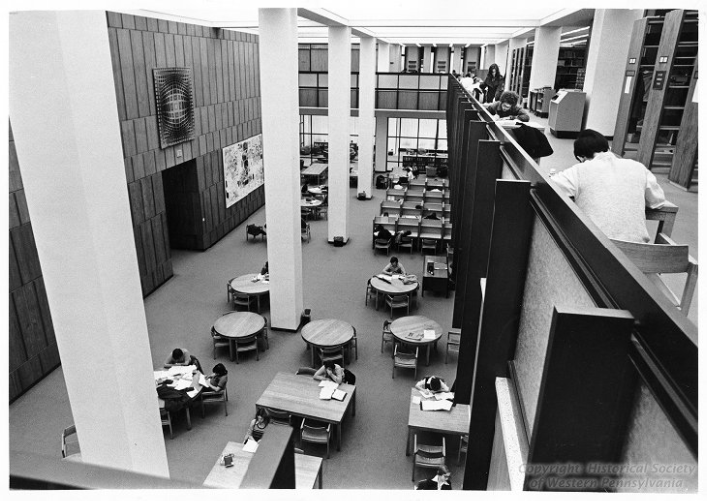
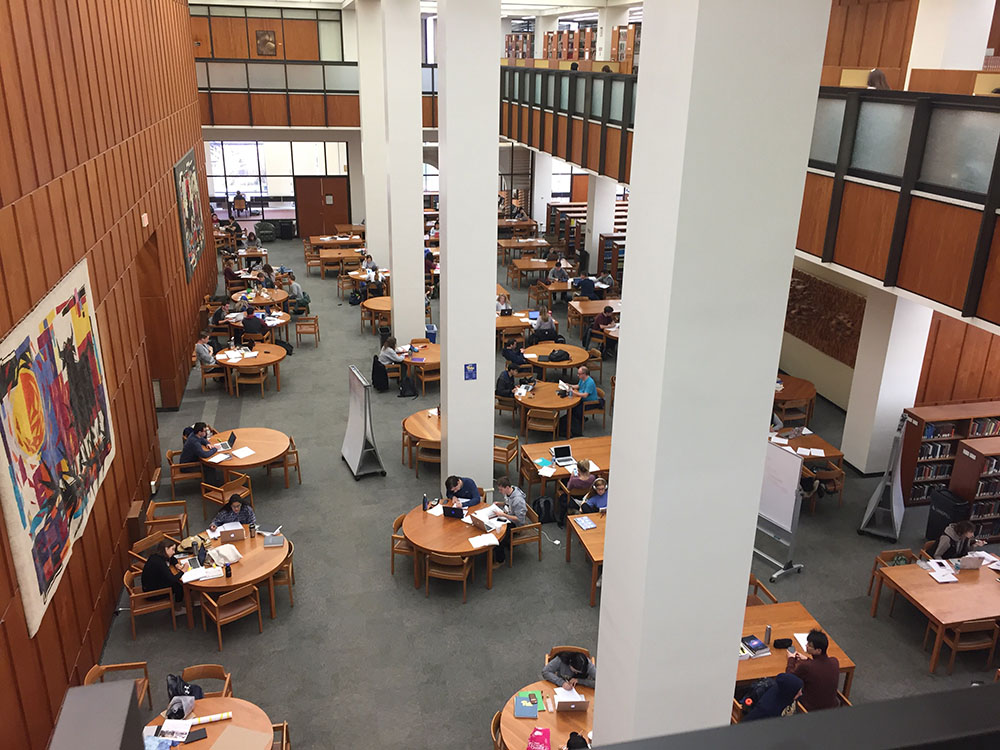
This year, Hillman Library celebrates its 50th anniversary on campus. The physicality of the library has changed very little since 1968. Students still crowd around tables with their studies, books still fill the stacks, and librarians keep busy helping students with their research. However, changes do exist as the university grows and evolves. Hillman no longer rubs elbows with Forbes Field and the cheering of baseball games doesn’t echo through the walls. Students crowd around outlets to power their electronics, and the circulation statistics show declines. Yet, one could still consider Hillman Library a hub of campus activity. Due to the nature of libraries, Hillman remains a valuable resource to the community by being more than a library in the physical sense.
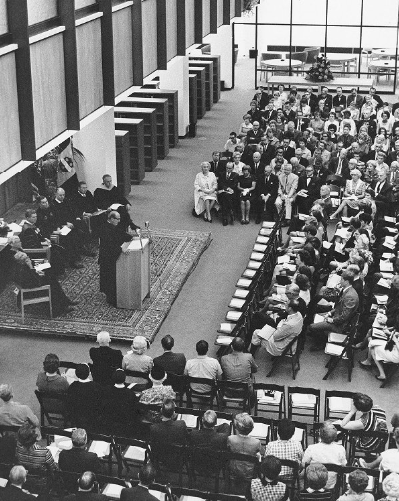
Hillman Library was dedicated on September 6, 1968 (pictured). Standing at the podium on the first floor is Samuel B. Gould, the Chancellor of the State University of New York. Hillman Library Director, Dr. C. Walter Stone is seated to the right of the podium and closest to the camera. Despite being open to students for the past nine months, the bookshelves in the upper left portion of the picture are curiously empty. The dedication ceremony is well attended, with only a handful of chairs empty. The audience listens intently, with a few appearing to take notes or having their heads turned in thought (or distraction). While the image doesn’t include a list of who attended the dedication, it’s not unreasonable to imagine that the audience including a cross-section of many departments of the University, gathered to celebrate a new era of student research and education. The opening was groundbreaking for the university because it introduced an open stack concept. Students were free to search for books themselves; doing so permitted them to find related materials or simply anything that caught their eye.
Today, Hillman Library and the University Library System greet over 20,000 students per day. Only a small percentage of these students are accessing the university’s physical print collection. Now, they’re gathering in the Cup and Chaucer, accessing one of the dozens of computers, booking a tech-enabled group room, and using the resources free to students like portable power banks, whiteboards, and iPads. Our modern educational philosophy demands a constant review of the uses of an interdisciplinary library they wanted to create and now integrates technology into our understanding, collection, collation, and exchange of ideas. The resources used still reflect the same community and creative thinking present at its inception, but also incorporate and adapt to the student’s need to understand the current and constantly changing technologies. They facilitate this by offering workshops to all students, teaching them software, online publishing, and other marketable skills for the next level of their professional or academic career.
The embrace of future technology and the emphasis on information literacy across digital media doesn’t mean the library has completely shed its past ways. As a student worker, I spend my time behind the curtain of the library and see the importance of information access no matter the medium. The Archives and Special Collections departments organize and recommend resources across a large number of subjects. David Grinnell, a university archivist, digitizes and collaborates with local historical societies and libraries to digitize many collections on the Historic Pittsburgh Archive. Dozens of archivists, librarians, and specialists work in Hillman and at the Archive Service Center in Point Breeze. These specialists in preserving and archiving historical works of photography, maps, monographs, and books, published and unpublished, dedicate their careers to help academics and researchers find historical materials they need to complete their research.
The Preservation Department in the ULS plays a special part in the library’s goal of access and research. Preservation Coordinator, Miranda Nixon, runs the department and guides student workers and interns in proper care, storage, and repair of damaged books. Whether there is a quesadilla shoved in the pages of a book from the main library by a distracted student or delicate materials that are falling out of their original leather binding, the goal is to make sure the materials can continue to be used or digitized to preserve the information recorded within the pages. Preservation Coordinator, Miranda Nixon strongly believes in preservation as a benefit to the modern library. She feels,
No matter the era, preservation plays a critical role in the mission of the library. We promise our patrons we will provide them access to information and services. In order to fulfill those promises, we must be taking care to preserve that information (and sometimes the artifact itself) and ensuring its accessibility long-term into the foreseeable future. This holds true whether the information is written on paper, stored as a JPEG file, or captured on a glass plate negative.
Working as a student conservation technician under Miranda’s guidance has shown me so much about how a library is not a static institution. Whether I am building an enclosure for a rare art book or copying end sheets to make an old book look identical to the original, I’ve come to realize the information we seek from libraries is not simply the words on the page, but our interactions with those that work in the libraries and the materials themselves. I’ve had the honor of teaching various workshops at the library, like a traditional bookbinding workshop last month in the Digital Resource Commons. The event had twenty students and staff registered and we were able to share a bit about how books were traditionally made and the tools used to make and repair books.
Hillman has come quite a ways since Pitt’s closed stack system where the librarians served as metaphorical guardians of knowledge. Students were required to know what they needed and request the item. Today, students from all disciplines can come in with ideas of what they’re seeking and explore the subject through books, digital articles, original artworks, lectures, hands-on workshops, and more. Our notion of education shifted in forms of research, and the library itself continues to evolve to match how we research and collaborate, even if there’s still a lack of outlets in the library. The exploration of what the library represents takes us deeper than the limestone walls of Hillman Library and into the core mission the library serves and its role in creating a community of thought.