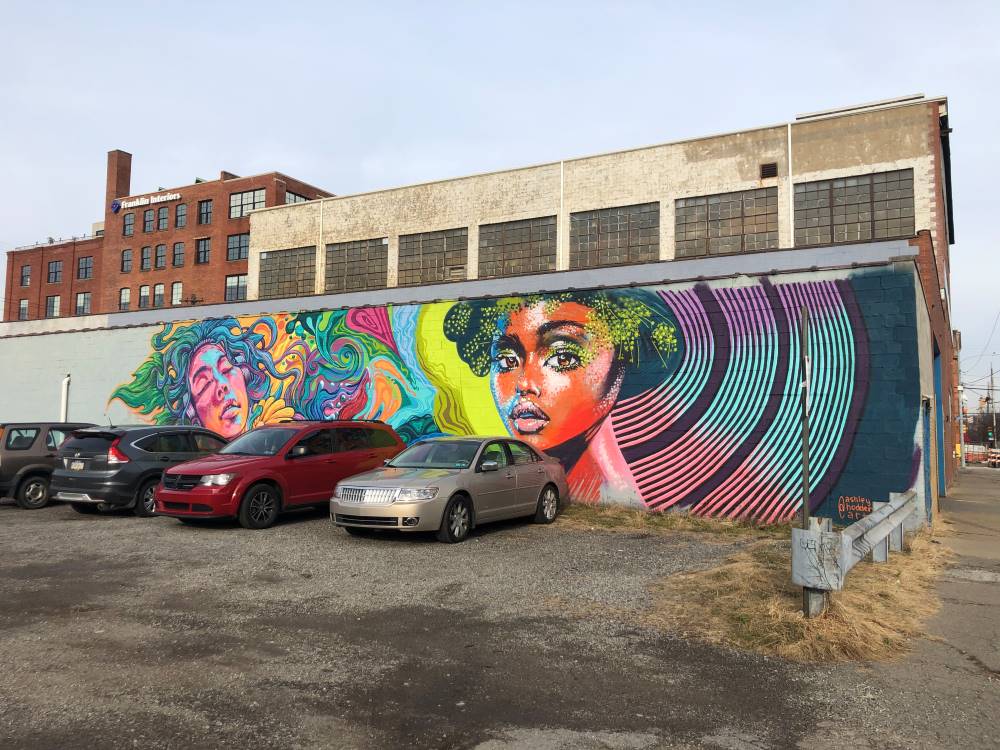
Mural of two women surrounded by bright colors, plants, and music. Photo by Kyra Moore, 2019
Distracted Art
As I stood at the cross road, I found myself entranced by the scene in front of me. The wall held a whole world inside of it. Colors twisted together in swirls and waves, greens wrapped around pinks, flowing seamlessly into yellows and flowers. Abstract shapes, plant life, and technology merge together in this one image creating a vibrant world of movement and music. As I stood there lost in the colors, I watched as person after person walked past without even a second glance at the beautiful piece before them. It fades into the background, without any notice from those who pass by. In fact, I probably would have missed it myself if I hadn’t paused to look behind me.
This piece that could be displayed in a studio is instead hung before an uninterested audience. I stand for a second and contemplate this phenomenon. City murals are often beautiful and creative pieces of art that most people ignore or fail to notice. They are used to commemorate a space or to add a little color to an otherwise drab area, but for the most part they become part of the background scenery. But maybe that’s the point. I’m sure these creative works are appreciated by most even if they don’t pay close attention to them. When you walk into a room or find a part of the city you’ve never been before, you’re going to feel more welcomed by a colorful area as opposed to a grey plane of sameness.
The art in the Strip District can be enjoyed by those who wish to observe but it can also just serve as a pleasant background to those enjoying the space. It gives the area a friendlier feel and makes it a more comfortable place to hang out. The unique sites and collection of bright colors in the Strip are part of the reason people want to visit repeatedly. Your eyes never get tired. As the founder of Flaneur Magazine, Ricarda Messner, put it “I always still see something else, there’s a never-ending story” (“A Flaneur in Montreal”). Here she is not talking about the Strip District but rather a street in Montreal. In her magazine she writes on her personal experience of flaneuring around the city.
Flanerie, or the act of being a flaneur, is a concept described in detail by Walter Benjamin. Benjamin describes this to be a sort of distracted perception. Walking around a city without contemplation or complete focus. It is wandering around without a set destination. Looking around and taking the world in without letting your gaze linger on one thing for too long (Galibert-Laine). Flanerie is a very subjective activity that is experienced differently by anyone who tries. What one person notices or decides to pay attention to can be completely different from what the next person picks up on. Besides that, two people can be looking at the same thing but have very different perceptions of their meaning. Flaneuring can be a fun activity that allows you to reconnect with the world and explore (“Flaneur in Montreal”). In today’s very fast paced environment, it can be nice to take some time, put your phone down and observe the living world around you.
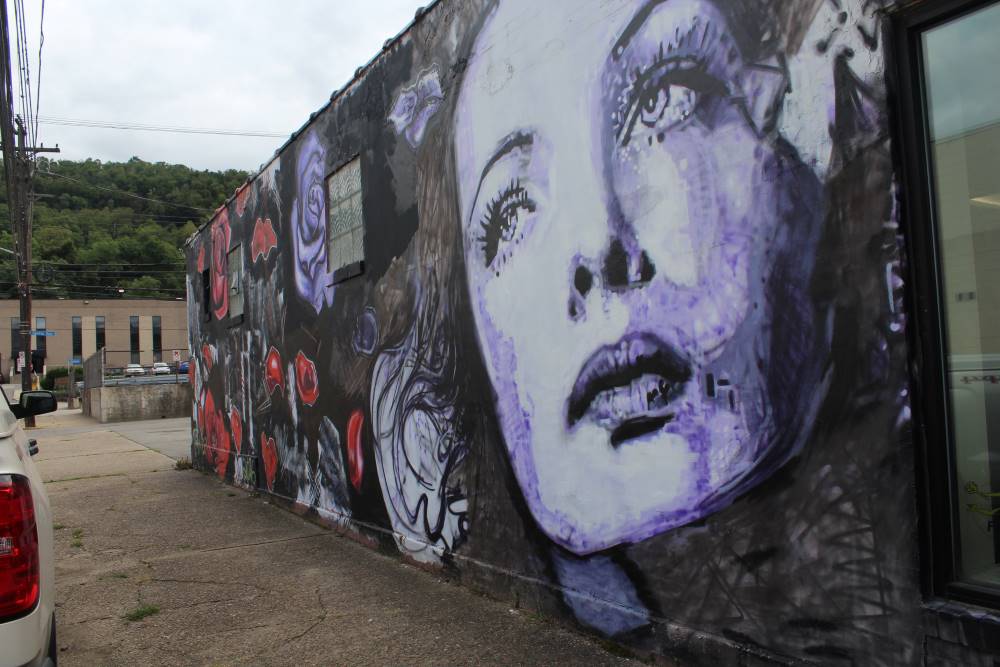
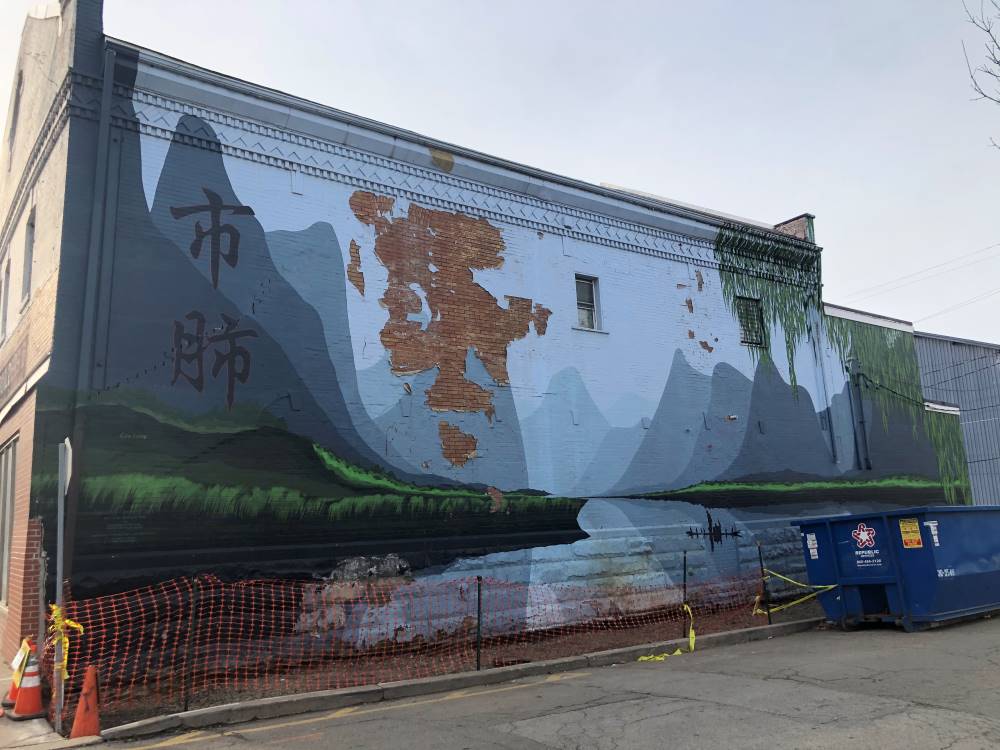
As I continued my journey around the Strip District, I found myself drawn to the murals and graffiti on the streets. I let my curiosity guide me around with no particular goal in mind. On one block I found myself starting into the eyes of a purple lady. Her gaze seemed to yearn for something not there, perhaps a fondly remembered past. A romantic wind blows her hair back along with some roses caught in the gust. Further along Penn Avenue, I find myself at a quiet river. It winds its way through a majestic mountain range, fading off into the distance. If you look long enough you can almost hear the running water or feel the cool breeze shifting through the greenery.
This mural, by Ian Thomas, is called “City Lung” and is painted on the side of WFH Oriental Market. The painting is based on Guilin, a city in China “nestled among undulating green hills and the Li River” (“City Lung”). This is just one example of the diverse culture you can find within Pittsburgh’s Strip District. This part of the city that we now see as a thriving market area was once the location for many large industrial factories. Pittsburgh was once recognized as an industrial power house, and companies such as US Steel and the H.J. Heinz Company used to operate out of the Strip. The neighborhood as we see it today is partially a byproduct of those industrial factories calling people from across the world to come work. In the late nineteenth century, the city saw a large increase in migrant workers from Poland, Germany, and other east European countries (“Historic”). Even though the factories are gone, the neighborhood’s industrial roots are still easy to see.
Many of the stores operating out of the Strip District today are in old warehouses that have been converted for modern use. In some places you can also still see train tracks where a train used to drop off materials and produce to the area. The industrial steel and vibrant art commingled around the neighborhood gives the Strip a unique feel of being in a modern but historical place. Lauren Elkin, author of Flaneuse: Women Walk the City in Paris, New York, Tokyo, Venice, and London, I think described this feeling perfectly. “The space we occupy- here in the city, we city dwellers- is constantly remade and unmade, constructed and wondered at.” (Elkin 286). We’re in a constant state of change and flux in a city trying to modernize but stay in touch with its historical beginnings. By keeping the old industrial buildings and modernizing them with art, the Strip finds a good balance of moving forward in time but embracing its origins.
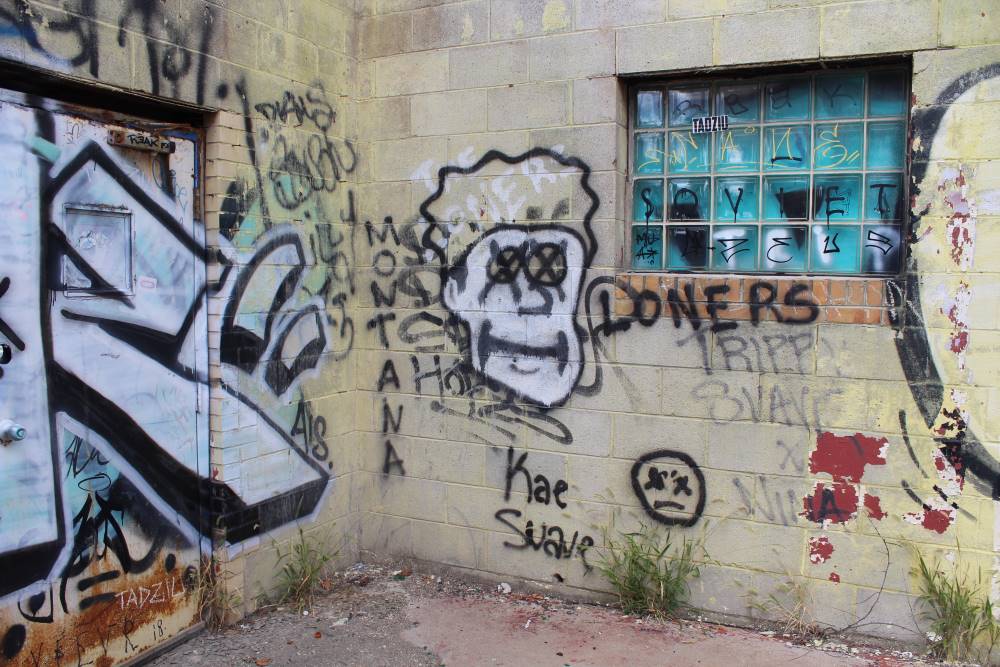
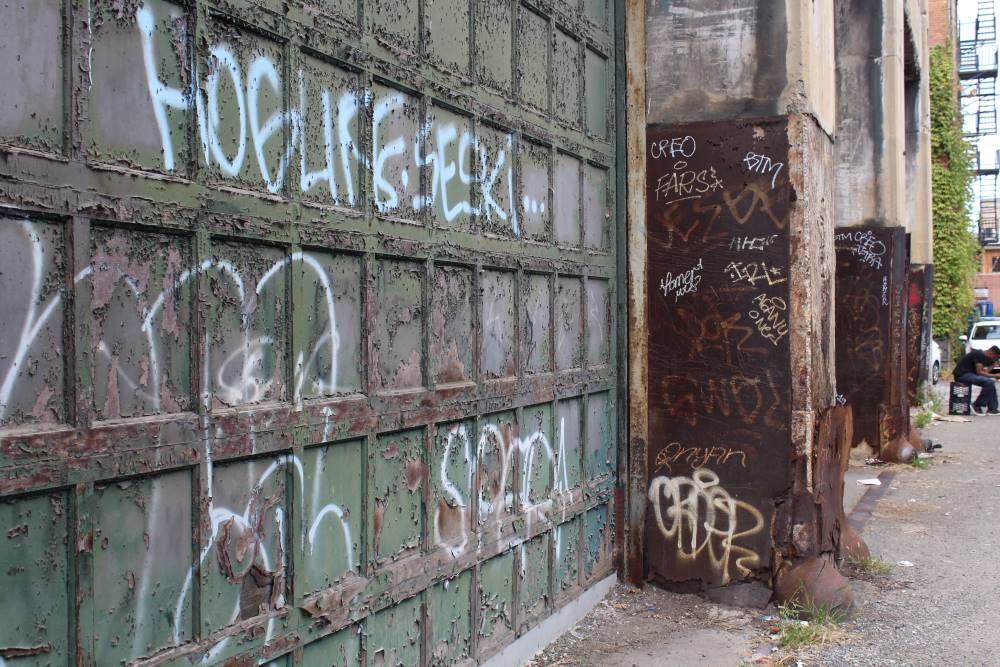
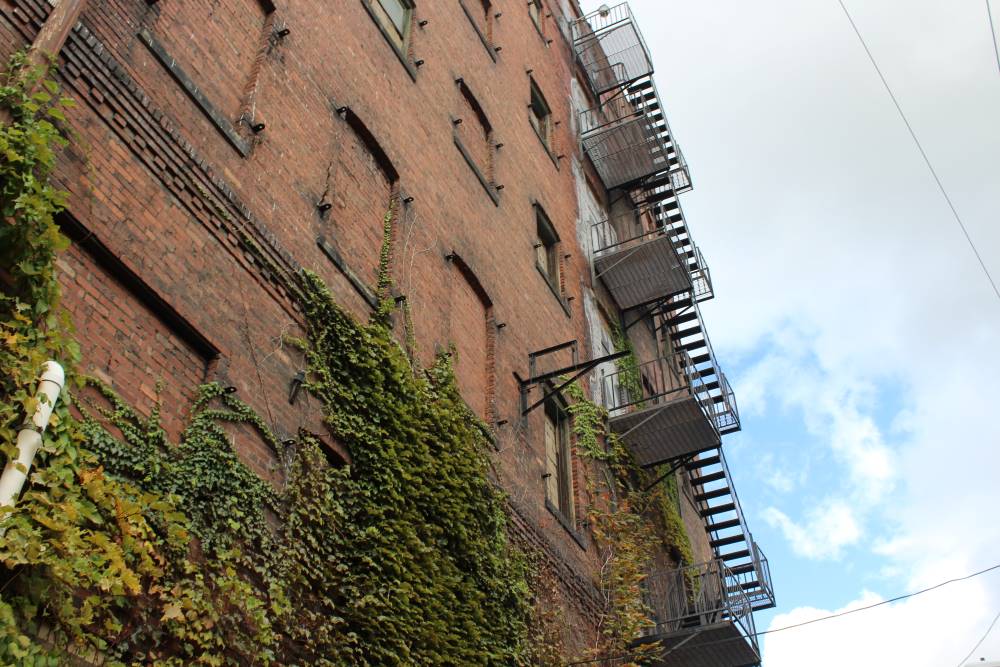
As my trip to the Strip District drew to a close, I found myself moving away from the main road and growing a little bolder in my exploration. I weave my way down side roads and back allies, allowed myself to explore newer areas and was pleased with what I found. As a compliment to the big murals along the main street, a lot of the side streets were covered in graffiti. Looking at this hidden art, I found myself just as entertained and enthralled by people’s creative genius. It wasn’t even just the art at this point that captured my attention. I found beauty in the way that old paint flaked off old garage doors, or in the way ivy climbed up a brick wall. The old industrial feel and obvious life seen in the back side of the Strip District was just as captivating as the bright colors and loud noises of the main street. It’s very easy to move through space with out noticing any of these details, to have a set destination and let it all pass by. I want to encourage people to take time and explore, let themselves get distracted by their surrounds and discover something beautiful.
Works Cited
Berger, John. “Ways of Seeing, Episode 1 (1972)” YouTube, uploaded by tw19751, 8 October 2012, https://www.youtube.com/watch?v=0pDE4VX_9Kk&feature=youtu.be
Elkin, Lauren. “Flaneuse: Women Walk the City in Paris, New York, Tokyo, Venice, and London” Farrar, Straus, and Giroux, 2017, pp. 285-288
Galibert-Laine, Chloe. “Flanerie 2.0 [ENG SUBS]” Vimeo, uploaded by Chloe Galibert-Laine, 11 March 2018, https://vimeo.com/259579651
“City Lung by Ian Thomas” Pittsburgh Murals and Public Art, 9 Jan. 2016. http://pghmurals.blogspot.com/2016/01/city-lung-by-ian-thomas.html
“A Flaneur in Montreal. Interview with Ricarda Messner, Founder & Published of Flaneur Magazine” YouTube, uploaded by Goethe-Institut Montreal, 2 Dec. 2013, https://www.youtube.com/watch?v=UZdJzCWWvmY
“The Historic Strip District” Strip District Neighbors, 2018. https://www.stripdistrictneighbors.com/history