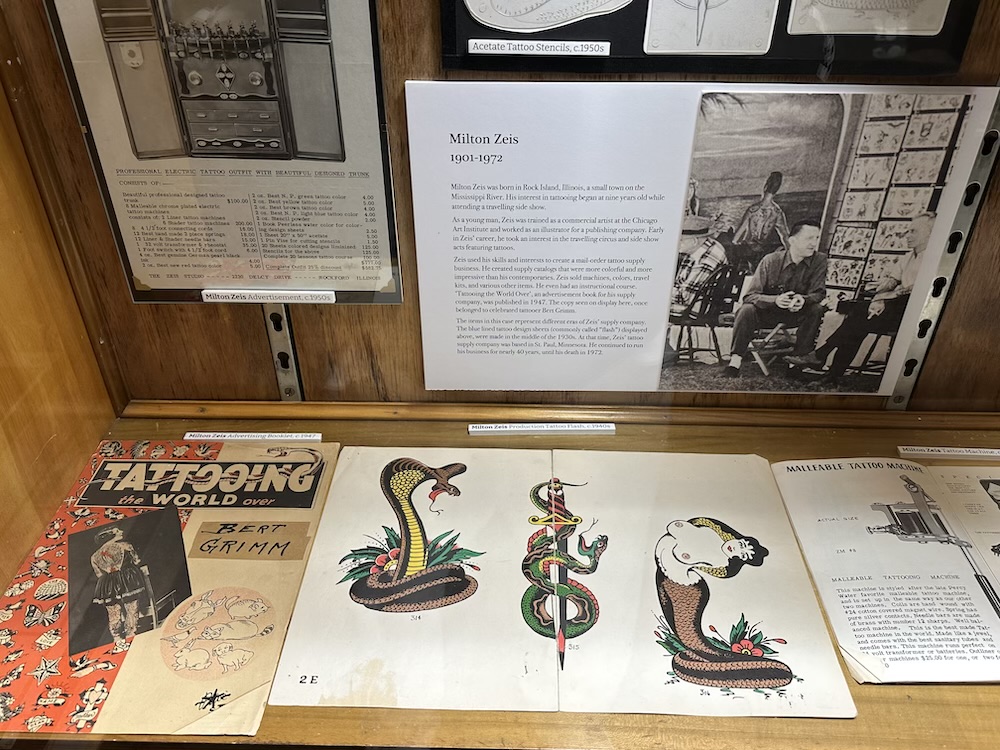
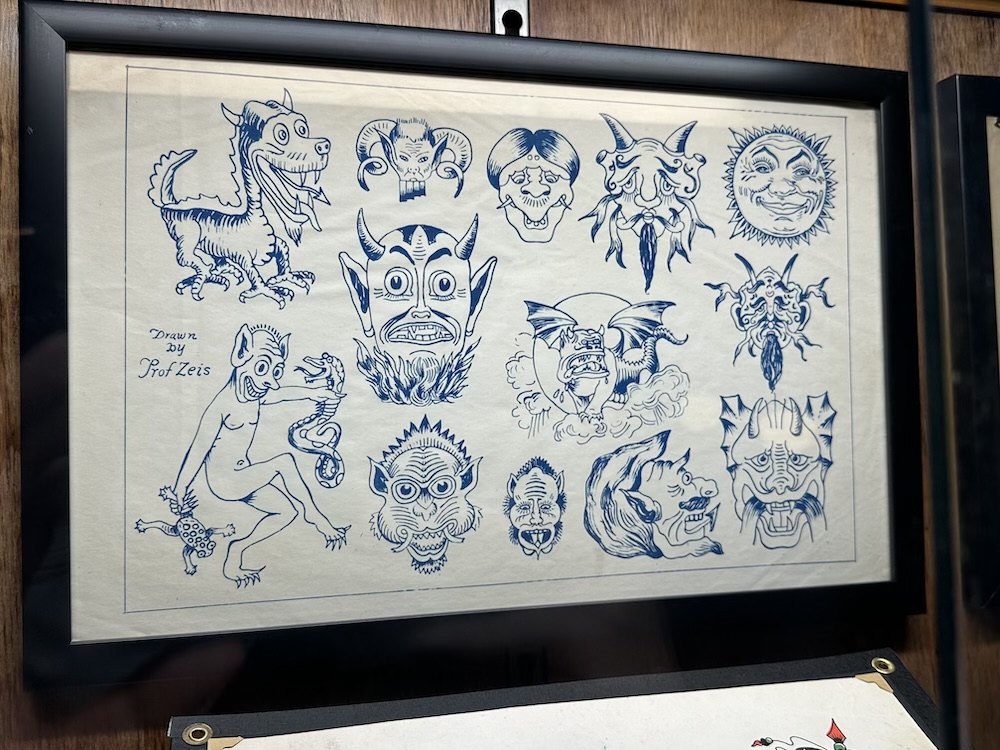
This Photo was taken by Junting Liu. It depicts the tattoo flash and his magazine Tattooing the World over from Milton Zeis, aka “Prof. Zeis”.
American Traditional Tattoos Rise Again in Pittsburgh
From living underground to the recognition by society, American traditional tattoo culture has undergone many historical moments. Many legendary tattoo artists like Milton Zeis and Ned Resinol devoted themselves to the world of tattooing, but they may not be as familiar to people as world famous painters like Vincent van Gogh or Picasso (Koscinski). Therefore, Nick Ackman and his partner Jill Krznaric decided to turn Nick’s rare tattoo flash collection into an art museum in Pittsburgh. While visiting the Pittsburgh Tattoo Art Museum, I learned more about the American traditional tattoo history and began to understand the meaning of collections as reflections of personal perspectives.
The museum’s entrance below Walnut Street under Kawaii Gifts puts it a veil of mystery over this unique location. Nick explained that choosing a more hidden place instead of an easier and more noticeable place was because “the tattoo culture was living underground for a long time and this space matched its characteristics as it existed in this society before.” Moreover, sailors were the main customers of tattoo shops during the war. Tattoos and tattoo culture were generally disdained by the upper reaches of society. Therefore, many tattoo shops were built in back alleys and on boardwalks by the 1950s (Pbs.org). This connection provides a more reasonable explanation of why the museum was settled down at this particular location. Through Nick’s conversation with a news reporter, he also implied that “people would look for their interests, it does not have to be someone or some groups to publicize the culture of tattoos.” Personally, Nick does not like the tattoo museum to be exposed more in front of the public because the more it stays hidden, the more mysterious and special it becomes (Koscinski).
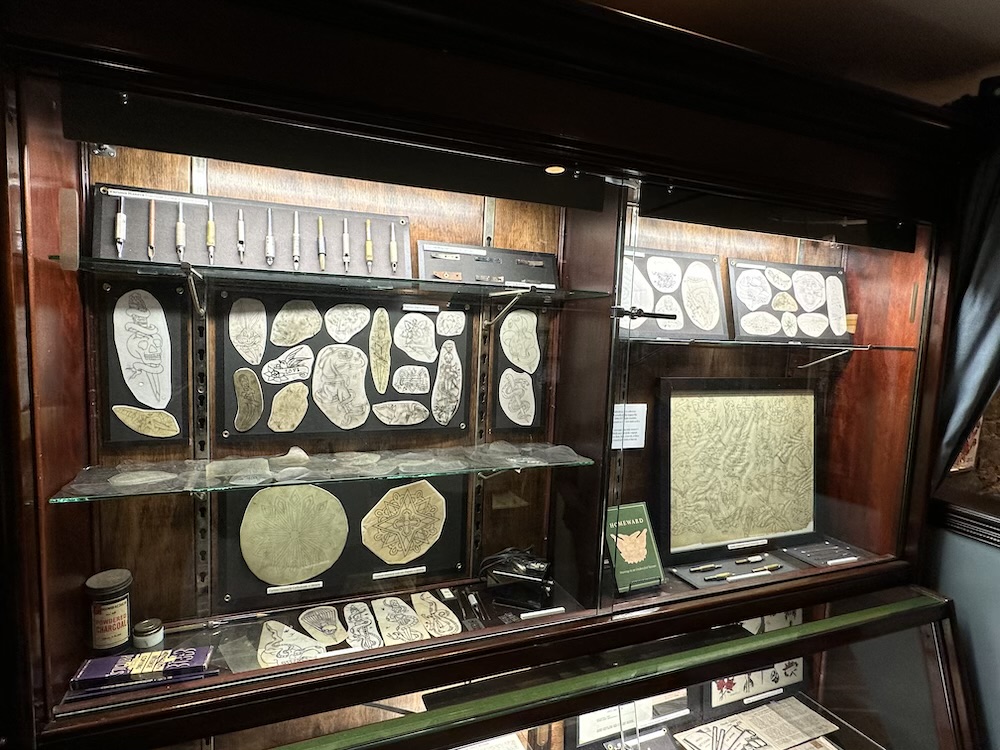
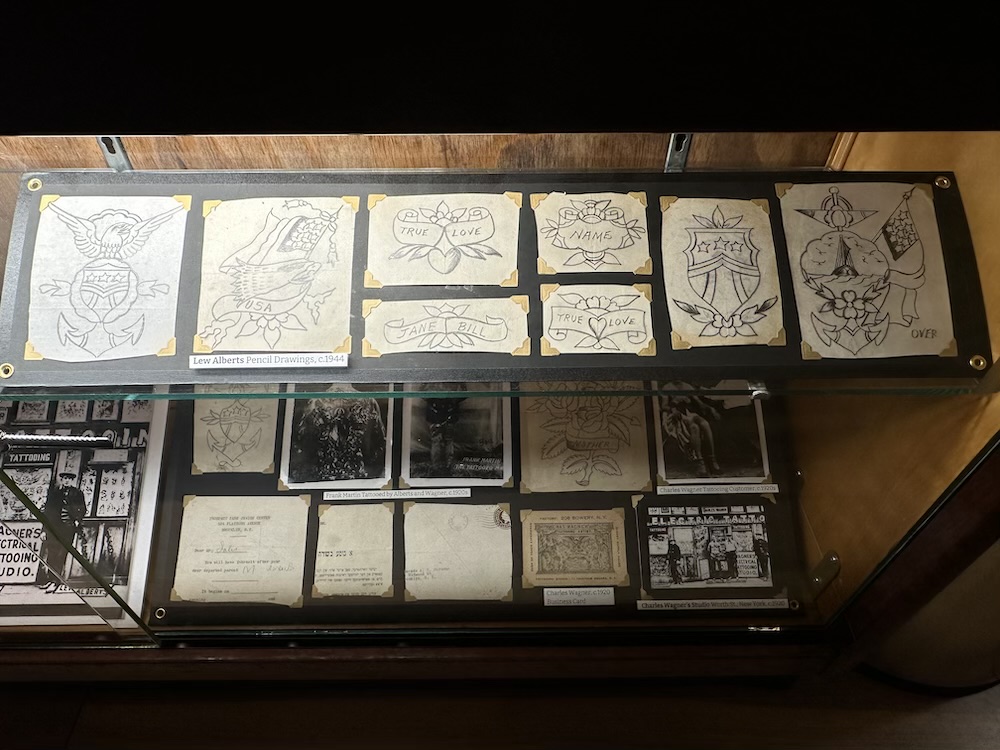
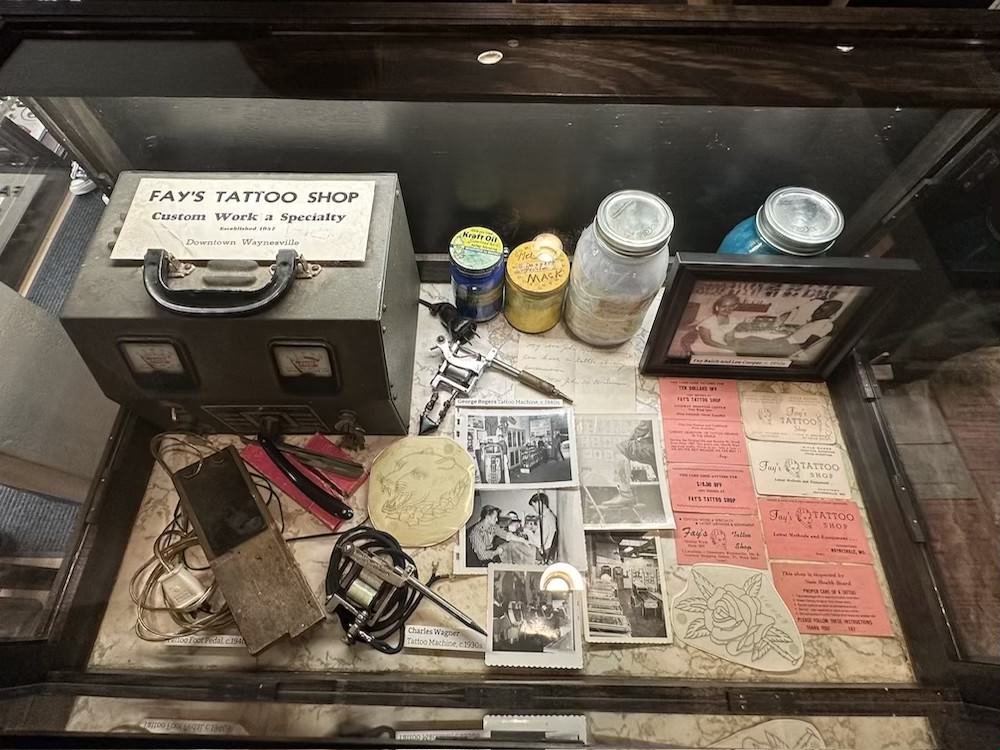
The exhibitions in the museum are all part of Nick’s personal collections. The tattoo flash, images, equipment, and even permission slips from underage kids hoping to get tattoos primarily covers the 1920s to 1940s. Regarding the meaning of collections, I believe they are memories and knowledge you obtain from the past. According to the book we studied, Walter Benjamin considered that collections are more of inspirations, memories, and thrills of acquisition of items from the past, to collectors (Benjamin 61). To Nick, collectors are like the caretaker for the collections because they would last for a longer time. Collections are meant to show and tell people the story of its piece. They have special meanings for the young generations to understand more about the history of tattoos. Most of the collections were from the early period.
For example, Ned Resinol was one of the sailors who became a tattoo artist and worked in Pittsburgh during the 1940s. His tattoo flash is kept in great condition in the collections. Another legend in the collections is Milton Zeis, who was inspired by the riverboat show on the Mississippi. His father took him to this show where he saw tattooing for the first time. This inspired his future life in many aspects. He operated a supply company for selling flash and other supplies and a tattoo shop in his basement. During the 1940s, he founded his own advertising magazine company named, Tattooing the World Over, and was first published in 1951 (Harriet Cohen et al.). Later, he became more famous in the tattoo community and the city. He was one of the legends in the tattoo world who has inspired many more generations.
American traditional tattoos started to rise in the mid of 1900s. American traditional tattoos, also known as old-school tattoos, is one of the styles that was kept from the early period. A lot of new designs and patterns started to emerge since then, which can be related to heavy black bold lines. These new designs symbolize more of a self-expression and some of the patterns can reflect American society in different ways such as American eagles, soldiers, nurses, and holy cross. You can find these in the museum. Also, some patterns and designs were kept from the old-time including anchors, swallow, lighthouse, and ships. These mostly could be seen from sailors. They liked to tattoo these as motifs or navigation symbols in order to show off their knowledge of sailing. (Sanders). Nowadays, tattoos are not only accessible to sailors and soldiers. More and more people are willing to get inked on their bodies. It even spreads out more deeply in a variety of jobs worldwide and an increasing number of young generations start to get ink on themselves as well. By contrast, seeing also as a Chinese student, this is socially unacceptable in the Chinese society, people who tattoos on their body will face a difficulty when they look for jobs in most cities. This is because people view it as a deviant behavior and represents gangsters or criminals.
After learning more about American traditional tattoos and tattoo cultures from the museum, it changed my perspective of tattoos. Many of those actually have special meanings behind them. It also made me realize that the significance of the collections may not only serve oneself, but also can affect the future generations or the collection itself.
Works Cited
Benjamin, Walter. Illuminations. New York: Schocken Books, 1969.
Harriet Cohen, Eric McKay, C. W. Eldridge. (n.d.). Welcome to the Tattoo Archive. Welcome to the Tattoo Archive. Retrieved December 5, 2022, from https://www.tattooarchive.com
Koscinski. (2022, April 20). Pittsburgh’s newest art museum keeps the tradition of American tattooing alive. 90.5 WESA. Retrieved November 16, 2022, from https://www.wesa.fm/arts-sports-culture/2022-04-20/pittsburghs-newest-art-museum-keeps-the-tradition-of-american-tattooing-alive
Pbs.org. (2003, May 4). Skin Stories. History of Tattoo | PBS. Skin Stories. History of Tattoo | PBS. Retrieved November 18, 2022, from https://www.pbs.org/skinstories/history/beyond.html
Sanders. (2022, February 26). Tattoos in Society: A Progression of Acceptance. Unsustainable. Retrieved November 18, 2022, from https://www.unsustainablemagazine.com/acceptance-of-tattoos-in-society/