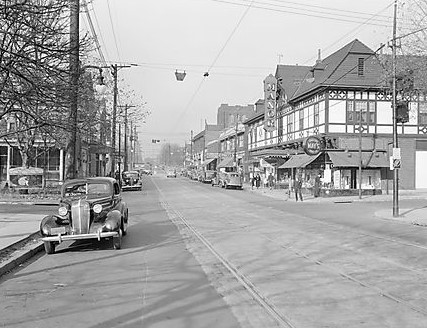
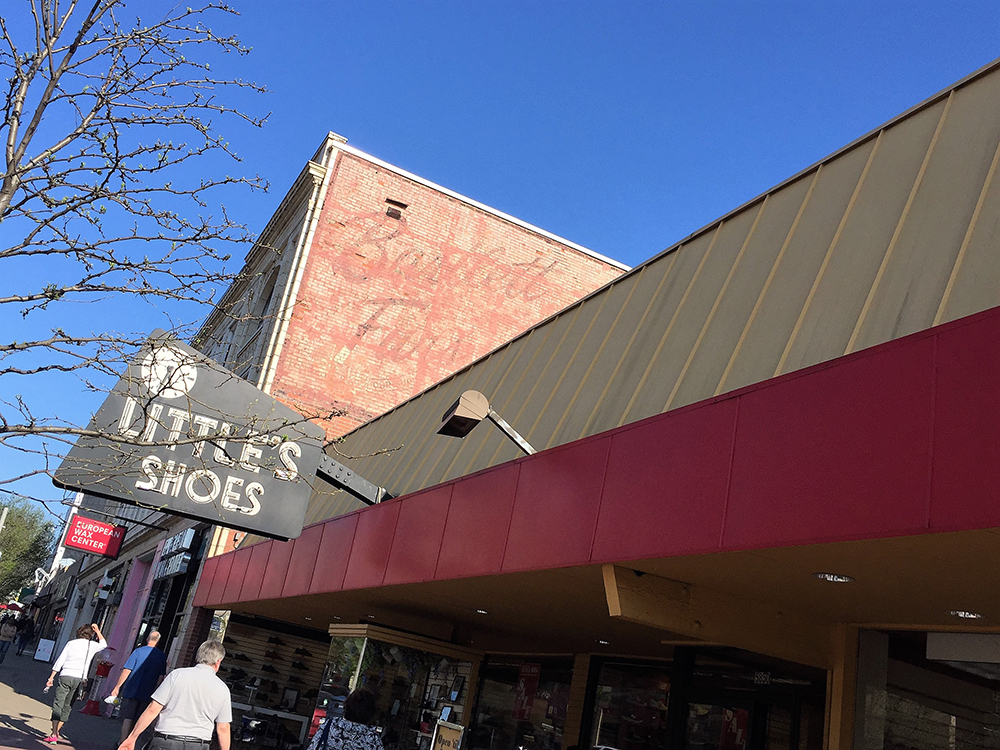
A historical photo of the Manor Theatre in the early 1900s. Much of the theater can be seen in the current photo and this one when compared.
A Stroll About Squirrel Hill
Given that I work at the Manor you hear a lot of stories from customers about how the place used to be. One day, as I was waiting for my shift to start, when a coworker began telling me a story, that a customer had just told him of his very first date, at the age of 14, that had happened at my beloved theatre. The customer, who was in his eighties (I forget his exact age), said that there was a girl in his class, that he very much liked, and wanted to ask her out to the movies. She obliged his request, and they set a date to come to the Manor together, but another classmate had his eyes set on her. The rival came up to the customer, and challenged him to a foot race, and told him, “If I win, I get to come on your date too!” Our protagonist objected, telling him no because he knew this boy was the fastest in class, but they came to an agreement where the speedster would run backwards. The race was on, but somehow our hero lost the race, so on that fateful Saturday his mother drove him, the girl, and the boy who beat him all to the Manor to see the movie, what’s worse the brat even sat between them during the film. Although this sounded like a memory that might be better left forgotten I was assured the customer was smiling as he left thinking fondly of his first date at the Manor (Manor Theatre Employees). You hear stories like this from time to time working here, but this one made me think. I wondered if one day I would be that man telling a story to some young concessionist about the shenanigans we used to pull here at the theatre.
The Manor has been a constant in my life for almost three years, yet for others it has been there even longer. I know all the regulars. I’ve consoled patrons who have lost a spouse that they used to bring to the theatre. Faces I used to serve, but now I will never have the chance again. People look for these things to hold on to in their lives, they need constants that make them feel safe: the friendly employee behind the counter, the violinist playing on the street, or even the crunch of popcorn underfoot. Change is always necessary, yet one need not throw away all signs of a former life. The threads to the past are what keep us grounded in life. After hearing that story, I left the theatre and began to look at Squirrel Hill with new eyes, that were looking for connections to the past. I trod along Murray, then to Forbes looking at these streets with new purpose. I started to imagine of all the other little histories of stores that were born in Squirrel Hill. The Manor was not a singular case, that there were others just the same, that residents of the neighborhood probably had fantastic stories of chance encounters at these establishments. I walked past Little’s Shoes, which opened its doors only ten years after the Manor in 1932 (Squirrel Hill). Even a Giant Eagle roosts proudly in Squirrel Hill, which I always heard rumors from coworkers about it being one of the first locations of their grocery stores though I could never substantiate the claim. Jerry’s Records rests at the bottom of Murray a world famous record store, that I am sure has a vast collection of stories, that is probably as numerous as they vinyl on the shelves. Nestled in between these antique landmarks are mom and pop shops as far as the eye can see almost without the scent of a chain store.
The neighborhood is filled with all these memories from countless generations, and every day more get added to it. On my way, I continued past the busy streets into the residential districts to look at the homes. I have known a few friends who have lived in the quiet streets hidden behind Murray and Forbes, and never once have I seen a renovated one. Each house feels like it has been taken out of time to restore Squirrel Hill to its naturalistic beauty. Looking at the homes, I can’t help, but to recall a line from the Mysteries of Pittsburgh where Art, the protagonist, talks of his new apartment in Squirrel Hill on Forbes and Wightman. He thinks about how all the apartments used to be a part of an estate, and how he imagines how his was probably once servant’s quarters (Chabon). There is this idea in Squirrel Hill where everything becomes reused and repurposed, and another memory becomes tacked on to the original. Here nothing is reduced to rubble, instead it is built upon a pre-existing structure we so sadly do not see in our throw away culture in America.
In Pittsburgh over the past years there has been much change, but not the kind that has taken place within Squirrel Hill. One look at places like the Waterfront, and one can see the devastating impact of gentrification where once stood powerful steel mills now lie shopping malls. Daniels book of poems, Milltown to Malltown, touches on the site’s former glory where he imagines the site of a future car commercial, and at the end of his prose it says, “But what’s that thing in the background, some old factory or something?” (Daniels 39). The entirety of the old mill has been wiped from memory save for some lonely smokestacks, but this is not the type of change that should be embraced. For the future to intermingle with the past these historic sights must be cohabited as they have been in Squirrel Hill. New purposes may take over the buildings of yore, but their memories are still intact, and they have not been washed away by the sands of time. The way Squirrel Hill has been morphed by time, yet still retains its initial skeleton reminds me of Long’s short story, Pittsburgh Returns to the Jungle. The story tells of two men who pushed into legislation a law, that required every window to how a flower-box attached to it, and thus Pittsburgh became rampant with flowers. This then changed the very nature of the city causing it to be a mecca for naturalist for better or worse (Long). Although, this changed the very nature of our city it was still Pittsburgh; the flowers did not destroy any building, but instead added to them and created a new memory on top of the old.
As I finished my walk through Squirrel Hill, I came to realize that change is a powerful force one that we cannot stop. We are resigned to this fate, that we must accept what comes with the future, but it is up to us on how we deal with the changes to come. There are ways in which we can accept change, and create positive benefits for an entire community, and there are ways in which we can shy away from it, and allow it run rampant, and destroy what we hold dear. I arrived back at the Manor just in time to start my shift with a new perspective on the neighborhood I had spent countless nights in ready for whatever changes may come.
Works Cited
Chabon, Michael.The Mysteries of Pittsburgh. New York: Harper Perennial, 2011. Print.
Daniels, Jim, Jane McCafferty, and Charlee Brodsky.From Milltown to Malltown: Poems. Grosse Pointe Farms, MI: Marick, 2010. Print.
Iskovitz, Mark. “Squirrel Hill History.” Squirrel Hill Historical Society: Welcome!. http://squirrelhillhistory.org/. Accessed 12 Apr. 2017.
Long, Haniel. “How Pittsburgh Returned to the Jungle.”Notes for a New Mythology.Web.
“Manor Theatre Employees.” Personal interview. 9 Apr. 2017.
Squirrel Hill. Charleston, SC: Arcadia, 2005. Print