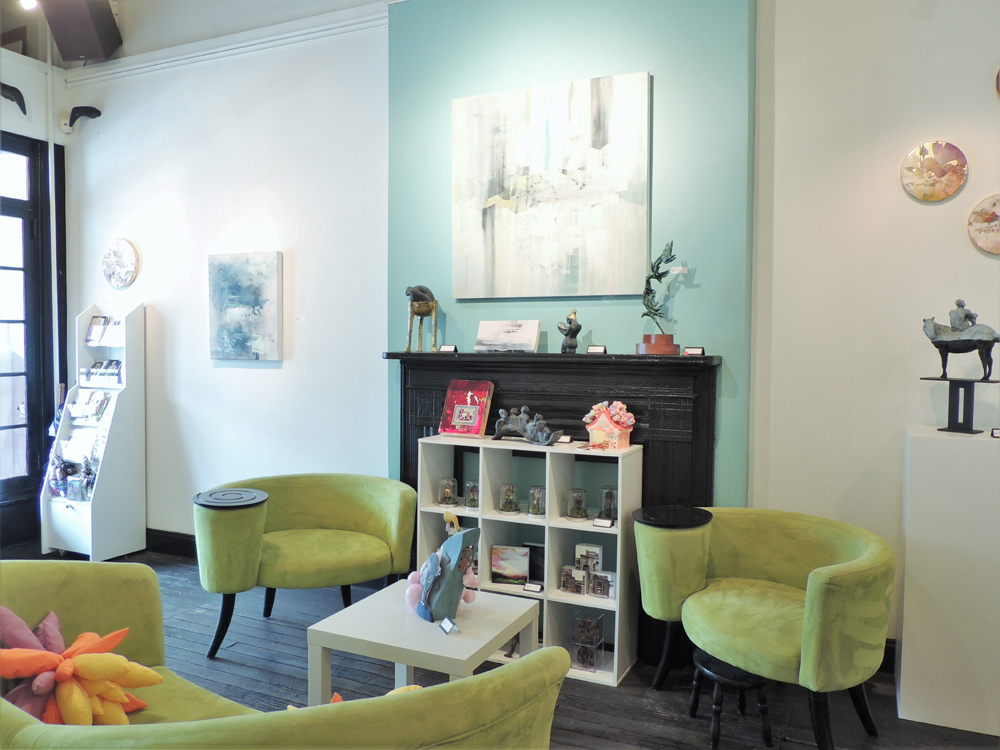
Seating area visible to the public walking outside Boxheart Gallery. Photo by Lauren Chronister.
A Personality that Stands Out
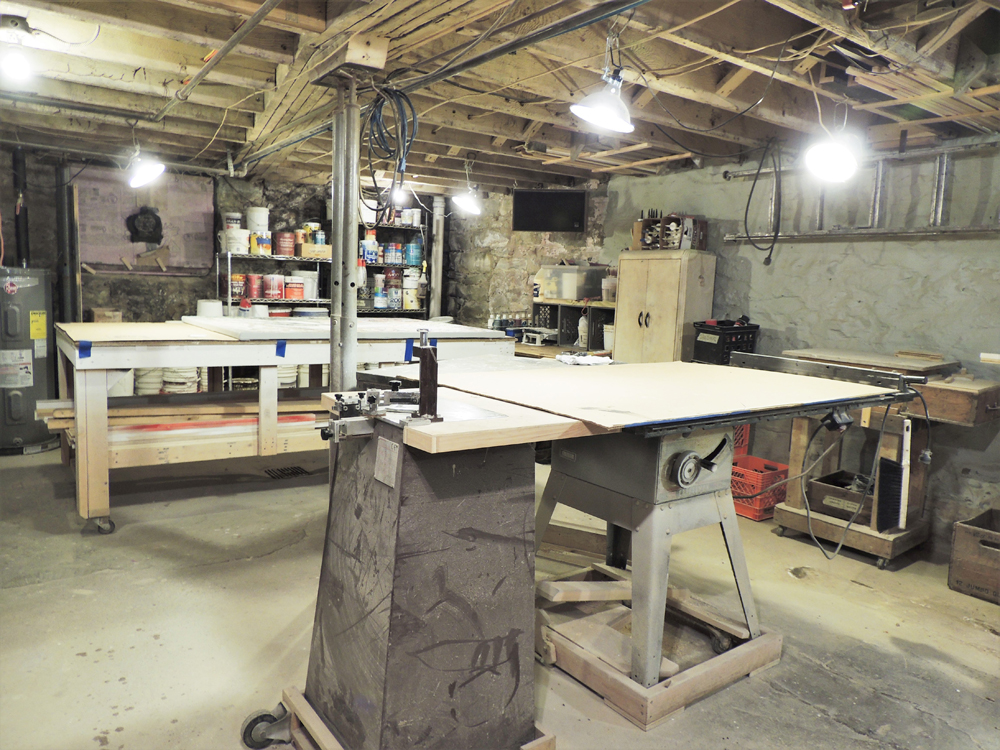
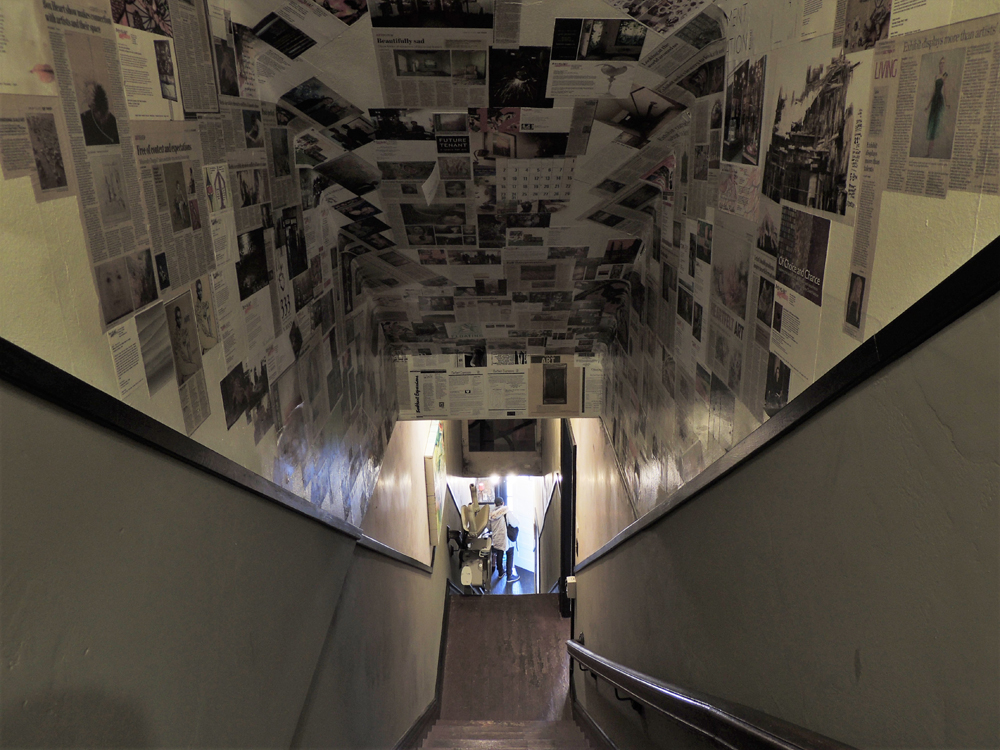
For those accustomed to viewing art from the internet or the stark, white walls of a museum, stepping into Boxheart Gallery for the first time might come as a surprise. In the entry are comfortable green chairs around a low table in front of an accent wall of robin’s-egg-blue. Behind this are more neutral walls where art hangs in the gallery space. Up the stairs on the right, old penciled-in writing can be seen, and newspaper clippings affixed to the ceiling. On another floor is Joshua Hogan’s art studio. Here can be seen plants, splatters of paint, an old palette which Joshua indicates has been accumulating dried paint since his days attending college, a menagerie of interesting objects placed on a mantle, and Joshua’s abstract artwork. A bathroom, a bedroom, and a kitchen integrate almost seamlessly into the rest of the gallery. If you looks up at one particular corner in an upper level, a large hole can be seen in the wall, out of which peer two metal rats. Taken in as a whole, Boxheart Gallery is eclectic, interesting, and most of all inviting. This “personality” which is apparent in the décor of this site is something which is unique to all art galleries between their aesthetics, their mission, and their interactions with people inside and outside the art community.
One way of conceptualizing this concept of galleries having personalities is through Edward Soja’s theory of space. In this theory, space exists as three non-discrete and overlapping entities. These are perceived space, conceived space, and lived space; or the actual physical space, the feelings spaces evoke and our preconceived notions about them, and finally the intersection of these two in the way we actually interact with a space (Soja). Gallery personalities probably fit best into the idea of lived space; how spaces make us feel, and the strange, abstract qualities we give them when we think about them. For instance, the rigid, somewhat trepidatious emotion experienced when entering or thinking about a museum art gallery which is influenced by the often sterile decor. Nothing about the gallery must dictate that we feel this way; rather, our experiences coupled with certain physical characteristics of the space come together to build up a conceived space layered on top of what the as it actually is physically.
To be an inviting space, Nicole Capozzi said, was one of her goals in bringing together the space that is Boxheart Gallery. She believes that to be a successful gallery, owners can’t cater to collectors or the artists themselves who might prefer a more blank décor so as to keep focus on the works of art. She made an important point during our visit: a passerby on the street might look in and if all they saw was completely white walls with a few hanging pieces in an open space, they might feel too intimidated to come in. Nicole believes that Boxheart should not be excluding potential art buyers by feeling too unapproachable. In her goal of expanding a customer base, she has crafted a space that has a unique personality in its physicality. In John Berger’s Ways of Seeing, a popular video series from 1972 which deals with our perceptions of art, the idea that the setting which art is viewed in has a large impact on our perception of the art it contains is explored (“Episode 1”). For instance, dramatic music might change our understanding of a painting from calm and peaceful to tense. The physical space of art galleries also changes our perception of the art they house, and Boxheart is no different with the feelings it casts on its pieces. Boxheart’s lively and upbeat personality makes one envision taking a colorful painting home to create a cheerful environment. This feeds into the intention of making the art Boxheart sells into something more accessable to all buyers, and not just the collectors.
But what about Boxheart’s mission? Here, too, a unique and compelling personality shows through. My own first experience with art galleries was not with Boxheart Gallery, but a different one. It was of the “hobbyist” type—that is, it was run by a person with a dream of owning a gallery, but no clear goal in how to run it. The effort was admirable, as this gallery served as a lively gathering spot on First Fridays, bringing together artists and non-artists alike. However, the lack of sales, low price tags on artworks, and quite low bar for accepting works were all telling that this little gallery was a net loss for its owner. This is why I was so surprised when entering Boxheart Gallery for the first time and seeing the professionalism embodied in it. I was taken off guard by the colorful interior which reminded me so much of that first gallery I had visited. Boxheart’s outwardly quirky charm shouldn’t fool you though; being a thriving business is a serious priority of Nicole and Joshua. Their mission with their gallery is to make a living in the art world, and that is not an easy feat. As Nicole put it when asked about the decision to purchase the building that would become Boxheart, “if we’re going to be starving artists, we might as well be starving and own a gallery” (Capozzi). But Nicole and Joshua have made wise decisions in their business practices that have ensured Boxheart Gallery has continued on through the years since its start. Besides selling artworks in the gallery spaces, Boxheart also has a framing shop for custom framing art, a studio where Joshua crafts his own works often on commission, and Nicole and Joshua also travel to other art venues to try and attract buyers. There is a certain sense of tenacity one gets after speaking with Nicole; a sense of “we’ve worked so hard to get to where we are at.” That tenacity seeps into the lived space of Boxheart and you feel it all around.
Art galleries all seem to have a different personality in their interactions with members of the community as well. For instance, art museums are truly meant to be service to the public. They typically do not serve as lively gathering spaces, as the art they house is often quite valuable and fragile. Museums are usually static; someone could visit years apart and (except perhaps in the case of a rotating exhibit) see the same things in the same placement. Private art galleries are something all together different. Though they certainly benefit the surrounding community, they do so in a different way: they support the livelihoods of owners and of the artists whose work they display. Their intention is to sell the works of contemporary artists, and as such they are always shuffling and rotating art. Boxheart and many other galleries tend to rotate artwork on a monthly schedule. They want to get customers in to purchase art, so they often choose to hold social events to invite the community in. For instance, Boxheart Gallery holds receptions for its displayed artists, inviting the public to come and interact with the artist for a night during the exhibition (“Exhibitions”). It makes sense for private art galleries to hold special social events for attracting customers in and making them excited about the art scene, encouraging them to purchase artwork.
Though Pittsburgh and the surrounding area have many options for purchasing art, each has a unique personality and it is worth visiting Boxheart even if one has visited others. Boxheart’s cheerful aesthetic, wise business practices, engagement with the public, and tenaciousness combine in its lived space to produce a personality which is truly unique.
Works Cited
Capozzi, Nicole. Personal Interview. 1 Feb. 2019.
“Episode 1.” Ways of Seeing, written by John Berger, produced by Mike Dibb, BBC Two, 1972.
“Exhibitions.” Boxheart Gallery, boxheartgallery.com/exhibitions/. Accessed 13 Apr. 2019.
Soja, Edward. Thirdspace: Journeys to Lost Angeles and Ither Real-and-Imagined Places. Cambridge MA: Blackwell Publishing Inc., 1996. 53-70.