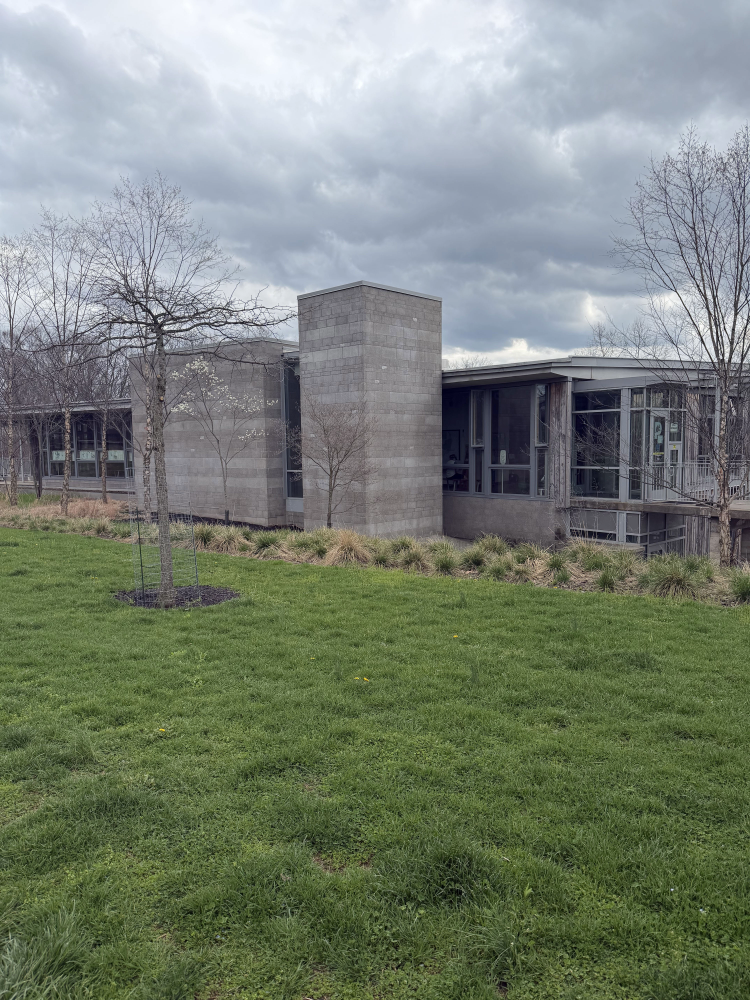
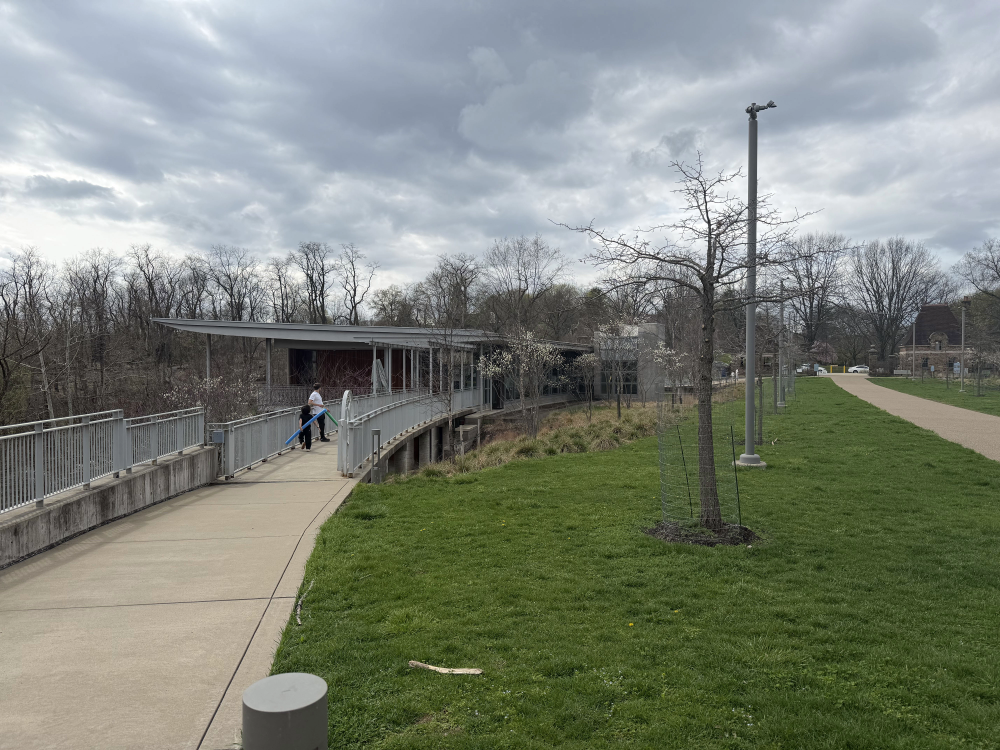
Photo by Clara Jane Mack, 2026. Side of FEC.
A More Circular Approach
A common misconception, born from past decades of heavy industrialization, is that Pittsburgh is an extensively polluted city with little intention to be more than the steel giant the city once was. While there is no denying past reports of smoke so dense streetlights stayed lit during working hours, consistent efforts to reduce pollution and establish healthier surroundings for residents enabled the city’s green spaces to grow and thrive (Adams). Over the past century, mass closure of industrial sites and growing pollution concerns pushed Pittsburgh to adopt a more environmentally friendly mindset. The Frick Environmental Center (FEC) is one of the many ways in which the Pittsburgh Parks Conservancy is attempting to expand sustainability within the city. The FEC is unique not only in design but also in operation. The Pittsburgh Parks website details how, “in partnership with the city of Pittsburgh, [Pittsburgh Parks Conservancy] opened the new Frick Environmental Center to the public in September 2016, and in 2018 it was certified as a Living Building, achieving Leadership in Energy and Environmental Design (LEED) Platinum status” (“Frick Park | Pittsburgh Parks Conservancy”). As an environmental studies student at the University of Pittsburgh, I have spent the past four years investigating the environmental issues that are prevalent throughout the city, while also celebrating the achievements of environmentalists who strive to combat these problems.
The FEC resides only a short walk away from the entrance to Frick Park. The intentional use of natural colors around the building and large, curtain-free windows reminded me of other nature centers that focus on blending in with the environment. Every detail from the dual-height doors to the accessible walkways into the building, invite people to enter. Once inside, visitors can turn right into the community room that offers inclusive seating, reading materials, and a diverse range of educational activities. The center might be the only location within Pittsburgh where you can learn what type of tree you are based on your personality (for whatever it is worth, I found out I was a black cherry tree). Not far from the back-to-back traffic clogging up the Squirrel Hill tunnel, you can find a quiet spot on the FEC’s wrap-around balcony that provides the perfect outlook.
Environmental education centers played a massive role in developing my personal understanding of the intrinsic worth within the environment when I was growing up. While I feel deeply that my penchant for the environment is innate, I see how attending summer camps as a child helped me to learn about the life present in every stream, every forest. Those opportunities cultivated the drive I and others have to defend the right for a clean environment. Sitting among the toys and programming intended for a younger audience at the center made me think about who would be walking into the FEC after me. Would afternoons spent wandering around the center, listening to tour guides peppering in facts about the native plants, or learning more about ecosystems work to inspire new environmentalists? Would a space built on education inspire the next generation of architects to create sustainable buildings that follow in the FEC footsteps?
The longevity of a space is often taken for granted. In a culture that praises the constant influx of new goods, new materials, new spaces, people fail to consider how infeasible that level of production truly is. This idea of a linear consumption model, where an item is made, used, and then thrown away, is reinforced not only in our capitalist culture here in the United States, but additionally through how the nation manages energy and waste. The bottom line is that the way most “developed” (I use the term reluctantly) countries operate is to disregard the harm they perpetuate by failing to offer more than a Band-Aid solution for systemic issues, such as waste management. Many of the solutions major corporations offer to reduce air pollution or to combat climate change never address the prospect of producing and consuming less; instead, they reactively target pollution only after it appears, needlessly using extensive amounts of energy in the process.
However, these failures on major powerhouse industries can serve to highlight the important difference seen in buildings like the FEC that take a second to think about how they can use less, produce less, and maximize energy efficiency. To receive the environmental accolades they have, the FEC found solutions to these issues. The ReUse People defines a circular economy as follows: “an economic model that prioritizes eliminating waste and using resources sustainably so that they’re available for the future. It contrasts sharply with the linear economy, where resources are extracted, turned into products, and then discarded after use” (2024). A circular economy is at the cornerstone of sustainability, the idea that we must produce with a product’s final destination in mind and that we loop as many materials as we can back into that circle. The FEC is a manifestation of a circular way of thinking. This circular notion is present throughout the FEC, through its reuse of rainwater to its solar panels.
Though Pittsburgh has left the worst of its pollution in the past, there are a multitude of fundamental changes that must be made to establish a productive and sustainable future for the next generation. The FEC stands as a leader that building developers can not only admire but should also learn from.
Works Cited
Adams, Ashley. “The Donora Smog Tragedy: The Deadly Air Pollution Incident in Pennsylvania That Helped Shape an Environmental Movement.” Keystonenewsroom.com, 22 June 2023, keystonenewsroom.com/2023/06/22/the-donora-smog-tragedy-the-deadly-air-pollution-incident-in-pennsylvania-that-helped-shape-an-environmental-movement/.
Frick. “Preservation Pittsburgh.” Preservation Pittsburgh, 2019, www.preservationpgh.org/frick-park.
“Frick Park | Pittsburgh Parks Conservancy.” Pittsburgh Parks, 12 Oct. 2020, pittsburghparks.org/explore-your-parks/regional-parks/frick-park/.
“Outdoor Discovery Space and Sensory Nature Trail | Pittsburgh Parks Conservancy.” Pittsburgh Parks Conservancy, 13 Jan. 2024, pittsburghparks.org/park-projects/frick-environmental-center-sensory-classroom/. Accessed 16 Apr. 2026.
“THE FRICK ENVIRONMENTAL CENTER.” International Living Future Institute, living-future.org/case-studies/the-frick-environmental-center/.
The ReUse People. “The Circular Economy: How Reuse Is Shaping the Future of Consumption.” The ReUse People, 2024, thereusepeople.org/the-circular-economy-how-reuse-is-shaping-the-future-of-consumption/.
USGBC. “LEED Rating System.” USGBC, 2025, www.usgbc.org/leed.
Wells, Bethany. “Net Zero Building Is a Global Model for Sustainability and Picture Perfect Backdrop for Special Events | Pittsburgh Parks Conservancy.” Pittsburgh Parks Conservancy, 19 Apr. 2023, pittsburghparks.org/fec-net-zero-building-is-a-global-model-for-sustainability/. Accessed 16 Apr. 2026.