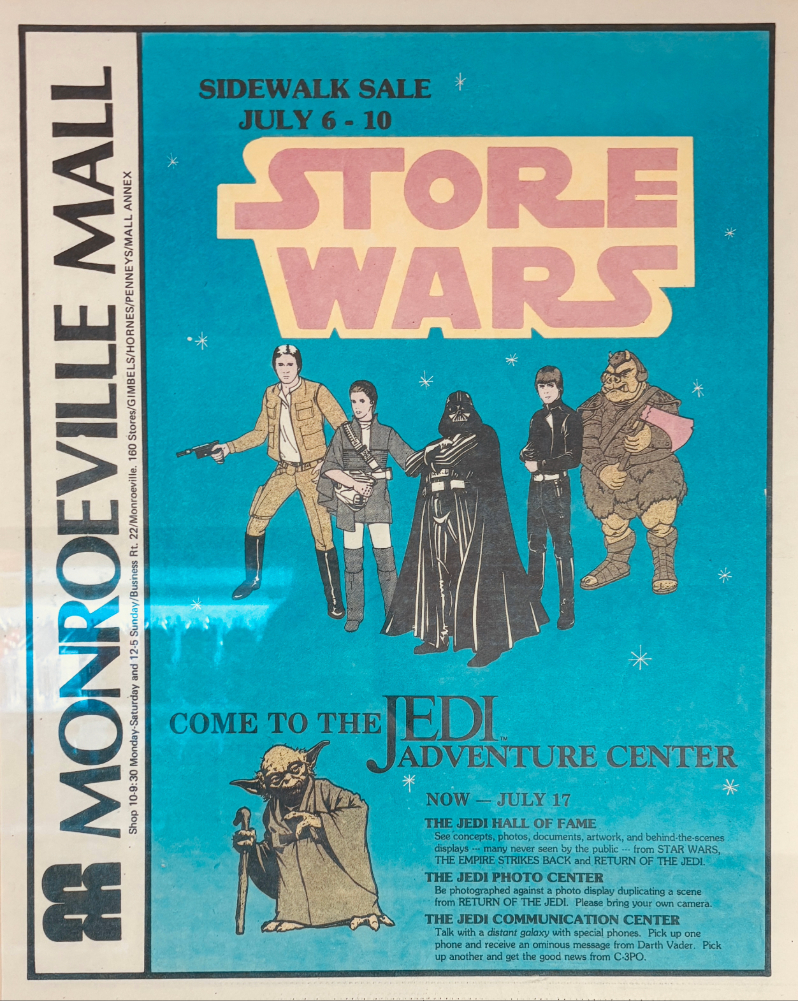
Photograph by Caroline Mulford, 2026. Monroeville Mall vintage poster advertising a Star Wars themed sale and event.
From Dawn to Dead: A History and Reflection on the Monroeville Mall
Inception
It is the mid 1960s, a time when indoor shopping centers were becoming increasingly popular. You are sitting in the offices of Don-Mark Realty, later the Oxford Development Company, listening to its principal members: Eugene Lebowitz, Edward Lewis, Mark Mason, Harry Soffer, and Don Soffer (Bolch). Ambitiously, the men want to build the biggest shopping mall in America, and they want to do it in a rural community known as Monroeville, located within the larger Pittsburgh region. Don-Mark Realty purchases a plot of land there known as Harper’s Mine, levels it, then begins construction in 1967. Their architects designed the mall with two floors, high ceilings, large skylights, and an ice rink in the center. The ground floor of the mall is set to have lush green spaces, with koi ponds and pedestrian bridges to create a welcoming atmosphere.
Opening
It is 1969: two years after construction began in Monroeville, and the mall is opening. You are a resident of this Pittsburgh suburb and have been excitedly waiting for this day. The mall has been advertised as an “Indoor Town Center,” where members of the community will be able to do everything they may need to do, all in one trip. You enter and are amazed by what you see. The large skylights scatter natural light onto the beautiful indoor trees and bushes, and the air feels fresh from all the plants. Walking further inside, you see a large fountain surrounded by places to sit—people are already lounging and relaxing. In the middle of the mall, there is a restaurant with windows looking out onto an ice-skating rink, free to the public, named the “Ice Palace.” On the other side of the mall, in front of a department store, stands a large Clock Tower. There are 12 puppets, each seeming to represent a different ethnicity of Pittsburgh, and at the top of every hour one of them comes out and performs a show. At 1pm and 6pm, you get to watch all 12 perform together. As you absorb all the community-building features of the mall, you start to take note of the actual shopping availability. The three large department stores within the mall provide everything you could need, but there is also a grocery store, bank, jewelry store, sewing supply store, and many other specialized shopping experiences. The developers have exceeded your expectations for the mall, and you are excited to enjoy this community center for years to come.
Today
It is 2026, and the mall is closing. As I walk down the long hallway from one empty department store to the other, I am filled with a sense of nothingness. It is the sense of nothingness that only occurs when you know there was once something there. The mall is a shell of its past self; the public ice rink is long gone, the food court is small, the clock tower and fountain have been removed, and many of the storefronts sit with their security gates down and locked. The businesses that once served the Monroeville community have closed or went bankrupt years ago: department stores like Gimbels, Penneys, and Horne’s that anchored the mall, and smaller shops like Herrold Jewelers, Kard Korner, Bakers Shoes, Candy Tree, and the Oyster House. The only store remaining from the mall’s opening in 1969 is Spencers, formerly Spencer Gifts (Monroeville Mall Archive). It now sits surrounded by Claires, Dicks Sporting Goods, Hallmark, Auntie Anne’s, and other chain brands. There are a select few local businesses that remain open, like Gloria Jean’s Coffees and 412 Toe, but they certainly are the minority.
Standing on a barren floor that was once occupied by plants, I listen to the white noise of the mall: escalators running, teenagers chatting, and quiet music playing in the shops that are still open. The temperature is mild, there are no strong smells, and the fluorescent lights are bright where there are no skylights. All of it contributes to this feeling of absence. I know that this mall was once a bustling hub of people, but the only real evidence left of that is tucked away upstairs.
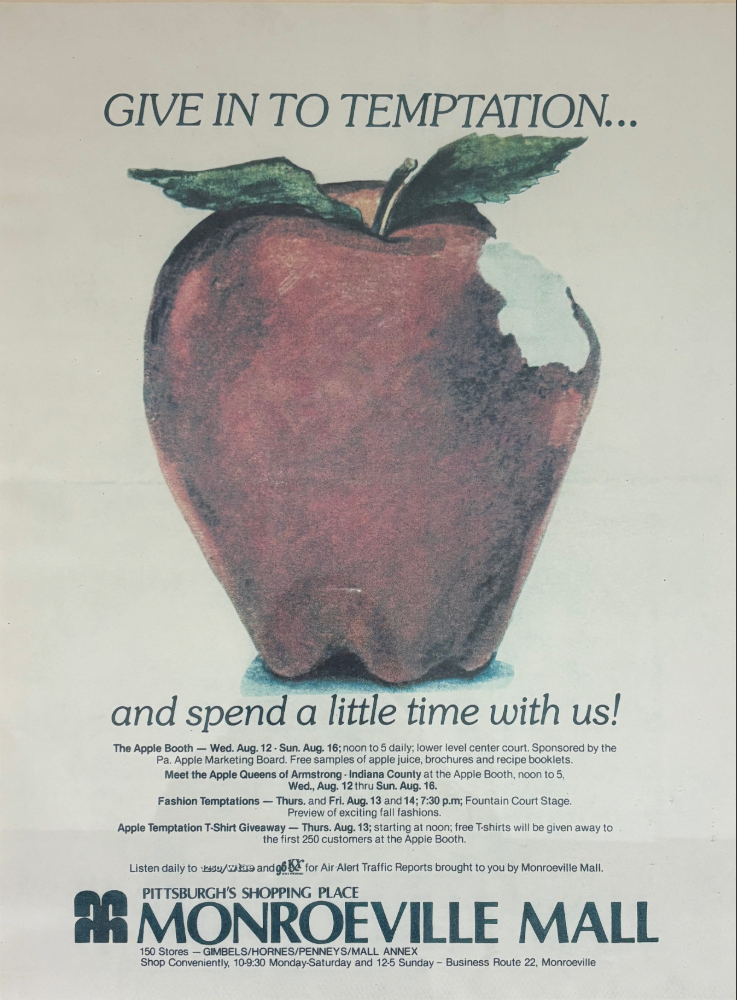
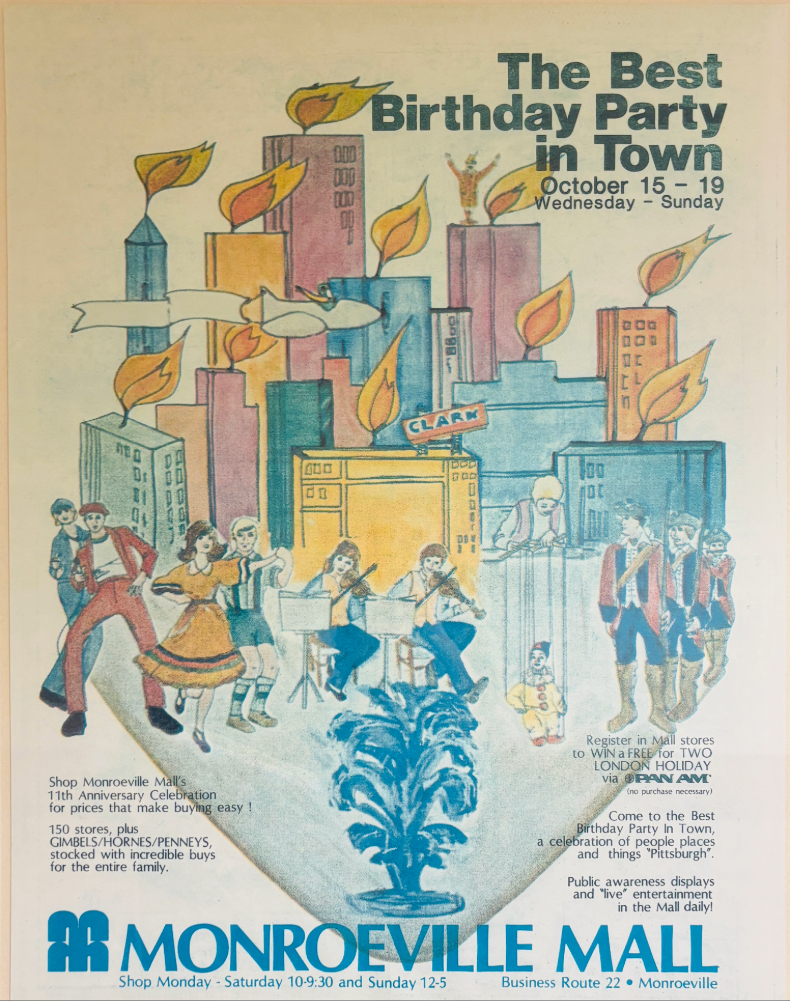
In the hallway leading to the bathrooms on the second floor, there is a long row of framed vintage posters. They are advertisements for the mall, informing its patrons of upcoming sales or community events. In one, the Monroeville Mall is celebrating its 11th birthday by hosting a party, complete with giveaways and live entertainment. In another, “Store Wars” is displayed in a familiar font, and it tells of a sidewalk sale and “Jedi Adventure Center” where visitors can indulge in Star Wars themed activities. A third has an image of an apple with a bite taken out of it, accompanied by text encouraging people to come to the mall for a fashion show and giveaways sponsored by the Pa. Apple Marketing Board. There are posters themed around the Steelers, Mother’s Day, spring flowers, Christmas, and anything else that once drew people to the mall. Walking down this hallway, I experience the history of the place, and I relish these glimpses into how special and popular this mall once was.
Moving downstairs, I see a bronze bust, positioned against a support pillar. The plaque reads:
HARRY SOFFER
1908-1972
A Man Whose Vision And Foresight
Made All That You See Here Possible
I am not sure when this tribute to one of the developers was first installed, but I would guess it was at a time when a look around the mall yielded more than views of empty storefronts. Reading the plaque now, it is difficult to imagine that this increasingly desolate scene is what Soffer desired. He and the other developers of Don-Mark Realty wanted to create a space that created community. Why else would they have included features like a free ice rink and clock tower representing the people of Pittsburgh? The Monroeville Mall was always intended to be a cultural meeting point, and despite its generally empty interior, it does still exist as one. The mall persists in the community’s memory as the location of the filming of Dawn of the Dead (1978), a cult classic taking place almost entirely within its walls.
Soffer’s original plans for the mall may no longer be fulfilled in the way he envisioned, but when “All You See” turns into vintage advertising posters and the Dawn of the Dead museum, it becomes a little clearer that the mall was and is special. Teenagers spending their allowances, mall-walkers conversing in the halls, families and friends gathering in the food court, and zombie fans finding those hidden locations where the dead once stood all give the impression that community still exists here. The future, however uncertain for this Monroeville landmark, still holds promise.
Works Cited
Bolch, Gene, and Monroeville Historical Society. “Monroeville Mall in 1070,” Historic Pittsburgh, historicpittsburgh.org/islandora/object/pitt:20110202-hpicmonroeville-0221.
Dudiak, Zandy. “Harper’s Mine Birthplace of Monroeville Mall.” YourMonroevile.com, The Times Express, 4 Apr. 2007, (www.yourmonroeville.com/timesexpress/article/harpers-mine-birthplace-monroeville-mall/). Internet Archive. (https://web.archive.org/web/20071215020717/http://www.yourmonroeville.com/timesexpress/article/harpers-mine-birthplace-monroeville-mall/). Accessed 17 Apr. 2026.
“Monroeville Mall Original Directory and Layout.” Malmanac.com, 1969, drive.google.com/file/d/1OelEaqE0p8ou0GdaFFpIUmaKzp-n5nGv/view. Accessed 17 Apr. 2026.
“Spencer Gifts.” Monroeville Mall Archive, 25 Mar. 2026, monroevillemall.org/mall/store/spencer-gifts. Accessed 23 Apr. 2026.