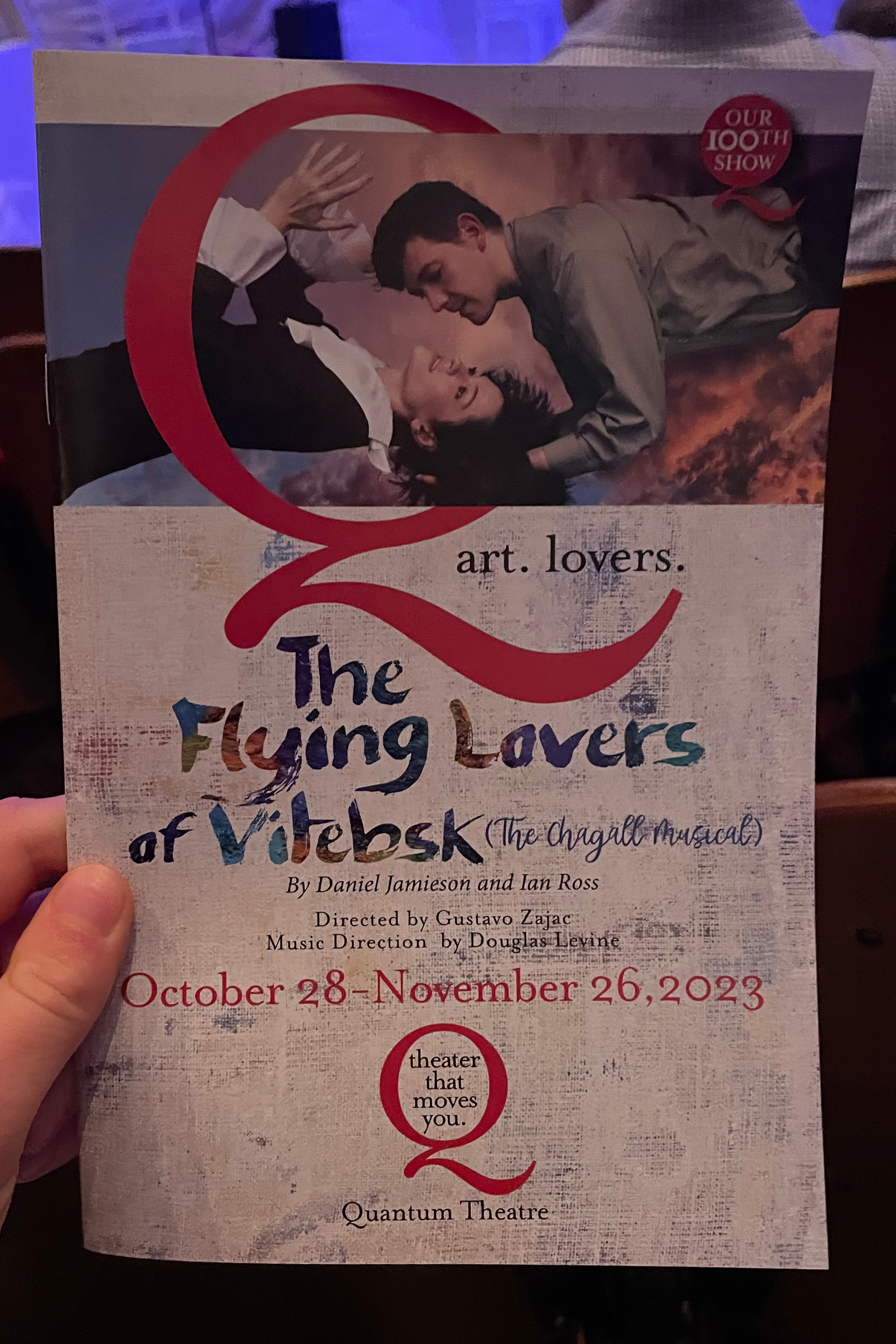
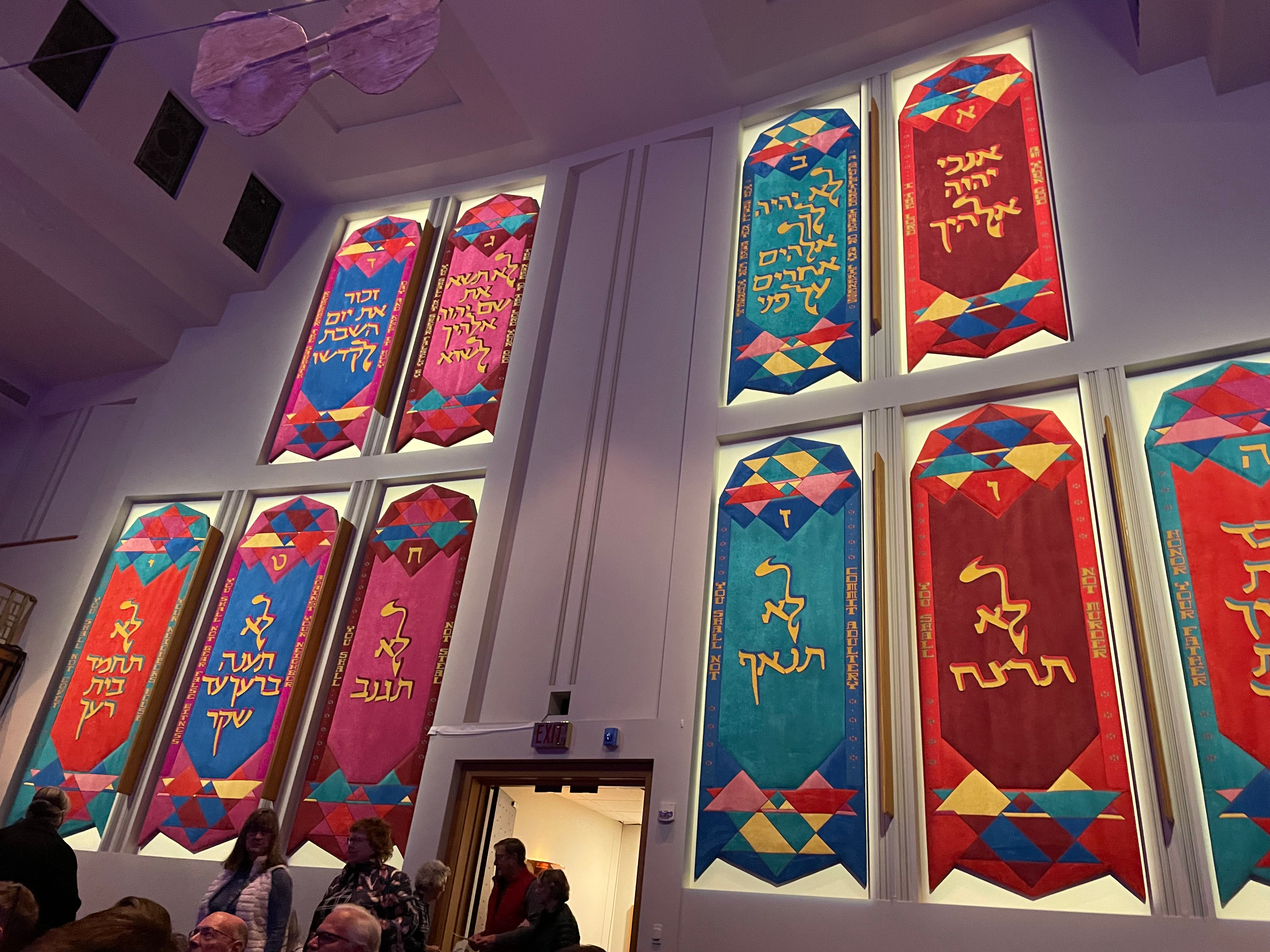
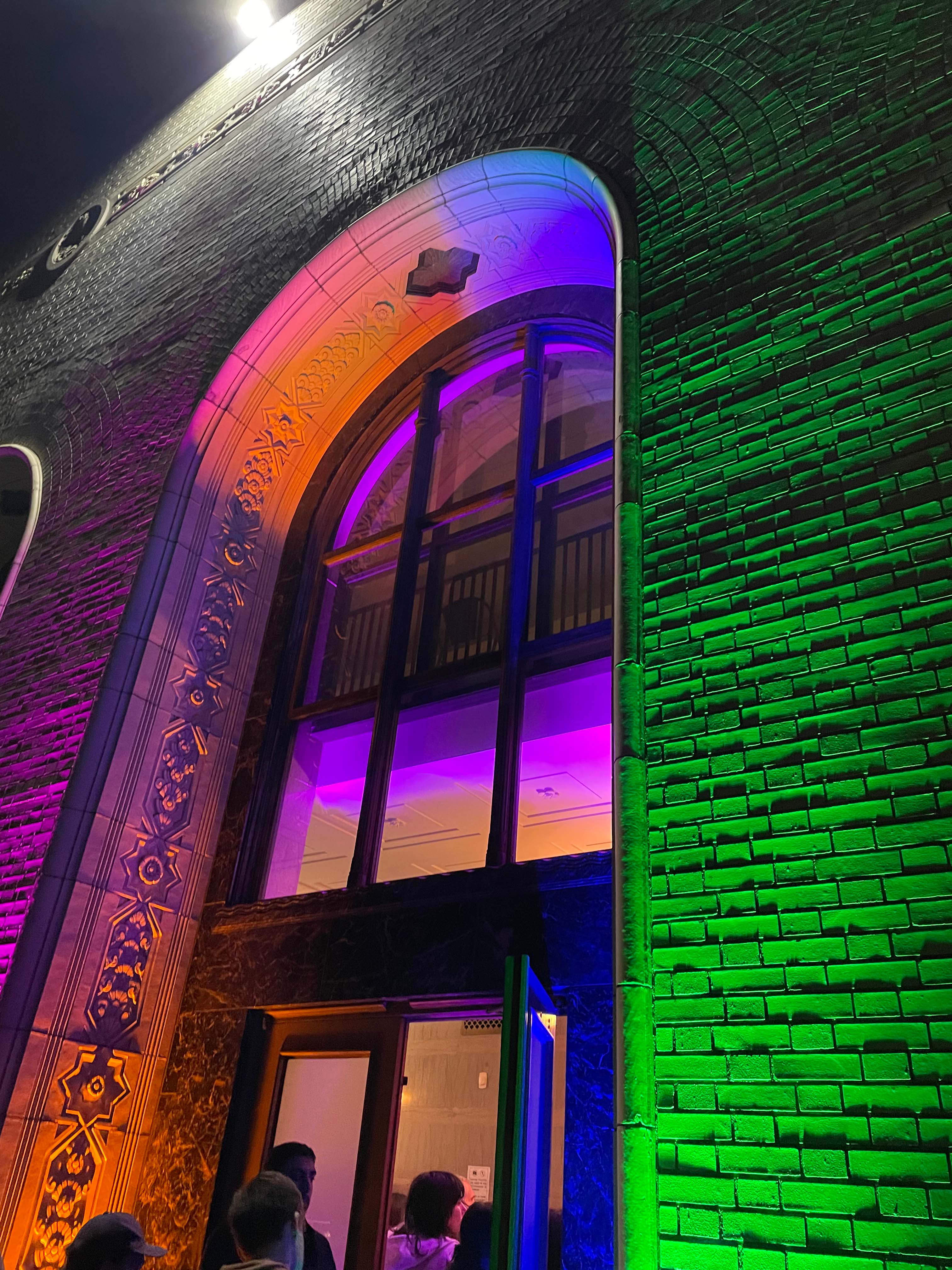
Program for The Flying Lovers of Vitebsk. Photo by Taya Hoetzlein-Sirman, 2023.
Coming to Pittsburgh: The Flying Lovers of Vitebsk
This page contains the transcript, show notes, and sources for the fifth episode of the Secret Pittsburgh Podcast, Season One . To listen to the episode, as well as the rest in the series, visit our SoundCloud.
Transcript
Announcer [mechanized voice]: Ladies and gentlemen, we ask that you please take your seats at this time as the program will begin momentarily. Thank you.
Catie: Set the scene… in 2023 Pittsburgh isn’t black or white at all. Color is everywhere. The shining gold bridges and the deep red rests that clings to them. The blue lights on the river and the purple sheen of the skyline at night, the air… [sniff]… smelling like fried perogies and a broken sewage line?
Or at least that’s how Marc Chagall might perceive it with his breathtaking painter’s eye. But he doesn’t live in Pittsburgh and 2023. In fact, he and his lover Bella lived far away a long time ago, in a small Belarusan town in the early 20th century.
It was Quantum Theater that brought them to Pittsburgh today, through their production of The Flying Lovers of Vitebsk staged in Rodef Shalom.
Welcome to secret Pittsburgh. In the past 15 weeks, we’ve traveled across the city, learning the story of Pittsburgh’s people in places. Join us today as we explore Quantum Theatre’s production of The Flying Lovers of Vitebsk. I’m Catie.
Taya: I’m Taya
Simona: and I’m Simona.
Catie: Let’s go. Today we’re going to discuss site-specific productions and how they can tell stories.
So what if you had to fit your whole life into a 90 minute performance? How would you do it? What would you focus on? Where would you hold it? What kind of story would it be–an action story? a thriller? a comedy?
Taya (airily): I think my life would be a coming of age story and I was sitting right here at Pitt in the cathedral.
Catie (unimpressed): Really?
Simona (deadpan): Mine would be a tragedy. Set in a graveyard.
[cricket chirps]
Catie: Well, anyways, for Marc and Bella Chagall, and the Flying Lovers of Vitebsk, it was a love story.
[applause, whistling]
Catie: Okay, calm down, calm down. It wasn’t all sunshine and roses for them. Marc and Bella lived in Europe at the turn of the 20th century. That was bad news.
In 1909, they met in their hometown of Vitebsk (gasp) and 1915, they married and moved to St. Petersburg (wedding bells). In 1916, they had their first child (child crying) and in 1917, the Russian Revolution began (rioting sounds).
This would definitely be impactful for anyone living in Russia at the time, but it was particularly impactful for artists. More specifically, Jewish artists. Marc and Bella both use their work, painting and writing respectively, to express themselves and their views of the world. Marc ushered in a new era of avant garde art, characterized by experimental and innovative techniques and imagery. As the MoMA describes them, his paintings had “a distinct vocabulary of abstraction, characterized by fantastic colors and folkloric imagery.” He combined all types of artistic movements: cubism, symbolism, fauvism, expressionism, surrealism and modernism in order to convey his vision of the world: a whimsical, colorful, dreamy place.
[piano music]
While his style adapted and changed through time, his content remained consistent. In the words of one art historian Michael Lewis, his work was “one long dreamy reverie of life in his native village of Vitebsk.”
[village noises]
Just as Marc used his chosen medium painting to express the story of the place, the Quantum Theatre used a given place to tell the story of a man. So how did they accomplish this? How can the place the performance is set in–Rodef Shalom–impact how the narrative is built? In order to explore this question, one must first have a little background knowledge about Rodef Shalom and Quantum Theatre themselves. For more in depth explanation, feel free to refer to other episodes in this podcast series about these specific organizations. For our purposes, it’s sufficient to tell you that Rodef Shalom is a historic synagogue in Pittsburgh PA, which serves as the center of Reform Judaism and the vibrant Pittsburgh Jewish community. And it is here that Quantum Theatre chose to stage their play about “the quintessential Jewish artist of the 20th century.”
Simona: Wait, so how did they decide to have the play at Rodef Shalom?
Catie: Well, we’ll let Karla Boos, the founder and artistic director of Quantum Theatre, tell you herself.
Karla: Here we are currently in Rodef Shalom for a play that is about the Chagalls and especially them as representatives of Jewish people, Jewish artists and what happened to them in the 20th century.
Catie:How does this Jewish space make the show more meaningful?
Karla: Right, I mean, you know, this beautiful building designed by Henry Hornbostel, has been home to Jewish people in Pittsburgh for generations, right? And so it’s in the air, they own a couple Chagalls. They just brought them out and hung them where our audience can appreciate them. Isn’t that magnificent? So I think where you started with others you’ve talked to see a metaphor, that is maybe what I would say there is a non literal sense of meaning that a place has for a community that is as good of a reason to do a play there as something like it’s the right texture or color, or height or size, right? I’m looking at all those things, actually. And we don’t have the key to the city. So there’s also an element of happenstance and practicality that feeds into what makes the right match.
Catie: As you can tell from Karla’s explanation, place is a big factor in how a story is built, told and perceived. The use of a Jewish space allows for a uniquely Jewish story to be told more authentically, both as a love story, a testament to Jewish perseverance, beauty, and art, and also as a tragedy. Mark and Bella Chagall were in a unique position, as they both were witness to the thriving and beautiful civilization of Eastern European Jews, and then lived to see it disappear. Bella herself died from a bacterial infection that would have been curable if not for the limitations born from war. This Chagall’s personal history thus coincided with the larger Jewish community’s political history, in a volatile violent way. And Marc’s art is a testimony to what was lost.
Taya: That’s so sad.
Simona: Yeah, it is.
[fiddle music plays softly]
Catie: In 1913, he painted the fiddler this vibrant cubist inspired painting shows a Jewish man playing the fiddle on a rooftop with contrasting colors that suggest the different occasions this music might be played… in a celebratory capacity, and a sorrowful one, marking weddings and anniversaries and holidays and festivals, or accompanying funerals and deaths. He thus immortalized a central aspect of Eastern European Jewish life in a very distinct way through his art. It actually inspired the Jewish musical Fiddler on the Roof.
[fiddle music continues]
In the performance, Quantum Theater masterfully pays homage to this iconic folksy piece through their incorporation of the Violins of Hope, a collection of violins, violas and cellos that survived the Holocaust, and were restored to play a musical tribute to their past players.
Catie: Can you describe the collaboration process with Violins of Hope? How do these violins add to the story and change the sensory experience?
Karla: Well, it’s just so wonderful to be part of something that is city wide and bigger than that, you know, the creators of Violins of Hope in Pittsburgh, experienced this exhibit out in the world, and felt it would especially resonate in Pittsburgh. They got in touch a full year or more in advance with cultural organizations like Quantum and said, ‘Would you have a work that might be appropriate?’ Well, you know, did we ever have work. It couldn’t have been better for us to hear and so we love that, that we’re maybe having audiences that last night they were at the symphony and the night before they were at the ballet and, and then they’re with us, and they’re really getting a multi layered experience of these violins and the ability to think about how they have survived and what they mean–continue to mean now.
Catie: What is so impressive about the Quantum Theatre’s production of The Flying Lovers of Vitebsk is the way that the audience is drawn into the narrative through the place that the show is set, and through the scenery that is used. Like all modes of storytelling, theater is limited by practical considerations and logistics like cost, staging, resources, etc. The production team had to contend with all that while still working to bring the non traditional theater venue to life in an engaging way.
[Fiddle music continues]
Catie: Can you describe the creative process for making the show? Was it any different than other shows you’ve put on in the past?
Karla: For this particular show? Well all the shows have a group of artists that come together and know that it’s not like work in other theaters where the theater is a known quantity. And often the designers do their work separately because they know the specs of the theater. In this case, the team had to work together for months and months, a good solid year. We had specific things that also played a role. Tree of Life’s congregation has services in Levy Hall on Friday nights. So it’s not just that we couldn’t perform on Friday nights, but our set needed to be movable enough so that it could accommodate services. So that’s what was behind the idea of the wonderful piece of scaffolding that you’ll see that does many beautiful things for the play, and you’d never know that it had a practical thing behind it that we had to remove it, right? [laughter]
Catie: And they do an excellent job at accommodating these logistical considerations while still using the site–Rodef Shalom–to its fullest potential. Onstage the set is composed of a main white piece that is turned at various points to create different places, several other small props, and a filmy gauze background onto which Chagall’s paintings are projected. This drenches the stage in colors and immerses the audience into his dreamlike world.
Taya: Oh yes, I love the projections
Catie: In the back of the auditorium large colorful banners are unfurled with the 10 commandments written on them in Hebrew. Their design resembles Chagall’s vivid works. Across the ceiling different wires hold props extended above the seats, colorful wings floating above the audience, a bouquet of flowers dangling, and a violin marked with the Star of David suspended in the air.
Simona: Yeah, that was my favorite part.
Catie: The rooms’ upper balconies are incorporated into the performance as at one point Marc climbs a ladder and unfurls his artwork over the audience to show us. [piano music building].
And the show ends beautifully with Bella, transformed into an angel with colorful wings that resemble Marc’s famous stained glass windows, walking down the main aisle in death, turning the audience’s heads as we perceive her the way Marc does: As an other worldly being, his muse, his flying lover.
[piano music]
Catie: Art is a form of expression. Above all it is meant to convey emotions and to tell a story. The Flying Lovers of Vitebsk focused on Mark and Bella Chagall, as two artists who are deeply in love and had a story to share. By telling their story in the format of a play, their chosen mediums of expression were able to be intertwined as Bella’s words and Marc’s paintings combined to detail their romance. The Quantum Theatre was able to successfully translate their individual lives into a universally understood and felt story through their use of place. In the words of Karla Boos, the Flying Lovers of Vitebsk with “the right site would allow us to bring people into a Chagall painting” and so they “set it free to fly over the dome of Rodef Shalom like a dove.”
[bird sound]
Catie: Thank you for joining us as we uncovered one story of The Flying Lovers of Vitebsk in Rodef Shalom. We hope you are inspired to visit this place and to find your own Pittsburgh stories. Please tune in to all the episodes we produced this season. You can find show notes and a transcript at secret pittsburgh.org. I’m Catie Grable. Simona Matiyevsky served as audio editor, and Taya Hoetzlein-Sirman wrote and researched this episode. See yinz later!
[applause]
Show Notes
Here you can find the websites for Quantum Theatre, Rodef Shalom, and the MoMA.
Here you can find two related visuals: Over the Town and The Chagalls (photo).
Bibliography
Acclivity. “WeddingBells1.mp3.” Freesound, 25 September, 2006. https://freesound.org/s/23090/.
Avajoliec. “Small crowd cheering whistling and clapping.” Freesound, 24 February, 2022. https://freesound.org/s/621392/ Bacruz666.
“Gasp.” Freesound, 2 April, 2016. https://freesound.org/s/341908/ Beman87.
“Ambience street NY firetruck.” Freesound, 15 August, 2012. https://freesound.org/s/163142/.
Boos, Karla. “Secret Pittsburgh.” Interview by Taya Hoetzlein-Sirman, Catie Gable, Simona Matiyevsky. November 3, 2023.
Breviceps. “Concert Pitch / Orchestra tuning.” Freesound, 27 February, 2023. https://freesound.org/s/677124/.
Buzzelli, Michael. “To Me, You Are Beautiful – a Review of ‘The Flying Lovers of Vitebsk.’” ’Burgh Vivant, 30 Oct. 2023, burghvivant.org/2023/10/30/to-me-you-are-beautiful-a-review-of-the-flying-lovers-of-vit ebsk/.
Edelhanie. “Birds and dove flying.” Freesound, 28 October, 2021. https://freesound.org/s/594656/.
Eqavox. “Sizzling.wav.” Freesound, 11 April, 2023. https://freesound.org/s/683522/.
Felin_quinol. “Cricket Sound.” Pixabay, 26 June 2022, https://pixabay.com/sound-effects/cricket-sound-113945/.
FillMat. “Crowd/Mob/Riot Noise (Voices Only) – 14 people, 2 minutes HENRY VI.” Freesound, 16 March, 2017. https://freesound.org/s/384401/
Fischer, Carol Anne. Quantum Theatre: A Language for the Voices of Contemporary Theatre. ProQuest Dissertations Publishing, 2004.
GirlWithSoundRecorder. “Village Soundscape.” Freesound, 20 March, 2023. https://freesound.org/s/679474/
Jacobs, Jacob, and Sholom Secunda. Bay Mir Bistu Sheyn. In MuseScore4. Uploaded by harmonika.cz. 1 December 2023. https://musescore.com/user/2809151/scores/1909001?share=copy_link
Jamieson, Daniel, and Kneehigh. The Flying Lovers of Vitebsk. United Kingdom, Oberon Books, 2017.
Jamieson, Daniel and Ian Ross. Directed and Choreographed by Gustavo Zajac. Music Direction by Douglas Levine. “The Flying Lovers of Vitebsk.” Quantum Theatre, 30 Oct. 2023, www.quantumtheatre.com/vitebsk/.
Kevp888. “220625-02_FR_Applause.wav.” Freesound, 17 November, 2022. https://freesound.org/s/659794/.
Lewis, Michael J. “Whatever Happened to Marc Chagall?” Commentary, October 2008 pp. 36–37.
Marcalexander8. “Take Your Seats.m4a.” Freesound, 2 May, 2020. https://freesound.org/s/516158/.
“Marc Chagall.” Elliott Gallery, 11 Sept. 2023, www.elliottgallery.com/marc-chagall/.
“Marc Chagall. I and the Village. 1911 | Moma.” MOMA, MoMA Highlights: 375 Works from The Museum of Modern Art, New York , 2019, www.moma.org/collection/works/78984.
“Marc Chagall: Paintings, Biography, and Quotes.” The Fiddler, 1913 by Marc Chagall, www.marcchagall.net/the-fiddler.jsp. Accessed 11 Nov. 2023.
Nathanson, Moshe. Hava Nagila. In MuseScore4. Uploaded by Rui.c.scousa.5. 1 December, 2023. https://musescore.com/user/172232/scores/313251?share=copy_link.
Nesrality. “The Lonely Instrument Series – Fiddle -Played by Andy Leftwich.” Pixabay, 2 January 2022, https://pixabay.com/music/solo-classical-instruments-the-lonely-instrument-series-fiddleplayed-by-andy-leftwich-13355/.
Program for Daniel Jamieson and Ian Ross’s The Flying Lovers of Vitebsk at Rodef Shalom, Pittsburgh, PA. Quantum Theatre, 2023.
Robinhood76. “00193 birds before storm.wav.” Freesound, 14 July, 2008. https://freesound.org/s/57170/.
Tangjingyuan. “Baby2.wav.” Freesound, 7 January, 2023. https://freesound.org/s/668663/.
TheFlyFishingFilmmaker. “Bluegrass Fiddle Ending.wav.” Freesound, 24 February, 2022. https://freesound.org/s/621592/.