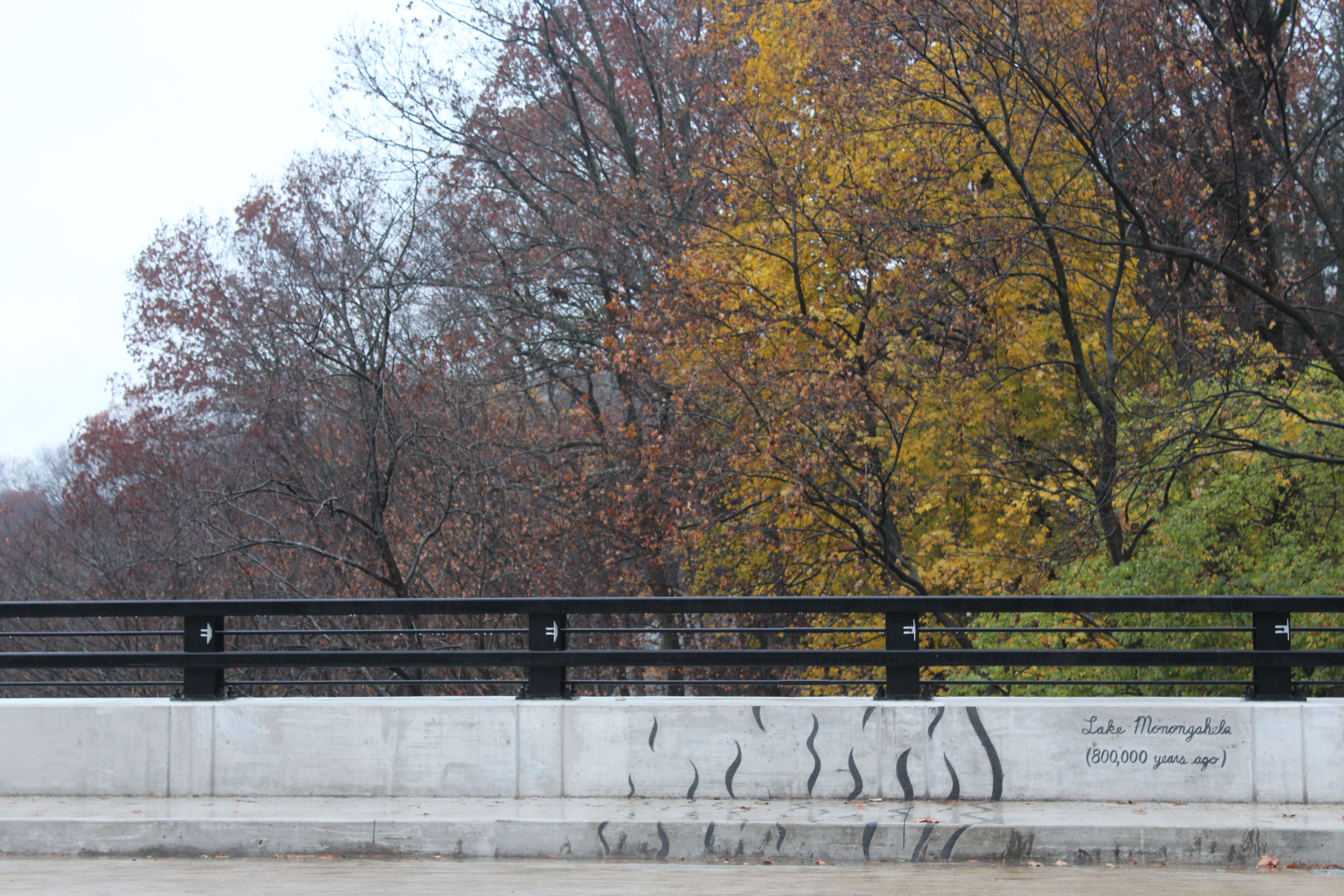
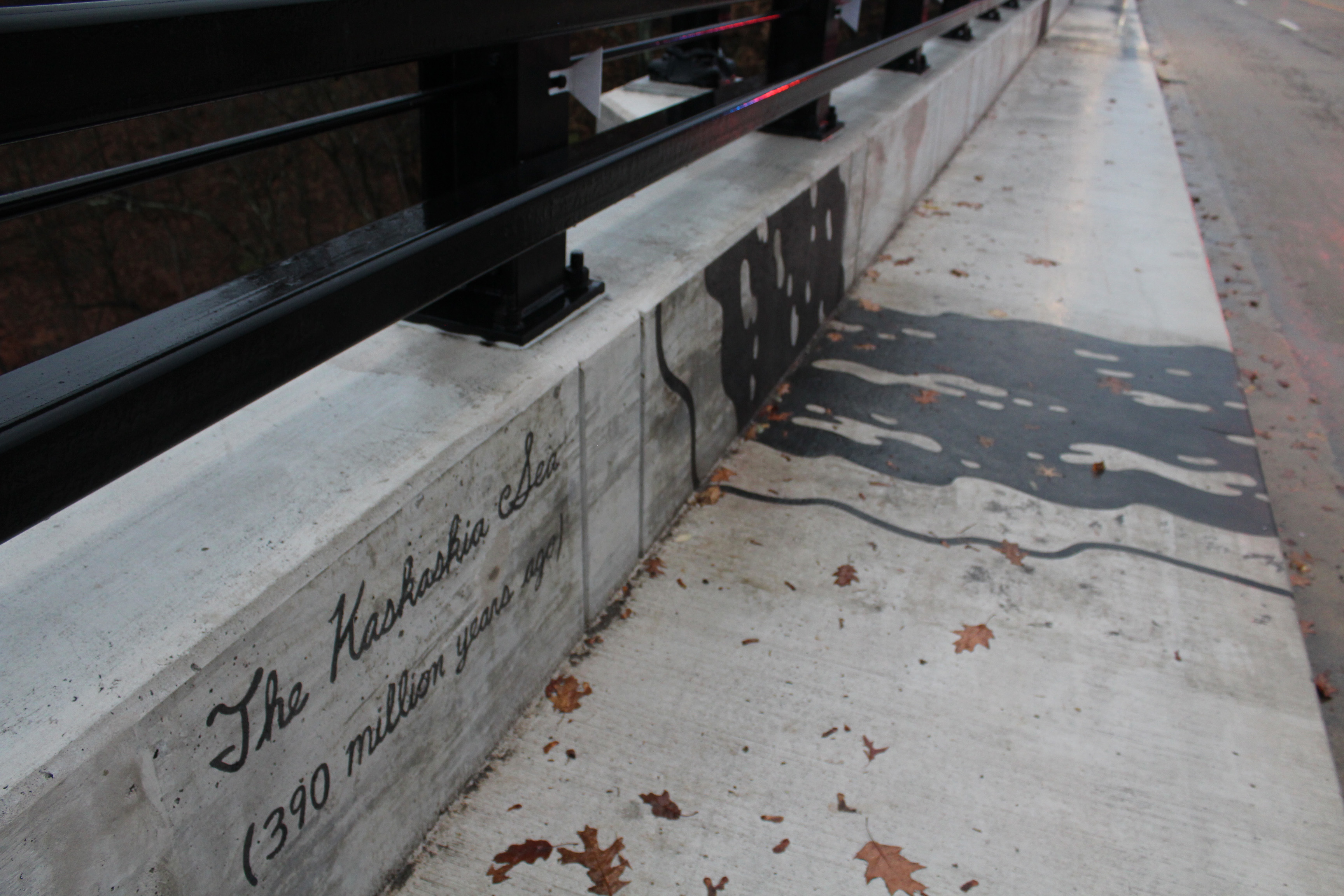
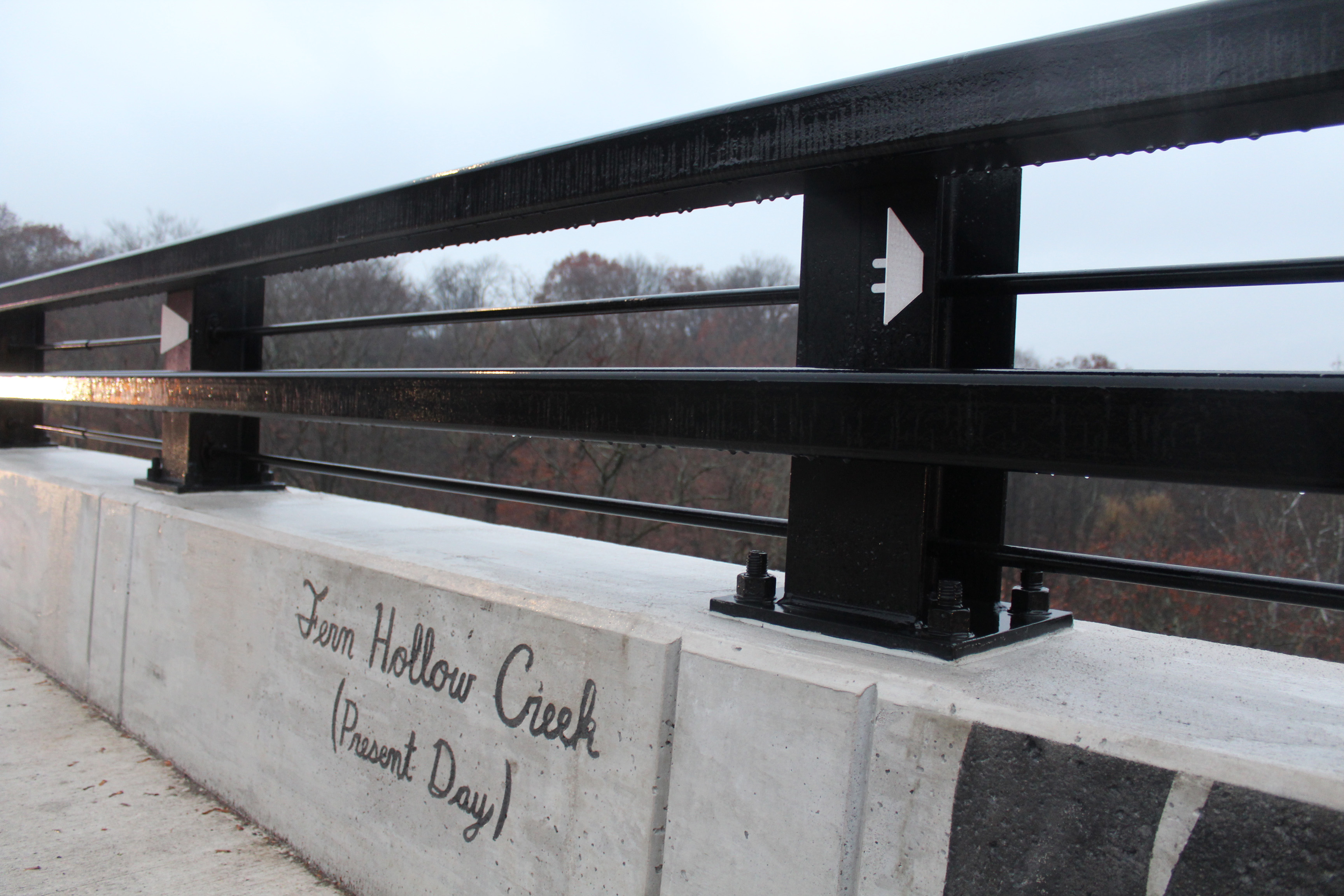
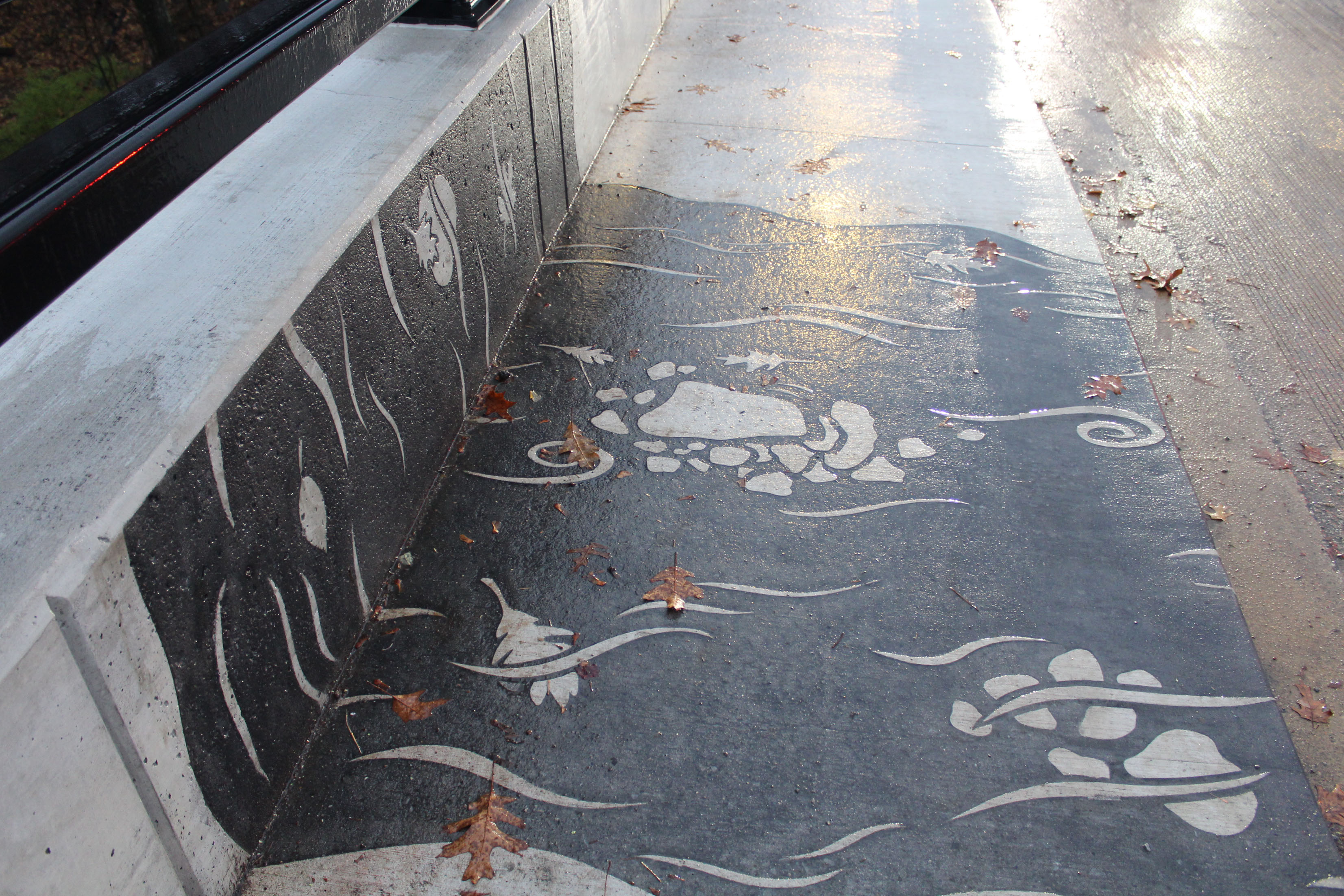
400 Million Years of Water public art installation (Lake Monongahela waterline). Photo by Veronica Close, 2023.
Accessing Pittsburgh’s Waterways Through Public Art
This page contains the transcript, show notes, and sources for the ninth episode of the Secret Pittsburgh Podcast, Season One . To listen to the episode, as well as the rest in the series, visit our SoundCloud.
Transcript
Kevin Collins: Welcome to Secret Pittsburgh! In the past 15 weeks, we’ve traveled across the city, learning stories of Pittsburgh’s people and places. Join us now as we explore Nine Mile Run and the buried streams of Pittsburgh. I’m Kevin Collins.
Hunter Bash: And I’m Hunter Bash.
Kevin: Let’s go!
[…]
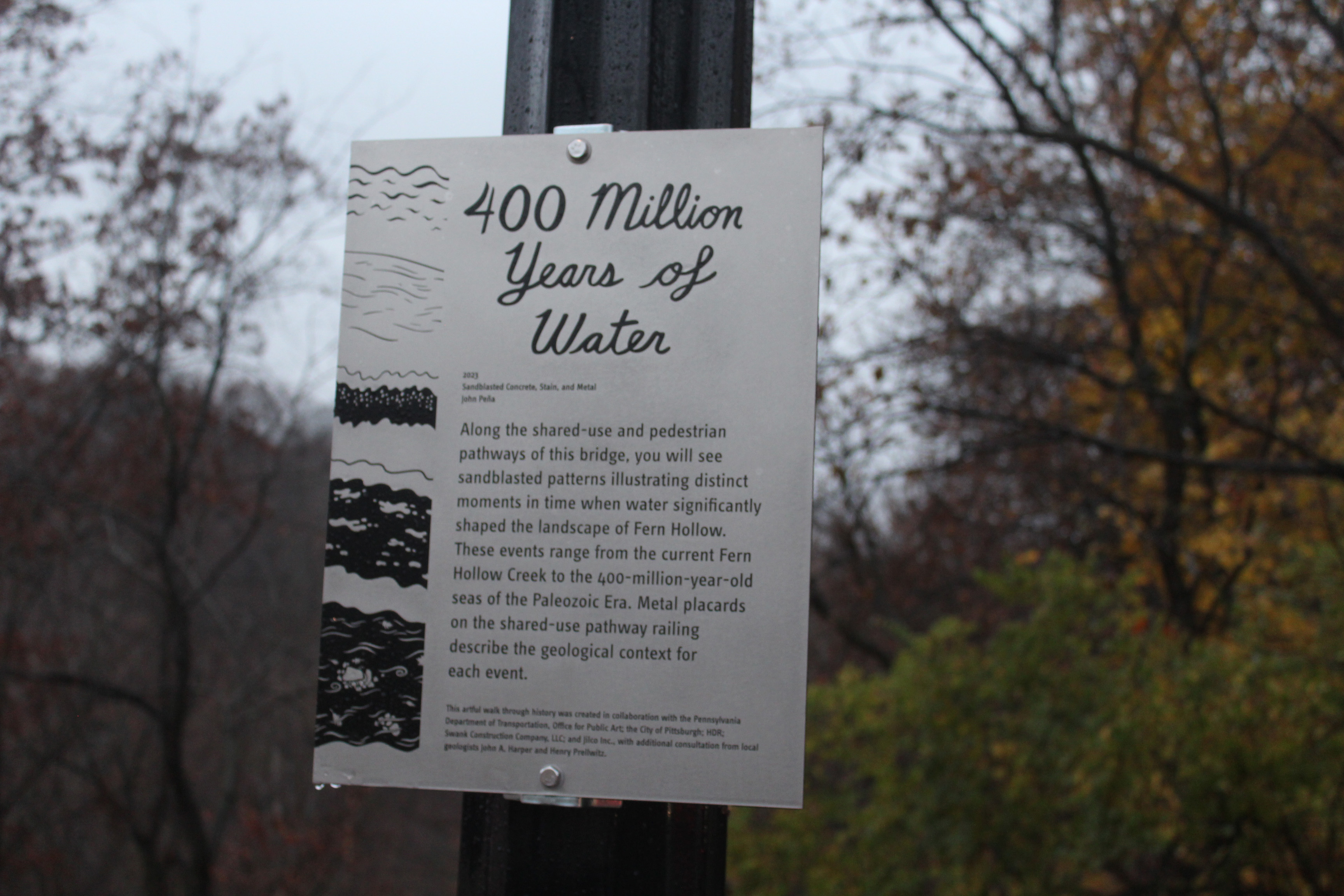
Kevin: In this episode, we will discuss some of the Public Art relating to the Nine Mile Run. We will focus on two works, specifically: the 400 Million Years of Water project by John Peña and the Viewfinder Project by Ginger Brooks Takahashi.
Hunter: Hold on, before we get into that, what exactly is public art?
Kevin: That’s actually a great way to get into the episode. In a basic sense, public art is what it sounds like: art that’s easily accessible to the public.
Hunter: What qualifies as accessible?
Kevin: In my opinion, accessibility means the lack of barriers around the art. Barriers can be things such as an entry fee or a membership to a museum, a need for transportation, or physical barriers, like a need for a lot of walking or something like that.
Hunter: Ok that makes sense. The easier it is to get to the art, the more public, per se, the art is.
Kevin: Exactly. There can also be barriers on the art itself. For example, imagine you’re… a math major, which I believe you are, right?
Hunter: Yea.
Kevin: So say you go to an art exhibit about the French Revolution which doesn’t have any context, explanations accompanying any of the works. As a math guy, you might not be able to enjoy the work like someone with a background in historical research could. Completely hypothetical scenario, but does that make sense.
Hunter: Yeah, definitely get that, so could education be another barrier?
Kevin: Of course! I only scratched the surface of what could qualify as barriers. It’s essentially impossible to create anything that’s completely barrier free, but public art definitely minimizes the amount of barriers around it.
Hunter: Got it. So, it seems like it could be pretty impactful for bringing a community together.
Kevin: For sure. It’s so important. Public art can do so many things by just simply existing. Besides just adding beauty to its surroundings, Public Art can inspire a sense of community, spark thoughts and actions, and provide a platform to raise awareness about just about anything in the public sphere.
Hunter: Gotcha. I never really put too much thought into public art, typically I thought it just kind of looks cool.
Kevin: Ha, there’s nothing wrong with that! At the end of the day, public art is for the members of the community to enjoy however they want to. It only matters that it’s possible for the public to enjoy it.
Hunter: I totally get that. So, let’s get into the 400 Million Years of Water project by John Peña. I really enjoyed seeing the project then actually getting to sit down with Peña and discuss it with him.
Kevin: Same. I thought that was awesome. He provided such interesting insights. We’ll be playing parts of the interview with John Peña throughout this episode. We wouldn’t be able to do some of his quotes and explanations justice if we just summarized his answers.
Hunter: That’s for sure. There’s nothing as valuable as insight into a creation directly from the creator’s head.
Kevin: Right. So, getting back on topic, the 400 Million Years of Water Project is located on the Fern Hollow Bridge over Fern Hollow Creek, which runs through Frick Park.
Hunter: Remind me where that’s at again?
Kevin: It’s on the Wilkinsburg side of Frick Park, right next to Regent Square.
Hunter: Oh yeah, right next to that, that entrance down into the park?
Kevin: Yeah, exactly. There’s also a playground area right next to it, on the Wilkinsburg side of Frick.
Hunter: I remember that. It was a—it’s a pretty busy area.
Kevin: Definitely busy. Actually, that—that’s one of the best parts about the location in my opinion. The Fern Hollow Bridge is really a perfect place to display public art. So many people pass by it in their daily lives.
Hunter: Definitely seems to check the box of accessibility.
Kevin: For sure! It’s extremely accessible. The bridge is open to cars and pedestrians, so regardless of how you travel, you can access the bridge.
Hunter: Sounds like public art to me. I can’t think of any obvious barriers to community access there.
Kevin: I totally agree. So getting into the actual work itself, the 400 Million Years of Water project consists of sandblasted patterns of bodies of water that have had an impact on Pittsburgh over the last 400 Million Years. It also has stainless steel placards giving the viewer a geological description of the water event that the pattern depicts.
Hunter: Yeah, it was a cool contrast. The patterns were pretty conceptual and artistic, while the placards provided a really cool scientific perspective.
Kevin: Yea, Peña also mentioned that the geological processes on the placards are also pretty poetic and artistic in a way. Here’s what he had to say:
John Peña: So, I was like, ‘oh this is really beautiful and poetic,’ so I wrote this language up, and then I shared it with this geologist, John Harper, who was the main consultant for me. And he was editing it for me, like I was like, ‘hey can you look at the text I’ve written for these placards?’ And he just crossed all that out. All the poetry, right. And he’s like, ‘ah that’s just confusing people, you don’t wanna do that.’ And then I, like, first, was like a little defensive about it, I was like, ‘no this is like the artistic part of it.’ And then I sat with it and I was like, ‘no, wait, he’s right: it is poetic on its own.’ It doesn’t need language to tell people how insanely poetic the idea that this ocean is moving through the world through time. Like that in itself is insanely absurd, right?
Hunter: It’s pretty amazing to translate something based on scientific fact into the form of public art.
Kevin: Yeah it really makes the project accessible doesn’t it? Like, I could go there thinking as a scientist or thinking as an artist and have equally as valuable experiences.
Hunter: Totally agree.
Kevin: John also did an awesome job of explaining what the art looks like and feels like to experience.
John: When you approach the bridge from either end on either sidewalk, the first thing you’re struck with are these faint, kind of, drawings that look like almost like, charcoal or graphite on the sidewalk themselves of the pedestrian sidewalk. And if you look as you walk up to ‘em, you’ll notice that they’re actually etched into the concrete. And the first one you’ll encounter will say Lake Monongahela in cursive. And that will be um, Lake Monongahela will be about 800,000 years ago and it’ll say that on there. And then you’ll have these water patterns literally carved, sandblasted into the pavement itself, and then stained with a, kind of a dark Gray stain. So on those water patterns, as you’re exploring them, say you’re on the north pedestrian side, for example. If you look to the South side of the bridge, you might see a placard on the railing and that placard will have text and drawings and stuff, but you won’t be able to experience it unless you cross back over. So say you cross back over, it’ll say Lake Monongahela, 800,000 years ago, and then it’ll have a ton of information about that particular body of water. How it came into being, when it disappeared, what are the remnants that—how we know that it’s still here, geologically speaking, scientifically speaking. So then, if you keep walking down the bridge further, you’ll encounter more water patterns from different eras and different time periods, um, and the deepest one you go to is 3nine0,000,000 years close to the middle of the bridge. That’s the Kaskaskia Sea. And, same thing, if you’re on the north side, you’ll experience just the etching, but then if you go to the South side, there’ll be a placard, like a stainless steel placard on the railing that has images and stuff like that.
Kevin: The layering adds to the accessibility too in my opinion. It makes the concepts of geological events tangible. Exactly as the older events are buried deeper underground, the depictions of the events are ‘deeper’ towards the center of the bridge.
Hunter: Yeah such a cool way to simplify and show that concept.
Kevin: Alright so by now I’m sure everyone has an idea of what the project looks like after that awesome description. We’ve also linked the website to the project in the show notes. So, now let’s move on to how the 400 Million Years of Water project factors into the community, and of course, the Nine Mile Run.
Kevin: So the most obvious connection between the 400 Million years of water project and the Nine Mile Run is water.
Hunter: Yeah and that one may seem obvious, but it actually could be quite important right?
Kevin: Right. The 400 Million years of water exhibit makes you think about water that isn’t currently visible.
Hunter: Water that’s not visible, but still impactful on our communities.
Kevin: Exactly. The bodies of water depicted on the bridge that shaped current day Pittsburgh are not visible anymore, but their impact is a part of our daily lives as Pittsburghers. On the other hand, The Nine Mile Run is not visible, it runs under our feet, it’s hidden away, but it’s always ‘here’ running beneath us.
Hunter: Exactly, and what else comes to mind when you think about impactful but hidden streams of water in the Pittsburgh community.
Kevin: The Nine Mile Run. This project has a chance to spark interest in water in the Pittsburgh area, which in turn could lead to interest in the Nine Mile Run.
Hunter: So the water events of the past might lead someone to think of the water events of today?
Kevin: That’s exactly what I think.
Hunter: That’s interesting. I’ve talked with some water researchers and they told me a lot about restorative work that can be done for Pittsburgh watersheds. I wonder if learning about Pittsburgh’s water history could help people see the importance of Pittsburgh’s water future.
[…]
Hunter: So what kind of public impact does this work have? We spoke about the general impact that public art has, but what about like specifically the 400 Million Years of—of water?
Kevin: Great idea, I think the best way to start is the—I guess pillars of public art we laid out.
Hunter: You mean community, accessibility, and awareness?
Kevin: Yup community, accessibility, and awareness. So let’s start with accessibility: what’s more accessible than a public road that also has space for pedestrians? Not much. Not to mention, the bridge is surrounded by one of the largest public parks in the Pittsburgh area, a busy neighborhood—
Hunter: Regent Square?
Kevin: Yea, Regent Square. And there’s even a public playground within walking distance from the Fern Hollow Bridge. Not only is it accessible, there are many reasons to visit the bridge
Kevin: Now let’s move to another pillar, Community: This project is something that could really bring people outside to appreciate something they typically might not appreciate.
Hunter: Yeah I get that, the Fern Hollow Bridge itself is kinda just a way to cross the Fern Hollow Creek, but the art makes it an experience.
Kevin: Exactly. Remember when we visited Frick Park?
Hunter: Which time?
Kevin: The second time, when we drove there
Hunter: Yeah, what about it?
Kevin: Yeah, we drove right over the Fern Hollow Bridge, I think multiple times actually in our journey to find the parking lot.
Hunter: Sounds about right.
Kevin: When we drove over it, there was a large gathering of people on either side of the bridge just appreciating the art work.
Hunter: Oh yeah I do remember that. I’m not sure I’ve seen a gathering like that on a regular bridge before.
Kevin: I definitely haven’t. I doubt the people on the bridge that day would have been brought together if it wasn’t for John Peña’s art.
Hunter: True, it brought a lot of people together too.
Kevin: Right, that actually segways well into the last pillar: awareness. The 400 Million years of water project really makes you think about water, which is taken for granted by many people. Especially in Pittsburgh, when we’re surrounded by water daily. Even as an outsider, I’ve almost ‘tuned out’ the amount of water around me after 3 years of living here. I think ‘yeah there’s water all around me, but so what’. I’m sure as a Pittsburgh native you’re used to the water too, by now, right, Hunter?
Hunter: Yeah, I mean, I like to get into the parks every once in a while, but it kind of just blends into the background at some point.
Kevin: Exactly, I agree. This project sparks interest in water and its impact on our community, which ties back into the Nine Mile Run. Water could spark research into the restoration of the Nine Mile Run, which could possibly spark activism and inspire people to join the battle against the Run’s pollution issue.
[…]
Kevin: So, our first site visit of the year was supposed to be the Nine Mile Run viewfinder project in Wilkinsburg and honestly I was very excited to see it.
Hunter: Me too, even as someone from Pittsburgh, I never even heard about Nine Mile Run ‘cause it’s buried underground, surrounded by so much mystery.
Kevin: Exactly, it was going to be so cool to see this stream that’s buried and hidden from public view. However, we ran into an issue…
Hunter: As we did so many times this semester.
Kevin: Yeah for real. So the day before the visit we get an email from Dr. Ryan reading,
Dr. Elise Ryan: Imagine my surprise when I saw that the viewfinder manhole covers are completely removed and covered over with standard issue City of Pittsburgh Manhole covers!
Hunter: Yea so that was really disappointing because the art exhibit sounded really cool. They were these see-through manhole covers that you could look through and—and see, and hear, and maybe smell the stream. Like I mentioned before, even as a Pittsburgh native, I had never actually seen the Nine Mile Run in-person, or even heard about it, before we were supposed to go visit the viewfinder project.
Kevin: And that makes total sense due to the fact it’s buried. It almost seems like it wants to be hidden from the public eye, especially due to the history it has with pollution.
Hunter: Exactly. And, as we discuss on our other episode on Nine Mile Run, stream burial was a way to avoid the problem of sewage being dumped into streams and facilitate urban development.
Kevin: So, back to the viewfinders. The office of Pittsburgh public art sanctioned the project. Located in Wilkinsburg, the project replaced manhole covers above the Nine Mile Run with see-through covers, so people could look down on the stream that’s buried underground. The artist, Ginger Brooks Takahashi, mentioned periscopes as one of the inspirations for her project. She said in an article by the Allegheny Front that the viewfinders were like “opening a portal into another place.” That’s what I thought would have been really cool about the viewfinder project: it brought this hidden, mysterious, underground stream of water to the surface, and it displayed it as a work of art, not just a stream.
Hunter: I agree, and, we did end up visiting the location in Frick Park where Nine Mile Run resurfaces and even just seeing it in person made me feel closer to the stream.
Kevin: Exactly, just imagine seeing it in the form of an art exhibit. In my opinion, it would’ve made the river even more tangible and accessible.
Hunter: Yeah, and accessibility is really an issue with Nine Mile Run. In order to get there, we first needed a ride. The bus was a good way to get close to the park but left us in a difficult area to say the least.
Kevin: Oh yeah for sure. The closest entrance to Frick Park from our bus stop was a steep hill with loose rocks. And I’m 21, and I consider myself in pretty good shape, but I really struggled to make it down the hill without falling and possibly injuring myself.
Hunter: Same here, it would be very daunting for someone with any kinds of physical accessibility barriers to make the trip down to Frick Park from that entrance.
Kevin: Exactly. Also, remember the second time we went in the car, we kind of briefly mentioned earlier?
Hunter: Haha, how could I forget.
Kevin: I wish I could, we circled the park for 30 or 40 minutes just searching for an open parking lot. It’s even hard to access with your own vehicle.
Hunter: And we did all of this just to see the resurfacing of the Nine Mile Run.
Kevin: And that wasn’t even easy to get to. It was basically this downhill obstacle course with random rocks, tree branches, and other loose impediments blocking the way. Hunter, if you didn’t go down first, I’m not even sure I would’ve made the trip down myself.
Hunter: Anything to get some audio of running water.
Kevin: Yea, exactly. So you might wonder what any of this side story has to do with public art. What’s so unique about public art, like we mentioned earlier, is its accessibility to the community and its members. Although we didn’t get to view it ourselves, we could guarantee that the Nine Mile Run viewfinder project provided the Wilkinsburg community with much more accessibility to the Nine Mile Run than they had before.
Hunter: Yeah, accessibility is massive. When something is buried underground away from the public eye, it really loses awareness.
Kevin: Especially when groups like Upstream Pittsburgh, who we go into depth in in the other Nine Mile Run episode, are working constantly to restore the Nine Mile Run. Any extra awareness helps greatly. To add on to this, the Viewfinders make the Run into a work of art. People are more likely to feel the urge to protect a work of art than a random, inaccessible underground river, in my opinion.
Hunter: I think that’s completely true. The art doesn’t physically change anything about Nine Mile Run, but subconsciously it adds this beauty and meaning to the river.
Kevin: Right, it makes it feel like it’s living and breathing
Hunter: Yea.
[…]
Kevin: Thank you for joining us as we uncovered one story of the Nine Mile Run. We hope you’re inspired to visit this place and find your own Pittsburgh stories. I’m Kevin Collins.
Hunter: And I’m Hunter Bash.
Kevin: This episode was edited by Veronica Close and written and researched by Kevin Collins and Hunter Bash. We would like to thank the artist John Peña for agreeing to interview with us. Please tune-in to all the episodes we’ve produced this season. You can find show notes and a transcript at secret-test.local/. See yinz later!
Show Notes and Corrections
The intro audio mentions an episode about the buried streams of Pittsburgh. This is actually the second episode in the Secret Pittsburgh podcast, “Unearthing Pittsburgh’s Secret Streams of Sewage,” which you can listen to here.
Here is the website for the Office of Pittsburgh Public Art.
Here is a website to view the 9 Mile Run Viewfinder Project.
Here is an article about the 9 Mile Run Viewfinder Project.
Here is a website to view the 400 Million Years of Water Project.
Bibliography
Holsopple, Kara. An Artist Wants to Give People a New View of an Urban Stream. 14 April 2022. Web. 17 November 2023. <https://www.alleghenyfront.org/artist-wants-to-give-people-a-new-view-of-an-urban-stream/>.
Peña, John. 400 Million Years of Water. 2023. Web. 17 November 2023. <https://www.johnpena.net/400-million-years-of-water>.
Peña, John. Personal Interview Kevin Collins. 14 November 2023.
Takahashi, Ginger Brooks. Nine Mile Run Viewfinder. Ed. J Aharonov. 2020. Web. 17 November 2023. <https://brookstakahashi.com/projects/nine-mile-run-viewfinder/>.
Audio Credits
Ambientsoundapp. “Kids Playing.” 2020. <https://freesound.org/people/Ambientsoundapp/sounds/536220/>.
bsumusictech. “Nuts and Twigs.” 2008. <https://freesound.org/people/bsumusictech/sounds/62540/>.
Bugden, Ross. “Migration.” 2023. <https://www.youtube.com/watch?v=_oHK9oF2Z7Q>.
klankbeeld. “traffic horns city nervous busy.” 2013. <https://freesound.org/people/klankbeeld/sounds/180156/>.
TrackTribe. “Helium.” n.d. <YouTube Creator Studio Library>.