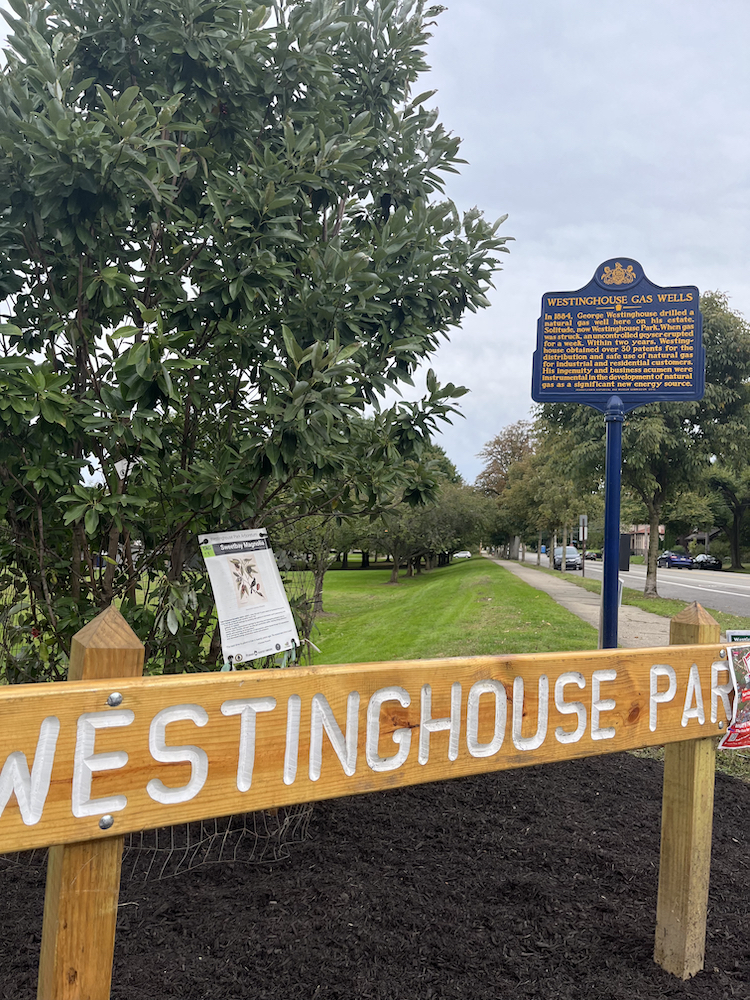
A large wooden sign and an historical marker for the Westinghouse Gas Wells welcome visitors into the park. Photo by Catherine Raspanti, 2022.
An Icon of Pittsburgh’s Industrial Past and a Symbol of the City’s Innovative Future
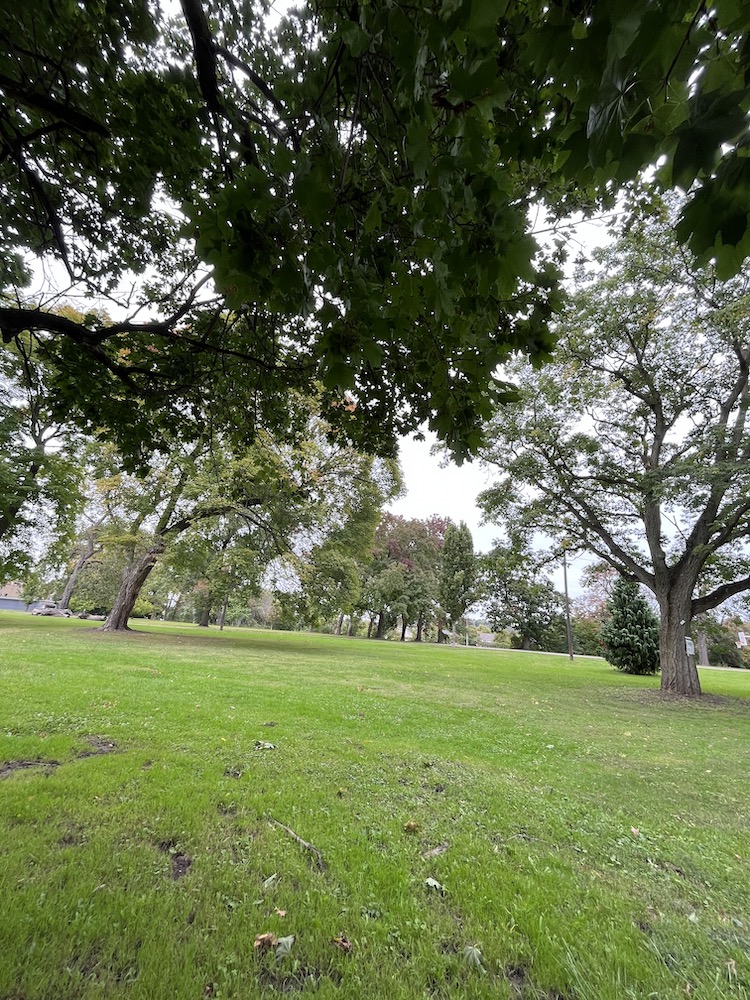
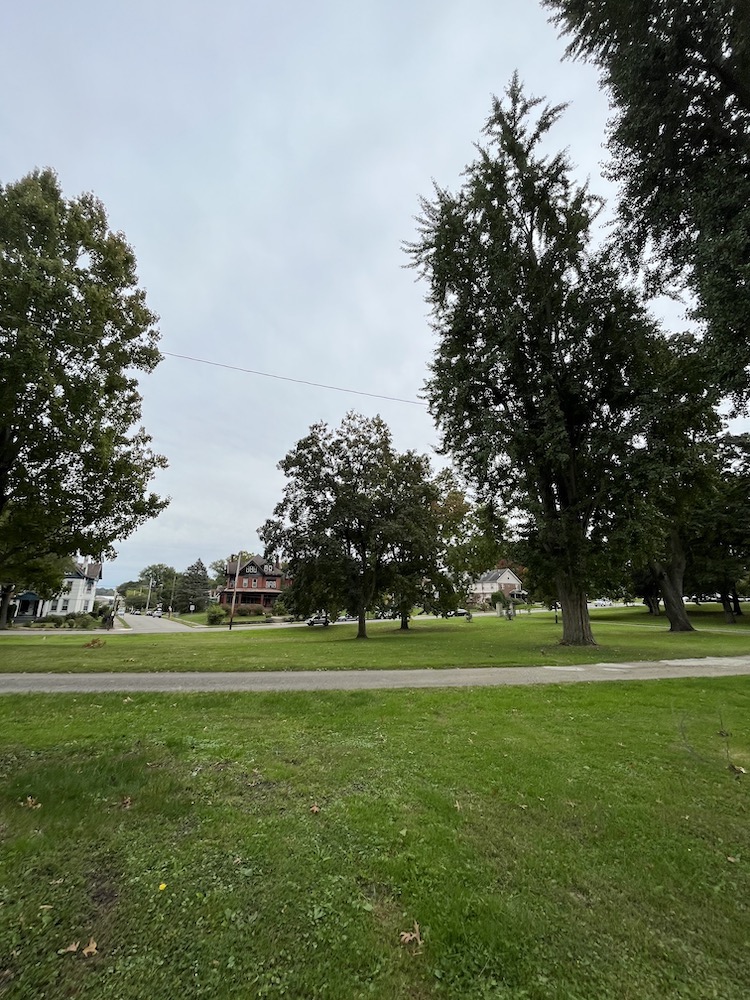
Westinghouse Park embodies Pittsburgh, Pennsylvania’s rich industrial history and its transition from a polluted “Steel City” to an innovative urban center driven by world-class universities, technology jobs, and eclectic neighborhoods. The park is situated between Pittsburgh’s Point Breeze and Homewood neighborhoods. It can be enjoyed in all four of Pittsburgh’s seasons, from a stroll on a crisp fall morning, to a picnic on a sweltering late summer afternoon. During the summer it would not be hard to find a shady tree to sit under. Westinghouse Park is replete with trees and is therefore classified as an arboretum (Rivera-Tinsley 2:24). There is a diverse array of trees ranging from stately red and black oaks to ginkgoes (Bear). This peaceful park invites visitors to unwind from their busy lives to enjoy a meal on a picnic bench, walk their dogs, bring their children to the playground, or simply enjoy the bright green grass and towering old trees. Today, the park retains a fascinating history connected to its namesake, the great industrialist George Westinghouse Jr. (“Westinghouse”).
A first-time park visitor may be surprised to learn that the site was once the home of the Westinghouse family estate “Solitude.” The park gives no indication that it was once private property. But Westinghouse, his wife Marguerite Westinghouse, and their son George Westinghouse III resided at Solitude for many years. However, the history of the park began before the 1867 construction of Solitude’s mansion, and it has continued long after the house’s demolition in 1919.
On September 11, 1785 when “Thomas Hutchins sold approximately eleven acres of land in what was then Westmoreland County to John McKee” the history of the park began (Huber, 60). Peter Schoenberger purchased the land in 1842 (Huber 60). The Schoenberger property was likely a bucolic slice of land. But, in 1852, “the Pennsylvania Railroad ran its first train from Pittsburgh, past the Schoenberger property, to Philadelphia” (Huber 60). Clearly, the innovations of the industrial revolution were spreading to all corners of Pittsburgh.
In 1869 James Hopkins owned the land. He constructed a spacious home on the property (Huber 60). Then in 1871, Hopkins sold the home to Westinghouse, beginning the park’s journey to its current iteration. Westinghouse’s wife Marguerite nicknamed the estate “Solitude” (Huber 61). Yet “[i]t’s very name, so representative of sentimental house nomenclature of the time, was a misnomer, since it stood only a few yards from the main line of the Pennsylvania Railroad, one of the great ‘highways’ to the west” (Van Trump 155). Although the nearby surroundings of the estate were not indicative of a quiet countryside landscape, it was situated in a leafy Pittsburgh neighborhood populated by wealthy industrialists. It was likely a place where the Westinghouses found personal tranquility.
A Pittsburgh Quarterly article “Finding Solitude in Westinghouse Park,” penned by our site guide, David Bear, further paints a picture of the industrial history of the park. Solitude was a place in which the private life of the Westinghouse family merged with Westinghouse’s professional life as an inventor. Westinghouse created “a 220-foot-long tunnel dug between his house and workshops” (Bear). To Westinghouse, “Solitude was itself a workshop and the inventor conducted there one of his most daring and spectacular experiments, one which helped make Pittsburgh the great industrial center which it became” (Van Trump 155). The experiments he conducted with natural gas wells were a monumental achievement; they paved the way for the development of natural gas as a new energy source for residential and industrial use. Presently, a historical marker stands at one of the park’s entrances commemorating Westinghouse’s experiments with the gas wells.
It is unsurprising that a home belonging to someone as influential as Westinghouse would be visited by notable guests. Noteworthy visitors included “President William McKinley and Britain’s Lord Kelvin. Regular local guests included neighbors H.J. Heinz and H.C. Frick” (Bear). In fact, “Nicola Tesla spent many months in residence at Solitude working out the principles of alternating current electricity” (Bear). The park holds a rich personal and professional history of Westinghouse’s life. Additionally, it was a destination for prominent political and industrial figures from near and far.
Westinghouse died on March 12, 1914 and Marguerite died three months later (Bear). This left the fate of Solitude in jeopardy. The Westinghouses bequeathed Solitude to their only child, George Westinghouse III—four years later “he sold the property to the Engineers’ Society of Western Pennsylvania for $100,000, which the Society raised from contributions from several of his father’s companies” (Bear). Ultimately, the Society transferred the deed to the property to City of Pittsburgh “for a token dollar in 1918 on the condition the property would become a public park and a memorial to Westinghouse’s memory” (Bear). Then in 1919, the City of Pittsburgh demolished Solitude’s mansion (“How Solitude Became Westinghouse Park”). These events marked a new era for the newly formed park. In recent decades it has become a robust neighborhood park. Uneven lumps in the park’s grass are evidence of the underground tunnels Westinghouse once utilized. But the sprawling urban park leaves no immediate visual indication that it once housed a stately private home, or that an intricate series of abandoned tunnels rest beneath the park’s surface.
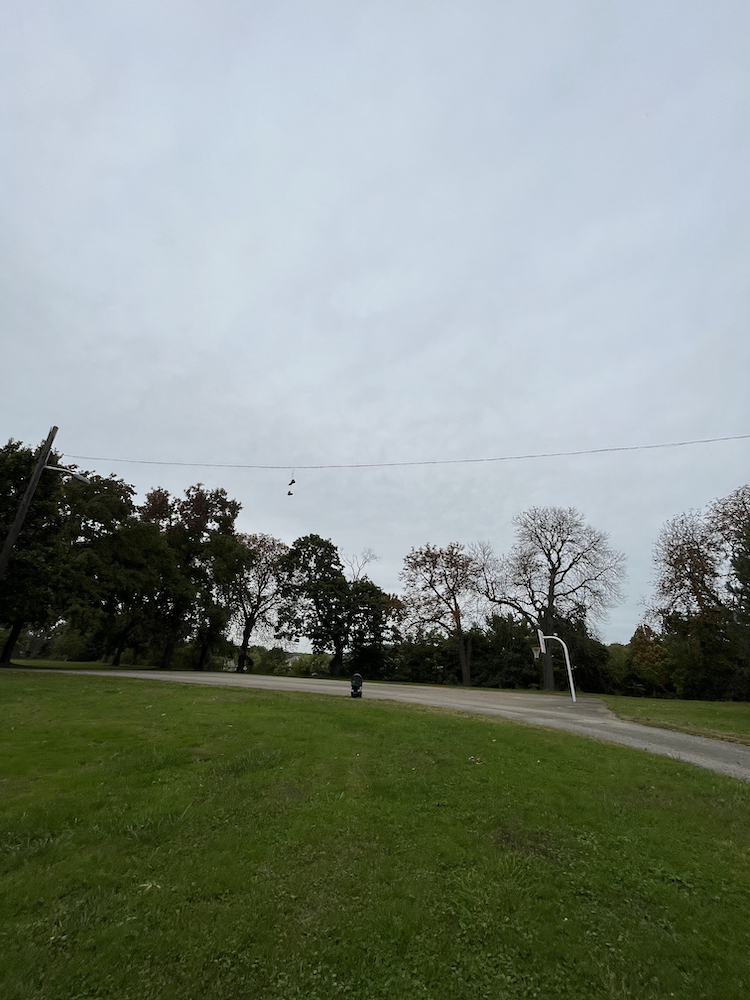
Today the park hosts community events such as musical performances (Krauss). And it is also known for its family friendly events such as the .5K race (“Tune up for the Great Race at the .5K”). However, debates have recently ensued over the proper usage of the park. Residents of the Homewood neighborhood were barred from fully enjoying the park because it was “designated a ‘passive park’….” (Krauss). As a result, it “disallowed large groups from gathering, whether that was for a rally, cookout, or a peewee football game” (Krauss). In 2015, the City of Pittsburgh reversed this edict, but the residents of Homewood were not informed of that change (Krauss). This lack of transparency and communication between the City and the Homewood residents deprived many people from fully experiencing the park’s amenities. The park is currently under consideration for renovations, and the City of Pittsburgh is seeking community feedback for future improvement projects (Behanna).
Westinghouse Park honors the legacy of George Westinghouse Jr., one of America’s most influential industrial figures. It also symbolizes Pittsburgh’s transformation from a sooty industrial city to a modern city filled with lively and accessible public spaces. Public green spaces are an enriching addition to Pittsburgh’s urban landscape. Improving Westinghouse Park and ensuring it is accessible to all current and future generations of Pittsburgh residents, as well as tourists, is a worthwhile investment for a city that prides itself on its beautiful parks and a high standard of living.
Works Cited
Bear, David. “Finding Solitude in Westinghouse Park.” Pittsburgh Quarterly, 4 Nov. 2019, https://pittsburghquarterly.com/articles/finding-solitude-in-westinghouse-park/.
Behanna, Garrett. “City planners want public input on Westinghouse Park Improvements.”CBS Pittsburgh,19 Nov. 2022, https://www.cbsnews.com/pittsburgh/news/city- planners-want-public- input-on-westinghouse-park-improvements/.
Huber, William. George Westinghouse: Powering the World. McFarland & Company, Inc., 2022.
Krauss, Margaret J. “Westinghouse Park Is No Longer Restricted, But No One Told Homewood.” 90.5 WESA News, 2 Sept. 2019, wesa.fm/development-transportation/2019-09-02/city-says-use-of- westinghouse-park-is-no-longer-restricted-but-no-one-told-homewood.
Rivera-Tinsley, Camila, host. “George Westinghouse: The man, the park, and the pond.” For the Love of Parks, 1 Nov. 2021, https://fortheloveofparks.libsyn.com/george-westinghouse-the- man-the-park-and-the-pond.
“Tune up for Great Race at the .5K.” https://westinghousepark.wordpress.com/2019/08/12/tune-up-for-the-great-race-at-the-5k/.
Van Trump, James D. “Solitude And the Nether Depths: The Pittsburgh Estate of George Westinghouse and Its Gas Well.” 31 May 1959, https://journals.psu.edu/wph/article/view/2641/2474.
Westinghouse Park Second Century Coalition. “How Solitude Became Westinghouse Park.” westinghousepark.org, 20 Jul. 2019, https://westinghousepark.wordpress.com/2019/07/20/how- solitude-became-westinghouse-park/.