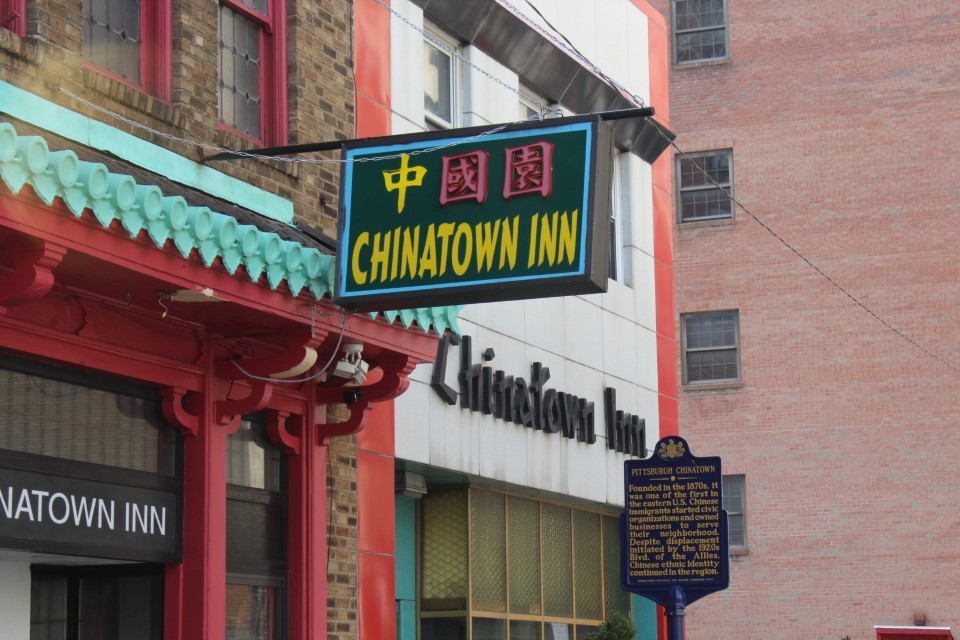
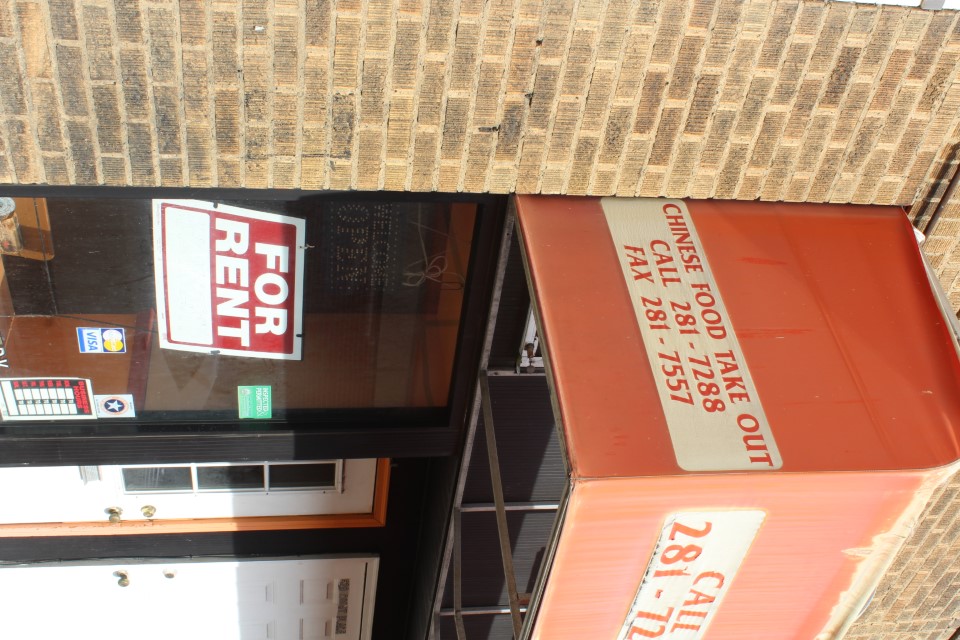
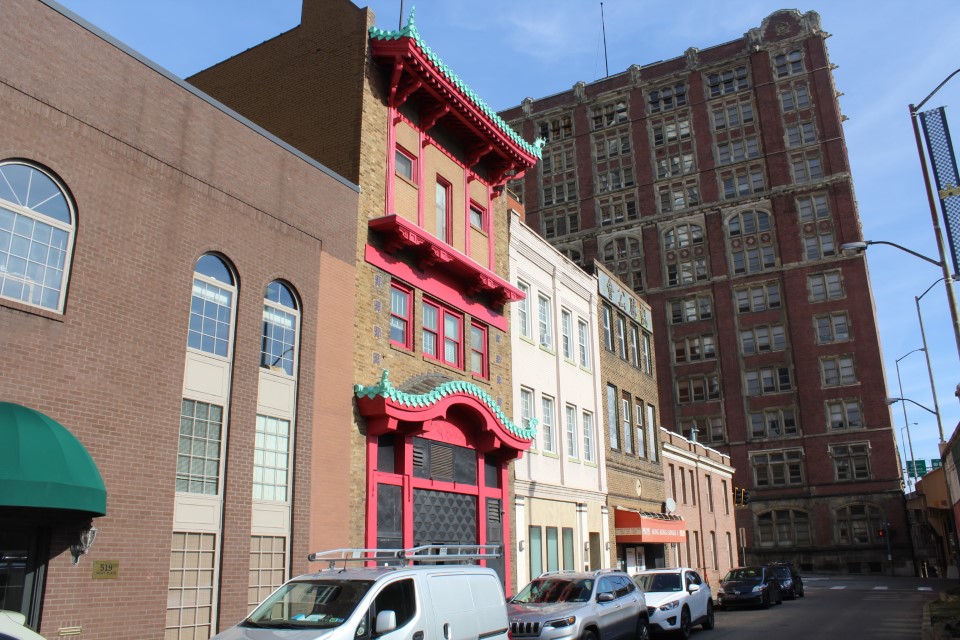
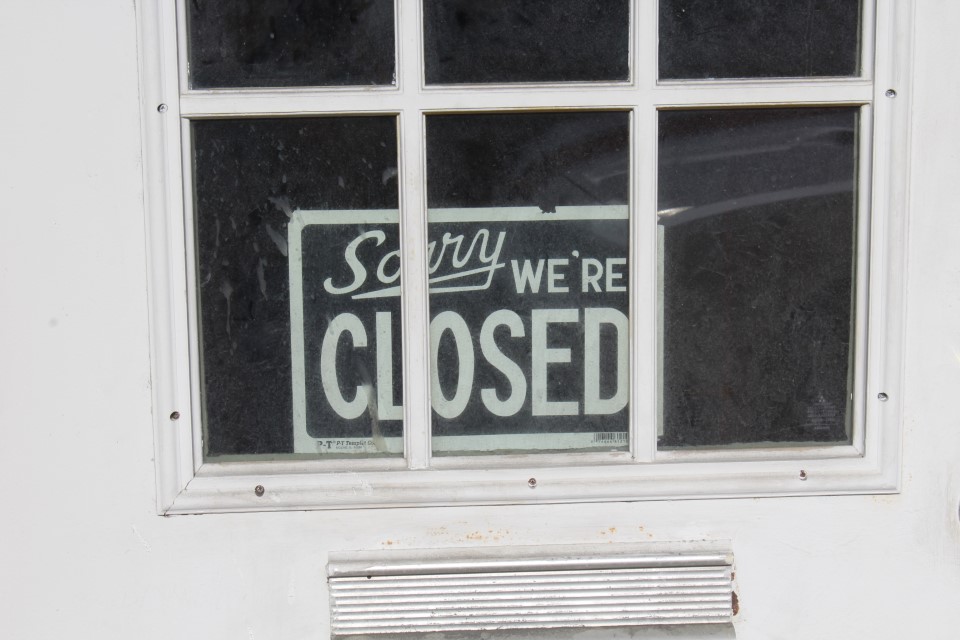
The front facade of Chinatown Inn. Photo by Chase Fong, 2022
Chinatown as a Case of Deja Vu
Pittsburgh’s Chinatown is a neighborhood defined by transitions and changes. From presence to absence, from absolute to relative placehood, and from population to emptiness. These elements mix and intertwine with history itself like the mythical caduceus, with the snakes of humanity and inhumanity overlapping along the staff of time. By this metric, in order to truly understand Chinatown, one must understand the history and memories of those who lived there. In the earlier phases of Pittsburgh’s history, Chinese workers immigrated to the area after the construction of the cross-continental railroad, congregating together as a form of comfort and protection from the outside world. The population was small but passionate, creating a local ecosystem of housing, small businesses, and grassroots cultural institutions. Over time, the people in Chinatown created tongs or associations that helped organize workers and community events. Internally, the residents of Chinatown created a local culture of support and socialization that flourished on Ross and Grant Street between Second and Third Avenue. The lifestyle was that of resilience to institutional racism and a focus on self-reliance, as non-residents entered the neighborhood for goods. This money was circulated inside the neighborhood from general store to restaurant to grocery store and so on, allowing Chinese immigrants to live in an unfriendly country. Unfortunately, this tight-knit neighborhood lost its physical form alongside the creation of another newer space. The city of Pittsburgh created a highway off-ramp that connected downtown to the Boulevard of the Allies that destroyed the homes and businesses that defined Chinatown life.
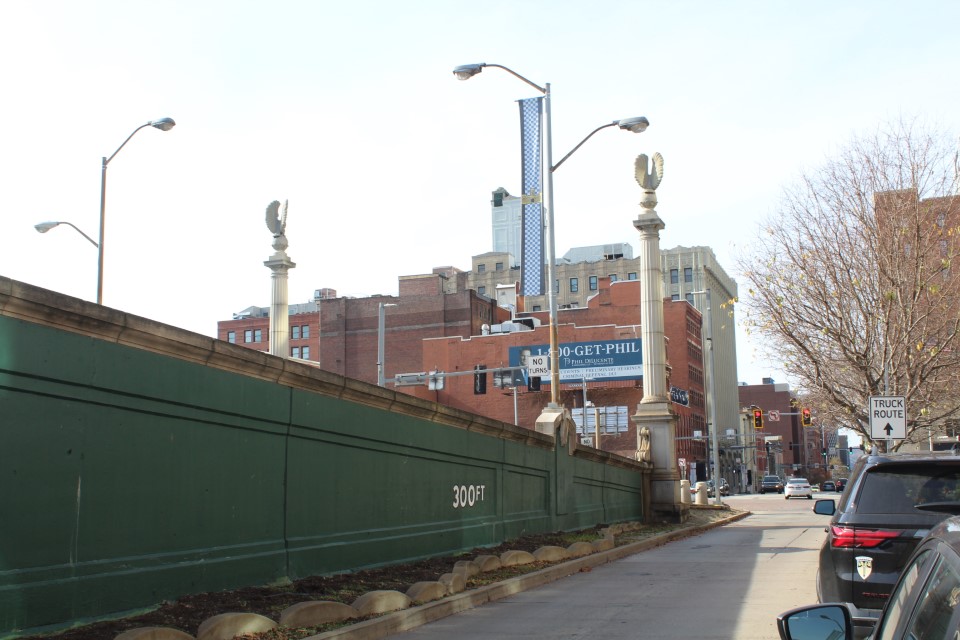
The modern day Chinatown is more notable for its lack of a true physical Chinatown; all that remains of its heyday is a singular Chinese restaurant named Chinatown Inn. Given that the Boulevard of the Allies off-ramp occupies much of the former space that Chinatown existed in, walking around what remains is an unusual experience. When we think of times long past, the first mental images can be literally black-and-white as an artifact of the film technology of the time. Standing in the same place as the perspective of the few photos of the period, it’s all too easy to see that same black-and-white perspective of Chinatown residents frozen in time against a background of the long-gone multistory home and business combo buildings. The massive infrastructure of the highway threatens to supplant the visualization of the bustling neighborhood that once stood here. Edward Soja, a highly acclaimed urban design professor at UCLA and spatial theorist, defined a place as “real and imagined” in that the lived experiences of the people who occupy the space that is to become a place(Soja). In the case of Chinatown, the people and the places that they created are being replaced with a highway, a way for other people to travel to and from their own spaces.
The founder of the humanistic geography school of thought Yi-Fu Tuan wrote in his seminal work Space and Place that experience allows for the learning that lets us create places from spaces. Importantly, our feelings and thoughts are the two ways that we are able to experience a space(Tuan). In the past, Chinatown was assuredly an ‘absolute’ place, as the residents gave meaning to their spaces, through all of their senses and through their strong feelings towards the neighborhood. Sound in the form of traditional instrument concerts in their homes, taste in the many family-owned restaurants, sight in the form of street fairs, and the sixth sense of belonging all created a true space. Even in a vacuum of outside perception, this space-generation was internal and continuous as the residents lived and moved through the neighborhood. Today, the only space that remains is a ‘relative’ one, as this internal space-generation has been lost and replaced with a need for others to visualize the space themselves. Only by using the memories and history of the people who lived there can one perceive the space. When we visited as a class, Ms. Shirley Yee acted as our guide through the neighborhood by providing us access to her family’s archives of the neighborhood. Without that history of the neighborhood and the residents, there would be no obvious way to feel the space that was so passionately felt by its residents.
In one sense, this could be seen as a negative case study of how spaces are only relevant to those who are there in the moment of creation. In another, it’s instead an example of how even when people leave, they cannot take the entirety of the space itself, but merely a small piece. By creating the memories and feelings, those who visit the now largely empty neighborhood can still get an idea of the neighborhood as a space instead of a mere place. The efforts of Ms. Yee as a custodian of the Chinatown lifestyle is evidence of exactly this, as from her singular act of maintaining an archive, the entire class were given a sense of the former space. As the modern viewer imagines the Chinese people who lived in the neighborhood, the space as the residents experienced it continues to exist even in the absence of the people themselves. With this in mind, by visiting Pittsburgh’s Chinatown with historical knowledge, the visitor is able to get a unique view of the space that is not clear to those who pass through. This is a unique experience that is only truly possible in spaces that were lost to the tidal forces of time and society.
In total, it’s clear that modern day Chinatown as a space is defined by its history and the memories of the former residents. For a 1930s Pittsburgher, walking along Second Avenue between Ross and Grant street would impart an instant sense of space. The change from a lived neighborhood to highway ramp destroyed much of the physical places and sparked a series of centrifugal events that flung the community apart. In this way, the people were pushed away and took a piece of the space with them when they left. Today, we only have the knowledge of the presence of the residents passed on from people like Ms. Yee to recreate the feelings and experience that allow for the generation of a space as defined by Tuan and Soja. In this way, by continuing to visit and experience what remains of Chinatown, we are connecting the dots from the absolute state of space to the relative state of space that exists today. By doing so, the intertwined nature of Chinatown’s history and reality is allowed to continue through us.
Works Cited
Soja, Edward W. Thirdspace: Journeys to Los Angeles and Other Real-and-Imagined Places. Blackwell, 1996.
Tuan, Yi-Fu. “Space and Place: Humanistic Perspective.” Philosophy in Geography, edited by Stephen Gale and Gunnar Olsson, Springer Netherlands, 1979, pp. 387–427, https://doi.org/10.1007/978-94-009-9394-5_19.