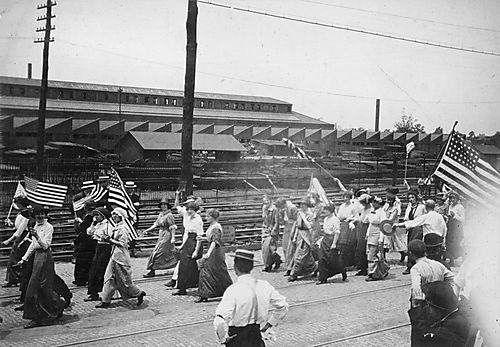
Figure 1. Women on Strike. This uncredited image displays women participating in the Westinghouse strike of 1914 on Edgewood Avenue in Swissvale, PA (Women on Strike).
Willa Cather’s Workingwoman Characters and the Westinghouse Strike of 1914
In the late 1800s and early 1900s, women in America were making substantial progress towards equality by advocating for the right to vote, higher education, and better working positions. These early instances where they sought to move away from the typical caretaker roles inspired the creation of many literary female characters at the time. Willa Cather, though not a vocal supporter of feminism, included strong women in the short stories that she published over the course of her professional career. Despite being a well-accomplished and respected writer at the time of these short stories, Cather’s female protagonists were portrayed as “workingwoman characters who [struggled] to balance the economic benefits of official employment with the patriarchal attitudes of their male supervisors” (Leichner). Examples include Stella from “The Bookkeeper’s Wife” and Ardessa from “Ardessa.” In these stories, Stella and Ardessa worked “pink-collared” jobs (typists, clerks, etc.) while trying to maintain a family life with their husbands. They’re not presented as stereotypically strong women, but rather as complex and flawed characters, which reflected Cather’s desire to create both realistic and compelling dramas. While these stories were being published in 1916 and 1918, a real story of women fighting for their livelihood had occurred in Willa Cather’s previous home Pittsburgh just a few years earlier, which would be covered by Cather’s former employer the Pittsburgh Leader. This event would come to be known as The Westinghouse strike of 1914.
Before the construction of the Edgewood Towne Center in Swissvale, PA; The Union Switch and Signal machine shop (also known as “The Switch”) stood in the exact location. It was one of three main factories associated with the Westinghouse corporation and, more importantly, was the site of a worker uprising largely comprised of women in 1914 that numbered thousands of employees from The Switch alone, with 12,000 being the total count of participants in what would be known as the Westinghouse strike (McCollester). The laborers demanded “… an eight-hour day, reinstatement of discharged union men, permission for workmen to elect grievance committees and higher overtime and holiday rates” (Women on Strike). The strike was deemed to be successful after months of nonviolent protesting when the company agreed to take their demands into consideration. The workers were to resume their jobs on June 27, 1914 when, a couple days later, armed gunmen appeared at the site and began provoking the strikers. A violent exchange broke out and two company men, along with the East Pittsburgh police chief were injured. The government sent troops in and the union was forcibly ended (McCollester).
Despite the coverage by press outlets like The Pittsburgh Leader and the movement being led and organized by women like Bridget Kenny, the Westinghouse strike of 1914 is an event in Pittsburgh history that many people don’t know about. This could be attributed to the start of World War I, or other larger strikes that broke out shortly after the one at The Switch ended. Regardless, the story of the many female workers who rose up for better treatment, in a time where there was still widespread inequality and repression, deserves to be told.
Women played a large role in organizing and participating in the rallies at The Switch. Carrying American flags and picket signs, around 1,000 female workers marched down Edgewood and Braddock avenues, with some taking up leadership positions among the initial 7,000 that walked out of the factory. This can be viewed in figure 1 where many women are photographed while walking down Edgewood Avenue. The Switch is visible behind them as flags are waved and the crowd marches onwards (Women on Strike).
A closer inspection of the image reveals smiles and expressions of laughter on several of the female workers as they talk with other members and look at the men watching them in the foreground. One of the women at the far left of the picture seems to be saying something jokingly to a man with his hands on his hip in the middle of the photo. It’s interesting how most of the men are standing and watching the women while they walk together. Whether these men are other strikers or members of the company is unknown. While many of their expressions aren’t visible, one of the men in the background to the left seems to be scowling with his arms crossed. Depending on whether these are company men or other strikers, this expression could reflect how a female resistance of this size was imposing at the time, and was probably an odd or maybe even frustrating sight to the men there. The time period reflects this as women all over America were becoming more vocal about gender equality.
It’s also notable how the clothing differs among the female workers as some are dressed in work shirts and skirts, while others are wearing dresses and fancy hats. This shows how some women wanted to dress nicely for the occasion (and the hot summer weather), while others wore their work attire to distinguish themselves as factory employees. Their choice of clothing might also have to do with the economic subdivisions in the groups. Most of them are wearing the same kind of black heels, regardless of their clothing choice, which could point towards any number of things. (Popularity/style? Comfort? Are the heels provided to the workers by the company?) Overall, the photograph provides a glimpse of the atmosphere of the union, along with how confident and determined the women laborers were to make a change.
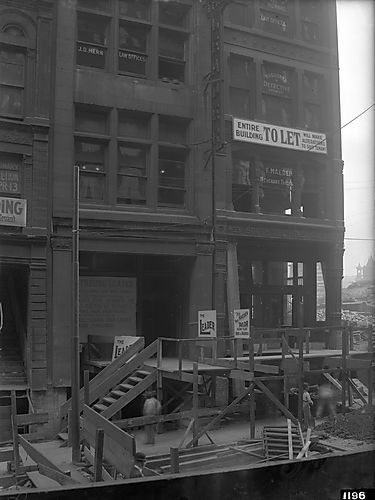
An important figurehead of the Westinghouse strike of 1914 was Bridget Kenny, a female Irish worker who had been fired the previous year “… for selling union benefit tickets on company grounds.” She organized marches, recruited workers, and was the most visible spokesperson of the strike. This made her a hero to the union and elevated her notoriety among the company men (McCollester, Women on Strike). The nickname “Joan de Arc” was given her by The Pittsburgh Leader (see fig. 2), which was a newspaper located in Downtown Pittsburgh known for its female writers and editors (among them, Willa Cather). This kind of press for Kenny, along with her actions, probably inspired many of the women who joined the strike.
Visible in the picture, though hard to see and slightly cut off, is a board in the middle of the frame that shows the newspaper’s support for women’s suffrage and proudly advertises the names of the women working in the building (Pittsburgh City Photographer). The Pittsburgh Leader was only around eight miles away from The Switch, which most likely made reporting easier; and because the union had a large female representation, the Westinghouse strike was also a story that the paper had a personal stake in with their progressive ideals for the time.
The Westinghouse strike of 1914 at The Switch was no ordinary uprising. It was an early instance of female workers fighting for fair treatment and better working conditions in a time where feminism was still in its first wave. The union wouldn’t have succeeded without the activism and leadership of its female members like Bridget Kenny. This event was an early instance of women in the early 1900s publicly demonstrating their ability to fight back against corporations and the patriarchy for the rights that they deserve. If it weren’t for these role models, the female characters in Willa Cather’s short stories and others in American literature probably wouldn’t exist.
Works Cited
Leichner, Amber Harris. “Cather’s ‘Office Wives’ Stories and Modern Women’s Work.” The Willa Cather Archive, 1999, https://cather.unl.edu/cs009_leichner.html. Accessed 17 April 2019.
McCollester, Charles. “The Next Page: Dark days in the Electric Valley.” Pittsburgh Post-Gazette, 7 Jun. 2014, https://www.post-gazette.com/opinion/Op-Ed/2014/06/08/The-Next-Page-Dark-days-in-the-Electric-Valley-Charles-McCollester/stories/201406080068. Accessed 5 March 2019.
Pittsburgh City Photographer. The Pittsburgh Leader. 1912. Historic Pittsburgh, Pittsburgh. Historic Pittsburgh, https://historicpittsburgh.org/islandora/object/pitt%3A715.121196.CP. Accessed 5 March 2019.
Women on Strike. 1914. Historic Pittsburgh, Pittsburgh. Historic Pittsburgh, https://historicpittsburgh.org/islandora/object/pitt%3A913.12B.SW. Accessed 5 March 2019.