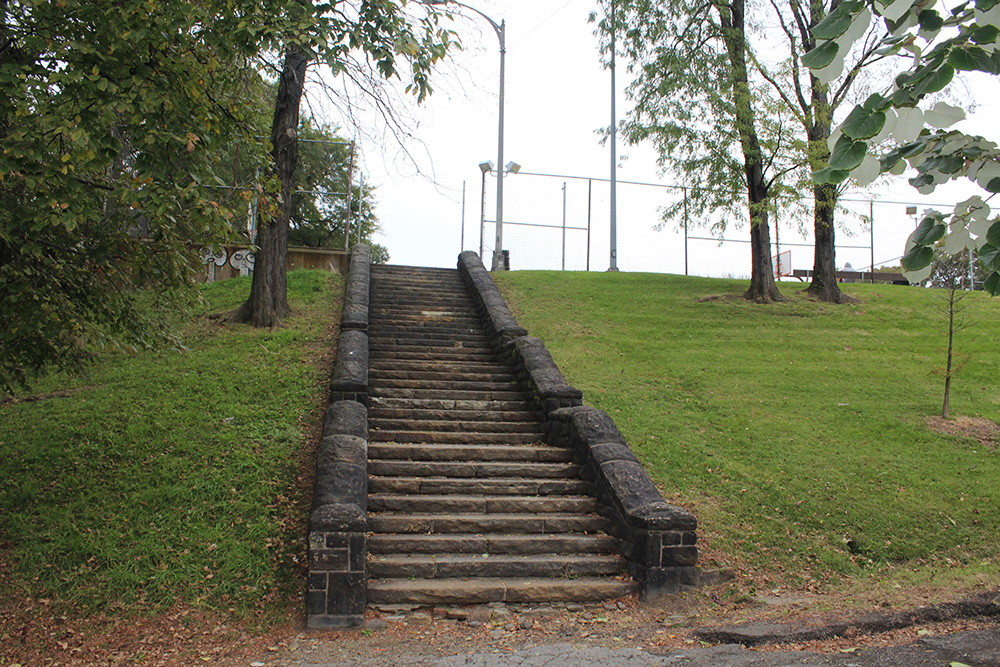
Staircase, photo by Emily Suruda
The Transformation of the Arsenal: How Do We Teach its History?
The 37 acre block between 39th Street and 40th Street in Lawrenceville has been home to several different places over 204 years, but one thing has never changed: “children have been on this city block since 1812” (Paine). One of the greatest attributes of the block is the opportunity to teach its long history and United States history through interaction with the park and surrounding space. The block was first home to the Allegheny Arsenal from 1814 to 1906. The Arsenal played a vital role in manufacturing ammunition for the Civil War, and in 1862 it was producing 128,000 cartridges a day (Creagh). Predominately girls a little older than 10 and women worked there filling cartridges, making harnesses, and handling live gun powder (National Archives at Philadelphia). On September 17, 1862, a tragic explosion near the laboratory and engine house occurred. Seventy-eight persons – most of whom were young girls – lost their lives in the worst civilian disaster in the history of the American Civil War (Wudarczyk). Following the explosion, the laboratory was rebuilt and the Arsenal continued producing ammunition till the end of the war. Once the war ended the Arsenal transitioned to a storage depot until 1906.
In 1907, the center of the 37 acre block became home to a park for children. During the Industrial Revolution, people were migrating to the Lawrenceville neighborhood, and with the influx of people there became a demand for a park. On March 12, 1907, a lease was obtained between the U.S. Treasury and the City of Pittsburgh on part of the Arsenal Grounds for a five year period at a rental cost to the city of one dollar per year (Stewart). At the dedication ceremony on July 4, 1907, Dr. John A. Brashear told the children that the park was theirs to play in and if signs were erected warning them to keep off the grass they were to “just kick down,” and if a policeman interfered “kiss the policeman” (Stewart). Arsenal Park remained open and still is due to a 1913 deed granting the park their previously leased land, and is now run by the Pittsburgh Park Conservancy. The former Arsenal site transformed from a place of work for children to now a place of play.
In 1908, five acres of the 37 acre block near Penn Ave laid the cornerstone for a merchant Marine Hospital on December 16, 1908 (Cantrell and Wudarczyk). This was only the beginning of the five acres of the former Arsenal transforming into a place for health and wellbeing. Now where the former Marine Hospital used to be sits the Frank B. Clack Health Center of the Allegheny Health Department. In the eight building health center is a tuberculosis testing center, the counties plumbing program, the counties food safety program, the Public Health Laboratory, and the counties air pollution program.
In 1921, eight acres of the 37 acre block near Butler Street was acquired by the Board of Public Education in the same 1913 deed, but construction did not begin until 1931 (Pennsylvania Historic Resource Survey Form). The school was built as a junior high school. The west, L-shaped wing was constructed in 1939 to house an elementary school. Then from 1952 to 1969, the school transformed into a Girl’s Vocational High School, but in 1971 the school returned to and still is Arsenal Middle School with an attached elementary school. Now the 37 acre city block that was once home to the Arsenal, is now a place for play, health, and education for children.
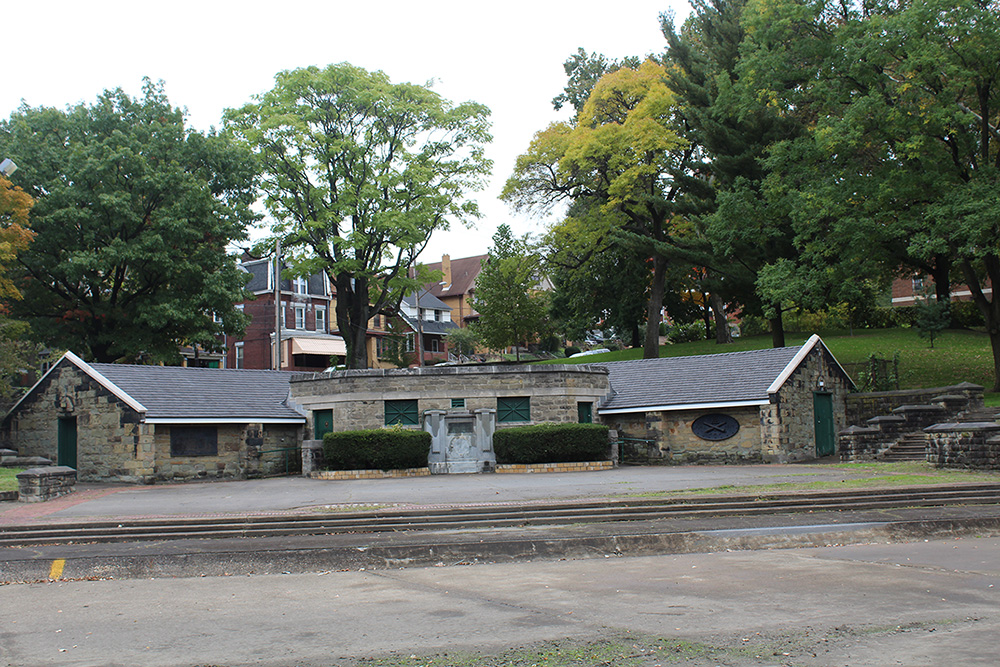
The Pittsburgh Park Conservancy sees this site and its long history as a teaching venue. Therefore, they have enlisted the help of Kirsten Paine, Pitt English Literature Graduate Student, to create a curriculum based on Arsenal Park. The former Arsenal, has an extensive history and provides the opportunity to teach about the concept of Civil War, child labor, and think critically on how the site has converted to a space for play, health, and education. So how do we teach about a space like Arsenal Park? A place that is almost unrecognizable except for the powder magazine as formerly being an Arsenal.
The first and possibly most important step is to identify your students and/or audience. For example, our class consisted of young adult college students who can handle knowing the precise locations of the Arsenal explosions; however children from Arsenal Middle school don’t need to know where the explosions occurred. The explosions occurred near the current playground and baseball field; a freighting thought for middle school students. In order to learn about Arsenal Park and its history, Paine has created questions that require an audience to interact with and physically go to the former site of the Arsenal. Some of the questions include: What did you notice about the border wall around the perimeter of the park? How do you think about Arsenal Park being a space for play? Where do you see the park’s history most clearly, and where is it mostly heavily covered? These questions require students/ an audience to walk the perimeter of the park, and think about how the history of the area is represented and the current space of the park. After about 30 minutes, everyone would return as a group and would discuss their observations and answers to the questions. According to Paine, the best way to learn about a site and its history is by interacting with your surroundings. This technique allows us to imagine ourselves as potential factory workers, think of reasons for why a border wall still surrounds the perimeter, and walk up the still standing staircase and visualize ourselves walking towards one of the laboratories.
Not only does interacting with the former site of the Arsenal help an audience learn about the site but so do stories from The Lowell Offering. The Lowell Offering was a monthly periodical written by New England mill women. An important aspect of the history at the Arsenal is that predominately children and women worked there. In order to exemplify the realities of the labor work force for children and young women during the Arsenal’s peak, excerpts from The Lowell Offering help expand on the realities of the time. For example, the short narrative “A Week in the Mill” describes a detailed day in the life of a factory girl. This story explains how factory women started their days before the sun rises, had a half hour to eat breakfast, and worked 12 to 13 hour days for six days out of the week: “Few would wish to spend a whole life in a factory, and few are discontented who do thus seek a subsistence for a term of months or years” (The Lowell Offering). This is one of the many stories included in The Lowell Offering that explain the life of a factory girl. Most of the young children and women who worked at the Arsenal experienced similar routines as the women in New England.
Another text that helps an audience learn more about Arsenal Park is the sermon by Reverend R. Lea. that was given at the memorial service for those who lost their lives during the explosion. Depending on the age of the audience, this sermon may or may not be appropriate. Unlike most sermons, this sermon can be interpreted more so as journalism than a remembrance of the victims. Therefore, included in the sermon are graphic details and explanations of the scene at the Arsenal following the explosion that would not be appropriate for a younger audience. “But amidst all this dismay and fearful consternation and apprehension of still worse to come, when the magazine should explode, there were many who entered the gates and climbed the walls, determined to aid, or die in attempt” (Rev. R. Lea.). Although, it is a useful tool that can help explain the details of the explosion and the events shortly after the tragedy.
Another technique Paine uses to teach about Arsenal Park is a photography assignment. This assignment also requires a student/audience to interact with the space through basic photography. For this assignment, Paine would tell students to go walk around the park and explore while taking pictures of things that are of interest to them on their phone. With this technique it teaches a person point of view, how to create a story and explain what the image tells us about a space, and how to create an argument of what their image signifies. With personal experience in doing a similar assignment this semester, I can attest that Paine’s photography assignment will teach a person how to tell a story based on an image. From my experience, I learned that everyone can take similar photographs, but write different narratives. This is because no one will envision a space the same way someone else will.
Children have been on the Arsenal’s site since 1812 with no sign of them leaving in the near future. The Arsenal went from a place of work for children to now a site for health, education, and play. In a location where there is an extensive amount of history it raises the question of how do we teach about the Arsenal? The idea of not teaching some audiences about certain events and readings involving the Arsenal tragedy is important for a site that is meant to be welcoming and enjoyed by all in the community. It’s important to not frighten certain especially younger audiences to the point of not viewing the space as welcoming or fun anymore. There is no right answer to the question, but Paine’s technique of interacting with the site through photography, questionnaires, and writings from women factory workers helps teach students and visitors alike about child labor, the tragedies of the Arsenal, and the concept of a Civil War.
Works Cited
“A Week in the Mill.” The Lowell Offerings. pp. 75-77.
“Allegheny Arsenal.” National Archives and Records Administration, National Archives and Records Administration, www.archives.gov/philadelphia/exhibits/allegheny-arsenal/allegheny-arsenal.html.
Cantrell, Joann, and James James Wudarczyk. “Lawrenceville.” Google Books, books.google.com/books?id=D8GsCQAAQBAJ&pg=PA49&lpg=PA49&dq=when%2Bdid%2Bthe%2Bmarine%2Bhospital%2Bin%2Blawrenceville%2Bclose&source=bl&ots=CbKLHxr0Ra&sig=sFTuWqbBjqSTi1xt84NlRs8oE7o&hl=en&sa=X&ved=2ahUKEwivrp3xgPveAhVjs1kKHVq-DEAQ6AEwBHoECAMQAQ#v=onepage&q=when%20did%20the%20marine%20hospital%20in%20lawrenceville%20close&f=false.
Creagh, Kevin. “This Used To Be Here – Allegheny Arsenal.” The Point of Pittsburgh, 25 Apr. 2016, www.thepointofpittsburgh.com/this-used-to-be-here-allegheny-arsenal/.
Lea. R. Rev., “Sermon Great Explosion Allegheny Arsenal.”1862. Sermon. https://courseweb.pitt.edu/bbcswebdav/pid-25477324-dt-content-rid-42341146_2/courses/2191_UPITT_ENGLIT_1412_SEC1010/ArsenalSermon%281%29.pdf
Pennsylvania Historic Resource Survey Form.” Pittsburgh History & Landmark Foundations, www.dot7.state.pa.us/CRGIS_Attachments/SiteResource/H005306_01D.pdf.
Paine, Kirsten, and Emily Suruda. “Arsenal Park.” 14 Nov. 2018.
Stewart, Howard. “Historical Data, Pittsburgh Public Parks.” Fact Book, 1943, documenting.pitt.edu/islandora/object/pitt%3A00awn7880m/viewer#page/1/mode/2up.
Wudarczyk, James. “Death at the Arsenal: September 17, 1862.” Lawrenceville Historical Society, Mar. 2012.