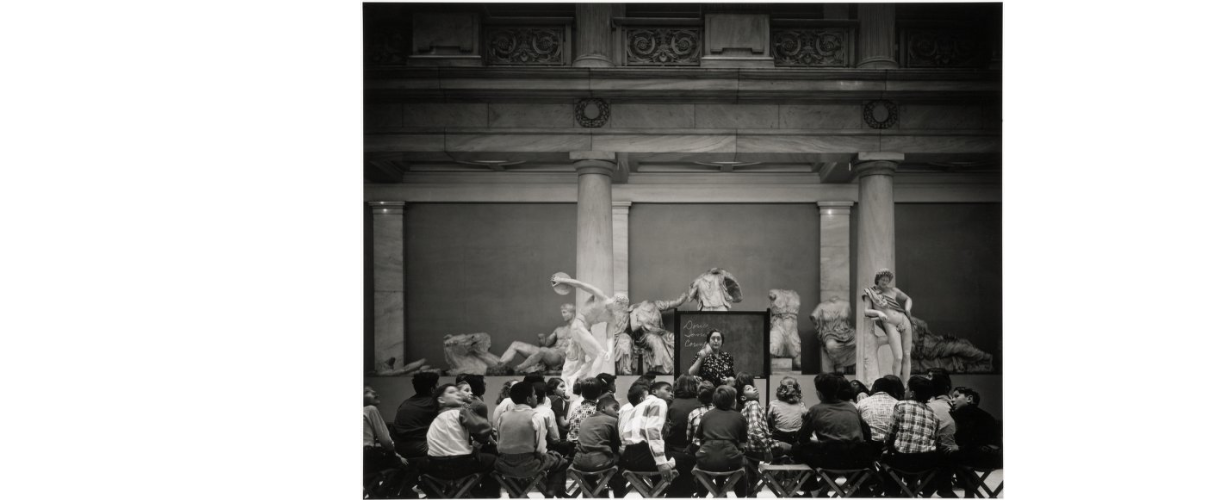
Carnegie’s statues sit on the ground floor of the Hall of Sculpture behind a teacher holding a class. “Instruction in Sculpture Hall, Carnegie Institute,” Clyde Hare Photographer, 1951, Carnegie Museum of Art Collection of Photographs, Historic Pittsburgh Site.
Carnegie Goes Greek
“Carnegie was fond of turning to an assistant during his later years to ask, ‘How much did you say I had given away, Ponyton?’ To which the answer was an inevitable ‘$324,657,339.’” -Les Standiford, Meet You in Hell
Andrew Carnegie was one of the great captains of industry of the 19th Century. He immigrated from Dunfermline, Scotland to Allegheny, Pennsylvania (now the city of Pittsburgh’s North Side) in 1848. In his first few years in the United States, Carnegie worked small jobs in factories and in telegraph offices. Shortly after, he found himself working for the Pennsylvania Railroad. With a few smart maneuvers and cutthroat tactics, alongside some quick-thinking investing, he soon found himself heading his own company – the Carnegie Steel Company. It was from there he found his fortune, and as the years went on he shared it with those around him. He opened more than 2,800 libraries worldwide, started the Carnegie Endowment for International Peace, and even founded Carnegie Tech in Pittsburgh (now Carnegie-Mellon University). He was also a lover of and a giver to the arts, collecting paintings and sculptures from around the world and adding to his collection with every trip he took. His love of art, combined with his over abundant collection, led to the creation and establishment of the Carnegie Museum of Art (“Andrew Carnegie”).
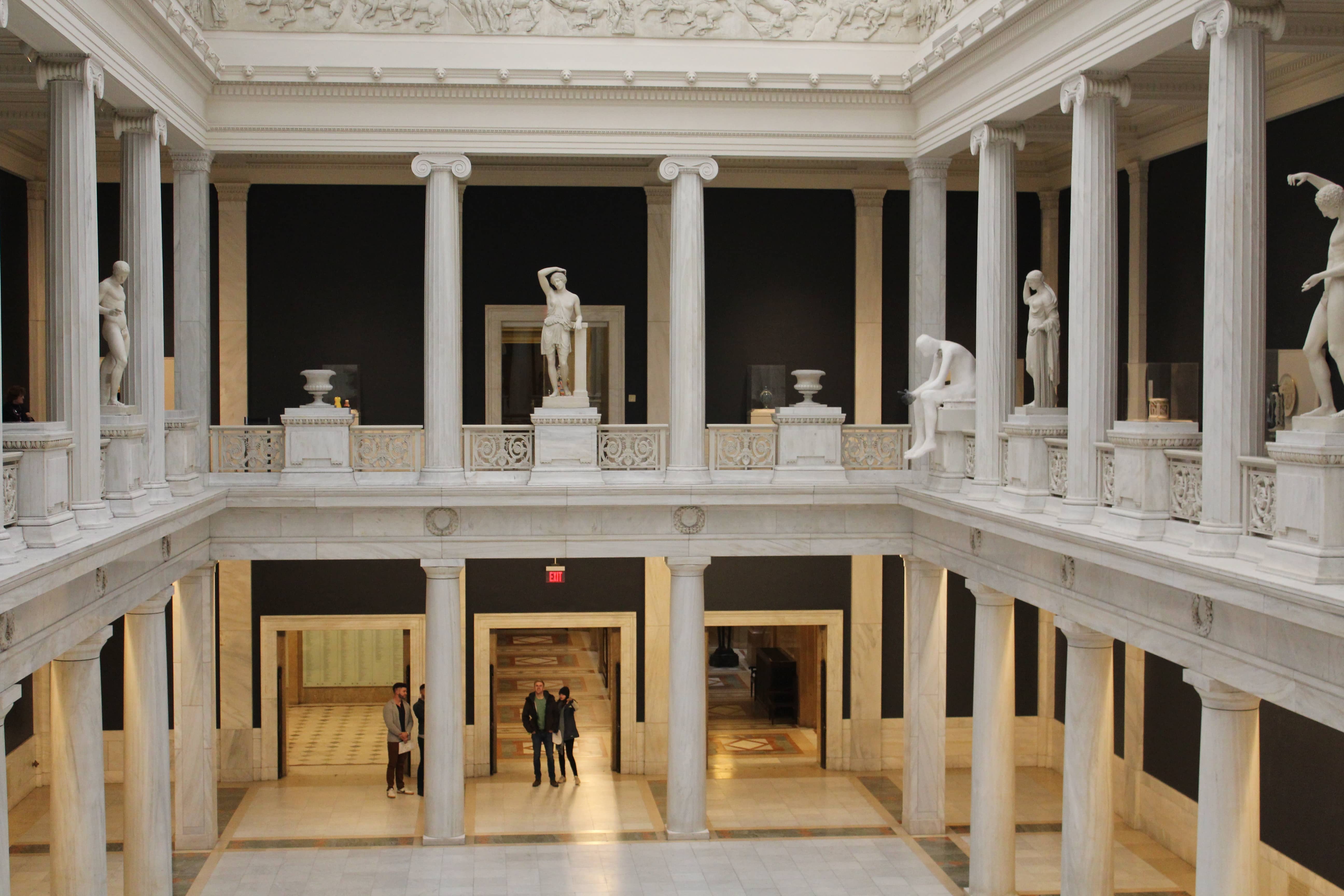
Carnegie not only loved art — he admired Greece. More specifically, he admired the influence Ancient Greece had on the American democracy. Carnegie’s personal collection included original Greek sculptures, as well as plaster reproductions. During his travels, he collected so many sculptures that he needed to construct a place to store them. That place found itself to be CMOA’s Hall of Sculpture. It was added in 1907, just twelve years after the museum had opened. Originally, sixty-nine plaster casts of Carnegie’s pieces were housed there. Many of the sculptures took refuge on the ground floor, with the remainder resting on the second-floor balcony. Today, only a handful are still on display, sitting on pedestals on the second floor, allowing the Hall’s ground floor to be used for both exhibits and public and private events (“Hall of Scuplture”).
While the Hall was meant to store Carnegie’s personal pieces of Greece, the design of the Hall itself was meant to emulate the renowned Parthenon in Athens. It was built with double tier columns similar to that of the ancient Greek structure. It was also built with white marble that came from the same quarries as the stone used to construct the Parthenon, linking the Hall even closer to its inspiration. Furthermore, alongside Carnegie’s casts of Greek sculptures, a plaster reproduction of the frieze found on the outside of the Parthenon’s cella is on display in the Hall. The frieze depicts the scene of the procession that marked the start of the annual festival of Athena held in Athens years ago. The Hall does differ from the Parthenon, however, in that it was also designed to be used as a museum space. It incorporates considerations made to accommodate changing exhibits, and it includes a balcony and railing to make the second floor publicly functional – something uncharacteristic of the architecture of Ancient Greece (“Hall of Sculpture”).
Roland Barthes, a 20th Century French philosopher, in his essay “The Third Meaning”, writes about the three levels of meaning any piece gives – a theory that can translate directly to CMOA’s Hall of Sculpture. In his theory, Barthes describes the first level of meaning as being strictly informational. He writes how “this level is that of communication,” for it tells the viewer exactly what is in front them (50). The second level of meaning, according to Barthes, is that of signification. This level is symbolic in nature, and conveys the not-so-obvious message of the author or creator (54). The third level, and perhaps the most complex, is what Barthes refers to as the obtuse meaning. He describes this level as being unintentional, giving a meaning to a piece that is a cause rather than a condition, being a “signifier without a signified” (61). All pieces of work, whether music or writings, paintings or films, or even halls in museums built by Carnegie, can be thought of as having these three levels of meaning.
Barthes’ first level, the information level, is applicable to the Hall of Sculpture when describing what is in it. The Hall’s columns, the sculptures in it, the marble it was constructed from – all of this tells you what the Hall is. It gives you information about what a person interacts with when visiting the Hall. The second level, the symbolic level, is created from its resemblance to the Parthenon. The Hall’s architects want visitors to use the physical features as a vehicle to envision the Parthenon, though they do not explicitly tell the visitors about Greece. This is the hidden intent of the architects, though it is still intentional.
The third meaning, however, cannot be derived from any intentional acts. Instead, it comes from how a person “reads” the Hall – what does he or she gather from it, how does he or she feel? While each person creates his or her own individual interpretation, therefore making a universal third level meaning impossible, the Hall can be said to have a third level of prestige. A Hall made completely of brilliant white marble is nowhere near inexpensive, indicating the wealth that was needed to create such a structure. In addition, housing numerous sculptures hints to the culturally minded, as well as educated, interests of Carnegie himself – interests that are not accessible to the lower classes. Furthermore, the Hall’s relation to Ancient Greece implies power. Inventions and theories, mathematics and philosophy, justice systems and democracies — concepts that are well respected and widely followed and trusted today — all came from Ancient Greece. A Hall revolving around the origins of these systems built for the mundane purpose of storage gives Carnegie a prestige associated with great power.
Though already known as a powerful and successful businessman, CMOA’s Hall of Sculpture further tells the story of the prestige Carnegie held. He started as a poor immigrant from Scotland and maneuvered his way to ruling America’s steel industry, making billions along the way. He did not forget those around him, however, and later devoted his life to philanthropy and the arts. CMOA and its Hall of Sculpture remind the public of the steel industry’s lover of art and his fascination of Greece, adding even more to his generous and philanthropic reputation.
Works Cited
“Andrew Carnegie.” Biography.com. A&E Television Networks, 22 Nov. 2016.
Barthes, Roland. “The Third Meaning: Research Notes on some Einstein Stills.” Image, Music,
Text, edited by Stephen Heath, Hill and Wang, 1977, pp. 50-68.
“Hall of Sculpture.” CMOA.org. Carnegie Museum of Art, Carnegie Institute, 2017.
Standiford, Les. Meet You in Hell: Andrew Carnegie, Henry Clay Frick, and the Bitter
Partnership that Transformed America. Three Rivers Press, 2005.