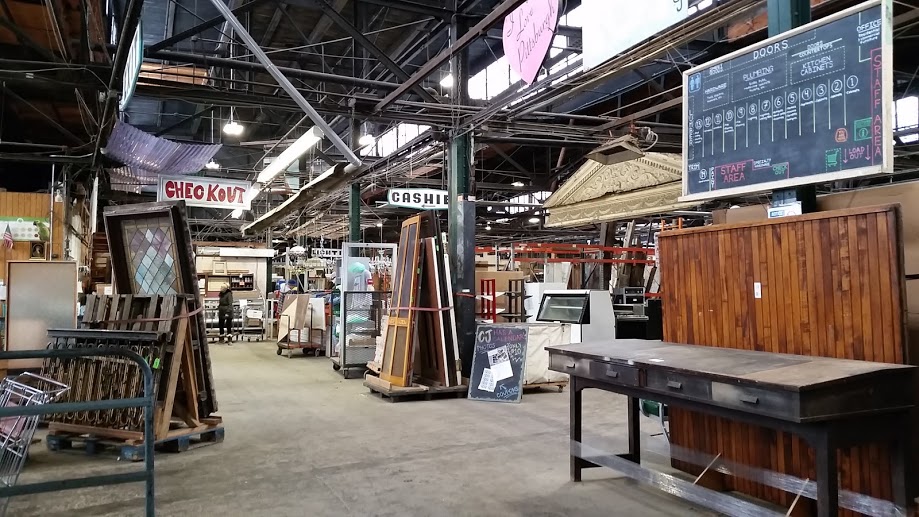
The Construction Junction is seen in this photo – a buffet of building pieces. Materials such as doors and tables are only a piece of what is sold here. Photo by Rachel Fleisig.
Loose Parts and Reuse Arts
For those unfamiliar with the Theory of Loose Parts, this is basically it. The theory, in short, describes how people placed in an environment with more individual parts will be able to channel their creativity better than people placed in an environment with fewer moveable parts. When thinking about everyday life, at least for adults, it’s difficult to think of many situations where this theory may apply. Many adults work office jobs or have careers that do not require too many individual variable parts or, for that matter, much creative thinking. Crunching numbers daily may not exactly get the creative juices flowing.
That’s where the Pittsburgh Center for Creative Reuse and Construction Junction come in to play. Construction Junction focuses its efforts on recycling larger objects, such as kitchen appliances, doors, and toilets, for its customers to repurpose.
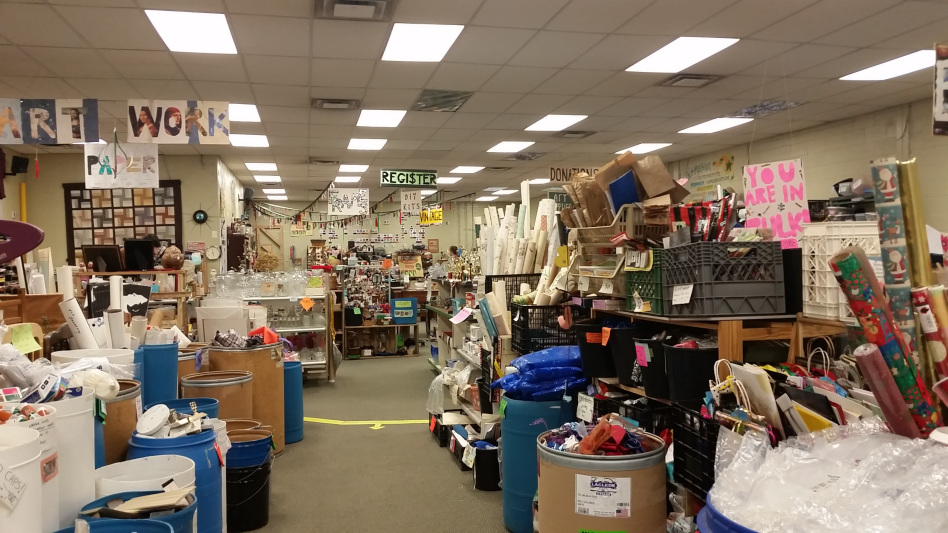
Similarly, Pittsburgh Center for Creative Reuse focuses its efforts on conserving and recycling smaller items that may be some of the most random things you could possibly think of, such as old cassette tapes, fake flowers, and old alphabet letters from elementary schools.
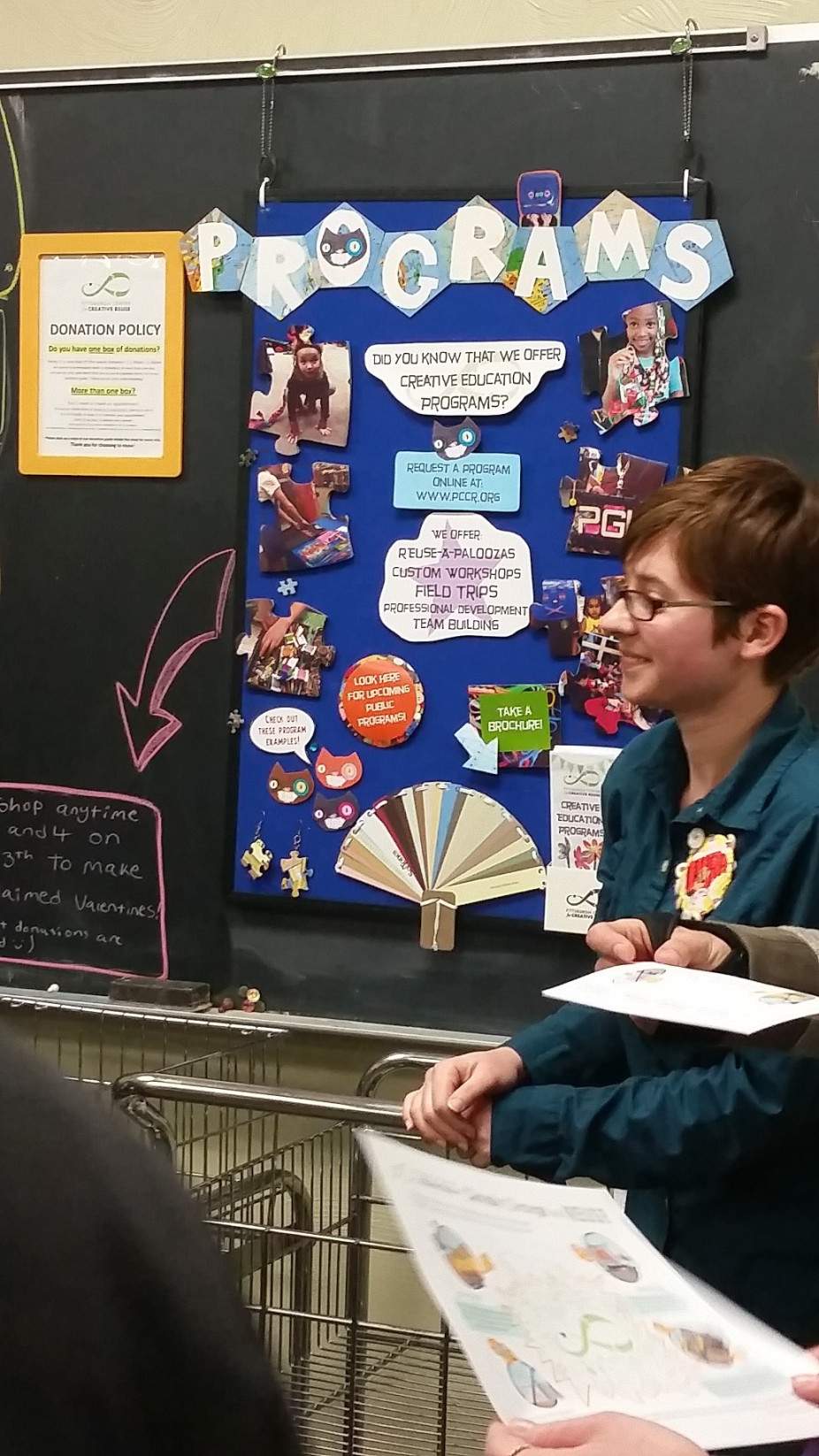
Though Construction Junction does fit with the theory of loose parts, the Pittsburgh Center for Creative Reuse abides even better. One reason for this is the classes that are offered by the center. Employees at the Pittsburgh Center for Creative Reuse educate teachers on how to use seemingly useless or old materials to make new, unique art projects with their students. Examples of these projects include, but are certainly not limited to, redecorating old trophies into more meaningful and unique awards, making jewelry out of old technology supplies, and binding books made out of old wallpaper and sewing supplies.
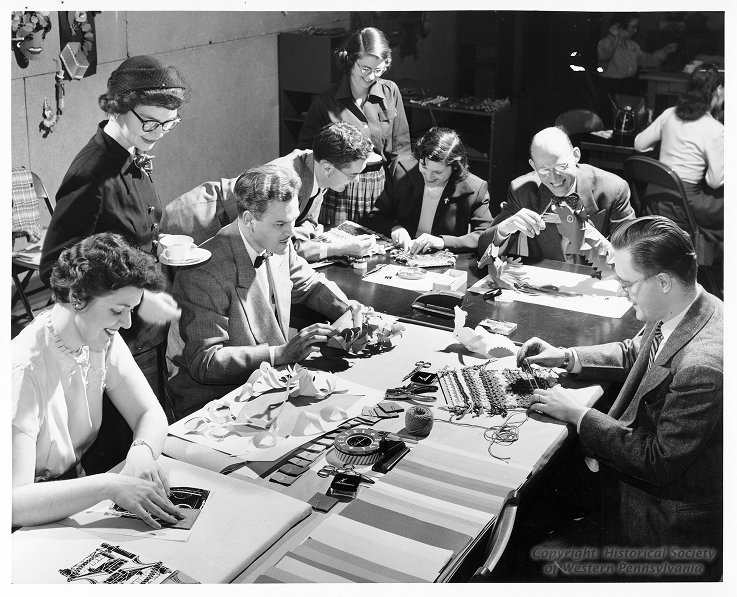
The reviews of the Pittsburgh Center for Creative Reuse have been nothing but positive. From children to teachers to parents alike, people cannot get enough of these creative crafts that are not only fun, but also cheap and environmentally friendly. This type of crafting is a relatively new phenomena. In decades past, childhood crafting was more traditional and less eco-friendly, as evidenced by the following photo found in the Historic Pittsburgh Archives.
Even still, the benefits from the Pittsburgh Center for Creative Reuse’s programming do not stop there! The center seems to embrace the theory of loose parts with open arms. According to two nationally known doctors of education, “children’s spontaneous, creative expression increase their sense of competence and well-being now and into adulthood,” and “children extend and deepen their understandings through multiple, hands-on experiences with diverse materials” (Drew). This information basically reinforces the main idea behind the programming at the Pittsburgh Center for Creative Reuse. Assuming we consider spontaneous, creative expression, a sense of competence and well-being, and deeper understandings of the world good qualities to have, it seems as though the theory of loose parts is accurate.
Anyone well-learned enough to know about the theory of loose parts, or even read this blog post, is likely too old to be considered a child, and may therefore get the impression that this theory is not applicable to them. With both anecdotal evidence and some real research, I can explain how this is false. We can begin with the story.
For the Secret Pittsburgh course, we were tasked with shopping at the Pittsburgh Center for Creative Reuse. For the mere price of $8 a bag, we split into groups and filled each bag to the brim with items from the “bulk” section of the store. Boy, did we find some amazingly random items. A few weeks later, we were tasked with using these items to create a display about our class. At first glance, we were not quite sure what to do. The items were not very cohesive and most of them were people’s old junk from years ago. However, if only for a passing grade, we got to work on what to do. We got our creative juices flowing and started digging through the bags to see what could be useful. In only a few hours, we had successfully created a display that really captured our class, made mostly out of old, recycled items! The display looked great and we felt great. If we had been given a bag of uniform items, or only a few of them, there’s no way we would have been able to create something so imaginative and cool.
A cursory search does not present any studies relating the theory of loose parts to adults. However, according to a 2000 study, “creative thinking is a universal ability that can help adults manage satisfying lives and that is increasingly in demand in the workplace” (Kerka). Many adults do not consider themselves the creative types, but its likely that those who do somehow involved themselves with the theory of loose parts, which would have an effect even without knowledge of the theory itself.
As the theory states, environments with more lose parts, as opposed to static parts, are much more stimulating to children. One may wonder, then, what the point is of stimulating children to be creative if the effect of the theory of loose parts has not been proven as well on adults. This is a valid question. At the end of Nicholson’s article about the theory, he addresses it, claiming “most of the existing [curricula for children] do not take into account the theory of loose parts and thereby fail. [Utilizing the theory] could act at least as a start toward solving the problem of cultural availability of bits and pieces of the environment—in both the software and hardware sense—and the extent to which a new generation will be able to invent new systems with the parts” (13). This article was originally published in 1972. Children born this same year would be 44 now, which has left plenty of time for the theory to prove itself.
Think back to how much technology has improved in the past 44 years. It’s astounding to think about the sheer volume of new inventions and improvements that have been made in recent years. We can also include modern art, architecture, and environmental advancements. Assuming the theory of loose parts has been taken to heart by at least a few of these innovators and integrated into some curricula, it’s not difficult to see the lasting effect it has had.
Seeing all the progress that’s been made since this theory has been brought to light, we can only imagine what will be next. Children now more than ever, thanks in part to organizations such as the Pittsburgh Center for Creative Reuse that help teachers utilize the theory of loose parts to their advantage, are getting an education and playtime activities that allow them to embrace their inner creativity and inventiveness to blossom into innovate adults who will surely change the world. The creativity of children is extremely important to nurture instead of suppress. We are lucky that these organizations have been moving toward embracing this characteristic.
In addition, the Pittsburgh Center for Creative reuse not only recycles old items, but it offers them at extremely cheap prices. With public schools cutting funding for art programs left and right, the Center’s offering of affordable art supplies might make schools reconsider. And, if not, parents and other caretakers are always welcome at the Pittsburgh Center for Creative Reuse to do their shopping and make their own inventive projects. After all, the theory of loose parts strongly encourages children to let their imagination run free.
Works Cited
Chilcote, Lee. “Turning Trash into Treasure, Creative Reuse Movement Boosts Urban
Economies.” TheLineMedia. N.p., 28 Aug. 2013. http://www.thelinemedia.com/features/creativereuse082813.aspx>. Accessed 23 April 2016.
Fullenwider, Kyla. “How To: Start a Creative Reuse Revolution in Your Community in 5 Steps.” GOOD Magazine. N.p., 12 Dec. 2010. https://www.good.is/articles/how-to-start-a-creative-reuse-revolution-in-your-community-in-5-steps. Accessed 23 April 2016.
Jackson, Sarah. “Rethinking Reuse: Catching Up With Erika Johnson.” Remake Learning. 10 Feb. 2015. Accessed 2 Dec. 2016.
Kerka, Sandra. “Adult Learning in and through the Arts. ERIC Digest.” Adult Learning in and through the Arts. ERIC Digest. N.p., 2003. Accessed 19 Apr. 2016.
Nicholson, Simon. “The Theory of Loose Parts.” Studies in Design Education Craft & Technology 4.2 (1972): 5-14. Open Journal Systems. Accessed 8 Apr 2016.
“Recycling Facts and Statistics.” http://www.juneau.lib.ak.us/pubworks/documents/Recyclingfactswebsite3-28-07final.pdf. Library of Juneau, n.d. Accessed 1 Dec. 2016.
TwistedSifter. “15 Famous Quotes on Creativity.” TwistedSifter. N.p., 08 Nov. 2012. Accessed 26 Oct. 2016.
“The University of Thriftsburgh.” The University of Thriftsburgh. University of Pittsburgh, n.d. Accessed 23 Apr. 2016.
http://www.universityofthriftsburgh.com/;.