Signs and a bike. Photo by Elizabeth Furiga.
Making Pittsburgh Bike Friendly: A Collaborative Effort
Bikers are a common sight in the Pittsburgh area today. In the past 13 years, businesses and advocacy groups have worked together to make the city a safer and friendlier place for bicyclists. Bike Pittsburgh and Free Ride, the former a bicycle advocacy group, the latter a bike repair shop and education center have been supporting the community since 2003. Newcomers like the Wheel Mill, a 3 year old indoor bike park have been just as important to the movement as the original supporters.
Together these businesses and organizations have helped make Pittsburgh a city, where commuting by bike is easy, bikes can be rented with the touch of a smartphone, and local legislators are constantly working to make the city more bike friendly.
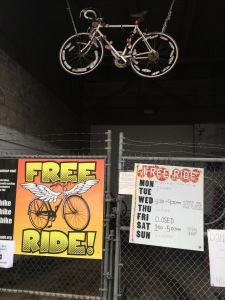
Bike Pittsburgh and Free Ride were two of the earliest groups working to support cyclists in Pittsburgh. Bike Pittsburgh is a charitable non profit organization. The group works on behalf of the Pittsburgh community to make the city safe, friendly, and accessible to bicyclists. (Bike PGH!) Free Ride is a bicycle recycling and education facility focused on teaching the DIY approach to repairing and maintaining your bicycle. Free Ride is organized as a collective so no one person owns the shop. Like Bike Pittsburgh, it is also a nonprofit. (Free Ride Pittsburgh)
Bike Pittsburgh began in the winter of 2002, after the founder, David Hoffman, was hit by a car while riding his bike. This accident inspired Hoffman to create a website dedicated to bringing exposure to bicycle safety in Pittsburgh. By 2003, Bike Pittsburgh had reached nonprofit status. Later that year, Free Ride became a project under Bike Pittsburgh’s support. Since 2003, the two have worked together tirelessly and supported each other immensely in the fight to keep Pittsburgh street’s safe for cyclists. (Bike PGH!)
By spring of 2004, Bike Pittsburgh was growing in strength and the community of cyclists was rallying around them. At this time, it became clear that Bike Pittsburgh would assume leadership of Sustainable Pittsburgh’s Urban Cycling Committee. By this time, it was clear that an advocacy group was something the community wanted and needed. (Bike PGH!)
At the same time, Free Ride was growing enthusiasm and education for bicycles in the Pittsburgh community.
Safety Improvements
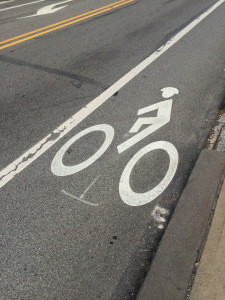
By 2007, after a few years of steady preparation and planning in cooperation with city council, Bike Pittsburgh, the advocacy group that could, was able to see some huge improvements for biking safety in Pittsburgh. In spring of 2007, the first commuter oriented biker lanes were created on Liberty Avenue in the Bloomfield/Lawrenceville area. Later that year, a bike lane was created on the Birmingham bridge. (Bike PGH!)
Already, things were getting safer for cyclists. But this was just the beginning. In 2008, the city created the Bike and Pedestrian coordinator position as part of the local government. This position was the first of its kind in Pennsylvania. At this time Bike Pittsburgh also released an updated version of a map for a guide to biking the streets of Pittsburgh. (Bike PGH!)
From 2008 to 2009 multiple more bike lanes and sharrows were installed throughout the city as the result of Bike Pittsburgh and the community’s hard work. At this time, the city also improved bike parking and installed several more bike racks in various locations across the city.
Moving into the 2010’s, Port Authority announces that now all buses have bike racks. The buses went from 0 in 2001 to the full fleet in ten years. By 2012, Governor Corbett, announces a new law, the Safe Passing bill. Among other things this makes it illegal to pass a bicyclist without at least a four foot clearance.
And finally most recently in 2014, Schenley Drive and Penn Avenue both got protected bike lanes. This means the bikers are separated by some sort of barrier from traffic. One of the most praised efforts came in 2015, when Oakland created a major expansion of bike lanes. Much of this was on Bayard street as an alternative to the Forbes/Fifth corridor. (Bike PGH!)
A Growing and Thriving Community: More than Just Advocacy
In recent years, the bicycling community in Pittsburgh has grown from more than just advocacy groups and education centers. The community is also focused on more than just safety and adding bike lanes. In 2013, Pittsburgh became a place known not just for outdoor bicycling, but indoor as well when the The Wheel Mill opened. The Wheel Mill became Pittsburgh and Pennsylvania’s only indoor bike park. Ray’s bike park located in nearby Cleveland had previously been the destination for BMX riders and people looking to ride in the winter. (Wheel Mill Home)
Since 2013, the Wheel Mill and it’s owner Harry Geyer have established themselves as an integral part of the biking community here in Pittsburgh. Geyer dreamed up the idea of the Wheel Mill after visiting Ray’s in Cleveland. He knew that Pittsburgh had many BMXers and mountain bikers and he figured an indoor park would do well. (McGill)
Using his experience as a construction worker and builder, Geyer brought his vision to life in a former warehouse. Today, the park now works with other organizations like Bike Pittsburgh, Free Ride and the Over the Bar Bicycle Cafe to keep the cycling community in Pittsburgh alive and well.
The Wheel Mill has been growing the strength of the biking community by encouraging young children to pick up a bike and ride. The Wheel Mill is a family friendly park and it brings together generations over the joy of riding a bike.
The park also brings fundamental skill lessons to the community and hosts special nights for kids as well as ladies’ nights. (Wheel Mill Home) The Wheel Mill has become a hub of activity for the cycling community. Here friendships and memories are created. It is a place to get outdoor riding safety lessons from Bike Pittsburgh as well as hone your mountain biking skills. The Wheel Mill has built upon the advocacy Bike Pittsburgh did in the past ten years to make Pittsburgh safer for commuters and now the park is making Pittsburgh a place for biking leisure.
The Bicycle in the Past: A Long Legacy
Transportation has certainly evolved a lot over the last century. In the 1880’s and 1890’s, when the bicycle first rose to popularity, the invention created a transportation revolution in the US. But even today, with the car as the main mode of transportation, the bicycle is once again making a comeback. This revolution as was previously discussed has come about in Pittsburgh as the integration of the bicycle into a car-obsessed society. Bike Pittsburgh and other cycling organizations have worked hard to make the bicycle an accepted part of our automobile dominated roadways.
In the late 1800’s, the bicycle did not have to worry about competing with automobiles. Instead the bicycle was a revolution all its own. For the working class and women, the bicycle created opportunities and freedom that were not previously afforded to these groups (Macy, 36). In the book, the Wheels of Change we can see how bicycles changed the dynamic of the US. Bike riding became a mode of transportation as well as a leisure activity. At the same time bicycle racing evolved as a sport, which can be compared to mountain biking and BMX as a sport that is rising in popularity in the US (Macy, 63).
The bicycle was questioned at first as to whether it was safe for the health of women and others. The bicycle while popular, still faced criticism in the beginning (Macy, 35). Although the bicycle has remained a constant in the United States, even today we see it facing sharp criticism among the automobile heavy world. But biking enthusiasts have rallied around it now just as they did then. Biking today will become an environment friendly alternative to cars and a way for kids to gain more mobility and freedom similar to the way that bikes allowed women to gain more liberties in the past.
The bike has and always will be supported by a strong community, therefore it will endure.
Soja, Space and the Bicycle
Finally, after discussing the evolution of the bicycle community in Pittsburgh and the way the bicycle is perceived now and how that compares to the beginnings of the bicycles, I’d like to bring up the idea of space. For bikers here, through their actions and hard work, they have converted the space of Pittsburgh into a biking city, biker’s destination, and a place where cyclists and drivers can get along. These ideas and views of Pittsburgh fall into certain ideas of space.
Edward Soja was a space theorist, and his ideas can give us a way of thinking about “thirdspace” a place that is both real and imagined (Soja). A thirdspace is also what Soja sees as a lived space. This is a space that is transformed by the way we live and interact with it (Soja). Pittsburgh is a city, but it became a biker’s city and a cycling destination through the way the specific community has interacted with the city and lived in its spaces. Because of the people who commute by bike through our city, because of the bike lanes they utilize and the spaces they have utilized for community activities, Pittsburgh has been transformed through these lived activities into a biking city.
Conclusion
The biking community in Pittsburgh has transformed the city as a safer place for cyclists in the last ten years. The advocacy groups and businesses involved have worked to give bicyclists more safety and freedoms while living in a automobile dominated city. Bike Pittsburgh, Free Ride, and later the Wheel Mill have all played a key role in growing the community.
In addition, the criticism bicyclists have faced from drivers today and the obstacles bicyclists have faced is similar to the very beginning of the bicycle in America. In both times, the bicycle was adopting to changing times in the society around them.
And finally, the actions the biking community have taken to make Pittsburgh more bike friendly have also turned the city into the thirdspace, lived space idea of Pittsburgh as a bike friendly city.
Turning Pittsburgh into a bike friendly was a collaborative effort. It is also an effort that speaks of the bicycle’s rich history and the ways that bicyclists live and interact with Pittsburgh. Pittsburgh has a rich and strong bike community something that would surely be felt if you were to visit the Wheel Mill.
Works Cited
Bell, Thomas. Out of This Furnace. Pittsburgh: University of Pittsburgh, 1976. Print.
“BikePGH!” Bike Pittsburgh RSS. Accessed 23 Apr. 2016.
“Free Ride Pittsburgh: Who We Are.” Free Ride Pittsburgh. Accessed 27 Apr. 2016.
Macy, Sue, et al. Wheels of Change: How Women Rode the Bicycle to Freedom (with a Few Flat Tires along the Way). Print.
McGill, Andrew. “Wheel Mill: One Man’s Vision Turns Homewood Warehouse into Indoor Bike Park.” Pittsburgh Post Gazette. 19 May 2013.
Ruck, Rob. Lecture. History of Sports. University of Pittsburgh, Cathedral of Learning, ON September 15, 2015.
Soja, Edward. Thirdspace: Journeys to Lost Angeles and Other Real-and-Imagined Places. Cambridge MA: Blackwell Publishing Inc., 1996. 53-70.
“The Wheel Mill.” The Wheel Mill Home. Accessed 24 Apr. 2016.
Widrich, Leonhard. “The Origin of the 8 Hour Work Day and Why We Should Rethink It.” The Huffington Post. TheHuffingtonPost.com, 9 Mar. 2014. Accessed 24 Apr. 2016.