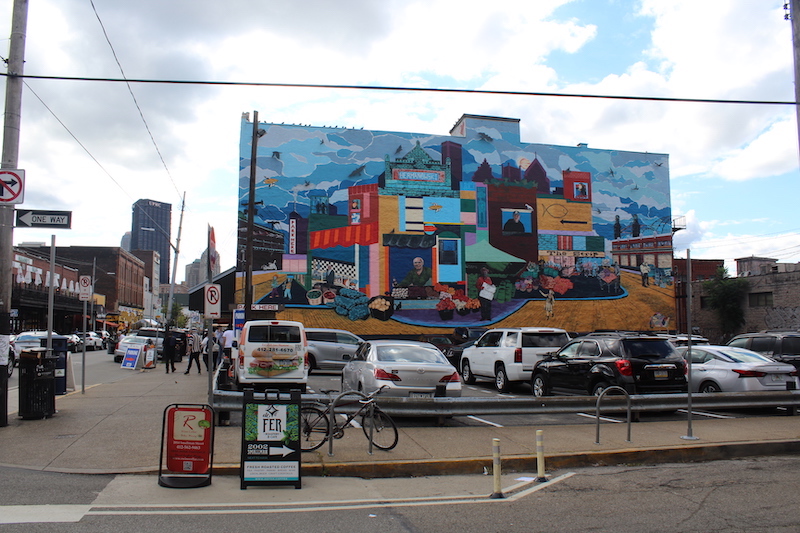
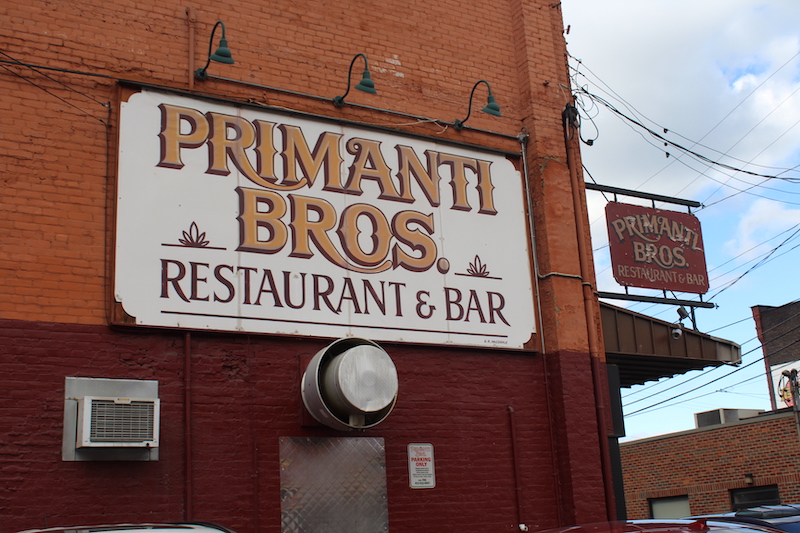
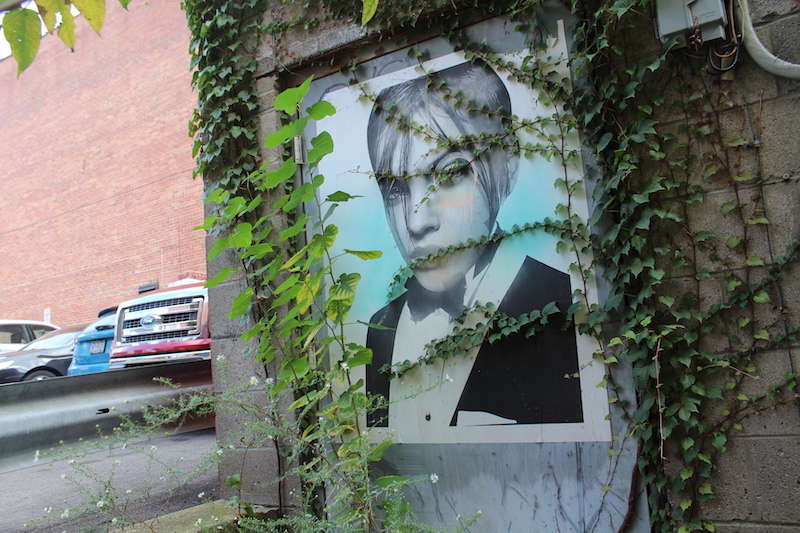
A large Mural in the middle of the Strip District, painted by Carley Parrish and Shannon Pultz. Photo by Kyra Moore, 2019
The Strip
Location Information
Address: Between the 11th and 33rd block of Penn Ave, North of Downtown. From the south bank of the Allegheny river to Liberty Ave.
Hours: The neighborhood is open 24/7. Individual store hours vary
Website: Visit website
Transportation: Bus or car (street parking and paid parking), the Strip itself must be walked
Access: Busy sidewalks with limited space, individual store accessibility varies
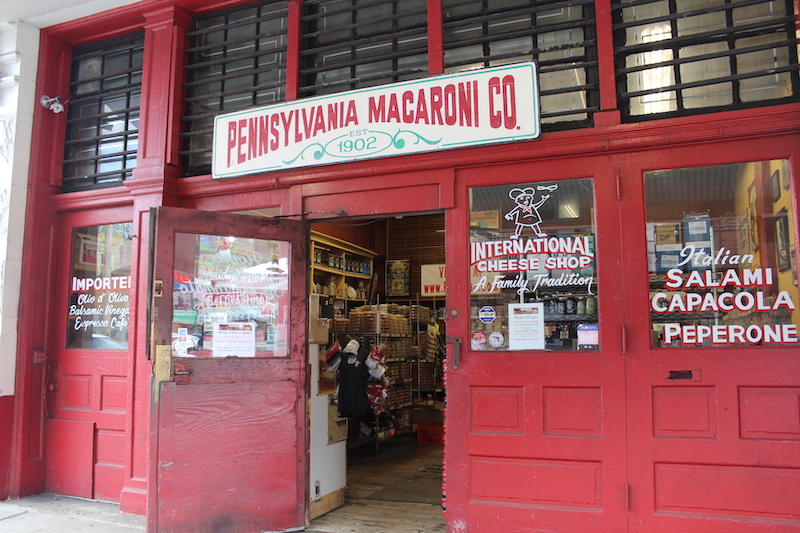
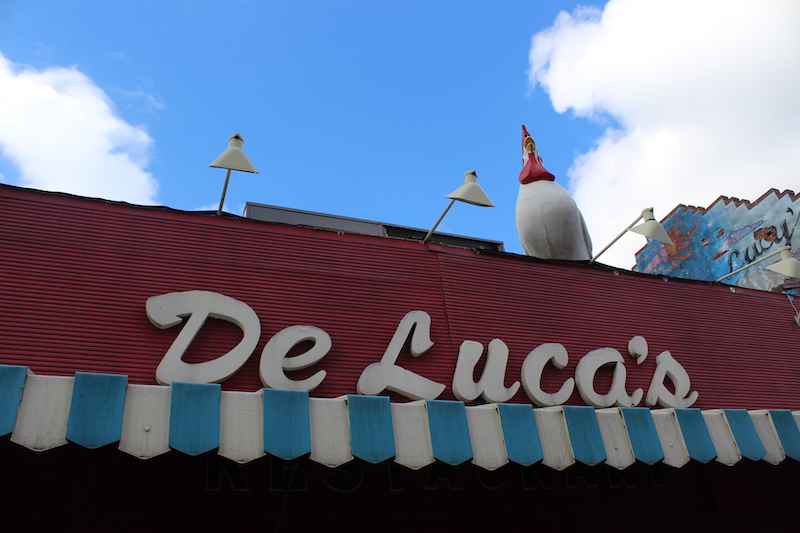
Black and Gold letters shout out at you from all angles in the Strip District. It’s easy to see the Pittsburgh pride with stall after stall selling all sorts of sports paraphernalia. But it’s not just sports pride that you can find in the Strip District. This area is a lively and colorful market place just north of downtown Pittsburgh. Along the main street, Penn Avenue, you’ll find most of the shops and stalls that make up the Strip District. There is a very unique collaboration of stores here. There’s a fish market, fresh produce, Italian delis, multiple Asian markets, pottery shops, a flower shop, and artist studios. Local Pittsburghers frequent the shops and restaurants along the Strip, especially on the weekends, and anyone visiting the city would be remise to skip the Strip, where old and new Pittsburgh comes together.
Most of the businesses along the Strip operate out of old industrial warehouses that have been converted to storefronts. The industrial feel of the neighborhood is a reminder of the area’s rich history. Spanning back to the late eighteenth century, the land has always been used for varying consumer means. Starting in the mid- to late 1800s, the Strip was mainly used for industrial production of Coca-Cola, steel, and glass. At one time Pittsburgh was responsible for a quarter of the U.S.’s steel and glass production (Coffing and Uhl, 22-24). The Strip continued to be a strong industrial spot until the area saw a shift to wholesale produce. The produce market first moved to the Strip in 1906 when the Liberty Ave. railway shut down, forcing salesman to move to the railway down Smallman St (Coffing and Uhl, 31). By the 1920s, many of the industrial factories had moved out of the city entirely and produce became the dominant market. The wholesale market was so prominent that a large warehouse was built along the Smallman St. that ran from 16th Street to 21st Street (Coffing and Uhl, 71). The building still exists today and is currently undergoing construction to be transformed into market space (Belko). The Strip underwent it’s last major transformation in the 1970s when the area switched from wholesale produce to retail. Small business owners started moving in and the Strip finally became the market area we know it as today.
Works Cited
Belko, Mark. It’s Official: Strip District Produce Terminal is Getting a $50M Makeover. Pittsburgh Post-Gazette, 2019. https://www.post-gazette.com/business/development/2019/02/14/produce-terminal-Strip-McCaffery-URA-development-parking-food-warehouse-Smallman/stories/201902140192
Coffing, Tracy L., and Lauren Uhl. Pittsburgh’s Strip District: around the world in a neighborhood. Historical Society of Western Pennsylvania, 2003.