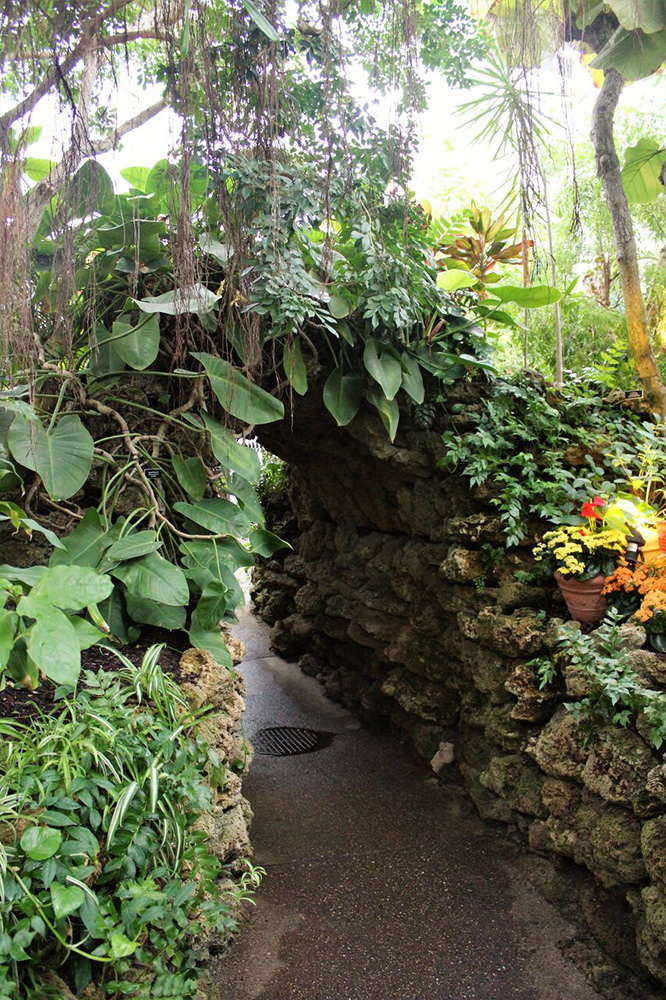
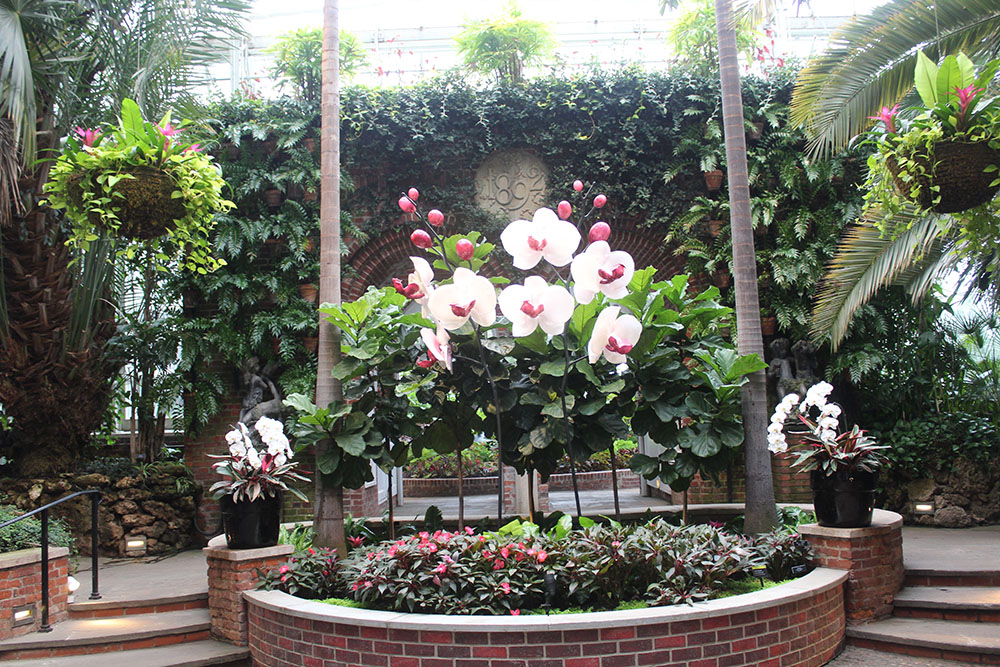
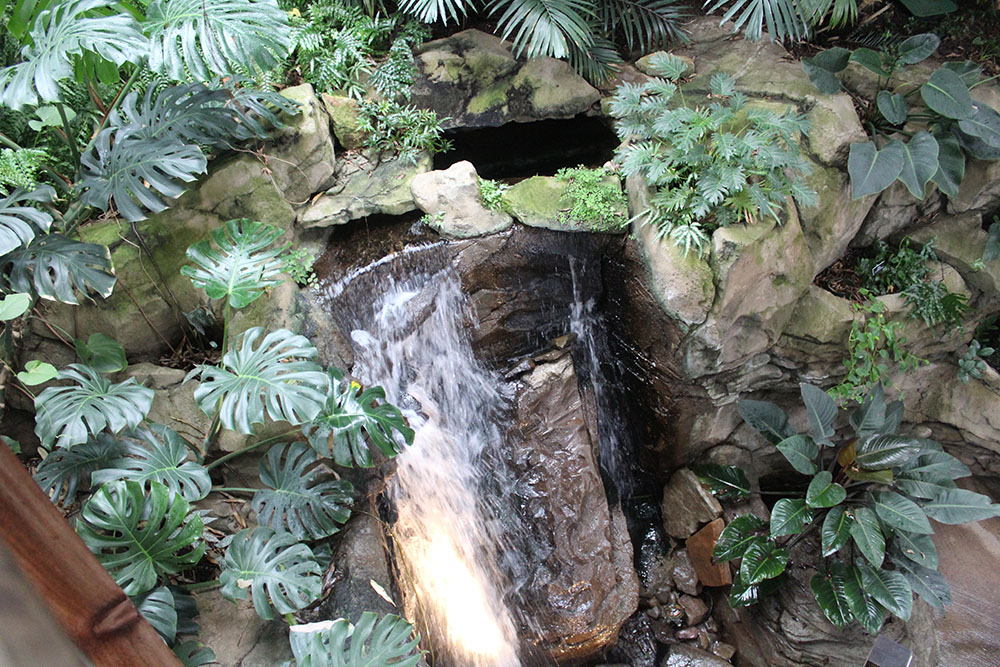
A stone tunnel covered in foliage and flowers at the Phipps Conservatory. Photo by Allyn Reynolds.
Phipps Conservatory
Location Information
Address: 1 Schenley Drive, Pittsburgh, PA 15213
Hours: Monday – Thursday 9:30AM – 5PM
Friday 9:30AM – 10PM
Saturday – Sunday 9:30AM – 5PM
Website: Visit website
Admission: $$
Adults $17.95
Children (2-18) $11.95
Free to college students with ID
Transportation: Car (parking provided), walking, or bike
Access: Handicap accessible
Phipps Conservatory and Botanical Gardens is located in Schenley Park toward the Oakland Neighborhood of Pittsburgh. Phipps Conservatory was founded by Henry Phipps in 1893 as a gift to the City of Pittsburgh. Phipps had made a fortune as an entrepreneur, and he believed that successful people should give back to the community. He wanted “to erect something that [would] prove to be a source of instruction as well as pleasure to the people”. After a year of construction, the Phipps Conservatory was open to the public with no admission fee. He knew that most working-class people lived in row houses which did not have room for gardens, and he believed they would appreciate the idea of seeing flowers.
Henry Phipps died in 1930, causing the conservatory to be neglected until 1935. It was almost closed. In order to remain open, every visitor was required to pay twenty-five cents. Phipps had never wanted to charge an admittance fee, but it became necessary in order to keep the building up and running. In 1937, a windstorm damaged the plant houses and forced the gardens to close for two years while it was repaired. The time was also used to make the Conservatory larger, and by the time it reopened, the greenhouses were one-third larger, and central garden pieces had been added for each room. It was after these renovations that it started to look like the Phipps of today. In 1989, the Conservatory started to offer tours to children from schools around Pittsburgh, enabling them to learn all about sustainability.
The Center for Sustainable Landscapes opened in 2006. Since then it has gained a LEED Platinum certification, passed the Living Building Challenge, and the Sustainable SITES Initiative for landscape design, effectively becoming the first building to simultaneously accomplish all three goals.