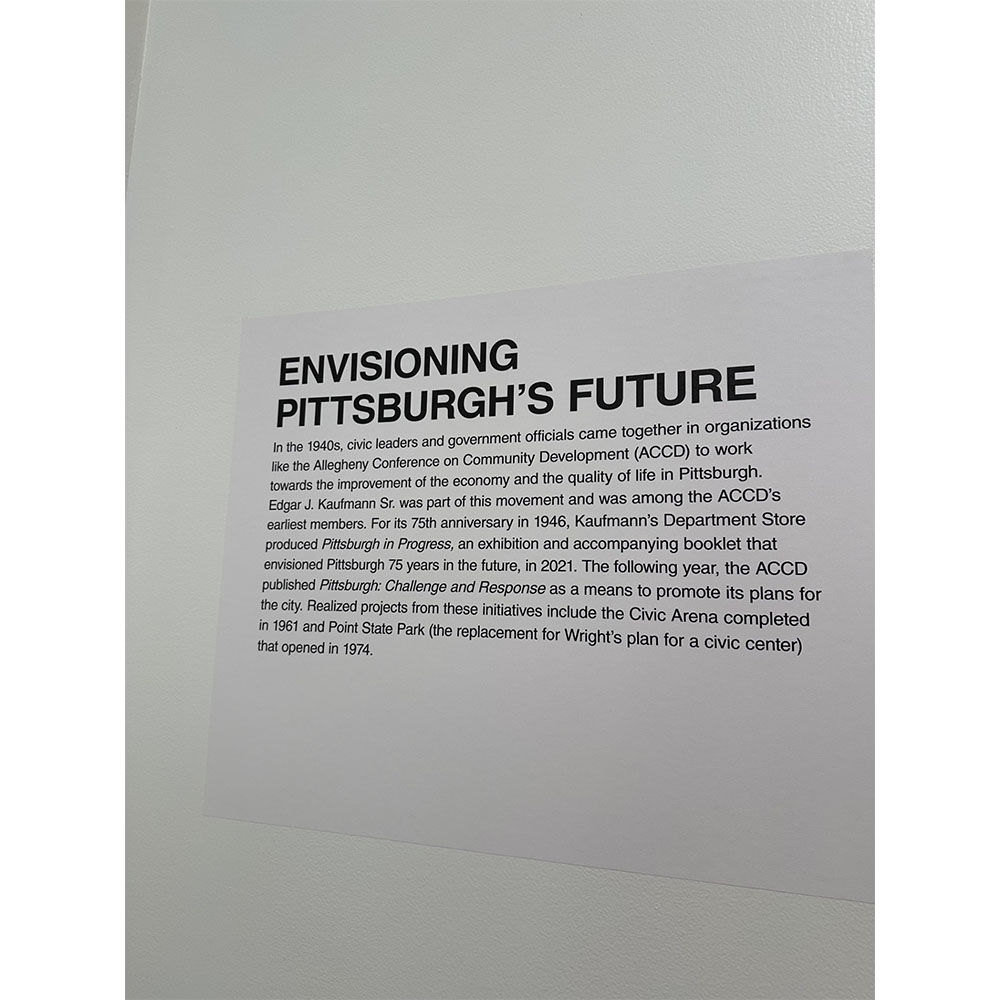
ACCD wall plaque, "Envisioning Pittsburgh's Future"
The Power of Revitalization
In 1947, a booklet on display at 820 Liberty Gallery states that “American cities grow old from the heart out. Pittsburgh has been no exception. Decay at its core has been pronounced” (Pittsburgh—Challenge and Response). You step back, stunned, as you read this. This idea wasn’t new to the twentieth century; in 1868, writer James Parton described Pittsburgh as “hell with the lid taken off,” something you noticed in an Andy Warhol Museum introductory panel. You fell in love with Pittsburgh the second you arrived at its lush green hills and saw a yellow bridge, and even deeper after noticing the unique buildings lining every street. It’s strange to think it wasn’t always so inviting.
Stretching from downtown Pittsburgh, through the Strip District and Bloomfield, and ending in Shadyside, Liberty Avenue has transformed since its conception in the mid-eighteenth century. At first, Liberty Avenue downtown housed breweries and food suppliers, then department and retail stores. The 1936 St. Patrick’s Day flood and the Great Depression led to the street’s deterioration.
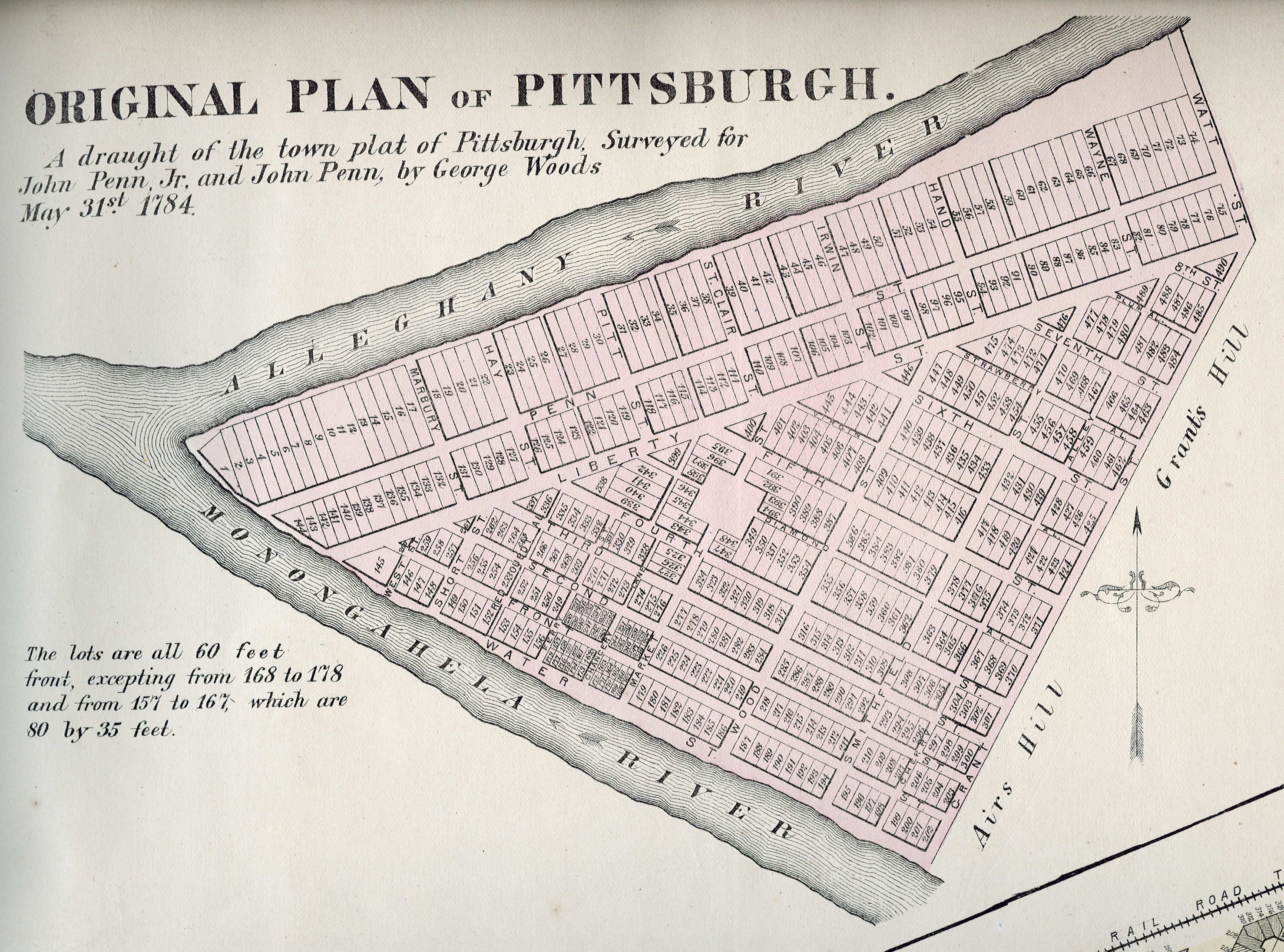
Pittsburgh’s first Renaissance took place in the mid-1940s, focusing on controlling the ever-present smog and revitalizing neighborhoods, ending with Three Rivers Stadium’s construction. The impacts of this renaissance were not always equal, however: black families in the Hill District and East Liberty were displaced to make room for the new cultural centers, their neighborhoods demolished. So, what changed downtown in the years following?
Adult movie theaters, strip clubs, and sex workers filled the streets of downtown Pittsburgh, a former red-light district. Additionally, the steel industry collapsed in the 1970s and 80s, leaving tens of thousands without jobs, and hundreds of thousands left the city entirely. Walking down Liberty Avenue today, however, you would never know.
In 1984, H. J. “Jack” Heinz II—the grandson of the successful Heinz company co-founder—founded the Pittsburgh Cultural Trust with an aim to transform the city into a must-see center for the arts. Jack Heinz used his estates’ money and philanthropic funds to save the city (King). Rather than displacing families, he began to buy underutilized buildings, renovating and converting them into cultural spaces. Restoring Stanley Theater became his first project, and he chose to keep the original chandeliers, marble, and wood.
He also renovated Heinz Hall, home to the Pittsburgh Symphony Orchestra. Originally Loew’s Penn Theater, the building closed in 1964 after struggling against competing theaters and raising maintenance costs. Heinz Hall, opened in 1971, keeps the basic architectural features of Loew’s, while adding a wing to the building’s rear. Heinz also restored Stanley Theater, now the Benedum Center.
He did not stop there, and he continued restoring structures into the theaters, galleries, public art displays, and performance spaces that now span fourteen blocks and one million square feet of Pittsburgh’s Downtown, forming the vibrant Cultural District we know today. Walk down Liberty and notice the distinct buildings: the Harris Theater’s alternating orange and purple brick and crenellated parapet, intricate red brick with flourishes and large windows, yellow brick with small arched windows, SPACE’s rich decorated eaves next door to the gallery. 820 Liberty Gallery itself formerly housed Pittsburgh Popcorn Company, and the four upper floors were vacant. Brown paint covered the brick, and windows were dark and dull. After real estate developers Harris Jones and Bill Krahe updated the space to align with their belief in reurbanizing Pittsburgh, the building begs to be entered from the street, transformed into a center for exhibiting Pittsburgh’s art and history (Tolliver).
820 Liberty Gallery and, by extension, Pittsburgh Cultural Trust, aims to bring the community together through local art and culture, enriching and revitalizing Pittsburgh’s unique place in history. The current exhibit (as of April 2026), “Frank Lloyd Wright’s Southwestern Pennsylvania: The Pittsburgh Projects,” takes this idea of radical transformation one step further, and asks: “What if Wright’s designs for Pittsburgh had been realized?”
On a Friday afternoon, Liberty Avenue is bustling with kids leaving school and adults getting off work. A crowd blocks the door to 820 Liberty Gallery; the building’s facade is entirely glass, so you peer inside, excited to get closer to the models and sketches you glimpse from outside. Upon entering, a sign advertising the art crawl occurring the final Friday of every month reveals itself.
Soft pink walls and calming, swelling music shout in their quietness, a contrast to the whirlwind of activity outside. The tip of Pittsburgh’s “Golden Triangle,” The Point, reminds you where and when you are. Walk around the corner, past white polylactic-acid-filament models and colored-pencil sketches, and you will see a long screen. Skyline Ink Animators + Illustrators curated a video bringing Wright’s unrealized visions of a radically different Pittsburgh skyline to life.
Sit for the rest of the video and stay through a whole additional cycle. In the animation, schemes for buildings like Point View Residences include moss and plants spilling out of terraces. Windows span entire walls, roads and buildings are well-lit: people live there.
You are aware of your place, humanity’s place, in the world. You, too, want to live in harmony with nature the way Wright imagined that it should be. You want art to follow you everywhere, be present in everything. Although his plans never came into fruition, Wright attempted to accomplish a sense of connection with his, and Heinz did accomplish this with his intense focus and passion for the arts. Today on Liberty Avenue, community members walk among art and nature; they smile, listen to music, soak in the sunshine. Even if Wright’s plans never came to be, the Trust has helped Pittsburgh become a beautiful city once again. You’re proud every day to call it your new home.
Works Cited
Allegheny Conference on Community Development. Pittsburgh—Challenge and Response. “Frank Lloyd Wright’s Southwestern Pennsylvania: The Pittsburgh Projects” exhibition (1947), 820 Liberty Gallery, Pittsburgh, PA.
Hopkins, G.M. & Woods, George. “Original plan of Pittsburgh. A draught of the town plat of Pittsburgh. Surveyed for John Penn, Jr. and John Penn by George Woods, May 31st 1784. Third ward, Pittsburgh., Pittsburgh.” David Rumsey Map Collection (1872). https://www.mapsofpa.com/pitts/1784fromhopkins.jpg.
King, Maxwell. “How Culture Saved the Steel City.” Western Pennsylvania History: 1918-2023 (2020): 22-31.
“Pittsburgh Cultural Trust Background and History.” The Pittsburgh Cultural Trust, trustarts.org/pct_home/about/history.
“Pittsburgh’s Liberty Avenue.” Pittsburgh Post-Gazette (2013). https://newsinteractive.post-gazette.com/thedigs/2013/05/01/pittsburghs-liberty-avenue/.
Pittsburgh Symphony Orchestra. “History of Heinz Hall.” Pittsburgh Symphony Orchestra (2025). https://www.pittsburghsymphony.org/pso_home/web/about-landing/history/history-of-heinz-hall.
Tolliver, Sandra. “820 Liberty Avenue went from yow to wow creating four large lofts in an extensive renovation.” NEXT Pittsburgh (2019). https://nextpittsburgh.com/city-design/820-liberty-avenue-went-from-yow-to-wow-creating-four-large-lofts-in-an-extensive-renovation/
Visit Pittsburgh. “Public Art in Pittsburgh.” Visit Pittsburgh (2026). https://www.visitpittsburgh.com/blog/public-art-in-pittsburgh/