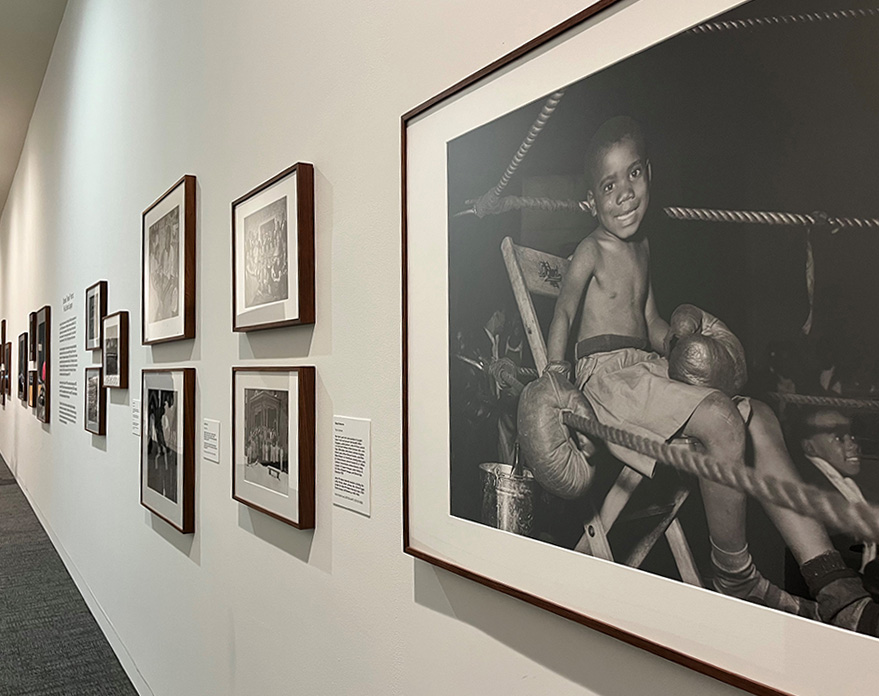
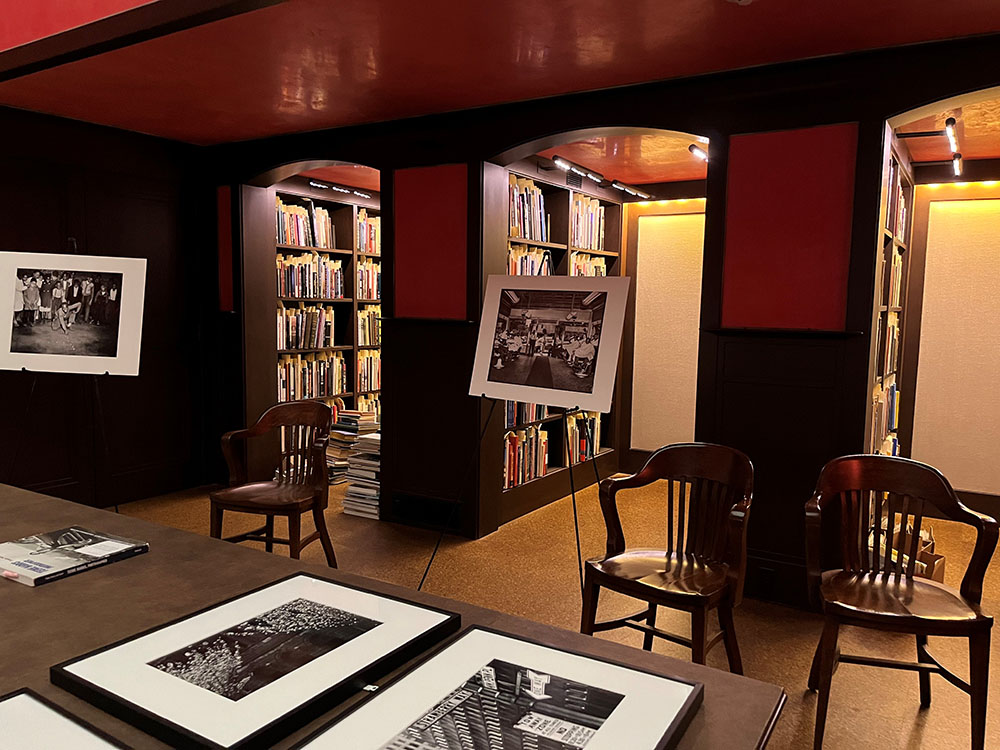
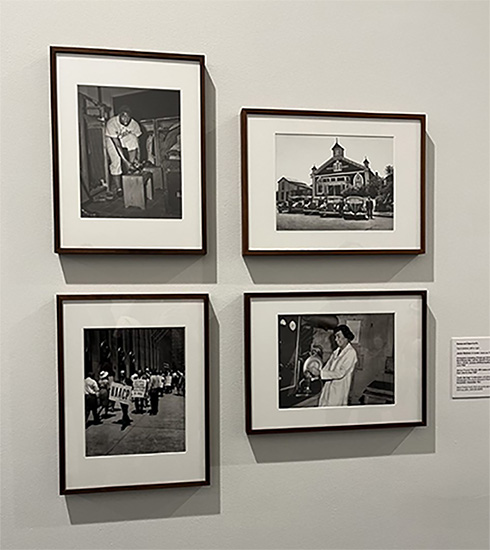
Teenie Harris gallery in theater hallway, photo by Lauren Testa
A Talk with Charlene
I’m walking through a museum, the white walls displaying large prints, the voices of other patrons bouncing off them. The works I see I appreciate for their beauty and their artistry, but I feel a sense of frustration only being able to take these pieces at face value. I enjoy the pieces, but I can’t ignore the flicker of disappointment I feel in realizing that I know nothing about them – how they were created, the people involved, their backstory, and their meaning. Not only that, but the reality that we often don’t get the opportunity to have these questions answered allows this feeling to linger even after my visit has ended.
Many of us have had this experience, feeling that the work around you has so much to offer and that you are missing something because you don’t know where to go to learn more. These feelings are why it’s so enlightening to be able to sit down and talk with someone that not only knows the work but is passionate enough about it to take the time to tell its story. This is exactly how I would describe my meeting with Charlene Foggie-Barnett, the community archivist for the Charles “Teenie” Harris collection at the Carnegie Museum of Art. The following represents our conversation and has been edited for length and clarity.
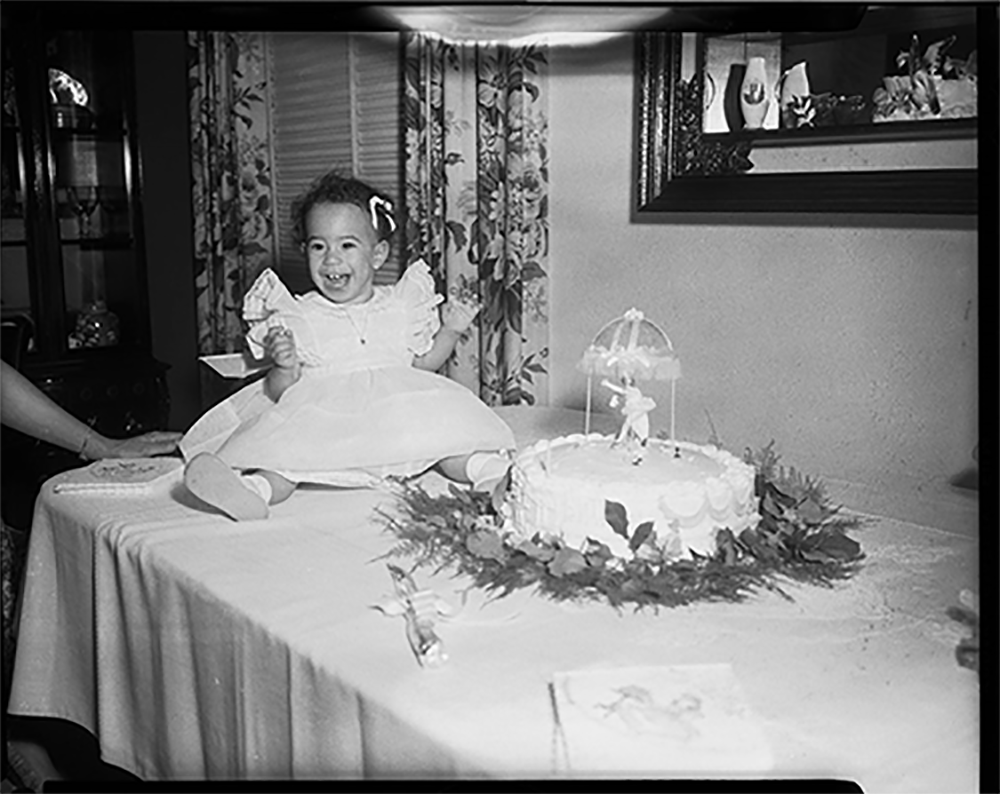
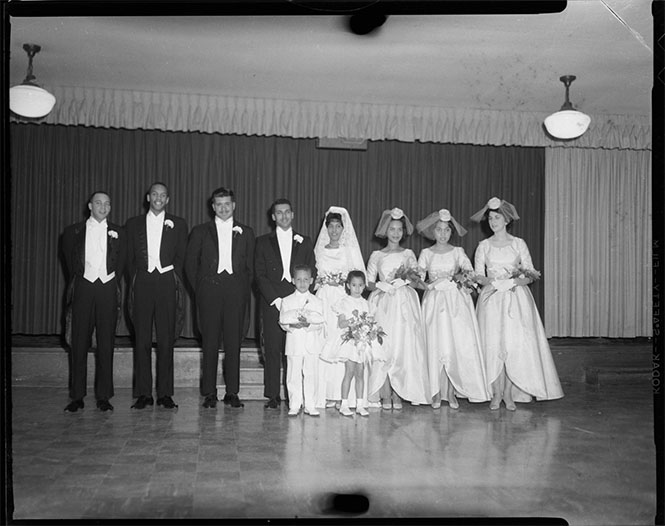
Charlene is a Pittsburgh native and grew up in the Hill District where Teenie did much of his work. Not only is she an expert on Teenie’s photos, but she could also be considered an expert on Teenie as a person, having grown up around him and considering him a dear friend. He was there to capture photos from her baptism, birthdays, and family events throughout her childhood and into adulthood, several of which have been displayed in the museum. Her parents had a close relationship with Teenie, her mother had grown up with him and her father had been photographed on many occasions throughout his career as a Protestant bishop and his role as a Civil Rights leader in Pittsburgh.
When she was eighteen, Charlene moved to Los Angeles to pursue a career in theater. She lived there for many years before she returned home to find the Carnegie Museum of Art looking for children that had been photographed by Teenie Harris. When she saw this in the paper, she recalled being surprised, “I thought that’s the oddest thing in the world! What does the museum want to know about Teenie Harris for?” Her interest piqued, she decided to go. She remembers taking family pictures, taken by Teenie, off her walls at home and bringing them into the museum, thinking that there were going to be many people there. To her surprise, she was the only one that showed up.
The museum was putting together a retrospective of Teenie’s work and was trying to gather oral histories to learn more about the pictures in his archive- who these people were, what was going on behind the scenes. They were also gathering these histories so that in years to come when people went online, they would be able to click on a photo and hear about its history from those that had actually lived it.
When Charlene got to talking with the curators of the Teenie Harris archive, she found that the museum had been having a hard time getting the African American community to come in and tell their stories, which she could understand. She agreed to come down and talk with them but went into this project hesitantly, unsure why the museum had the archive, what they were going to do with it, and how they were going to use it. The museum had not initially understood the black community’s mistrust, because generally, people are clamoring to be involved in something as public as this project. She reports that due to how their information has been utilized in the past, the Black community is very protective of it, especially considering the personal nature of these photos.
When Charlene met with the curators of Teenie’s archive, she says she was incredibly impressed with how they were handling it. “I have to say that the people who were handling this work, the archivist and the curator, were amazing. They fell in love with Teenie, they researched their buns off, they worked very hard. They really came to care about the Harris family, about people they met in the interview process, and about what was going to be done with this information. That’s another reason why I agreed to work with them, because I respected what they were doing”.
When she realized how important this project could be and the care the museum was taking with it, she started bringing more people in to share their stories. Many of them were willing to help, they just didn’t want to say the wrong thing or support this work if it was going to turn out to be a bad thing. They were willing to share their stories, but many of them wanted Charlene to be there with them while they did it. She remembers having a luncheon so that more people in the community could come and share their stories in a relaxed setting, “I had about 6 or 7 women come and that was a great idea…but also a disaster because they all talked over each other, they were so excited”.
She worked closely with the museum for the remainder of this project and ended up getting a position there as a community archivist. Though the retrospective has long since passed, there is still work to be done with Teenie’s archive of over 70,000 photos. Charlene continues to act as a community liaison and archivist and believes that her work with this archive and the community has softened some of their concerns about getting involved and has helped to promote a greater appreciation of Teenie and his work.
There are still people today who come into the museum and see their own faces staring back at them in the collection, and if not their face, then that of their friend, sibling, parent. This is one of Charlene’s favorite parts of her role, sharing in their joy when they see their pasts presented to them. She often travels around the community with photos from the archive to share with schools and nursing homes or to hang in important buildings. Charlene says that when she visits nursing homes, she can see how comforted the people are seeing these photos that remind them of their pasts, that even people that had been noncommunicative come up and engage with Teenie’s work. Having worked in this kind of setting myself, I know how difficult it can be to engage people like this, and how important it is to foster this. Getting the chance to connect with others through Teenie and his work and to continue to share it in new ways is part of the incredibly important and rewarding responsibilities of the community liaison. When asked if she could have imagined herself working in this position, she immediately replied, “Heck no!” before lovingly describing her role as “a privilege, an honor, and a responsibility that I take seriously, but with a lot of joy.”
When asked how she thinks Teenie would feel about what has become of his photos if he were alive today, Charlene smiled, saying that she thinks he would be very proud. She thinks he would be stunned at how much his work has been used, not only his photojournalism but his more artistic work as well. Working with this archive has given her a greater appreciation for the artistry of his photos. “His perspective of why he was doing this was almost innocent, he wasn’t trying to become an artist, wasn’t trying to become a star, he was just working. He knew how to look around and catch something in process that makes you feel like you’re there”.
Now, at least when I walk through the Teenie Harris gallery, I won’t have that same feeling of frustration. Although there’s no way to truly know everything about his work, I feel a lot closer to Teenie’s archive than ever before. It’s people like Charlene that help to keep his work and stories alive, and I have great respect for all that she has been able to accomplish. It is through talks with people like her that help you not only feel more connected to the art around you, but to the community as well. This experience also taught me that it may not always be as hard as it seems to engage with art. Even if you don’t have access to an expert as I did, there is almost always information to be found and conversations to be had.
References
Testa, L., & Foggie-Barnett, C. (2023, April 4). A Talk with Charlene. Personal.