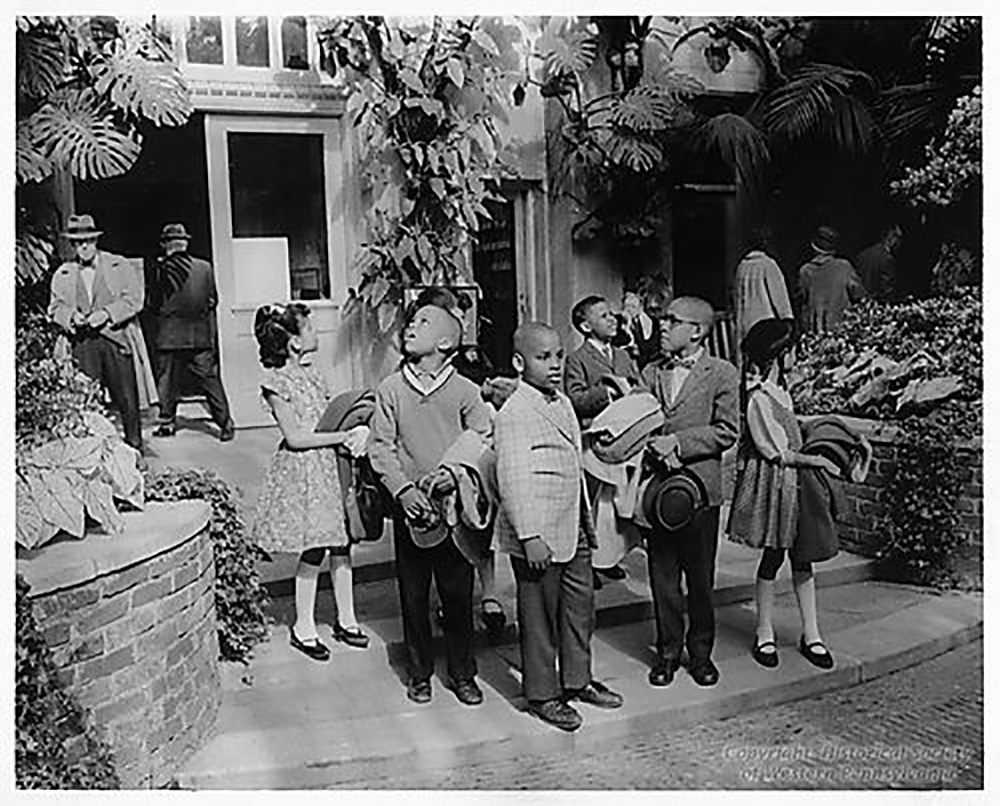
Pictured is a group of school children at Phipps Conservatory. They are dressed quite nice, as are all the other quests. They are standing and looking around the conservatory. They are at a doorway surrounded by monstera plants. Photo taken by Lou Malkin ca. 1949/1969.
Using the Archives to Contextualize a Site’s History
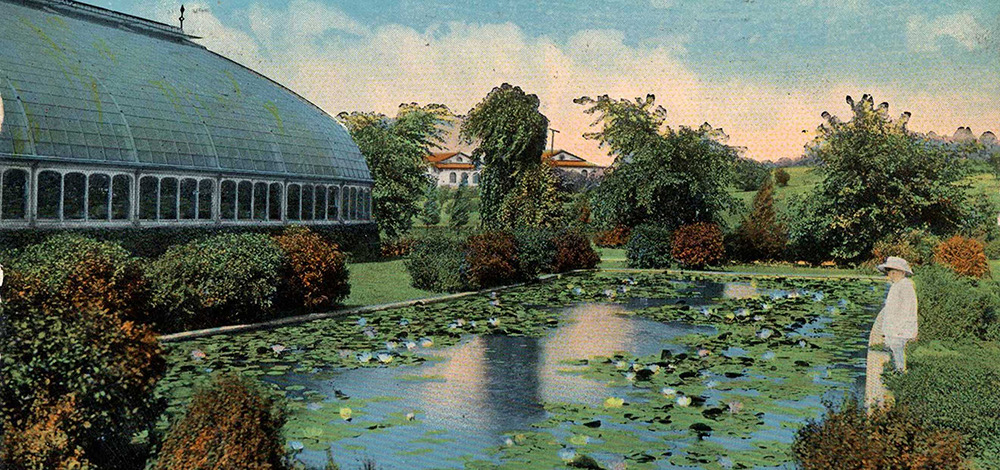
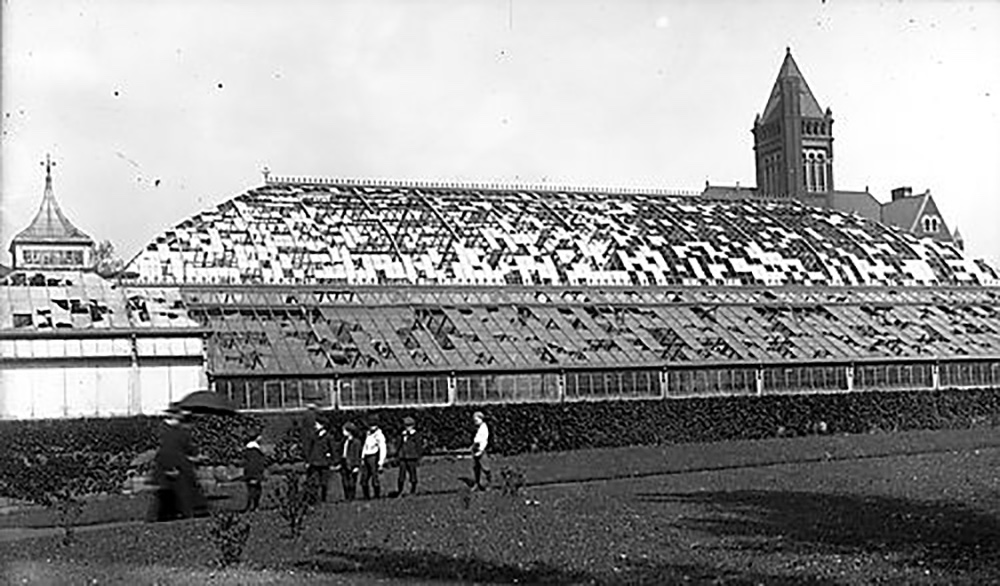
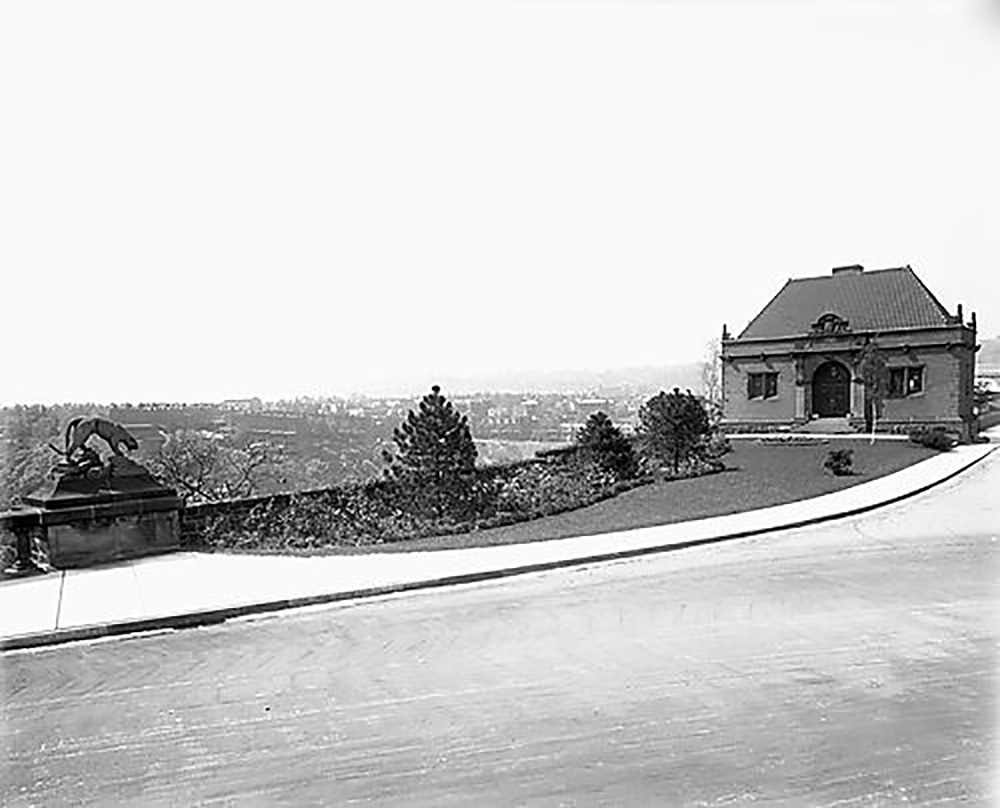
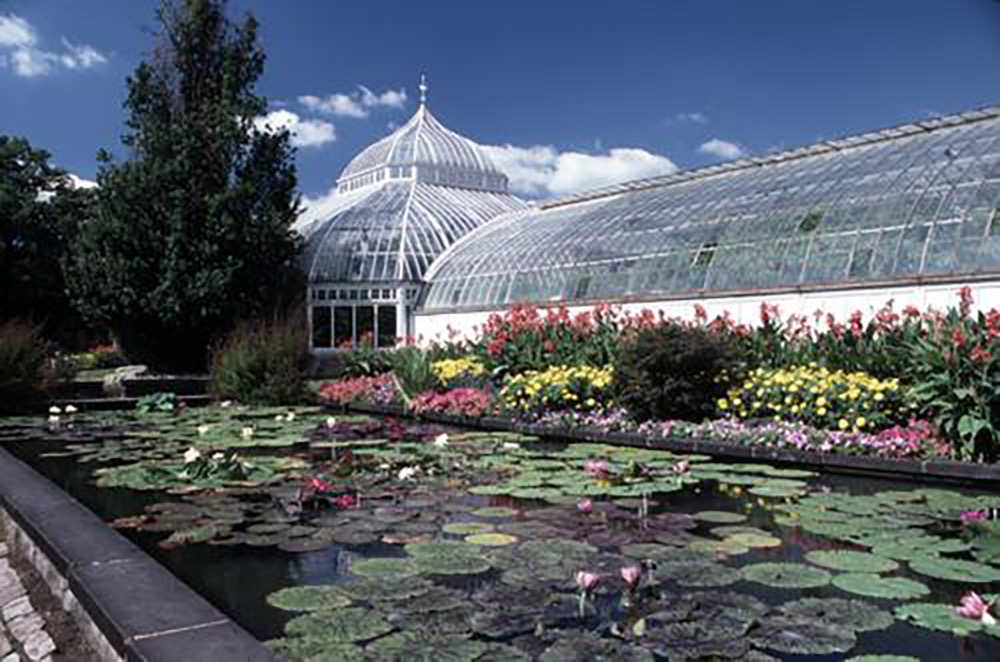
One way to use this the Historic Pittsburgh archives is to research the history of certain sites. One of my favorite places within Pittsburgh is Phipps Conservatory. If you’ve never been, Phipps is a plant conservatory that contains a wide variety of plants from many different climates. They are tended to by experts and the plants are given an informational plaque to describe what they are. Rooms are divided by theme e.g. Bonsai room, tropical room, etc. Seeing this site in present day is enjoyable enough, but the archives can be used to gain a better understanding of the site. Phipps conservatory originated as a donation by philanthropist Henry W. Phipps. If you look at figure 1, this is one of the first pieces of archival data on Phipps Conservatory available through the historic Pittsburgh website. In the attached photo, the conservatory is still under construction, and you may notice, looks rather different from how the conservatory currently looks today. That’s because Phipps Conservatory started out in the North Side in Alleghany Park, not Schenley Park where it currently resides. This photo is dated to 1890-1910 via the archives, but according to the Phipps Conservatory website, construction of the site was completed in 1893, thus limiting the timeframe to when this photo might have been taken. In the photo of its construction, note that it is essentially a large greenhouse. Henry W. Phipps commissioned this from Lord & Burnham, a greenhouse manufacturer in New York. Shortly after the creation of Phipps Conservatory in 1893, in 1901 Henry Phipps commissioned the Botany Hall as an addition to Phipps Conservatory. Referencing figure 2, Phipps Hall of Botany is pictured. Interestingly, the location of this site is not North Side, but rather Schenley Park, and located where Phipps Conservatory would later be moved to. In the 1910’s Phipps Conservatory built the Aquatic Gardens. As can be seen in figure 3, the aquatic gardens are located on the outer portion of the conservatory and have a wide variety of plant life inside of it. In figure 3, there are water lilies and lily pads. The photo was taken in 1986, a little over 70 years after the pond was built. While I was unable to find an archival photo of the Aquatic Pond shortly after its creation, there is a vintage postcard of the pond available through the Phipps Conservatory website, linked as figure 4. Noting the similarities of the two photos, it appears that the pond has retained its beauty and thriving aquatic botanical ecosystem through the years. What has changed is the addition of a wall of flora against Phipps Conservatory itself that is present in the photo taken in 1986, bnut not in the vintage postcard. Phipps has also been used as a source of educational materials throughout the years. As seen in figure 5, a group of school children from Pittsburgh public elementary school are going on a tour. The conservatory itself is a source of valuable botanical information, in addition to the Hall of Botany mentioned earlier which functions as an educational tool as well.
Above, I walked through some of early archival data I was able to find about a site that means a lot to me. Knowing the history and seeing the passage of time through direct sources can add to the experience of a site and I strongly encourage the use of the archives to better understand spaces that you enjoy and visit on a regular basis. Something that I find particularly helpful when doing archival research that may assist you as well is reading up on the history of the site and matching the archival sources with those years. When performing archival research, starting off on the online Historic Pittsburgh site is a great way to start. While not exhaustive, the information online can give clues on what the archives have available. You may get lucky and find exactly what you need, but if not reaching out to the archivists is a great way to get what you need. They can compile files and sources that you can go and see at the archive’s physical location. When I went to visit the archives, I was informed that only about 5% of the archives are digitized. This is due to lack of resources and prioritization of data based on grant money and prestige of the owner of the archival material. Thus, chances are if you can’t find something online, they’ll have it in person. On a final note, a tip from Mr. Grinnell, an archivist at the Historic Pittsburgh Archives, when utilizing the online repository, using the filter tool can greatly refine the results when searching. When I was researching Phipps, I made sure to filter based on date to try and find documents that matched up with time periods I was discussing, as well as filtering by key words, such as “Aquatic Gardens” when I wanted a source specifically for that architectural addition. With the above tips and information, I hope you can use the archives to better understand the history of certain sites, and I hope this furthers your appreciation for a site like it did for mine for Phipps Conservatory.
Works Cited
Archives for All: The Importance of Archives … – My.tlu.edu. my.tlu.edu/ICS/icsfs/JimersonArchivesForAll18pg.pdf?target=0df0c395-ce3e-4678-9ade-19fb68245749.
Levinson, Joel B. “Phipps Water Lilies.” Request Rejected, 1986, historicpittsburgh.org/islandora/object/pitt%3A201501.03.033.7.
Malkin, Lou. Request Rejected, 1949, historicpittsburgh.org/islandora/object/pitt%3AMSP117.B015.F05.I02.
“Phipps Conservatory.” Request Rejected, Alleghany Observatory, 1890, historicpittsburgh.org/islandora/object/pitt%3A6422.14.18.AO.
Phipps Hall of Botany. Pittsburgh (Pa.). City Photographer, 7 Sept. 1910, historicpittsburgh.org/islandora/object/pitt%3A715.107799.CP.
“University of Pittsburgh Library System.” Doing Research in Archives & Special Collections | University of Pittsburgh Library System, www.library.pitt.edu/asc-doing-research.
Visit and Explore | Phipps Conservatory and Botanical … www.phipps.conservatory.org/visit-and-explore.