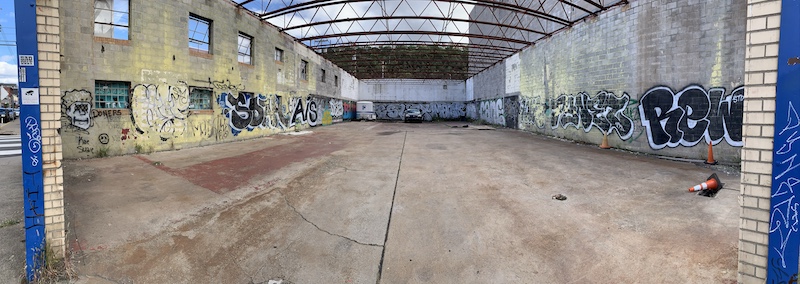
Graffiti empty building on main street of strip. Photo by: Athena Tolentino, 2019
Sensing the Way Through the Strip District
When people go on outings, people usually plan ahead how to get there, where they are going, why they are going, how long they are going, and basically going into a new place with a sense of familiarity. This has come from new technology such as cell phones and the internet that make it possible to “know” a place before being in the space. From this, the art of flânerie has been in a sense lost. People do not just go out without a plan and just take in the environment and space in the moment. A flaneur is a person that goes to a place, simply has no plan and has no certain direction to be moving towards and takes in the place using their own senses. In an interview with Ricarda Messner, Founder and Publisher of “Flaneur” Magazine in which each issue is about a different street, she says that there is a “thin line between illusion or literature and facts” in reference of how a place is based off of someone’s experience of it. As a flaneur, they retell their experience based off their perspectives of it so there are multiple truths of the same space.
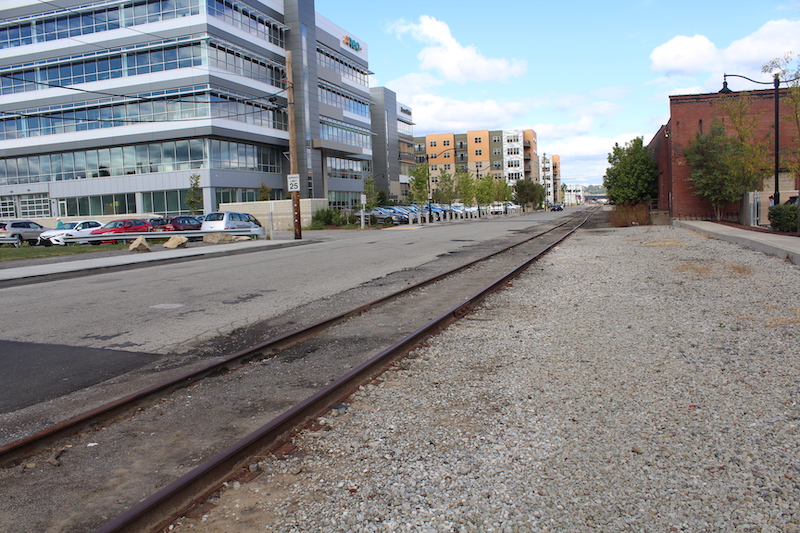
My experience of the Strip District will be different depending on multiple factors. I was with my site partner visiting on a Friday afternoon with a limited amount of time and a meeting place at the designated time. The Strip District has different vibes depending at the time and day you go. It is most crowded on the weekends when there are families and visitors from farther away coming to visit. As for the time crunch it only affected the pace of the walk through the neighboring residential area and the main street itself. Then the meeting place only affected us in the final minutes of our allotted time when meeting to leave became crucial. Our visit was not one of shopping and typical family bonding at unique restaurants and only scratched the surface of that side of the Strip District. Our time was spent in the residential area close to the train tracks on Railroad Street, a street over or two over on Mulberry Way and Smallman Street, then ending by walking down the main street, Penn Ave.
In the beginning instead of following the rest of groups down Penn Ave, we continued towards the residential area, where we saw people walking their dogs. We found The Dog Stop which offers a variety of services for canines. The building itself seemed, like many others in the Strip, to be an old mill or factory building. It was painted a bright red and orange with big block letters listing the services that they offered. It stood out against the surrounding brick buildings, I remember admiring the bright colors, I could hear the sounds of construction and machinery occurring further down the road, the sun was behind the building giving the shop a darkened look in the shadow.
In our class, we learned about Trialectics of Being and Spatiality by Edward Soja. In the Trialectics of Being, the theory is that we are “historical-social-spatial beings, actively participating individually and collectively.” (Soja 73). In this way, we have our past, society around us, and the environment that make us what we are as human beings. Then within the Tralectic of Being, spatial breaks up into its own Trialectic of Spatiality, it is like three objects are circling each other making one cycle and then one of the objects have their own circling of three smaller objects making the one piece of the larger circle. Trialectic of Spatiality is made up of perceived space, lived space, and conceived space. Perceived space is traditional reality, lived space is how we use space and how it affects us in a mix of real and made up, and conceived space is imaginary space that is made up and varies with each person. With this in mind, I experienced The Dog Stop as something that stood out because of the ominous lighting of the moment, in contrast with the bright colors that was painted on the old building that used to be a factory. It’s not something that is seen every day and gave me a slight feeling of discomfort with the juxtaposition, but it was intriguing. In this way, this space could be taken in differently to the customers who bring their beloved dogs there or to passersby at different times of the day or in different seasons.
Continuing further into the residential, everything was calm. The sun would peak through the buildings and no one was around. Very few cars would pass drive down the road and all of them were sleek and modern. The wind would blow slightly down alleys and can be heard as you walk through the neighborhood. It felt like time was pausing in a way, with the only thing moving was us seeing apartment buildings and modern architecture. It was interesting to see the shift to modern after passing a few old mills and factories. In that way it was like looking into the future because you could look down toward Penn Ave and see the past with bold colors from murals and then look towards Railroad Street and see modern office buildings and pristine residences with little to no murals in comparison.
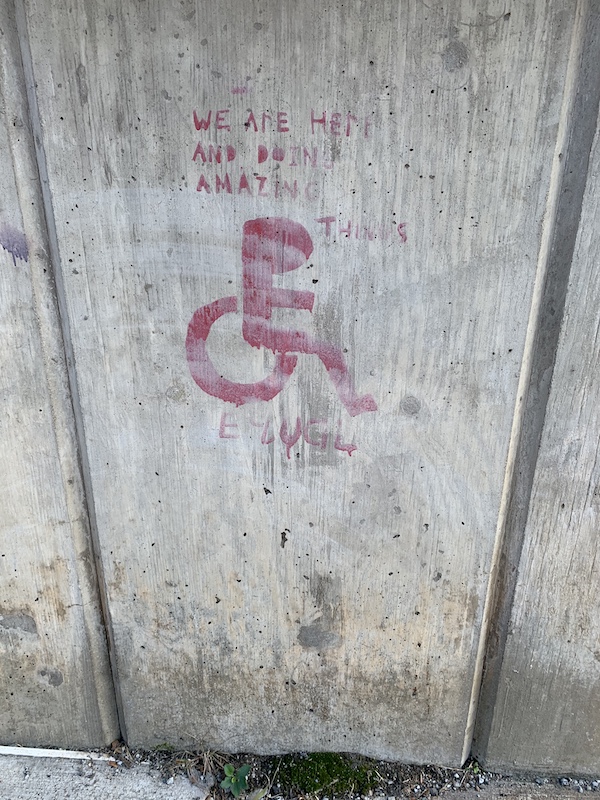
Heading towards Penn Ave, we walked through Mulberry Way and Smallman Street which is the behind the scenes of the main shops and markets that are located on Penn Ave. There was a shift towards the industrial feel of the buildings. The buildings were more worn, graffiti was everywhere you looked with ivy covering full walls of buildings. The graffiti was vast, colorful, and either was protesting something, making fun of a sign, or were indiscernible. Very few people were around except some of the workers who were taking a break or throwing garbage out. In “Walking in the City”, Michel de Certeau made an analyzation of the urban space of New York City. Certeau made said that “New York has never learned the art of growing old by playing on all its pasts.” (Certeau 91). In that regard, the Strip District has learned to balance the modern and its pasts. In the way that New York is constantly inventing itself, so is the Strip District. The old buildings and history remain, nature returns, colorful murals and graffiti appear, the markets and restaurants change, the residents around are modernizing. The Strip is a hybridization of honoring the past and moving toward the future.
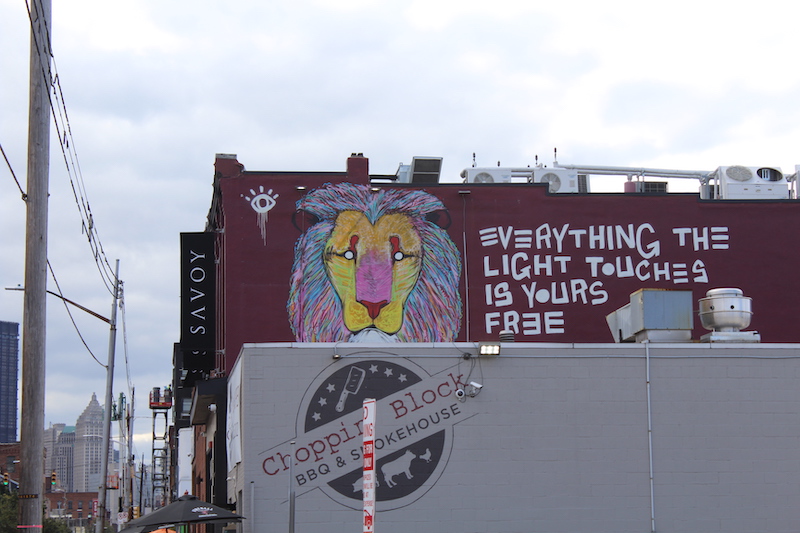
The shops on Penn Ave are the ultimate sign of modernization. There are several markets of different specialties. There is the Fish Market, WFH Oriental Food Market, Reyna Foods, Pennsylvania Macaroni Co., and several delis. These specialties are spanning several cultures all on one street and in historical industrial buildings. If the diversity of shops was not enough, there are also several bold, striking murals that are scattered around. They transform the intimidating buildings to be more inviting through art transforming space. These large industrial buildings used to be imposing and neutral in color. Now they are painted with meaningful images that represent the space and giving the Strip a more open feeling instead of intimidating. Walking down the streets, you can hear the traffic, the music each shop is playing, people talking and enjoying the different shops. You can feel the excitement of shoppers, feel the warm sun, the slight wind, and the busyness of all the vendors. You can smell the different spices, fresh produce, cheeses, and the occasional smell of cotton from the Pittsburgh paraphernalia that line the sidewalks. You can see different cultural clothing, bold colors, graffiti both murals and vandalism, there are several abandoned buildings, you can see trash littered, and writings written in dust on the windows of abandoned buildings, and then you can see the old large factories that that are now inhabited by modernized shops and restaurants.
The overall experience of the Strip District was calm during our visit. It was not during a busy time with a lot of shoppers and a lot of foot traffic. We were able to focus on the little details like the ivy covering buildings, the graffiti that were a street over from Penn Ave, the way the building would be perceived, and just the little nuances that make the Strip District a place that people come from all over to visit.
Works Cited
Certeau, Michel de. The Practice of Everyday Life. University of California Press, 1988.
“A Flaneur in Montréal. Interview with Ricarda Messner, Founder & Publisher of Flaneur Magazine.” Youtube, 2 Dec. 2013, www.youtube.com/watch?v=UZdJzCWWvmY.
“A Shopping and Eating Guide to Pittsburgh’s Strip District.” Discover the Burgh, 5 Dec. 2019, www.discovertheburgh.com/strip-district-guide/.