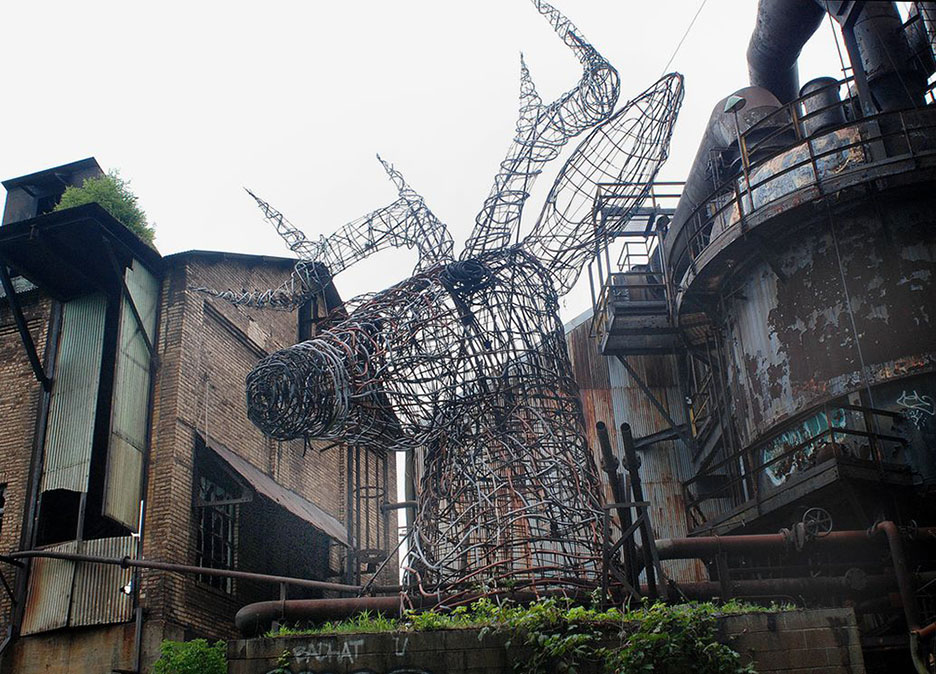
Carrie Deer sculpture (Photograph by Larry Roberts)
Revitalization of the Carrie Blast Furnaces: The Carrie Deer and Graffiti
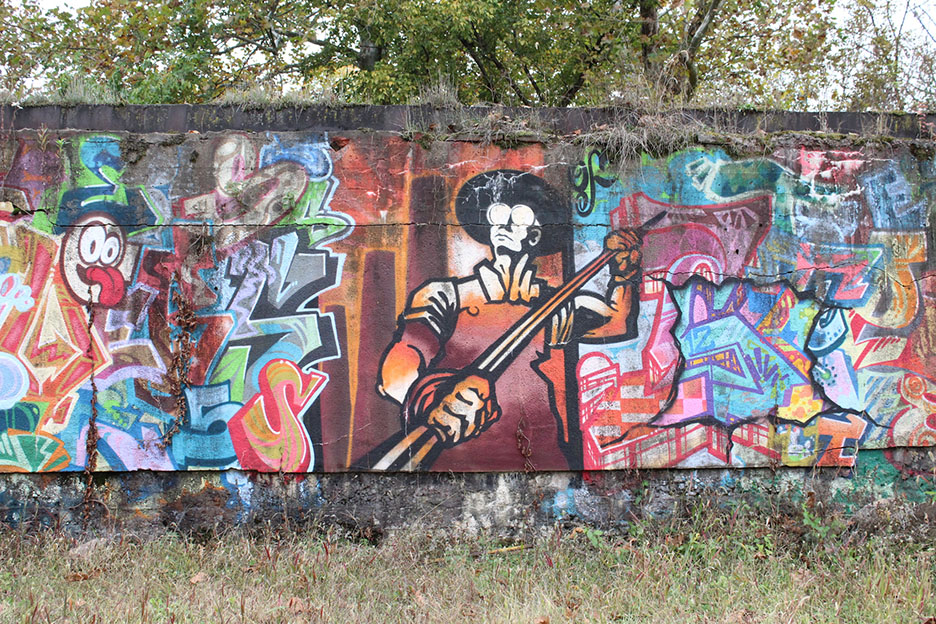
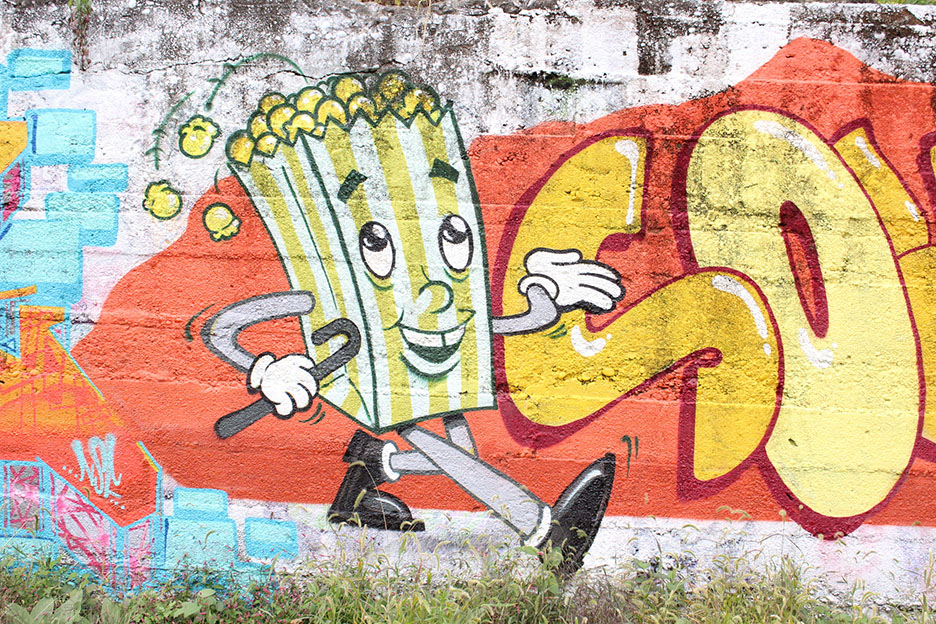
As I walked in the shadow of the decrepit, abandoned blast furnaces, I noticed a color-splashed wall. It was covered in graffiti ranging from animated popcorn buckets to steelworkers. Later during the tour, I glanced up and noticed a massive deer head rising above a decaying building. This wasn’t just a dead, abandoned industrial site; it was a resurrected, thriving canvas.
The Carrie Blast Furnaces were operational from 1884 through 1982. U.S. Steel retained the property until 1988, when it was sold to Park Corporation. However, the site remained undeveloped, and Carrie Blast Furnaces #6 and #7 remained standing. Urban explorers, photographers, looters, and graffiti artists visited the site from the late 1980s through the early 2000s: “Driven by a reverence for the regions’ industrial roots and a strong sense of local identity, these street artists recognized unique opportunities for creative self-expression and cultural production amidst the abandoned factories,” ( “Urban Arts Workshops”). The Carrie Deer, a large metal sculpture, and a significant amount of graffiti have been preserved by Rivers of Steel and have been a significant component of the non-profit organization’s revitalization efforts (Henderson).
The Industrial Arts Co-op (IAC) was a group of seven Pittsburgh artists: George Davis, Liz Hammond, Tim Kaulen, John Latell, Joe Small, Tim Yohman, and Bob Ziller. They created an owl sculpture that was hung in the Blowing Engine House in 1994. As the site became more popular for parties, rumors began that satanic worship was occurring. One night, a nearby resident in Swissvale called the police, and one officer shot a person in the back of the leg with a shotgun. As a result of this incident, the owl was removed, but the IAC felt partially responsible for attracting people to the site with their sculpture. After the site was abandoned, natural elements began to return to the industrial site. The IAC was inspired by herds of deer they observed and created the sculpture as a symbol of the site’s natural revival. They returned to the site each Sunday during 1997 to construct a 40’ tall wire-deer sculpture. It was constructed using only materials found on site with pliers and linesman’s shears. When Rivers of Steel acquired the site, they chose not to remove the sculpture, and it inspired the non-profit organization to use the site for other non-historical projects, such as preserving and promoting graffiti (Henderson).
Graffiti comes from the Italian word graffare, meaning to scratch (Denotto). The present-day graffiti style began in New York City in the late 1970s with significant influences from the Beat generation and artists such as Andy Warhol and Roy Lichtenstein (Denotto). However, writing upon walls, also known as parietal writing, is as old as human culture and is a product of the primal human instinct to artistically alter the material environment (Schacter and Fekner). Schacter and Fekner describe the global context of graffiti: “As quite possibly the most common popular art form in existence today, this aesthetic practice has taken numerous different physical forms…absorbed variant influences…occurred in multifarious environments…and been produced by disparate individuals.” Depending on these complex societal factors, some graffiti is immediately destroyed while other graffiti is reverently protected. Graffiti artists also face a variety of public reactions from imprisonment to adoration (Schacter and Fekner). There is appreciation for graffiti in many U.S. cities, and many of them allow legalized graffiti in designated areas (Donohue and Russell). However, Pittsburgh has nearly no designated areas for graffiti artists to showcase their talents (Donohue and Russell). Furthermore, the mayor even re-instated an “anti-graffiti task force” in 2014 (Donohue and Russel).
When Rivers of Steel acquired the site, a significant amount of the site was adorned with graffiti. The graffiti on the furnaces and inside the blowing engine house was scrubbed by Rivers of Steel, and some movie and TV crews also scrubbed some additional graffiti for their purposes. From 2006-2012, multiple trespassing incidents would occur weekly as graffiti artists continued to add to the site. Rivers of Steel continually had to scrub the newly added graffiti while trying to scare or prosecute trespassing artists.
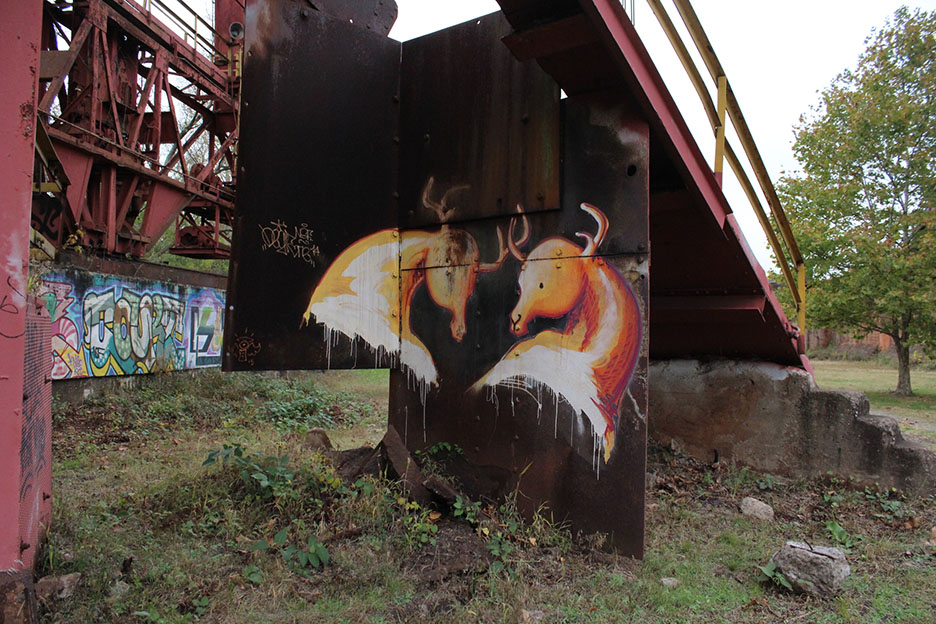
Shane Pilster is a graphic and web designer and also creates murals in Pittsburgh (Donohue and Russell). He started painting graffiti in high school and was one of the trespassing artists at the Carrie Blast Furnaces (Donohue and Russell). He attended a public tour of the Carrie Blast Furnaces in 2012. After asking several questions about the graffiti that his tour guide could not answer, the tour guide connected him with Ronald Baraff, the Director of Historic Resources and Facilities. Shane revealed his identity and offered to act as a liaison between Rivers of Steel and the graffiti community in Pittsburgh. He described his motivation: “My initial goal was to create a sanctioned permission area for people to be able to let loose and to showcase their skills. There was already a developing arts culture there to discuss the post-industrial story of the site, and graffiti was a part of that story,” (Donohue and Russell). Rivers of Steel identified locations that were “non-contributing structures” to the landmark designation and artists interested in adding graffiti to the site would contact Shane. If Shane approved an artist, they would be provided with a specific location and time to paint. The program was very successful in reducing the number of trespassing artists and attracting renowned local, national, and international graffiti artists. Some artists from Mexico have painted pieces as part of a program called Hemispheric Conversations: Urban Art Program. Graffiti created by Shane and other local artists will eventually be painted over, but graffiti by national and international artists will have their work preserved indefinitely (Henderson).
Shane offers urban art tours and workshops at the Carrie Blast Furnaces (Henderson). These programs allow the public to appreciate the impressive graffiti collection and draw inspiration from the graffiti artists who contributed to the collection (“Urban Art Workshops”). During the workshops, master urban artists provide an introduction to style-writing, typography, traditional sign-painting techniques, and painting with aerosol (“Urban Art Workshops”). They also promote the value and legality of graffiti (“Urban Arts Workshops”). In addition to the programs at the Carrie Blast Furnace site, Shane also leads school and community group programs about murals and community art (Henderson). In addition to promoting graffiti at the Carrie Blast Furnaces, Shane has established partnerships with the South Side Community Council and the Borough of Wilkinsburg (Donohue and Russell). “My goal is to establish several places to allow artists to get as creative as possible, and to get artists paid for their work whenever permitted,” Pilster said (Donohue and Russell).
The Carrie Deer and the vast amount of graffiti at the Carrie Blast Furnaces contribute to the site’s past, present, and future. Both the Carrie Deer and the graffiti pay tribute to the workers who toiled in very dangerous conditions in the blast furnaces over a span of nearly a century. They also demonstrate how artists and urban explorers interacted with the site after the furnaces were closed. In addition to the natural and industrial components of the site, Rivers of Steel actively preserves and educates about these impressive artistic contributions. The graffiti at the furnaces will also continue to play a significant role in the site’s future. New graffiti is regularly added to the site. Furthermore, the tours and workshops promote graffiti as an acceptable and significant art form in a city with a very strong stance against graffiti.
Works Cited
Denotto, Michael. “Street Art and Graffiti: Resources for Online Study.” College & Research Libraries News, vol. 75, no. 4, 2014, pp. 208–211., doi:10.5860/crln.75.4.9109.
Donohue, Katie, and Riyan Russell. “TPN X Nazareth Prep Carrie Furnace: National Landmark, Graffiti Hotspot.” The PittNews, 21 Feb. 2019, pittnews.com/article/144731/tpn-x-nazareth-prep/tpn-x-nazareth-prep-carrie-furnace-national-landmark-graffiti-hotspot/.
Henderson, Ryan. Personal interview. 20 Nov. 2019.
Schacter, Rafael, and John Fekner. The World Atlas of Street Art and Graffiti. Aurum Press, 2017.
“Urban Arts Workshops.” Rivers of Steel, riversofsteel.com/experiences/workshops/urban-arts-workshops/.