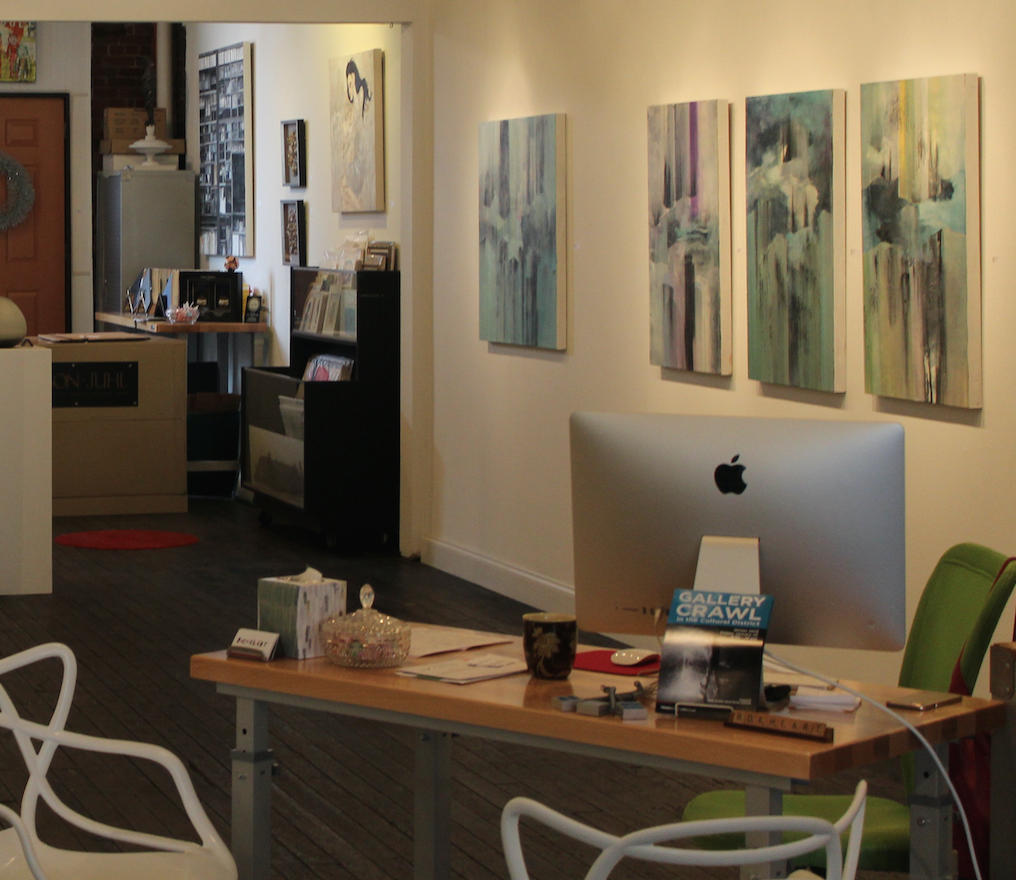
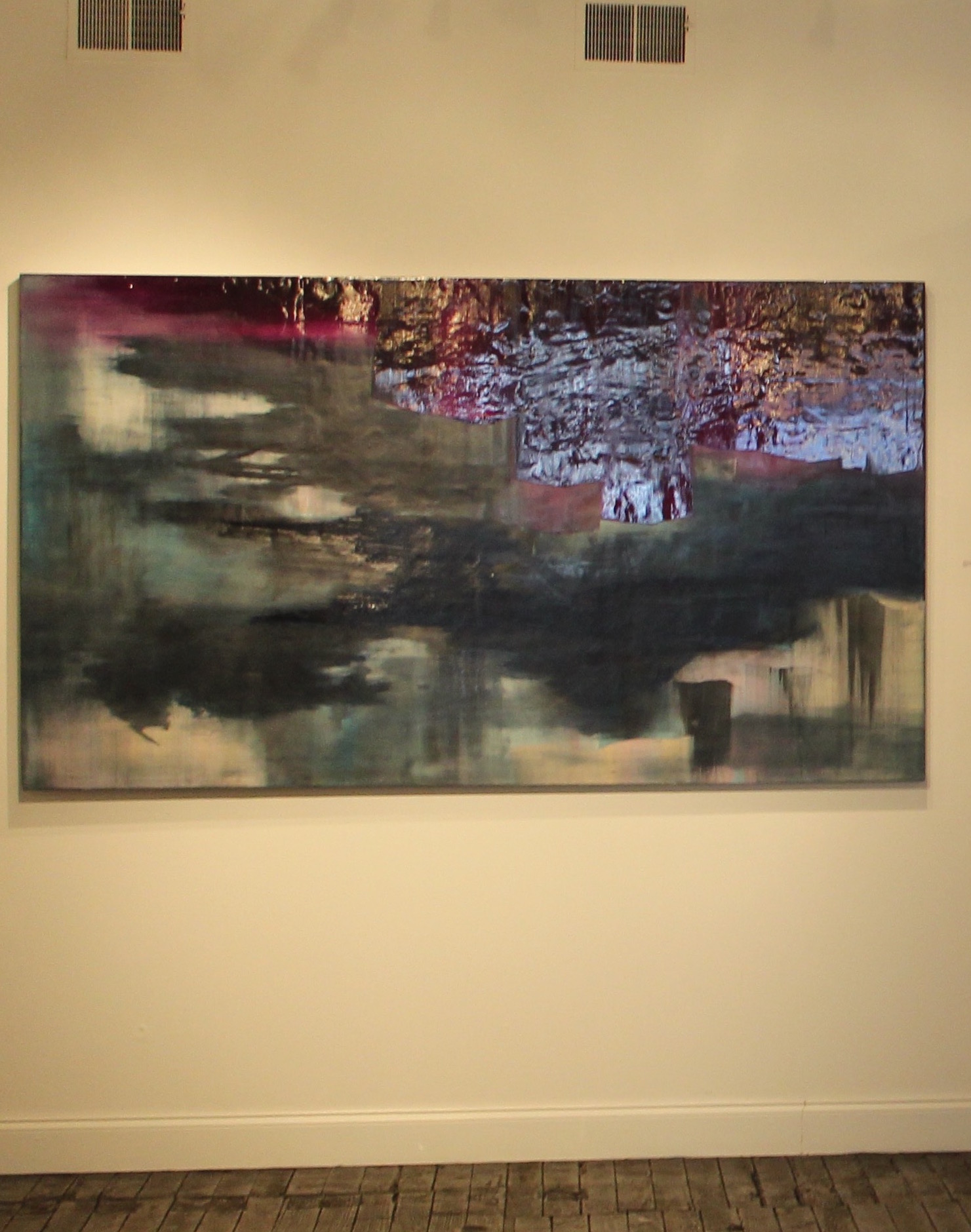
Figure 1. Three Abstract Pieces at BoxHeart. Photo by Andrew Zentgraf.
A Gallery Visit for the Uninitiated
I felt in way over my head while on the bus to Bloomfield’s BoxHeart Gallery. Any formal art education I had acquired likely stopped in middle school. Despite being a total stranger to Pittsburgh’s art scene, I was prepared to take on the challenge and further my knowledge with regard to art. One of the biggest issues that I was forced to tackle on this journey was how to answer a relatively simple question: how does one interact with art and spaces for art? I went into BoxHeart Gallery armed with useful frameworks in the form of Edward Soja’s spatial theory and the ideas of John Berger’s BBC series, Ways of Seeing.
Writing about a lived space is trickier than most people think. The writer not only has to take on the task of describing a space as we experience it, but also as we perceive and conceive it. A perception of a space provides more depth and exists within an empirical, measurable reality. The conception of a space is something else entirely and full of concepts we project into the material space. Edward Soja coined this phenomenon the “trialectic of being” in his works on spatial theory (Soja). Take, for example, the space of Pitt’s Hillman Library. Full of books, tables, desks and, (either over or under) caffeinated students, its function as a lived space seems obvious enough. But there is more to this space than meets the eye.
Our perception and conception of Hillman Library is more intricate. Nothing about the space itself clearly tells you that the level of accepted conversation progressively ranges from “Club Hillman” on the ground floor to total silence on the fourth. But, it does and a writer covering the space needs to capture this fact. Likewise, one’s perception of the space is separate from the other parts of the trialectic and demonstrably subjective. Maybe someone perceives the Cup and Chaucer coffee stand as a place to hang-out with friends and chat with a coffee or tea. Just as well, another person may perceive it as a quiet place for writing or research.
Pittsburgh has a number of spaces in which to interact with art in different ways. They include the downtown galleries, museums of Oakland and, of course, Bloomfield’s BoxHeart Gallery. Yet, it is not obvious what exactly one is to do at a museum or gallery. (And as I was to learn, there is a definite difference between those two things.) Nobody pulls you aside at the entry of the Carnegie International and gives a five-minute crash course about spatial theory or art viewing. Each space for art is different and every painting or artwork is its own piece worth being viewed and appreciated.
Museums and galleries largely have the same lived space but different perceived functions. A museum is usually much larger, intensely curated for artistic merit and puts an emphasis on the historicity of pieces and exhibits. Galleries, on the other hand, can be many things. A gallery could be a dedicated room in a museum, for example. Additionally, a gallery could be a non-profit place for art viewing with a specific focus on an individual artist or movement. Conversely, in the case of BoxHeart, a gallery can operate as a business to make money for the gallery owners and featured artists (Art & Artists).
I was able to tell immediately how special a place BoxHeart Gallery was that day in February. Entering the world of art can feel imposing for a newcomer. Yet, BoxHeart seems to welcome you in with comfortable chairs and a desk facing the door. In a way, it feels like you have entered an art hobbyist’s living room and not a dedicated gallery. In fact, the homey feel of BoxHeart Gallery is partially rooted in the fact that the building also operates as Nicole and Joshua’s — director and art handler of Boxheart — home (Contact). The second and third levels are complete with a bedroom, kitchen and even the couple’s cat. Take everything you think about when considering the world of art, strip it down, and reconstruct it as something inviting and fun. That is Boxheart, in essence.
Now that the space was properly established in my mind, I had to interact with the art that was there. The principle tool that I had used was John Berger’s 1972 BBC series, Ways of Seeing. The documentary series was seminal for its time and is still used in art classes to this day. One of Berger’s most prominent points in the first episode is that art has to be viewed in person without distractions in order to take in what the artist had originally intended in the piece (Episode 1). Art, when put before a videographer or printed in a book, can have its meaning changed.
There are many ways that not viewing art in person can change one’s interaction with it. For example, a camera can zoom in on parts of a painting not intended to draw your eye, put only segments of a landscape into view or pan on a work that ought to be considered in full. When printed as a reproduction, the change in size can manipulate the scale of the painting. Works that span the walls of museums can instead be printed on a single page. Sound also impacts one’s experience of the visual (Episode 1). Background music can make the viewer feel sensations that they otherwise would not when viewing the art without it. Take, for example, when classic film scenes are played without the accompanying music. The experience of the film-viewer is totally different.
With Berger’s ideas in mind I approached some of the abstract works (pictured above as Figures 1 and 2) featured in the gallery at the time. The first – and perhaps most difficult aspect of the experience – was focusing my mind solely on what was at hand. In essence, I had to get rid of all preconceptions and focus strictly on what was presented in front of me. Varying sensations and feelings took me into different directions within my interpretation. Perhaps, I finally concluded, there may not even be a single correct interpretation of these pieces at all. We each bring our own experiences and thoughts into the important and tricky process of interacting with art.
A gallery like BoxHeart brings a large number of things to the community that it exists in, the Pittsburgh neighborhood of Bloomfield. After all, Bloomfield is a part of Pittsburgh that is now expanding with young professionals, medical workers and students. Artists that progress through the rigorous selection process of the gallery have a chance to display and sell their art to members of the community in a unique setting. Additionally, the for-profit institution offers Pittsburgh art buyers the chance to consider art in their own way before purchasing it, something they are unable to do at museums, non-profit galleries or when buying art online. BoxHeart serves several functions to artist, gallery owners and diverse Pittsburgh community alike. On that day back in February, BoxHeart gave a group of students a place to interact with art along the ideas of Edward Soja and John Berger in their own way.
Works Cited
“Art & Artists.” Boxheart Gallery, boxheartgallery.com. Accessed 22 Apr. 2019.
“Contact.” Boxheart Gallery, boxheartgallery.com. Accessed 22 Apr. 2019.
“Episode 1.” Ways of Seeing, written by John Berger, produced by Mike Dibb, BBC Two, 1972.
Soja, Edward. Thirdspace: Journeys to Lost Angeles and Other Real-and-Imagined Places. Cambridge : Blackwell Publishing Inc., 1996. Print.
Zentgraf, Andrew. Abstract Pieces at BoxHeart Gallery. Figures 1 and 2. 2019, digital photograph.