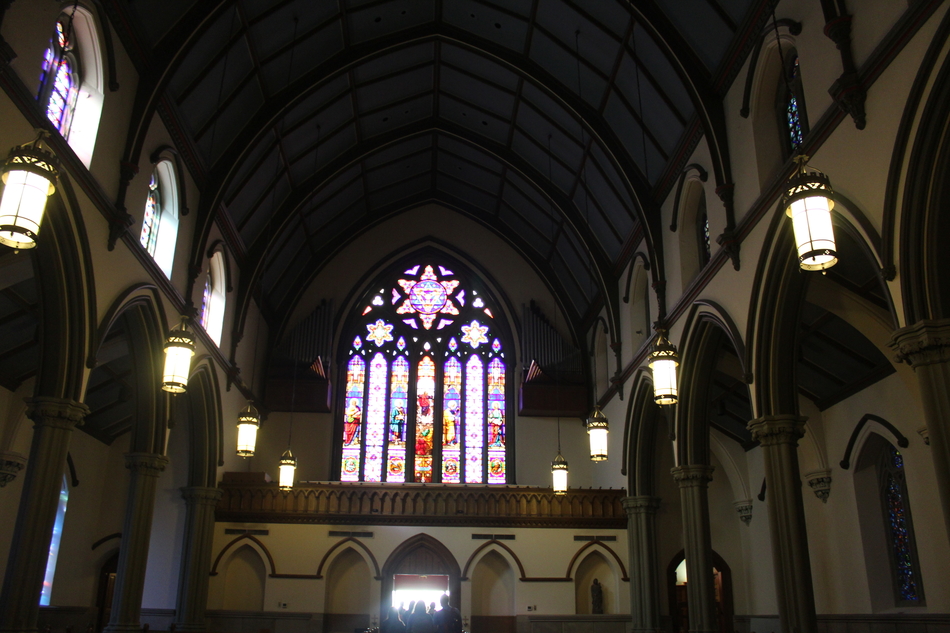
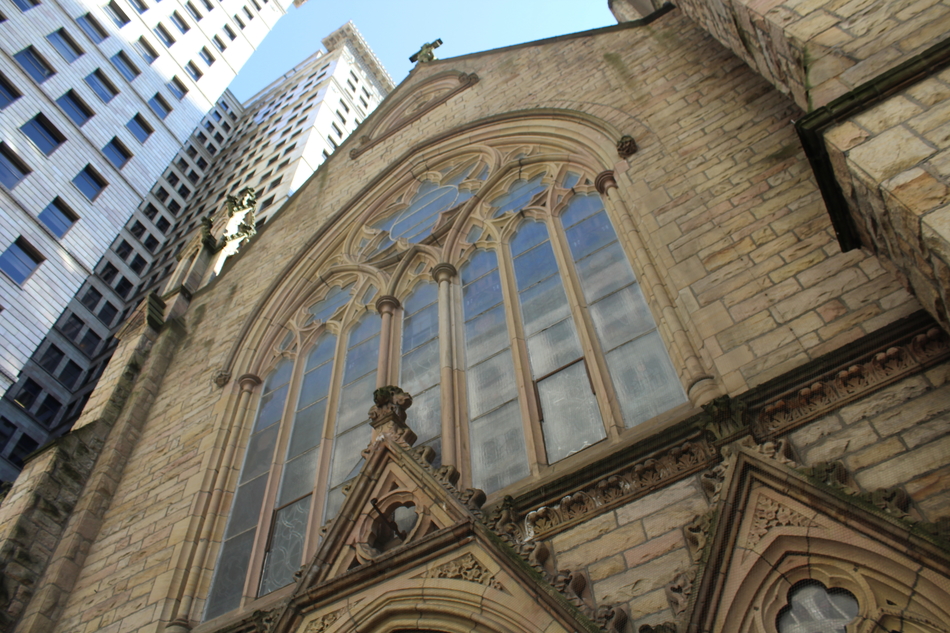
The interior of Trinity Cathedral (Photo by Janine Faust)
Trinity in the Modern Age
Trinity Episcopalian Cathedral has existed nearly as long as the city it resides in – the church was established in 1805, less than 50 years after Pittsburgh was named by General John Forbes. Over the last two centuries, Trinity, which began as a church, has gone through several extensive renovations, the most recent occurring in the late 1960s after a disastrous fire destroyed much of the cathedral’s interior. This particular renovation, which brought Pittsburgh residents the Trinity that is known today, occurred during the city’s initial Renaissance era, when officials were attempting to “revitalize” the city. Hence, Trinity’s most recent renovation aimed to “modernize” the church, displaying the cathedral’s close connection with the atmosphere and ambitions of the city as a whole.
Descriptions of Trinity’s first few iterations tend to focus more on their beauty, size and holiness of the new building rather than any modern amenities – these changes occurred during times when Trinity was still rapidly growing along with the city and working to establish itself as a powerful place of worship in the mid-Atlantic. The first Trinity Church was built in 1805. Pittsburgh was already a borough at the time and was only about a decade away from earning the status of city, with a population of 1,565 by 1800 and over 60 shops. The subsequent renovations made to Trinity Church in 1825 and 1872 served to make more room for an expanding congregation – the population of Pittsburgh had reached 7, 248 by 1820, and expanded further to a whopping 86, 076 in 1870. The growth of inland trade the rise of industrialism made the city a center for commerce and manufacturing, putting it in competition with other burgeoning cities. An article in written in a February 1872 edition of The Episcopal Register describing the third version of Trinity focuses heavily on the unique, impressive beauty of it, describing cornices as “richly moulded,” the lectern as “a thing of beauty,” the altar as a “chaste and beautiful work of art,” and the new tower and spire as the “crowning beauty and glory of the church.” Words such as “elegant” and “elaborate” also feature heavily in the piece.
But much happened between 1872 and 1967 that affected the priorities of the city, and thus Trinity. While Pittsburgh had always been an industrial region, the introduction of mass production and modern industrialism resulted in a more accelerated explosion of production and population – between 1870 and 1930, the population grew by more than half a million. Pittsburgh also developed rapidly during this time in education, the arts, transportation and other areas. Beginning in the 1940s, city officials began “Urban Renewal” projects to transform the city and make it more “welcoming” for visitors. This included factors to clear up pollution, such as smoke and waste control. It also included demolishing vast swaths of buildings to construct new structures such as the Gateway Center and the Civic Arena. The construction of the latter displaced more than 8,000 people and hundreds of small business in the primarily African-American Hill District. In her essay “Root Shock: How Tearing Up City Neighborhoods Hurts America, and What We Can Do About It,” Mindy Thompson Fullilove describes how residents of the Hill were deeply affected by the bulldozing of their neighborhood, claiming many suffer from “root shock,” a traumatic stress reaction to the destruction of their emotional ecosystem, as a result. In losing their home, the citizens of the Hill lost their connection to the memories and support system they forged there, an act which “destabilizes relationships, destroys social, emotional and financial relationships, and increases the risk for every kind of stress-related disease, from depression to heart attack.”
Thus, Pittsburgh’s “renewal” in the mid-twentieth century was far from being entirely positive or beneficial for all denizens of the Steel City, but a desire to revitalize had taken hold of the city. When Trinity Cathedral’s interior was destroyed by a fire in 1967, the trend of modernizing was reflected in its ensuing reconstruction. After overcoming their initial shock, Trinity’s parish determined to place the Cathedral, Pittsburgh’s “twin,” on the same path the rest of the city was heading down, as described by “Trinity and Pittsburgh,” a pamphlet detailing the changes made to Trinity Cathedral in the 1960s by Eric Mantle. As far as I can find in my research, none protested against the ensuing “modern” changes made to the cathedral, though Mantle writes that people were aware rebuilding the exterior in a “more modern mold” would be expensive. “But as times change and responsibilities grow, so must the contemporary church, and there was no hesitation in deciding that Trinity should be built anew…the better to fit today’s and tomorrow’s needs, and its proper status as a Cathedral Church,” he wrote.
Mantle’s extensive descriptions focus primarily on the new “modern” amenities added to the church after its interior was entirely redone from 1967-69, and which are still present today. While he does promote the dignity and grace of the interior – noting the new “heroic cross” hanging above the altar, made with materials to honor Pittsburgh’s industry and drawing worshippers’ attention to the “Vault of Heaven” – Mantle describes new utilitarian commodities even more. The new air conditioning, fireproof floor system, audio system and lighting system are all brought up. The organ has been augmented to increase its versatility, allowing it to “handle music from thinner baroque pieces,” and the new windows ensure the “proper diffusion of light.” A separate pamphlet included in the book, solely describing the religious imagery in the new windows also touches upon modern times, tying the depictions of Jesus as a teacher, healer, and worker to the development of contemporary education, medicine, and industry.
This change in the emphasis of Trinity’s attributes throughout its history relates to Pittsburgh’s growth, which can be elaborated on through Edward Soja’s concepts of perceived and conceived space. Both exist within his idea of “thirdspace” – a space that is both real and imagined at the same time. Perceived space describes space that people traditionally call reality, something physical and empirically measurable, such as the chair you sit in, the floor you walk on, etc. In the case of descriptions of Trinity Cathedral, both past and current, the “perceived space” is the real, tangible structure; the alcoves, altar, pews and other physical forms that make up the building. The conceived space, in contrast, consists of imaginary spaces, of “projections into the empirical world from conceived or imaginary geographies.” This sort of space can take over the perceived space influencing how people view and consider the physical structures and locations they encounter.
In the case of Trinity Cathedral’s most recent and current iteration, its perceived space can be seen as being taken over by conceptions of it as a thoroughly modern establishment, marching forward with Pittsburgh, its “contemporary twin,” as Mantle describes it. Trinity has always been linked closely with Pittsburgh – the author of the 1872 The Episcopalian Register article speaks of the two existing together for years to come. Mantle lays out Trinity’s conceived space as it was in the late 1960s, with modern aspirations projected onto it, encouraging people to view it as connected to the rest of Pittsburgh’s developments through an extensive focus on fancy new amenities and practical devices. He reiterates the presence of this conceived space in the final chapter of “Trinity and Pittsburgh,” going on at length about Trinity as an everlasting presence in the city, changing as it does and continuing to stay relevant. “Many churches have moved out of the city – but Trinity will stay on in downtown Pittsburgh, where both the church and the community had their origins some 160 years ago,” he writes.
Mantle’s declaration has so far remained true – Trinity Cathedral still stands proudly in the same location downtown, in about the same condition as it was 50 years ago. The congregation of the cathedral has lasted for more than two centuries now. It is likely to endure so long as people live and worship in the city. Perhaps in coming years, the cathedral’s physical structure, and possibly its relation to the city, will once again alter, creating a new meaning for the ancient and historical space and affecting the citizens that worship and invest in it.
Works Cited
Fullilove, Mindy Thompson. Root Shock: How Tearing up City Neighborhoods Hurts America, and What We Can Do about It. New Village Press, 2016.
Mantle, Eric. Trinity and Pittsburgh. 1969. Trinity Episcopal Cathedral Records 1797-1979, Detre Library and Archives, Heinz History Center.
Muhl, Andy. “Our History.” Trinity Cathedral Pittsburgh, Trinity Episcopal Cathedral, 15 Apr. 2016, www.trinitycathedralpgh.org/our-history/.
Soja, Edward. Thirdspace: Journeys to Lost Angeles and Other Real-and-Imagined Places. Cambridge MA: Blackwell Publishing Inc., 1996. 53-70.
“The Opening Services of Trinity Church, Pittsburgh.” The Episcopal Register, 3 Feb. 1872. Trinity Episcopal Cathedral Records 1797-1979, Detre Library and Archives, Heinz History Center.
“U.S. Census Bureau QuickFacts: Pittsburgh City, Pennsylvania.” Census Bureau QuickFacts, United States Census Bureau, 2017, www.census.gov/quickfacts/fact/table/pittsburghcitypennsylvania#.