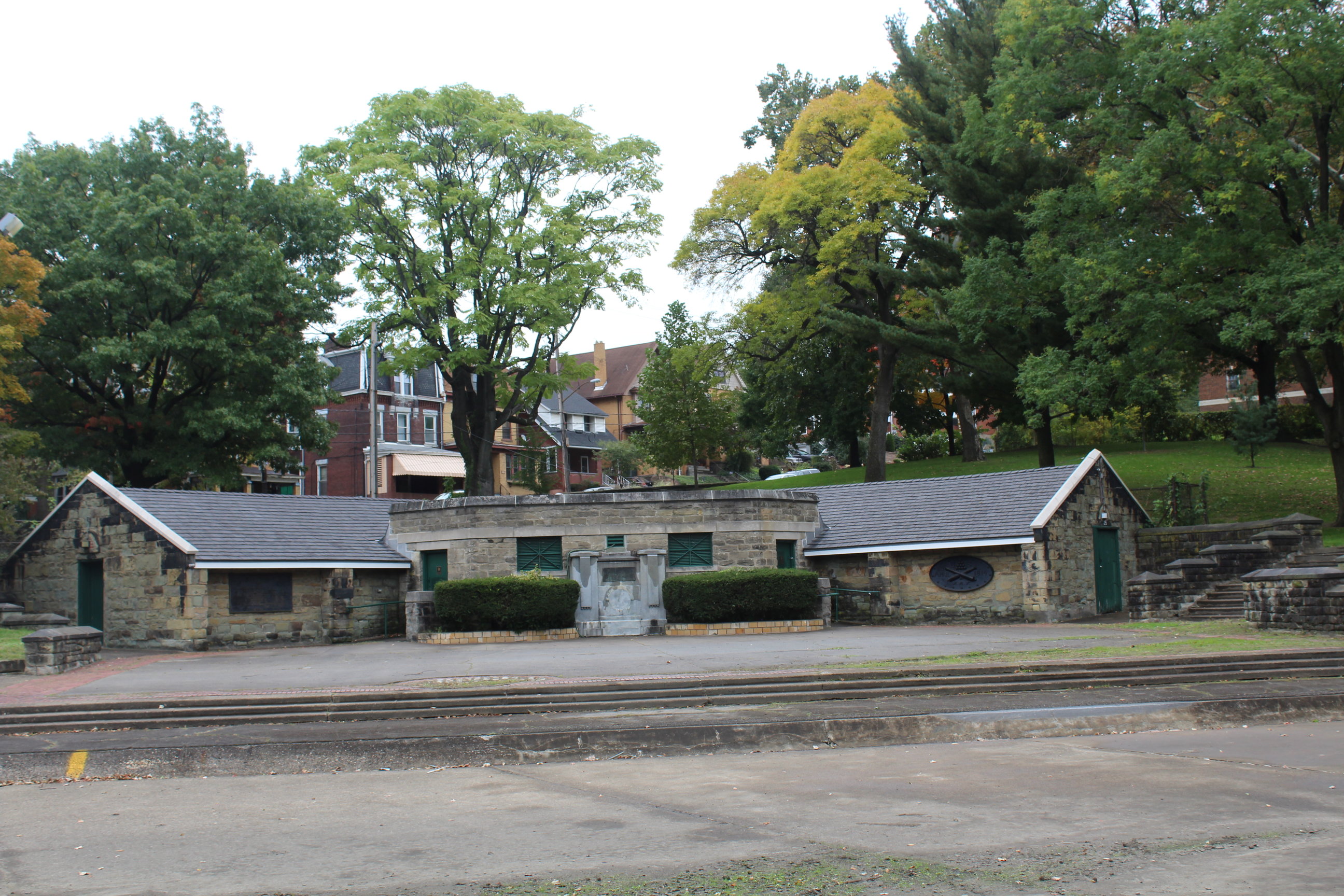
Allegheny Arsenal's Gunpowder Magazine still stands today. The fountain dedicated by President Taft is stands in the middle of the building. Photo credit: Elise Hoffman
Strikes, Bullets, and Presidential Visits: Arsenal Park’s Strange History
Arsenal Park is a beautiful place today. When you first walk in, there you see this massive green space in the middle of a city. It’s a lovely place to walk around. Perhaps you even bring your dog with you. Maybe you see the sign from the Pennsylvania Historical and Museum Commission that tells you that this is the site of the old Allegheny Arsenal. Maybe you are more knowledgeable about this site and have heard about the tragedy during the Civil War. But do you know all of this site’s history?
Allegheny Arsenal was founded in 1814 and was used to make ammunition for 86 years (The U.S. National Archives and Records Administration). During its time as an arsenal, the workers were made up of mostly women and children. Factory jobs such as the work done at the arsenal were very important for women of the time. It gave them an opportunity to make money for their families. It was necessary for the workers of Allegheny Arsenal to be women due to the way bullets used to be manufactured. In the past, bullets were made of paper surrounding a lead ball and packed tightly with gunpowder. The gunpower had to be packed in by hand in order to make effective bullets (Wudarczyk 2). The only people who had small enough hands to do this were young women and children. Not to mention, the men were all fighting in the wars, from the Civil war through the Spanish-American War, so the women had to step up and take the manufacturing jobs.
Life for working women in the 1800’s was different than working women today. A factory girl from Lowell Massachusetts best describes a factory girl’s “occupation is as laborious as that of almost any female who earns her own living, while it also has its sunny spots and its cheerful intervals, which make her hard labor seem comparatively pleasant and easy” (Eisler). Life in factories was enjoyable and usually uneventful.
That does not mean that Allegheny Arsenal never had any shocking events. The Great Strike of 1877 occurred nearby the arsenal. There was a railroad strike from the nearby Pennsylvania Railroad Company. When the railroad company called in reinforcements to break up the strike, the reinforcements were chased out of the city. In need of refuge, the militiamen sought shelter at the arsenal. The arsenal was a piece of government property, so the militiamen had hoped they could stay there until the riots died down, but the commanding officer at the arsenal told them they couldn’t stay and forcing them to move beyond the city limits to find safety (“Allegheny Arsenal” sign).
The arsenal was one of few places that the riots could not get through due to the wall providing safety to the arsenal within. That wall is still standing today and has been since the early days of the arsenal. You can see this as you head into the park. In some places the cement between the rocks is wearing away. It made for an easy to defend site. All that was needed to protect the arsenal were a few guards. This was not the only remarkable event at Allegheny Arsenal, though.
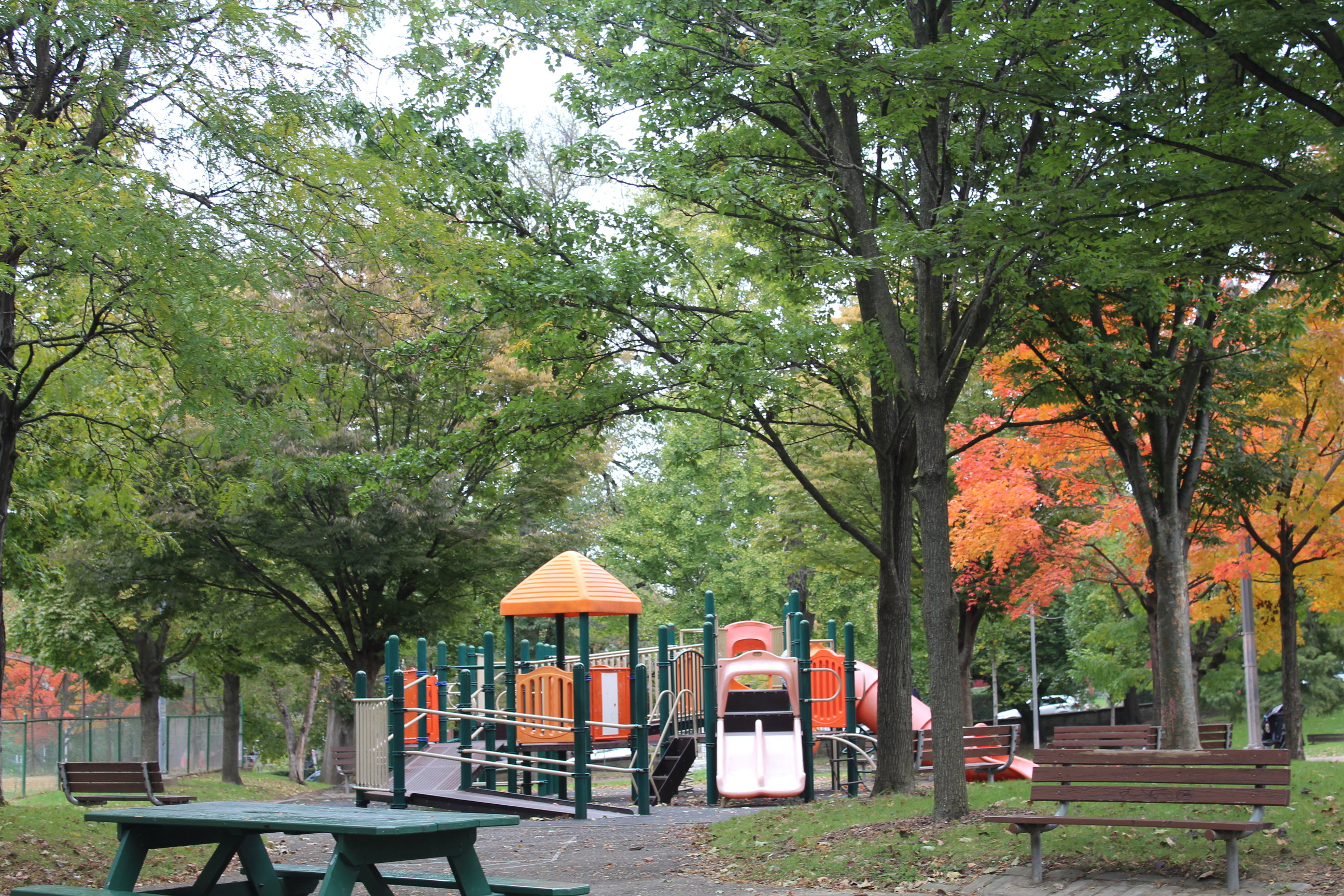
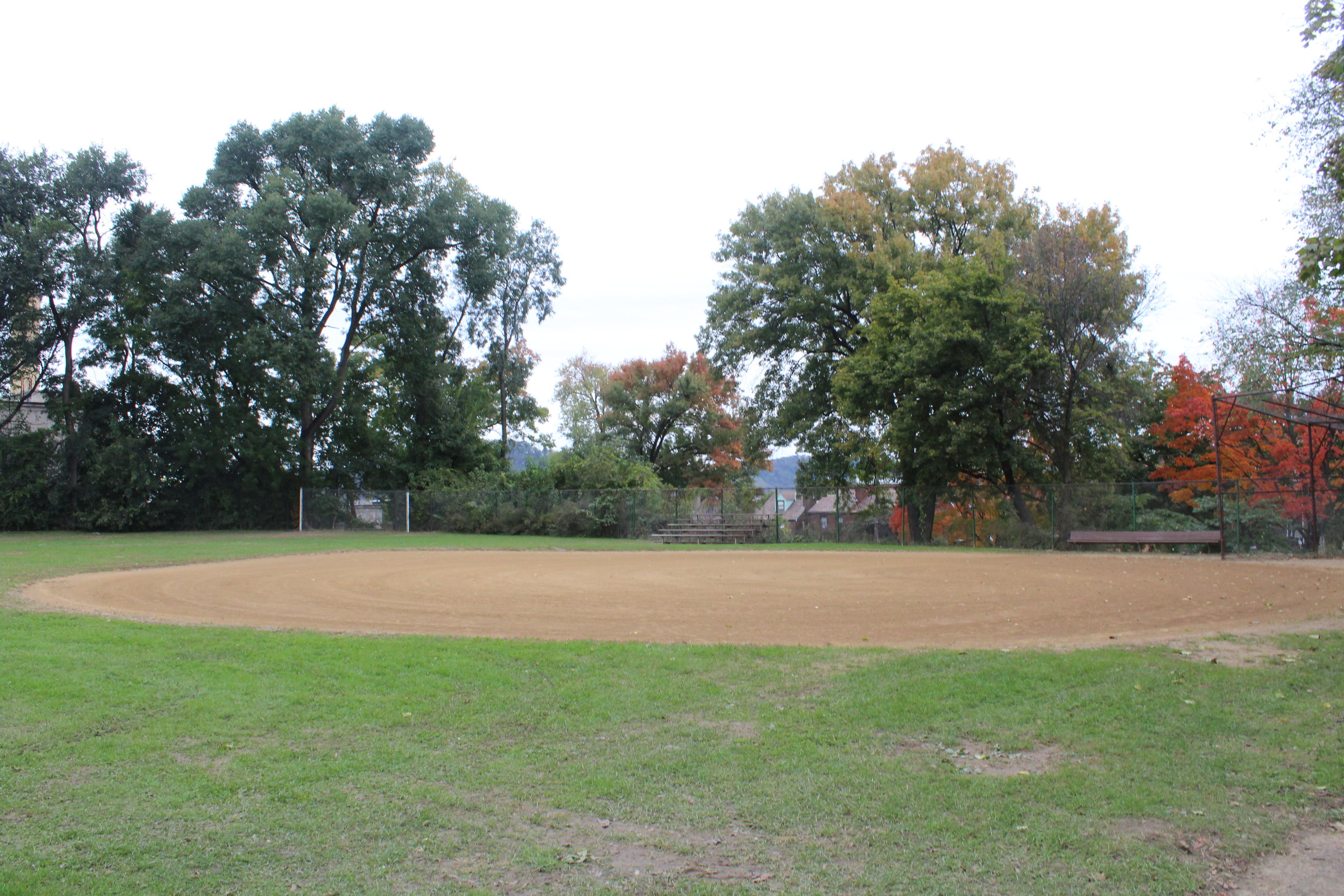
In 1862, an explosion took the lives of the more civilians than in any other day in the Civil War (Paine). There were two explosions that injured and killed 78 people. These places are now occupied by the playground and a baseball field. If you follow the path down the hill from the playground, you will soon see the old gunpowder magazine, the only remaining building from the days of the arsenal, now used as the park’s restrooms.
Up against the old gunpowder magazine, there is a slab of concrete with a plaque on it. The plaque itself only tells you who put this slab of concrete there, but not what this slab is. This is what remains of an old drinking fountain. Originally, this fountain connected to a natural spring, but when a push to drink filtered water occurred, the fountain was decommissioned. What makes this fountain especially interesting is that, while in office, President Taft came to Pittsburgh and gave a speech at the dedication of this fountain. Before you get excited about seeing the place a president once stood, this was not the original location of the fountain. You will have to head back up the hill to where the tennis courts are now if you want to get an idea of where this fountain once stood.
This was once one of the most productive ammunitions manufacturers in the nation. Weapons and bullets were made quite differently back when this was a functioning arsenal. By the early 1900’s the arsenal had been operating for over 80 years. Within that time period there were changes in weaponry. Eventually there came a time that the United States government would need to modernize its methods in weaponry and ammunition. The arsenal had to close down, but the federal government was not done with the site quite yet. What was once an arsenal turned into a military supply location briefly.
As you walk through the park, note the various locations that have a deeper history than what meets the eye. Even just a few years ago, Arsenal Park was a very different place. Arsenal Park has been around as a park since 1907. In the 1900’s this was mostly a large green space. By 1994, it was due to for renovations and was granted funding by the Pennsylvania Bureau of Recreation and Conservation. This added the basic recreational structures in the park today. The renovations in 1994 did not keep the park a welcoming place for long. In 2012 a group called Friends of Arsenal Park formed to help revamp the park again (Jones). Prior to the Friends of Arsenal Park, the space was in desperate need of attention from the members of the Lawrenceville community. An article from 2012 in the Pittsburgh Post-Gazette describes Arsenal Park as a place where “the ball-field base paths stand in water long after a rain. Weeds grow through cracks in the tennis courts and bleachers, which themselves are rotting. Fences are rusty, paint is flaking and not so many kids use the playground” (Jones). In addition to this, the shady people who frequented the park made the locals afraid to use it (Jones).
Of course, today Arsenal Park is no longer like that. The ball-fields are in good condition, and the playground equipment is much more user friendly. As you walk through Arsenal Park, you will see that it has become an inviting place where you can feel safe to bring your kids or play some basketball.
Eventually, the military found little use in the site and gave it over to the city of Pittsburgh to make a park out of it. Even as a park, this location has changed many times over. For a while, this park was booming with activity. It eventually fell into less frequent use, but as renovations updated it, the park has become a better place. As you walk through this park, be sure to enjoy yourself, but also note the historical importance of the various locations within the park. Everything has a meaning behind it. Knowing the history of a place can change the way you view and appreciate what that place is.
Works Cited
“Allegheny Arsenal” sign. Pennsylvania Historical and Museum Commission, Arsenal Park.
Eisler, Nenita ed., “A Week in the Mill.” The Lowell Offering: Writings by New England Mill Women (1840-1845), Norton, 1998, pp. 75–77.
G.M. Hopkins and Co. Lower Lawrenceville, Central Lawrenceville. Plate 22. 1906. G.G. Hopkins Company Maps. Pittsburgh.
Jones, Diana Nelson. “Neglected Lawrenceville Park Finally Has a Few Friends.” Pittsburgh Post-Gazette, 2012, www.post-gazette.com/local/city/2012/09/24/Neglected-Lawrenceville-park-finally-has-a-few-friends/stories/201209240174.
Paine, Kirstein. “Secret Pittsburgh in Arsenal Park Tour.” Fall 2018.
Preservation Pittsburgh. “Tending to Arsenal Park’s Soldiers & Sailors Memorial Fountain.” Preservation Pittsburgh, 2018, www.preservationpgh.org/blog/2018/5/27/tending-to-arsenal-parks-soldiers-sailors-memorial-fountain.
“Rehabilitation of Arsenal Park” plaque. City of Pittsburgh, Arsenal Park.
The U.S. National Archives and Records Administration. “Allegheny Arsenal.” National Archives and Records Administration, National Archives and Records Administration, 2016, www.archives.gov/philadelphia/exhibits/allegheny-arsenal/allegheny-arsenal.html.
Wudarczyk, James. “Historical Happenings.” Mar. 2012.