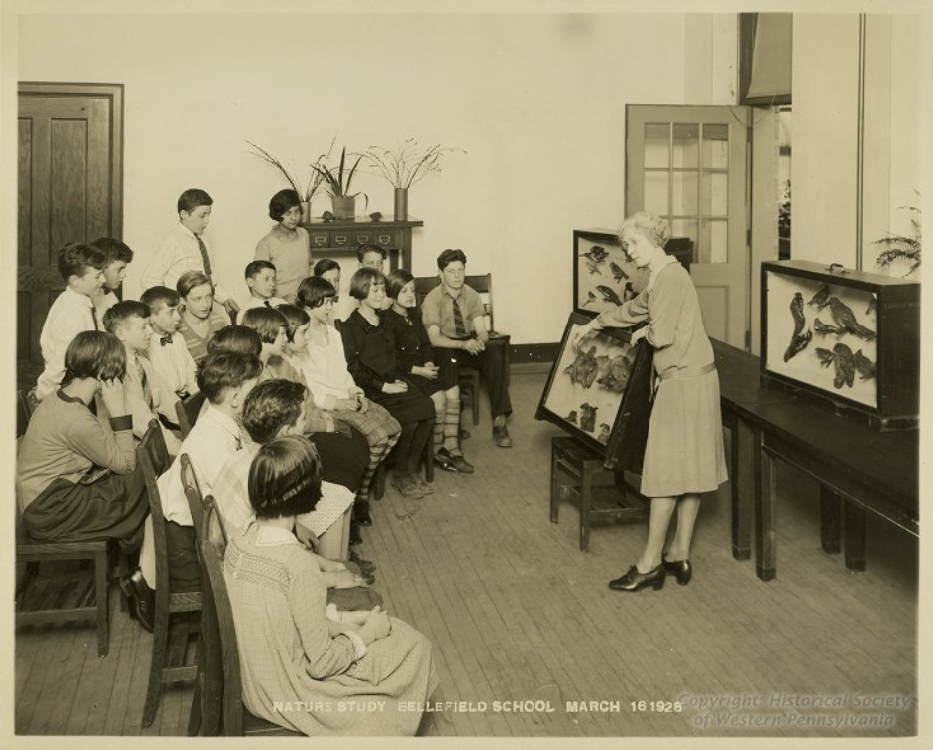
Figure 1. Students observe a nature class at Bellefield Elementary School; S. Musgrave; 16 March 1928. “Pittsburgh Public School Photographs, Detre Library & Archives, Heinz History Center”.
Vanished Schools of a Vanishing Neighborhood
Since Bellefield is considered a “vanishing neighborhood,” it can be viewed as an area that is somewhat known by residents yet on the cusp of being completely forgotten. We might acknowledge its existence as a sub-neighborhood in Oakland, but we have forgotten its significance to the city of Pittsburgh. With this in mind, it is worth looking backwards and to see Bellefield from a historic perspective, as it was lived in the past. When most residents think of the word “Bellefield”, they will likely imagine Bellefield Hall, a landmark building owned by the University of Pittsburgh, known for its recreational facilities and grand auditorium (“Bellefield Hall”). However, most are unaware that Bellefield remained a thriving area for education in the twentieth century with a school that vanished in the late-1950’s.
Bellefield Elementary School
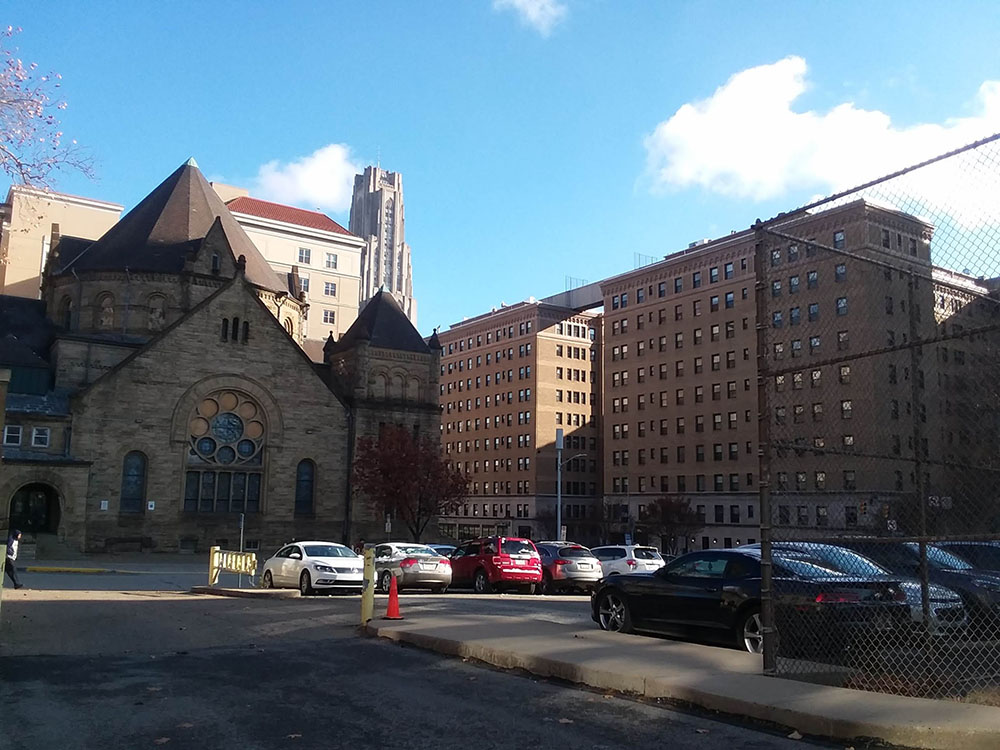
This school was originally known as Bellefield Elementary School and was located on 3907 Fifth Avenue, at the corner of Fifth Avenue and Thackeray Avenue (“Nature Study at Bellefield Elementary School”). Looking at a map of Oakland today, this school would likely be situated across from Litchfield Towers, a student dormitory, and next to Bellefield Presbyterian Church. Bellefield School was a site that was closely tied to the community that lived in the neighborhood. The school went through a series of changes by undergoing a name change, surviving a catastrophic flood and being razed after a tragic fire. From its establishment in 1928 to its demolishment in 1957, these events occurred in the span of merely twenty-nine years. To gain a better understanding of these events, we can examine images from the archives and see how the school changed over time.
One of the earliest images of Bellefield School was taken in March 1928, before it operated as a vocational high school (See Figure 1). The photograph is titled “Nature Study at Bellefield Elementary School” and features a class sitting around various displays of rodent species and birds in glass cases. Overall, the classroom appears sparsely furnished with several chairs and wide tables to display the cases. The students sit attentively in the photograph as the teacher points to certain woodland animals. The image appears natural as the children appear more focused on the nature study than the camera. The smiles and eager faces of these students contribute to the lighthearted yet productive atmosphere that the school provided. With this image, we can see how Bellefield Elementary School functioned as a space for children in the community to learn and converse with each other. While the purpose of the photograph remain unknown, it is clear that this image is meant to show the benefits of establishing a school for children.
The Great Flood of 1936
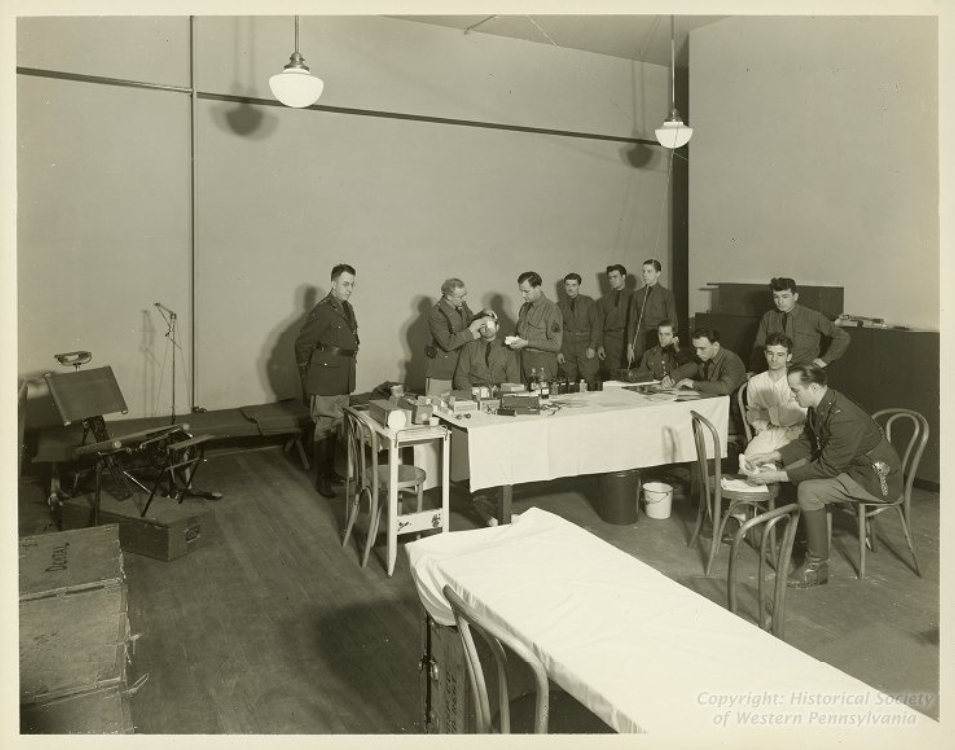
In addition to serving children, Bellefield School also functioned in ways that diverged from its original intentions. A catastrophic flood known as the Flood of 1936 spread across Western Pennsylvania at an alarming rate. Records show that the water rose up to 46 feet in March with 500 injuries and 36 deaths. Costs of the damage were estimated to be between $150 million and $200 million. During that time, the Bellefield School was made into a clinic or receiving room by the National Guard Cavalry (“Scene at Bellefield School during the Flood of 1936”). The image shows a group of men surrounding a table with various medical supplies (See Figure 2). Officers of the National Guard are shown carefully putting bandages on civilians’ eyes and feet. The foreground of the photograph also shows a makeshift hospital bed propped up by wooden boxes and chairs, which was likely used for injured civilians to rest on. By examining this image, we can see how Bellefield School was a versatile space that not only provided education but also served as a place of refuge during times of disaster. In its essential form, a school is an expansive space with the purpose of accommodating many people. While education is often viewed as the main objective of a school, its physical characteristics allow for it to be transformed for different uses, such as a temporary hospital. With this image, we see how spaces such as schools can offer unexpected relief and support to the community when it is needed.
Bellefield Girls’ Vocational High School
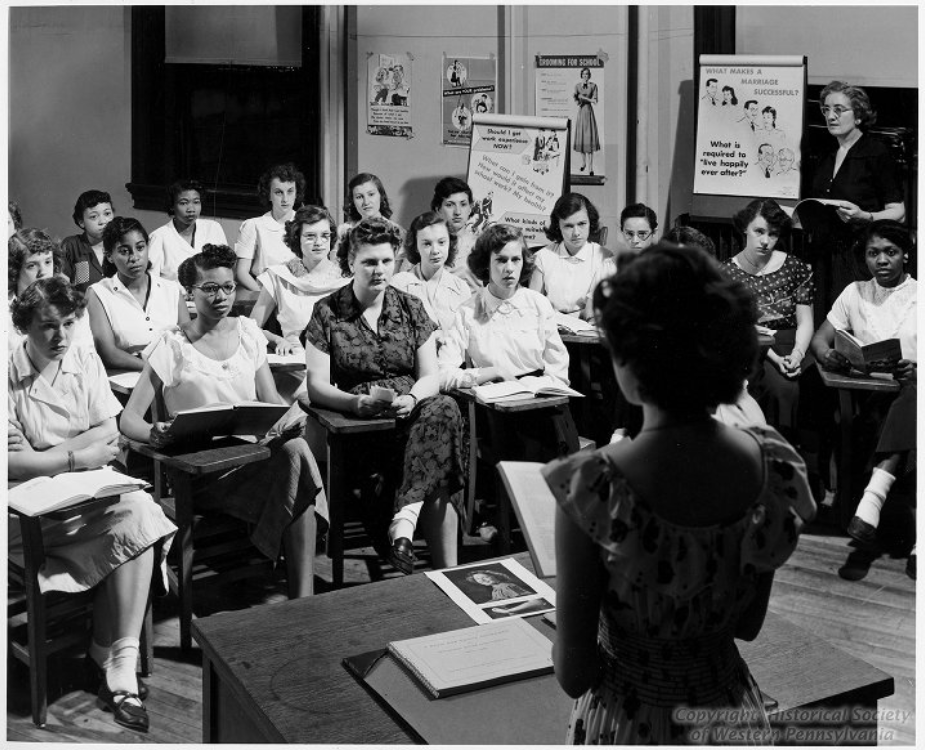
Moving forward to the 1950’s, vocational education became a significant aspect of education for women, who were expected to learn a variety of skills and techniques before graduating in order to join the workforce. Women were considered “non-traditional” students at the time and were required to take a unique set of classes (“Bellefield Vocational Guidance and C.A. Class”). In the same year that the first photo was taken, the school changed its name to the Bellefield Girls’ Vocational High School on February 6, 1928. The photographs taken after the name change show a striking contrast compared to the school’s days of serving children. A photograph from 1951 depicts a “Group Guidance” class at Bellefield School (See Figure 3). The students are shown sitting in desks facing the vocational guidance counselor, in a more traditional setting. Posters about work experience for women, grooming etiquette, and physical health are presented facing the camera. In doing so, it emphasizes that the school’s curriculum is customized to fit the career needs of women during this time period. The students are shown with focused, serious expressions, contrasting with the carefree mood in the photograph of the elementary school. Given the significance of women obtaining jobs and an education during the mid-twentieth century, it is reasonable for the students to appear more solemn than the children from Bellefield Elementary School. Comparing the two images, we see how the space of Bellefield School could be utilized for a variety of students and different types of education.
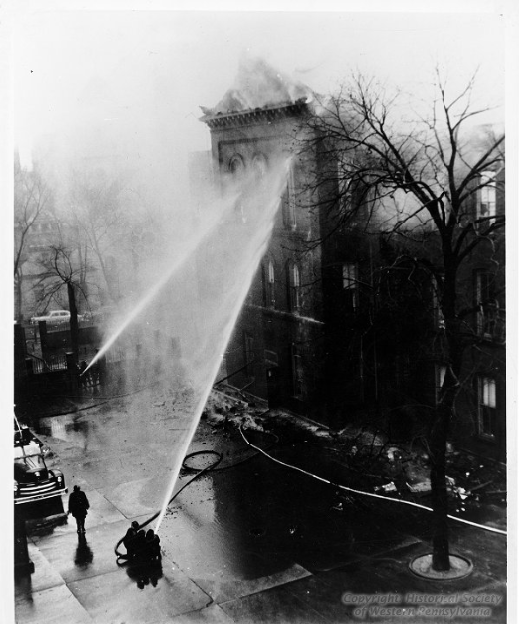
Six years after this photograph was taken, Bellefield Girls’ Vocational High School was partially destroyed by a fire on January 22, 1957. While the cause of the fire is unknown, the image that was taken of the school shows the extent of the damage (See Figure 4). A group of firefighters are shown using extended hoses to mitigate the fire. In terms of quality, the photo is grainy and appears to be taken from a high angle which serves to emphasize the fire’s intensity. A cloud of smoke billows above the school and the surrounding trees. The smoke is also shown heading towards Bellefield Presbyterian Church on the left of the image. In addition, the front of the school is completely charred, with debris scattered on the ground below. The unfortunate scene in this image is a significant disparity from photographs of the past few decades. A space known for its role of educating the community and saving lives during the Flood of 1936 was suddenly reduced to a shell of its former self. Two weeks after the fire, the Bellefield School was demolished and the site was later used as a playground for the Henry Clay Frick School, a public elementary school in the Pittsburgh area (“Frick School Students”).
Bellefield Today
Today, the Frick School is now known as the Pittsburgh Science and Technology Academy. In addition, the space where the Bellefield School was located now serves as a parking lot for the Academy (See Figure 5). While the Bellefield School is now a vanished space, it is still utilized as a place of education. While a school is typically conceptualized as a space for young people to learn, the Bellefield School is indicative of the opposite. Instead of being made for a particular level, it was utilized by men, women, and children across its 29-year history. Given the historical significance of Bellefield School, it might be worth asking if this space should remain a secret. While nothing is mentioned on the Academy’s website, perhaps if they were to create a plaque honoring the school, the neighborhood of Bellefield might not vanish after all.
Works Cited
Musgrave, Samuel A. Bellefield Vocational Guidance and C.A. Class, Pittsburgh. Historic Pittsburgh. June 1957. https://historicpittsburgh.org/islandora/object/pitt:MSP117.B017.F02.I01/from_search/13d7f0aca37edc560c24f51b82eef3b7-17
Unknown. Frick School Students, Pittsburgh. Historic Pittsburgh. https://historicpittsburgh.org/islandora/object/pitt:MSP117.B008.F02.I05/from_search/45f2f6efc8ffe28641ac61e214e872c8-1
Unknown. Nature Study at Bellefield Elementary School, Pittsburgh. Historic Pittsburgh. 16 March 1928. https://historicpittsburgh.org/islandora/object/pitt%3AMSP117.B022.F03.I08
Unknown. Scene at Bellefield School during the Flood of 1936, Pittsburgh. Historic Pittsburgh. 24 March 1936. https://historicpittsburgh.org/islandora/object/pitt%3AMSP117.B008.F01.I14
Vinard Studios. Bellefield Girls’ Vocational High School, Pittsburgh. Historic Pittsburgh. January 1957. https://historicpittsburgh.org/islandora/object/pitt%3AMSP117.B004.F03.I10