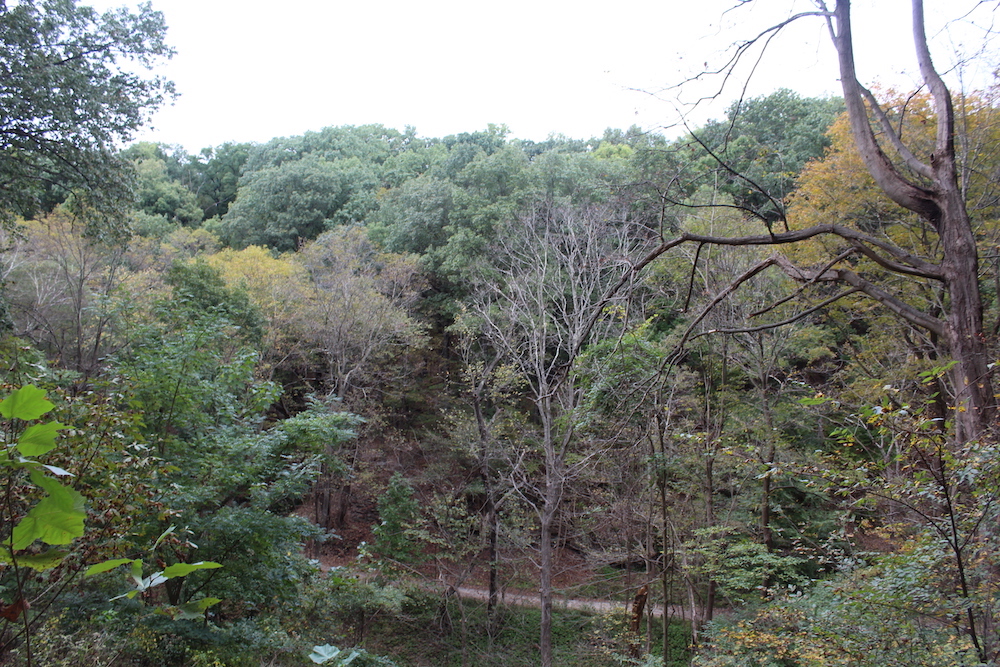
A view of trees within Schenley Park. Photo by Kiaya Sechrest.
Civic Parks: More Than Meets the Eye
I moved to Pittsburgh in the Fall of 2016 to begin my education at the University of Pittsburgh. I was four hours away from home, I knew no one, and I was living in a city for the first time. I wanted to take advantage of what Pittsburgh had to offer, however it was easy to be overwhelmed by this prospect. Schenley Park was one of the first places that I explored in the early weeks of my freshman year, both because of its proximity to campus (which meant that I did not have to navigate the buses) and the fact that it was free. It quickly became a place that I would go if I had a free afternoon to do reading for class, instead of going to the library, or spend time with a friend. I spent my first semester of college learning the different trails and shortcuts that stem from the main entrance in Oakland, and Schenley Park has remained a special place to me ever since.
In Robin Kimmerer’s chapter “Learning to See,” she discusses the importance of “opening” one’s eyes when it comes to studying moss. She writes, “All it requires of us is attentiveness. Look in a certain way and a whole new world can be revealed” (10). This same idea can be applied to city parks. A city taking the effort and money to create parks for its citizens can reveal a “whole new world” by changing that city for the better, and this has specifically occurred in Pittsburgh as it has moved away from its Steel Mill roots. Visitors of the parks are given a new perspective as well, as it allows them to see their urban home in a new way, as one that includes nature, quiet, and space to exercise. City parks aid in supporting the public health, both physically and mentally, of its citizens, and Pittsburgh specifically has used green spaces such as Schenley Park to cause an environmental shift in the urban area.
Research has shown how parks and green spaces provide extensive positive impacts in urban areas, and how these impacts reach into several facets of the city. Civic parks affect not only the air quality, but also the physical and mental health of the city’s inhabitants, and the overall connotation of the city or a specific neighborhood within it. One said study, published in the article “An Exploration of Psychosocial Pathways of Park’s Effects on Health: A Qualitative Study,” uses interviews of city dwellers for its research. The results of the study draw on four main themes: connection to one’s family, loved ones, and friends, connection to one’s community and neighborhood, connection to self, and connection to nature (Huang and Swierad). The participants’ comments suggest that all of these connections were strengthened by having a neighborhood park. Regarding mental health specifically, one interviewee stated, “‘For me being in a park is relaxing; it is about disconnecting from stressful life and breathing fresh air, walking around, reading a book, playing with kids, just relaxing, enjoying the sunshine and forgetting about the city’” (Huang and Swierad). Another participant discussed how important it is to them to return to “green areas in the city” as a pause from their “hectic” life which they can often get carried away by (Huang and Swierad). The study concludes, “Urban parks are not only the lungs of the city enabling people to breath fresh air and stay healthy; parks are also the heart and soul of the city – they beat in the rhythm of our own hearts letting us develop emotional connections to the social, physical, and spiritual world around us” (Huang and Swierad). The interviews show how important green spaces are for city living, and how detrimental it can be to a city’s inhabitants if they do not have access to a public park.
Another study, “Public Green Spaces and Positive Mental Health – Investigating the Relationship Between Access, Quantity, and Types of Parks and Mental Wellbeing,” focuses specifically on the importance of having a public park within a reasonable distance of the home, and how this affects the health and wellbeing of residents. The study uses the Warwick-Edinburgh Mental Well-Being Scale (WEMWBS), which is a validated tool used to measure positive mental health. The results of the research display that having public parks accessible in all areas of a city are vital in increasing the mental wellbeing of citizens, as the article states, “The overall count of parks [within 1.6 km of the home] was positively associated with positive mental health, where, for every additional park of any type (i.e. size), WEMWBS scores increased” (Wood, et al.). This information shows that the more public parks in a participant’s region, the more likely it was that their WEMWBS score would be higher than their counterparts with a lower number of accessible green spaces. The article concludes, “While the physical activity benefits of living near parks and public open space are well documented, and space has shown to ameliorate depression and stress, this study has demonstrated that the provision of parks in local neighborhoods and within walking distance is important also for positive mental health” (Wood, et al.). Both of these studies, using very different methods, depict how public parks in urban areas have positive impacts on the wellbeing of citizens, and how it is important for parks to be accessible to residents in all areas of a city.
According to this research, Pittsburgh’s parks have undoubtedly improved the health of the city’s inhabitants, especially larger green spaces like Schenley Park which are easily accessible for residents in multiple neighborhoods. However, green spaces have also helped to reshape the face of Pittsburgh as a whole. In Haniel Long’s dystopian short story, “How Pittsburgh Returned to the Jungle,” it becomes law for the city to have a window box outside of every window. He writes how drastically it changed Pittsburgh, “The air grew clearer. No smoke was permitted; only electronic locomotives penetrated the city. The roads and highways were banked with shrubs and blossoms” (Haniel). Although this story is fictional, it holds some truth regarding the environmental shifts Pittsburgh has experienced. As Joel Tarr mentions in the introduction of his book, Pittsburgh was at one point known famously as the “smoky city” (8). Since the leave of the Steel Industry and the introduction of the many parks of Pittsburgh, this is obviously no longer the case. The book Links Between Air Quality and Economic Growth: Implications for Pittsburgh explores the possibilities of what clean air can do for a city and concludes that it has a high impact on attracting new people and businesses (70-72). The authors state that this has occurred in Pittsburgh and predicts that it will continue to occur in the future, so long as the policymakers continue to make “green,” environmentally conscious choices (70-72). Tarr also discusses the population of Pittsburgh in his introduction, and that while in 2000 it was half of what it was in 1950, it has been strong since 1970, and will hopefully continue to grow in the future (6).
City parks provide a very different space from that of parks located in more rural areas. Even simply visually, while one is inside of a city park, they can often see the tall buildings in the surrounding area. Yet, they remain separate from the bustle of the city and instead are surrounded by greenery. This is what I enjoy about them and is one of my favorite aspects of Schenley Park. The unique space of an urban park is more than just exciting for the visitor, it has physical impacts on a city and its people. Green spaces help to keep citizens literally “happy and healthy,” and they also can reshape a city that was once viewed as strictly industrial and grey. They may have even played a large role in Pittsburgh’s ability to grow economically and will remain important for the city’s future.
Works Cited
Huang, Terry and Ewelina Swierad. “An Exploration of Psychosocial Pathways of Park’s Effects on Health: A Qualitative Study.” International Journal of Environmental Research and Public Health, vol. 15, iss. 8, MDPI, 8 August 2018, https://www.mdpi.com/1660-4601/15/8/1693/htm. Accessed 1 December 2018.
Kimmerer, Robin Wall. “Learning to See.” Gathering Moss. OSU Press, 2003.
Long, Haniel. “How Pittsburgh Returned to the Jungle.” Notes for a New Mythology: Pittsburgh Memoranda. The Bookfellows, 1926.
Nataraj, Shanthi, et al. Links Between Air Quality and Economic Growth: Implications for Pittsburgh. The Rand Corporation, 2013.
Tarr, Joel A. Devastation and Renewal: An Environmental History of Pittsburgh and its Region. Pittsburgh, University of Pittsburgh Press, 2003.
Wood, Lisa, et al. “Public Green Spaces and Positive Mental Health – Investigating the Relationship Between Access, Quantity, and Types of Parks and Mental Wellbeing.” Health & Place, vol. 48, pp. 63-71, Elsevier Ltd., November 2017, https://www.sciencedirectcom.pitt.idm.oclc.org/science/article/pii/S1353829216303689#bibliog0005. Accessed 1 December 2018.